

Your audit preparation checklist should cover six core areas from day one: a signed-off trial balance, completed bank reconciliations, a fixed asset schedule, a contracts inventory, payroll records, and a prepared-by-client (PBC) tracker with named owners against every item. Print this list, assign it to your audit liaison, and work backwards from your fieldwork start date.
Here is the one-page checklist to hand to your team immediately:
- Trial balance — agree to the general ledger and prior-year comparatives
- Bank reconciliations — all accounts, all periods, signed off by a named reviewer
- Fixed asset schedule — additions, disposals, depreciation, and net book value reconciled to the ledger
- Contracts and revenue agreements — filed by customer, with start dates, values, and renewal terms visible
- Payroll records — payslips, pension contributions, and employer social-security filings for the full year
- PBC tracker — one shared document listing every auditor request, the owner, the due date, and the status
- Prior-year audit findings — each point addressed with a written response and evidence of the fix
- Centralised document repository — a single shared folder with a consistent naming convention, accessible to the audit team
Pro Tip: Appoint your audit liaison before any other step. A single point of contact between your finance team and the auditors cuts response time, prevents duplicated requests, and keeps the PBC tracker moving. Without one, the same question often lands on three desks and gets answered by none of them.
Download Finovate's audit readiness template to use as your PBC tracker and scoring matrix throughout the process.
Key takeaways
A complete, named-owner PBC response submitted before fieldwork begins is the single most effective step you can take to reduce audit time, follow-up requests, and fees.
| Point | Details |
|---|---|
| Assign a liaison first | A single named audit liaison cuts response time and prevents duplicated or inconsistent answers to auditor queries. |
| Use a 90-day phased plan | Structure preparation across three phases: foundation, review and repair, and final readiness, working backwards from the fieldwork start date. |
| Complete core reconciliations early | Bank, AR, AP, and payroll reconciliations reviewed and signed off before fieldwork are the highest-priority items on any audit preparation checklist. |
| Address prior-year findings in writing | Every open point from the prior audit needs a written response and documented evidence of the corrective action taken. |
| Finovate provides hands-on support | Finovate's readiness review, PBC packaging, and template delivery give Finnish businesses a structured, repeatable audit-preparation process. |
Table of Contents
- What do auditors actually look at?
- How do internal, external and compliance audits differ?
- Step-by-step planning and scoping checklist
- Detailed document checklist by account area
- Who does what: assigning roles and responsibilities
- How long does audit preparation take in Finland?
- Which tools and templates speed up audit preparation?
- Finovate's pre-audit readiness assessment for Finland
- Common pitfalls and red flags auditors look for
- One-page printable checklist
- What Finovate has seen working with Finnish businesses
- Finovate's audit preparation support for Finnish businesses
- Sources
What do auditors actually look at?
Every audit starts with a defined scope: the financial periods under review, the entities included, and the assertions the auditor must test (completeness, existence, accuracy, cut-off, and presentation). For a statutory financial audit, the objective is to form an opinion on whether the financial statements give a true and fair view. For an internal audit, the objective shifts to control effectiveness. For a compliance audit, it is adherence to a specific regulation or standard.
The typical account areas auditors will work through are:
- Cash and bank — reconciliations, outstanding items, and authorisation controls
- Accounts receivable — ageing analysis, bad-debt provisions, and confirmation letters
- Accounts payable — cut-off testing, unrecorded liabilities, and supplier statement reconciliations
- Payroll — headcount reconciliation, gross-to-net calculations, and employer contributions
- Fixed assets — physical verification, additions and disposal authorisation, and depreciation rates
- Leases — IFRS 16 or local GAAP schedules, right-of-use assets, and lease liability movements
- Revenue — contract review, recognition timing, and journal-entry testing
- Related parties — identification, disclosure completeness, and arm's-length pricing
- Provisions and contingencies — basis of estimate, management papers, and sensitivity analysis
- Tax — current and deferred tax calculations, Verohallinto filings, and VAT reconciliations
- IT general controls — access rights, change management, and backup procedures
For each area, auditors will ask for the relevant schedule, the supporting documents (invoices, contracts, bank statements, correspondence), and evidence that a responsible person has reviewed and approved the figures. Knowing this in advance lets you prepare financial records in the right format before the PBC list even arrives.
Pro Tip: Auditors commonly send their PBC list 4–6 weeks before fieldwork begins. Preparing the most time-consuming schedules — AR ageing, fixed asset register, debt and lease schedules — before that list arrives means you are never scrambling to produce them under pressure.
How do internal, external and compliance audits differ?
The type of audit you are facing determines which checklist items matter most and how deep the evidence trail needs to go. The three main types share some preparation steps but diverge significantly in scope, testing method, and the standard of evidence required.
| Dimension | Internal audit | External (statutory) audit | Compliance audit |
|---|---|---|---|
| Objective | Assess control effectiveness and operational risk | Opinion on financial statement fairness | Confirm adherence to a specific law or regulation |
| Conducted by | In-house or co-sourced internal auditors | Licensed statutory auditor (tilintarkastaja) | Regulator, certifying body, or specialist auditor |
| Primary framework | IIA Global Internal Audit Standards | Finnish Accounting Act, IFRS or Finnish GAAP | Regulation-specific (e.g. GDPR, AML, ISO) |
| Testing method | Control testing, walkthroughs, process observation | Substantive testing, analytical procedures, confirmations | Compliance sampling, document review, interviews |
| Evidence depth | Process documentation, control evidence, exception reports | Financial schedules, reconciliations, third-party confirmations | Policy documents, training records, system logs |
| Typical preparation time | 4–8 weeks | 8–16 weeks | 4–12 weeks |
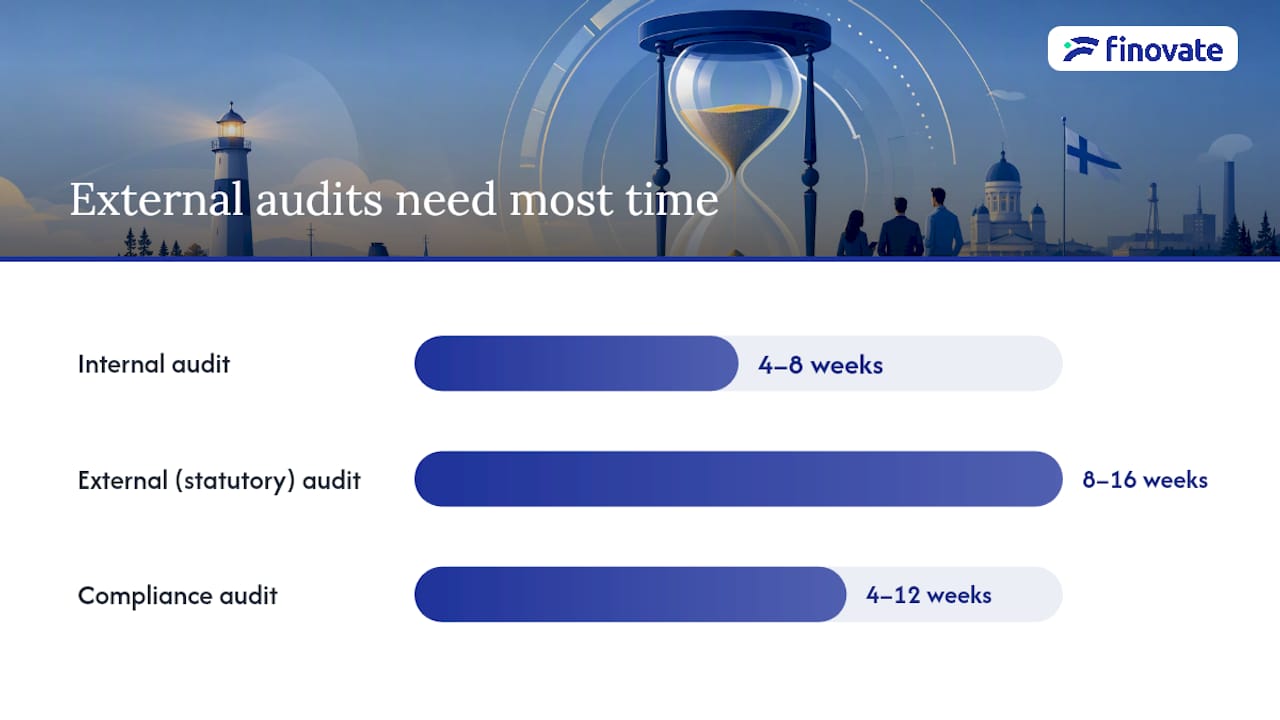
The IIA's global internal-audit standards set the planning, scope, and documentation expectations for internal-audit engagements. For external audits, COSO's internal-control guidance is the accepted framework auditors use when evaluating whether your control design is adequate and whether controls operated effectively during the period. A compliance audit may draw on both, plus the specific regulation's own requirements.
The practical consequence: for an internal audit, your evidence package leans heavily on process documentation and control testing results. For an external audit, it leans on financial schedules and third-party confirmations. For a compliance audit, it leans on policy records, training logs, and system access reports. Matching your preparation to the audit type prevents wasted effort on the wrong documents.
Step-by-step planning and scoping checklist
Good audit preparation is not a sprint in the final two weeks before fieldwork. It is a sequenced process that starts the moment you know an audit is coming. Work through these steps in order.
- Confirm the audit scope and timeline. Get the audit engagement letter or internal-audit charter in writing. Note the period under review, the entities in scope, and the fieldwork start and end dates.
- Request the PBC list early. Ask the audit team to send their prepared-by-client list as soon as possible, even if fieldwork is weeks away. Use it to build your internal task list.
- Review prior-year findings. Pull the prior-year management letter or internal-audit report. Every open point needs a written response and evidence of the corrective action taken.
- Set internal deadlines with named owners. Assign each PBC item to a specific person, not a department. Set an internal due date at least five working days before the auditor's deadline to allow for review.
- Lock in fieldwork dates with the finance team. Block the calendar for key personnel. Auditors arriving to find the finance manager on holiday is one of the most common causes of delayed fieldwork.
- Map controls to control owners. For each significant account area, identify who performs the control (e.g. who reconciles the bank account, who approves payroll). Document this in a simple control matrix.
- Define materiality and cut-off assumptions. Agree internally on the materiality level the auditor is likely to use and confirm your revenue and expense cut-off policy. Inconsistencies here generate queries.
- Choose a sampling approach for high-volume areas. For payroll, invoices, and expense claims, decide in advance whether you will provide a full population or a stratified sample. Auditors will tell you their preference, but being ready with the data speeds the process.
- Set up the shared document repository. Create the folder structure, apply the naming convention, and grant auditor access before fieldwork begins.
- Run a pre-audit internal review. Walk through the key schedules yourself before handing them over. A brief internal check uncovers reconciling items and incomplete schedules that would otherwise delay fieldwork.
For the roles matrix, assign preparation, review, and sign-off responsibilities explicitly:
- Audit liaison — owns the PBC tracker, manages all auditor communications, and escalates blockers
- Finance manager / controller — reviews and approves all schedules before submission
- Bookkeeper / accountant — prepares individual schedules and reconciliations
- Department heads — provide supporting documents for their areas (contracts, headcount data, asset lists)
- Senior management / board — sign off on going-concern assessment and post-balance-sheet event disclosures
Pro Tip: Year-round discipline and a pre-audit readiness assessment are the highest-leverage steps most organisations skip. Businesses that maintain monthly reconciliations and a live PBC tracker spend a fraction of the time in fieldwork that those starting from scratch do.
Detailed document checklist by account area
This is the granular list auditors will work from. Organise your shared folder to mirror this structure, with one subfolder per area.
Cash and bank
- Bank statements for all accounts, all months
- Bank reconciliations signed off by a reviewer, agreed to the general ledger
- Outstanding cheque and deposit listings at year-end
- Bank confirmation letters (sent directly by the bank to the auditor)
Accounts receivable
- Aged debtors report at year-end, agreed to the ledger
- Bad-debt provision schedule with basis of estimate
- Customer confirmation letters for material balances
- Credit notes issued after year-end (cut-off testing)
Accounts payable
- Aged creditors report at year-end, agreed to the ledger
- Supplier statement reconciliations for top suppliers
- Accruals schedule with supporting calculations
- Invoices received after year-end (unrecorded liabilities testing)
Payroll
- Payroll summary by month, reconciled to the general ledger
- Employer social-security (TyEL, YEL) and pension contribution filings
- Verohallinto payroll tax filings and payment confirmations
- Headcount reconciliation (opening headcount, joiners, leavers, closing headcount)
- Employment contracts for new starters during the year
Fixed assets
- Fixed asset register with cost, accumulated depreciation, and net book value by asset
- Additions schedule with purchase invoices and authorisation evidence
- Disposals schedule with proceeds, gain/loss calculation, and authorisation
- Depreciation policy document
Leases
- Lease register listing all agreements, terms, and payment schedules
- Right-of-use asset and lease liability movement schedules (IFRS 16 or Finnish GAAP equivalent)
- Lease agreements for all material contracts
Revenue
- Revenue recognition policy document
- Contract inventory listing material customer agreements, values, and performance obligations
- Journal-entry listing for manual revenue entries with authorisation evidence
- Cut-off testing support: invoices raised in the last two weeks of the year and the first two weeks after
Related parties
- List of related parties (directors, shareholders, group companies, key management)
- Transactions with related parties during the year, with amounts and terms
- Evidence of arm's-length pricing for material transactions
Provisions and estimates
- Management papers for each significant estimate (bad debts, warranty provisions, litigation)
- Sensitivity analysis showing the impact of key assumptions
- Prior-year estimate vs. actual comparison
Tax
- Corporation tax computation and supporting workings
- VAT returns for all periods, reconciled to the ledger
- Verohallinto correspondence and any open queries
- Deferred tax calculation with movement schedule
Year-end disclosures
- Draft financial statements with notes
- Going-concern assessment paper
- Post-balance-sheet events review and board minutes
A complete PBC response at fieldwork start moves the audit forward faster and reduces the number of follow-up requests. Auditors prioritise high-risk areas first — revenue, estimates, and related parties — so prepare management papers for significant judgements before fieldwork begins. This is also where financial statement examples for Finnish SMEs can help you format disclosures correctly.
File-naming convention example: 2025_BankRec_Dec_Reviewed_JK.xlsx — year, document type, period, review status, reviewer initials. Apply this consistently across every subfolder so auditors can locate items without asking.
Who does what: assigning roles and responsibilities
A clear roles structure prevents the most common audit delay: a document that everyone assumed someone else was preparing.
The audit liaison is the single most important appointment you make. This person owns the PBC tracker, fields all auditor queries, and has the authority to chase colleagues for overdue items. Without a named liaison, auditors contact whoever picks up the phone, responses are inconsistent, and the same document gets sent in three different versions.
A practical RACI for common deliverables:
- Bank reconciliations — Prepared by: bookkeeper; Reviewed by: finance manager; Signed off by: finance manager
- AR ageing and provision — Prepared by: accounts receivable team; Reviewed by: controller; Signed off by: finance director
- Fixed asset schedule — Prepared by: fixed assets accountant; Reviewed by: controller; Signed off by: finance director
- Payroll reconciliation — Prepared by: payroll administrator; Reviewed by: HR manager; Signed off by: finance manager
- Management papers (estimates) — Prepared by: controller; Reviewed by: finance director; Signed off by: CEO or board
- Going-concern assessment — Prepared by: finance director; Reviewed by: CEO; Signed off by: board
For escalations, agree a simple protocol in advance: if a PBC item is more than two days overdue internally, the liaison escalates to the finance manager; if it is more than five days overdue, it goes to the finance director. This prevents items sitting unresolved until the auditor chases them directly.
Board-level sign-off is required for going-concern papers, post-balance-sheet event disclosures, and any significant accounting judgement. Schedule the board meeting to review these papers at least one week before the auditor expects them, leaving time for revisions.
How long does audit preparation take in Finland?
For a Finnish SME with clean monthly accounts and a functioning close process, a 90-day three-phase preparation plan is realistic: the first month for foundation work (reconciliations, document collection, PBC tracker setup), the second for review and repair (addressing gaps, preparing management papers, running the internal readiness check), and the final month for final readiness (completing the PBC response, granting auditor access, and resolving prior-year findings).
A mid-market business with multiple entities, complex estimates, or a first-year audit should allow 120 days and treat audit preparation as an ongoing discipline rather than a year-end project.
Key cost drivers in Finland:
- Late or incomplete reconciliations — auditors spend more time on substantive testing when reconciliations are missing or unreviewed, which increases billable hours
- Incomplete PBC responses — every follow-up request adds time to fieldwork
- Inventory observation — physical stock counts require auditor attendance; poor count procedures generate additional testing
- Complex estimates — provisions, impairments, and fair-value measurements require management papers and often specialist input
- Related-party disclosures — incomplete identification of related parties triggers extended procedures
- Multi-entity consolidation — intercompany eliminations and group adjustments add significant preparation time
Finland-specific checkpoints auditors focus on:
The Finnish Accounting Act (Kirjanpitolaki) sets the statutory framework for financial reporting. The Kirjanpitolautakunta (Finnish Accounting Board) issues guidance on specific accounting treatments, and auditors will check that your policies align with current KILA statements. Verohallinto (Finnish Tax Administration) filings — VAT, payroll tax, and corporate income tax — must reconcile to the financial statements. Any open Verohallinto queries or assessments must be disclosed and documented. For SMEs using the Finnish GAAP small-entity exemptions, auditors will verify that the exemption criteria are met and applied consistently.
Which tools and templates speed up audit preparation?
The right templates, used consistently throughout the year, turn a stressful audit into a manageable process. These are the core documents to have ready before the PBC list arrives:
- PBC tracker — a shared spreadsheet or project-management tool listing every auditor request, the responsible owner, the internal due date, the submission date, and the auditor's status (open/closed)
- Reconciliation templates — standardised monthly templates for bank, AR, AP, payroll, and intercompany accounts, with a reviewer sign-off field
- Fixed asset register — maintained monthly with additions, disposals, and depreciation calculated automatically
- Revenue contract inventory — a register of all material customer contracts with key terms, values, and recognition dates
- Lease register — all lease agreements with commencement dates, terms, payment schedules, and IFRS 16 or Finnish GAAP calculations
- Related-party register — updated at least annually, listing all related parties and transactions
For accounting systems, Finnish businesses commonly use Procountor, Netvisor, Visma, and Fennoa for cloud-based bookkeeping and VAT reporting. These platforms allow auditors to access transaction-level data directly, which reduces the volume of manual exports and printed schedules. For document sharing, a structured SharePoint or Google Drive folder with auditor access is preferable to email attachments, which create version-control problems.
The NIST Cybersecurity Framework provides practical controls for protecting the confidentiality and integrity of audit artefacts shared electronically. When granting auditors access to your document repository or accounting system, apply the principle of least privilege: read-only access to the specific folders and periods under review, with access revoked at audit completion.
Pro Tip: Set up automated monthly bank reconciliations in your accounting system and configure a shared audit portal with pre-built folder templates at the start of each financial year. When the PBC list arrives, you are uploading documents rather than creating them.
Finovate's pre-audit readiness assessment for Finland
Finovate's readiness template uses a simple 0–3 scoring matrix across the core audit areas. A score of 0 means the item is missing or not started; 1 means it is in progress but incomplete; 2 means it is complete but unreviewed; 3 means it is complete, reviewed, and signed off. An overall score of 2.5 or above across all areas indicates audit readiness. Scores below 2.0 in any individual area flag a risk that will likely generate auditor queries or additional testing.
The Finland-specific checks built into the template include:
- Kirjanpitolaki compliance: accounting policies documented and consistent with current KILA guidance
- Verohallinto filing status: all VAT, payroll tax, and corporate tax returns filed and reconciled to the ledger
- Inventory observation: count procedures documented and a count date agreed with the auditor
- Going-concern assessment: a board-approved paper covering the 12 months from the financial statement date
- Related-party identification: a complete list reviewed and approved by senior management
Use the template in an internal readiness meeting four to six weeks before fieldwork. Score each area, identify the gaps, and assign remediation tasks with deadlines. A brief internal review at this stage — sometimes called a mock audit — uncovers reconciling items and incomplete schedules before the auditor does.
Pro Tip: Score each area independently before the team meeting, then compare scores. Disagreements between the bookkeeper's score and the finance manager's score on the same area almost always reveal a genuine gap in understanding or documentation — exactly the kind of gap an auditor will find.
Download the template and scoring matrix from Finovate's accounting services page or contact us directly to arrange a paid readiness review.
Common pitfalls and red flags auditors look for
Auditors are trained to look for patterns that suggest incomplete records, weak controls, or management override. Addressing these before fieldwork prevents scope creep and additional fees.
The most frequent red flags:
- Unreconciled bank accounts — any account not reconciled monthly, or with reconciling items older than 30 days, will trigger extended substantive testing
- Missing contracts for revenue — auditors testing revenue recognition need the underlying contract; missing files force them to apply alternative procedures, which takes longer
- Incomplete inventory counts — a count with no count sheets, no supervisor sign-off, or no auditor observation (where required) will result in a qualified opinion or additional procedures
- Unrecorded liabilities — invoices received after year-end that relate to the period under review must be accrued; a search for unrecorded liabilities is standard procedure
- Weak segregation of duties — one person who both initiates and approves payments, or who both records and reconciles, is a control weakness auditors will report
- Inconsistent accounting policies — changing depreciation rates, provision methodologies, or revenue recognition approaches without disclosure is a red flag for management bias
- Unexplained journal entries — large, round-number, or late-period manual journals without supporting documentation attract detailed testing
Immediate fixes before fieldwork:
Prioritise bank reconciliations and the revenue contract file above everything else. These two areas generate the most auditor queries and the most additional testing. For reducing accounting errors in the weeks before fieldwork, focus on clearing reconciling items, not on adding new transactions.
For estimates and provisions, prepare a one-page management paper for each significant judgement: the basis of the estimate, the key assumptions, the sensitivity to changes in those assumptions, and a comparison to the prior-year estimate. Auditors prioritise testing high-risk areas first — revenue, estimates, and related parties — so clear management papers for these areas speed discussions and reduce rework.
Pro Tip: When an auditor sends a follow-up request, respond with a single, clearly labelled document rather than a series of emails with attachments. Package the evidence, add a brief cover note explaining what it shows and how it addresses the query, and upload it to the shared portal. This approach cuts the back-and-forth that inflates audit hours.
One-page printable checklist
Print this list, attach it to your PBC tracker, and hand it to your audit liaison on day one.
Essential — have ready before fieldwork begins:
- Trial balance agreed to the general ledger, prior-year comparatives included
- Bank reconciliations for all accounts, all periods, reviewed and signed off
- AR ageing report agreed to the ledger, bad-debt provision schedule attached
- AP ageing report agreed to the ledger, accruals schedule attached
- Payroll reconciliation for all months, employer filings confirmed with Verohallinto
- Fixed asset register with additions, disposals, and depreciation reconciled to the ledger
- Revenue contract inventory for material agreements
- Prior-year audit findings with written responses and evidence of corrective action
- Draft financial statements (income statement, balance sheet, notes)
- PBC tracker with named owners and due dates for every item
Important — have available during fieldwork:
- Lease register and IFRS 16 / Finnish GAAP schedules
- Related-party register and transaction listing
- Management papers for significant estimates and provisions
- Going-concern assessment paper (board-approved)
- Verohallinto VAT and tax filings for the full year, reconciled to the ledger
- Bank confirmation letters (sent directly by the bank)
- Customer confirmation letters for material AR balances
- Supplier statement reconciliations for top 10 suppliers
- Employment contracts for new starters, termination records for leavers
Stretch — prepare if time allows:
- Post-balance-sheet events review and board minutes
- IT general controls documentation (access rights, change management log)
- Intercompany reconciliations and elimination schedules (group entities)
- Sensitivity analysis for key accounting estimates
Recommended folder structure for the shared repository:
Audit_2025/
  01_Trial_Balance/
  02_Bank_and_Cash/
  03_Accounts_Receivable/
  04_Accounts_Payable/
  05_Payroll/
  06_Fixed_Assets/
  07_Leases/
  08_Revenue/
  09_Related_Parties/
  10_Provisions_and_Estimates/
  11_Tax/
  12_Financial_Statements/
  13_Prior_Year_Findings/
  00_PBC_Tracker.xlsx
  00_Index.docx
Place an index file (00_Index.docx) in the root folder listing every document, its location, and its status. This single file saves auditors hours of searching and reduces the number of "where is X?" queries. The financial statements preparation guide for Finnish SMEs provides additional formatting guidance for the financial statements subfolder.
What Finovate has seen working with Finnish businesses
Audit preparation is one of those areas where the gap between businesses that manage it well and those that do not is wider than most finance teams expect. The difference rarely comes down to the size of the company or the complexity of the accounts. It comes down to whether someone owns the process year-round.

The businesses that move through fieldwork quickly share three habits: they maintain monthly reconciliations without exception, they keep a live document repository that mirrors the PBC structure, and they address prior-year findings before the next audit cycle begins. Businesses that do the opposite — leaving reconciliations to year-end, storing documents in email threads, and treating prior-year findings as advisory rather than mandatory — consistently face longer fieldwork, more follow-up requests, and higher audit fees.
Finnish SMEs face a specific pressure: the statutory audit threshold under the Finnish Accounting Act means many businesses encounter their first external audit at a point when their internal processes are still maturing. Getting the preparation right from the first audit sets the standard for every subsequent year. Finovate works with entrepreneurs and SMEs across Finland to build that standard into the accounting process, not bolt it on at year-end.
Finovate's audit preparation support for Finnish businesses
Audit preparation does not have to consume your finance team for weeks before fieldwork. Finovate provides hands-on audit-preparation support for Finnish businesses: we package your PBC response, complete and review reconciliations, prepare management papers for significant estimates, and set up your shared document portal with the folder structure and naming convention auditors expect.

Our readiness review delivers a scored assessment across all core audit areas, a prioritised action list, and the Finovate PBC tracker template, typically within five working days of engagement. For businesses facing a first statutory audit or a complex year — group consolidations, going-concern risk, or significant estimates — we provide ongoing support through fieldwork, handling auditor queries directly so your team can keep operating.
The next step is straightforward: contact Finovate through our services page to arrange a readiness review or to receive the downloadable checklist and template. We will confirm scope and timeline within one working day.
Sources
These are the authoritative references to consult alongside this guide. Each one supports specific checklist items.
- Coso
- Nist
- Financial Audit Preparation Guide (2026) | Stratax Advisors
- Audit Preparation Checklist 2026: The Complete 90-Day Guide for Small Businesses | TallyScan
This article is general information, not a substitute for advice from a qualified financial advisor. Consult a qualified financial professional about your own circumstances before acting on anything here.