

Getting your financial records accountant-ready comes down to seven clear steps: gather core documents, organise and digitise them, reconcile bank accounts, finalise the trial balance, assemble the year-end pack, document internal controls, and complete a timed handover. Done in this sequence, the process saves professional time and reduces cleanup fees before your accountant even opens a file.
The single most effective thing you can do before contacting your accountant is to finalise your trial balance and collect all supporting documentation first. HMRC and the ICAEW both emphasise that well-prepared records reduce audit risk and lower the cost of professional review. A financial audit preparation checklist covering your trial balance, reconciliations, and schedules is the foundation every accountant works from.
The seven steps at a glance:
- Gather core documents (banking, revenue, expenses, payroll, VAT, contracts, assets)
- Organise, name, and digitise into a consistent folder structure
- Reconcile all bank, credit card, and petty-cash accounts
- Finalise the trial balance and adjusted trial balance
- Assemble the year-end or audit pack with supporting schedules
- Document internal controls and approval trails
- Complete a timed handover to your accountant
Key takeaways
Finalising your trial balance and reconciling every bank account before handover is the single most effective step you can take to reduce accounting costs and avoid delays.
| Point | Details |
|---|---|
| Finalise the trial balance first | Post all journals, accruals, and depreciation before exporting the trial balance for handover. |
| Reconcile every account | Bank, credit card, and petty-cash accounts must all balance to statements at year-end. |
| Use a structured folder system | Mirror your accountant's review categories (banking, revenue, expenses, payroll, tax, assets) to cut compilation time. |
| Document approvals and controls | Retain signed reconciliations and invoice approval emails as audit evidence. |
| Keep an emergency folder | Store company registration documents, insurance policies, and a secure access list for a named deputy. |
| Finovate handles the groundwork | Finovate's bookkeeping, VAT, payroll, and year-end reporting services prepare records to accountant-ready standard. |
Table of Contents
- What documents do you need to prepare financial records?
- How should you organise and name your financial files?
- How do you reconcile bank accounts and finalise the trial balance?
- What goes into a year-end or audit pack?
- Why do internal controls matter for audit readiness?
- What should your emergency 'grab-and-go' folder contain?
- Handover checklist: what to give your accountant and when
- How long must you keep financial records in the UK?
- How Finovate and Busayo support this process
- What most checklists get wrong about preparing financial records
- Finovate takes the preparation burden off your desk
- Sources
What documents do you need to prepare financial records?
Before any accountant engagement, collect documents across these categories. Missing items at handover create delays and additional charges, so flag gaps before you submit.
- Banking: Year-end bank statements for every account, including savings and foreign-currency accounts.
- Revenue: Sales invoices, receipts issued, and a reconciled sales ledger or income summary.
- Expenses: Purchase invoices, paid bills, expense claims, and petty-cash records.
- Payroll: Monthly payroll summaries, payslips, PAYE records, and employer National Insurance contributions.
- Tax and VAT: Filed VAT returns, VAT workings, corporation tax computations, and prior-year assessments.
- Contracts and loans: Signed supplier and customer contracts, loan agreements, and hire-purchase schedules.
- Assets: Fixed asset register, depreciation schedules, and purchase invoices for capital items.
Accountants almost always request the year-end bank statement, a reconciled trial balance export, and a payroll summary as their first three items. Applying the "one place" principle — every document in a single, structured location before submission — prevents the back-and-forth that inflates professional fees.
How should you organise and name your financial files?
Organising records into category folders that mirror how an accountant reviews them significantly shortens compilation time and lowers preparation costs. A practical digital folder structure looks like this:
01_Banking— statements, reconciliation exports02_TrialBalance— trial balance and adjusted trial balance exports03_Revenue— sales invoices, income summaries04_Expenses— purchase invoices, receipts, expense claims05_Payroll— payroll summaries, payslips, PAYE records06_Tax— VAT returns, corporation tax workings07_Assets— fixed asset register, depreciation schedules08_Other— contracts, loan agreements, board minutes
For file naming, a consistent convention such as YYYY-MM-DD_description_account.pdf (for example, 2025-03-31_BankStatement_Barclays.pdf) makes every file searchable and maps directly to a prepared-by-client (PBC) list. Categorising records into logical folders with a consistent naming convention keeps files audit-ready and reduces the time spent locating documents under pressure.
Pro Tip: Scan paper originals to PDF immediately after receipt and store physical originals in a labelled archive box. Keep at least one encrypted off-site or cloud backup that mirrors your folder structure exactly. A recordkeeping workflow guide can help you build this habit into your monthly routine.
How do you reconcile bank accounts and finalise the trial balance?
Reconciliation confirms that every transaction in your accounting software matches the corresponding bank or credit card statement. Every account — current, savings, credit card, and petty cash — must balance to its statement at year-end before you hand anything to an accountant.
The accounting cycle moves from individual transactions through journals and ledgers to a trial balance, then to an adjusted trial balance before financial statements can be prepared. Skipping or rushing reconciliation at any stage means your accountant must do it for you, at your cost.
Reconciliation deliverables to include in your handover folder:
| Item | Example file name | What it proves |
|---|---|---|
| Bank reconciliation | 2025-03-31_BankRec_Barclays.pdf | Ledger matches statement at year-end |
| Credit card reconciliation | 2025-03-31_CCRec_Amex.pdf | Card balance agrees to statement |
| Petty cash count sheet | 2025-03-31_PettyCash_Count.pdf | Physical cash agrees to ledger |
| Trial balance export | 2025-03-31_TrialBalance.xlsx | All debits equal all credits |
To finalise the trial balance:
- Post all outstanding invoices and bills up to the year-end date.
- Record accruals and prepayments for the period.
- Make depreciation entries for all fixed assets.
- Run the trial balance report and confirm debits equal credits.
- Export and save the file in your
02_TrialBalancefolder.
Preparing financial statements requires posting journal entries to the ledger, making adjusting entries, and producing an adjusted trial balance as the foundation. Your accountant cannot proceed efficiently without it.
What goes into a year-end or audit pack?
A professional year-end pack gives your accountant everything needed to prepare statutory accounts without issuing repeated queries. The audit preparation checklist should include:
- Adjusted trial balance (exported from your accounting software)
- Bank reconciliations for all accounts
- Accounting policies document (revenue recognition, depreciation rates, stock valuation)
- Year-end bank statements
- Paid bills and purchase invoices for the year
- Accounts receivable ageing report
- Accounts payable listing
- Payroll register and P60 summaries
- Fixed asset schedule with additions, disposals, and depreciation
Download year-end reports on the last day of your financial year. Schedules such as the AR ageing and AP listing can be prepared within two weeks of year-end, once all invoices for the period are posted. For a detailed walkthrough of the reporting timeline, the financial reporting process workflow guide sets out each stage clearly.
Why do internal controls matter for audit readiness?
Internal controls such as segregation of duties and documented approvals are central to audit readiness. They provide auditors with evidence that financial processes have been reviewed and are reliable, which reduces the extent of substantive testing required.
Practical controls to document and maintain:
- Segregation of duties: The person who raises an invoice should not also authorise payment. Separate these roles wherever your team size allows.
- Invoice approval trail: Retain stamped PDFs or approval emails showing who authorised each purchase before payment.
- Payroll sign-off: Keep a signed payroll summary each period, approved by a director or manager separate from the payroll preparer.
- Bank payment authorisation: Store confirmation emails or dual-authorisation records for all bank transfers above a set threshold.
- Reconciliation sign-off: Each reconciliation should carry a reviewer's signature or approval timestamp before filing.
Pro Tip: If your business is small enough that one person handles most finance tasks, document a compensating control — for example, a monthly director review of the bank statement — and retain the evidence. Auditors accept compensating controls when segregation is genuinely impractical.
What should your emergency 'grab-and-go' folder contain?
An emergency folder gives a trusted deputy or your accountant immediate access to critical documents if you are unavailable. Store originals securely and keep a separate encrypted electronic copy accessible to at least one named person.
Include:
- Company registration documents and certificate of incorporation
- Insurance policies (public liability, professional indemnity, property)
- Deeds, lease agreements, and title documents
- Powers of attorney and any shareholder agreements
- A secure access list covering banking login contacts, accounting software credentials, and HMRC online services access
- Bank contact details and relationship manager names
- A short instruction note for your accountant or deputy covering where files are stored and who to contact first
Pro Tip: Name a deputy in writing and document exactly where the emergency folder is stored and who holds the access list. Review and update the folder at least once a year, ideally at the same time as your year-end close.
Handover checklist: what to give your accountant and when
Using your accountant's PBC list as the master project plan avoids missed items and prevents duplicate effort. Most accountants issue a PBC list at the start of each engagement; treat it as your submission checklist rather than creating a separate one.
- Two weeks before handover: Complete all bank reconciliations, post year-end journals, and export the adjusted trial balance. Flag any missing invoices or unresolved reconciling items in a short cover note.
- At handover: Submit the full folder structure (sections 01–08 above), the adjusted trial balance, all reconciliations, the payroll register, VAT returns, and the fixed asset schedule.
- Cover note: Include a one-page summary listing what is included, what is outstanding, and any known issues (disputed invoices, pending supplier credits, unresolved VAT queries).
- Follow-up items: Agree a deadline for any missing documents and note it in the cover note. Partial submissions with a clear timeline are far preferable to delayed complete ones.
Pro Tip: Ask your accountant for their PBC list before you start gathering documents. It specifies exactly what they need and in what format, which saves you from preparing items they will not use.
How long must you keep financial records in the UK?
UK retention requirements vary by record type and business structure. The following periods reflect general HMRC guidance for limited companies and self-employed individuals, but you should verify the current rules directly with HMRC and Companies House for your specific situation.
- Limited company records: Generally six years from the end of the accounting period, per Companies House requirements.
- Self-employed and partnership records: Five years after the 31 January submission deadline for the relevant tax year.
- Payroll and employment records: HMRC recommends keeping these for at least three years after the end of the tax year to which they relate; employment law may require longer.
- VAT records: Six years in most cases, though some records must be kept for ten years if VAT MOSS or certain schemes apply.
- Property and capital asset records: Keep for as long as you own the asset, plus the standard retention period after disposal.
The IRS in the United States recommends keeping tax records for at least three years from the filing date, with longer periods for employment records — a useful benchmark, though UK businesses must follow HMRC's own rules. For local examples of tax documents and what to retain, the examples of tax records for Finnish small businesses guide covers common document types in detail.
How Finovate and Busayo support this process
Finovate provides bookkeeping, VAT reporting and filing, payroll management, year-end financial reporting, and accounting system integration for entrepreneurs and small to medium-sized businesses. Each service maps directly to the steps in this checklist: Finovate's bookkeeping service maintains the records that feed your trial balance; the VAT service keeps filings current; and the year-end reporting service assembles the audit pack on your behalf.
This guide was written by Busayo, who produces practical how-to content on bookkeeping, financial statements, and recordkeeping for the Finovate blog. Busayo's guides cover topics including bookkeeping best practices, the financial reporting process workflow, and ways to reduce accounting errors.
What most checklists get wrong about preparing financial records
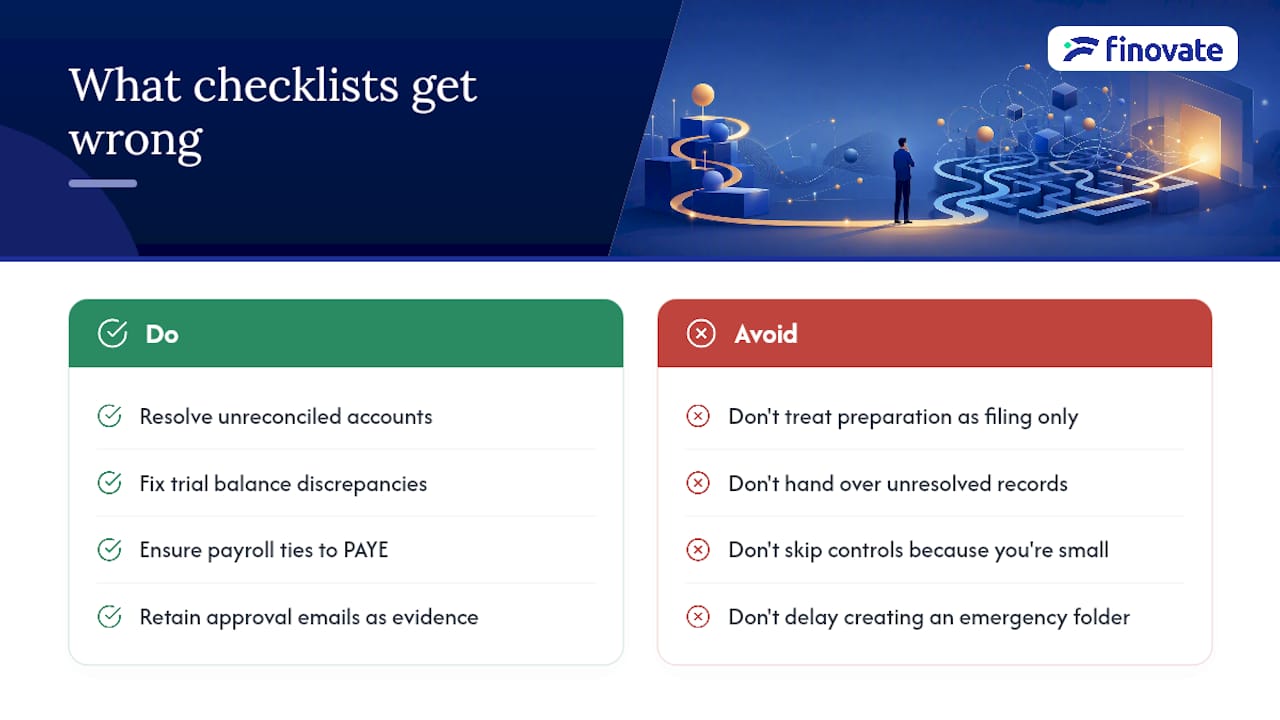
Most guides on this topic treat financial record preparation as a filing exercise. Collect documents, put them in folders, hand them over. That framing misses the point entirely.
The real work is not gathering — it is resolving. An unreconciled bank account, a trial balance where debits do not equal credits, or a payroll register that does not tie to the PAYE submissions: these are the items that stop an accountant in their tracks. Every hour they spend untangling your records is an hour you pay for, and it is avoidable.
The controls section of this checklist tends to get skipped by small business owners who assume it only matters for large organisations. It does not. A simple approval email retained in the right folder, or a director's monthly review of the bank statement, gives an auditor the evidence they need to move forward without additional testing. That is not bureaucracy — it is efficiency.
The emergency folder is the most underrated item on the list. Most business owners discover they need it at the worst possible moment. Building it once, reviewing it annually, and naming a deputy takes less than two hours. The cost of not having it can be measured in weeks of disruption.
Prepare records as if your accountant will open the folder without any explanation from you. If the folder tells the story on its own, you have done it correctly.
Finovate takes the preparation burden off your desk
For entrepreneurs and small business owners who would rather focus on running their business than managing submission folders, Finovate offers a direct alternative. Rather than spending evenings reconciling accounts or chasing missing invoices, you hand the ongoing work to a team that maintains your books, files your VAT returns, processes payroll, and prepares your year-end pack to accountant-ready standard throughout the year.
The difference is that by the time your accountant needs anything, the records are already structured, reconciled, and labelled. No cleanup fees, no back-and-forth queries, no last-minute scramble. Finovate's bookkeeping and year-end reporting services are built for exactly the kind of business this checklist is written for: entrepreneurs and SMEs who need reliable financial records without the overhead of managing them alone.
Get in touch with Finovate to find out how we can take over your bookkeeping, VAT, and year-end preparation so your records are always ready when they need to be.
Sources
- How to organize your financial records | Financial Education
- Institute of Chartered Accountants in England and Wales (ICAEW)
- Financial audit preparation checklist (IC template) — Smartsheet PDF
- From receipts to reports: step‑by‑step guide to accurate financial records – Accounting for Everyone
- Good recordkeeping year‑round helps taxpayers avoid tax time frustration | IRS
- Financial records organisation checklist for compilation — Custom Accounting & CFO Advisory
This article provides general information on financial recordkeeping and is not a substitute for professional accounting or legal advice. Confirm current HMRC and Companies House requirements with a qualified adviser before making retention or compliance decisions.