

TL;DR:
- Finnish taxi entrepreneurs must gather accurate driving logs, receipts, and bank statements for year-end accounting. They need to verify registration status, meet deadlines, and file their VAT and income tax returns via OmaVero accurately. Proper preparation and professional support ensure compliance, maximize deductions, and avoid costly penalties.
The year-end accounting process for taxi entrepreneurs in Finland arrives with real pressure. Deadlines stack up, VAT obligations shift, and the Finnish tax authority expects precise documentation. If you operate as a toiminimi (sole trader) running a taxi or courier business, getting this process right is not optional. Done properly, it protects you from penalties, unlocks legitimate deductions, and gives you a clear picture of your business finances. This guide walks you through every stage, from document preparation to post-filing verification.
Table of Contents
- What you need to prepare for your year-end accounting
- Step-by-step guide to completing your year-end accounting
- Common pitfalls and how to avoid them in your year-end process
- Verifying your filed returns and preparing for audits
- Rethinking year-end accounting for your taxi business: expert insights
- Professional accounting support for your taxi business
- Frequently asked questions
Key Takeaways
| Point | Details |
|---|---|
| Gather essential documents | Prepare your driving log, receipts, and check your VAT registration early to avoid surprises. |
| Meet filing deadlines | File business and personal tax returns by 1 April to prevent penalties and interest charges. |
| Maintain accurate records | Keep detailed mileage logs and all financial records for at least six years in case of audit. |
| Understand VAT rules | Apply the correct 10% VAT rate for taxis and file VAT returns according to your turnover bracket. |
| Consider expert support | Professional accounting services can simplify compliance and optimise your taxi business finances. |
What you need to prepare for your year-end accounting
Before you open OmaVero and begin filing, gather everything the process demands. Missing a single document mid-way through creates delays and increases the risk of errors. The year-end accounting process for taxi businesses rests on three categories of preparation: records, registrations, and deadlines.
Documents and records to collect
- Your driving log (ajopäiväkirja), recording every business trip with date, start and end locations, mileage, and purpose. Taxi entrepreneurs must maintain driving logs to claim mileage deductions and must be VAT registered if annual turnover exceeds €20,000.
- All sales receipts, invoices, and taxi meter reports for the full calendar year
- Bank statements covering all business income and expense transactions
- Receipts for deductible expenses: fuel, vehicle maintenance, insurance, tyres, and professional services
- Any subcontracting agreements or income from courier work alongside taxi operations
Registrations and access
- Confirm your Suomi.fi business authorisation is active. Without it, electronic filing through OmaVero is not possible.
- Verify your VAT registration status. If your turnover exceeds €20,000, VAT registration is compulsory.
- Review your chosen accounting methods in Finland to confirm whether you are using cash-basis or accrual accounting, as this affects how income and expenses are recorded at year-end.
Key deadlines for the 2025 tax year
| Task | Deadline |
|---|---|
| Business tax return (Form 5) via OmaVero | 1 April 2026 |
| Personal tax return confirmation | 1 April 2026 |
| VAT returns (monthly filers) | 12th of each following month |
| VAT returns (annual filers, turnover under €30,000) | 28 February 2026 |
| Record retention (invoices, logs) | 6 years from filing |
Pro Tip: Set a calendar reminder for mid-March rather than waiting for the 1 April deadline. This gives you two full weeks to resolve any access issues with Suomi.fi or discrepancies in your driving log before the filing window closes.
Refer to the dedicated guide on tax preparation for Finnish small businesses for a broader overview of what the tax authority expects from sole traders.
Having gathered the essential documents and tools, it is time to understand and execute the step-by-step year-end accounting process precisely.
Step-by-step guide to completing your year-end accounting
This section takes you through the filing process in sequence. Follow each step carefully to avoid errors that could trigger reassessment or late payment charges.
-
Log into OmaVero and verify your access. Use your personal online banking credentials or mobile certificate. Confirm that your Suomi.fi business authorisation is linked so the system recognises you as a representative of your toiminimi.
-
Review your pre-filled tax return. The Finnish Tax Administration (Verohallinto) pre-fills some income fields using third-party data. Check these figures against your own records. Do not assume the pre-filled data is complete or correct.
-
Complete Form 5 (business income tax return). Enter total business income, all deductible expenses, and your mileage deduction. The 2025 business tax return and personal tax return must be filed by 1 April 2026 via OmaVero, with the mileage allowance set at €0.59 per kilometre for business travel.
-
Calculate and enter your mileage deduction. Multiply your total business kilometres by €0.59. This figure comes directly from your driving log. If your log is incomplete, your deduction will be reduced or disallowed entirely.
-
File your personal tax return. Confirm the business income figure carries through correctly to your personal tax return. Business profit from a toiminimi is taxed as personal income, so accuracy at this stage directly affects how much tax you pay.
-
Submit your VAT return. Taxi services in Finland carry a reduced VAT rate of 10%. Confirm that all your taxi meter fares are recorded at the correct rate. Check that your input VAT claims on expenses are accurate and supported by receipts.
-
Retain all filed documents. Download confirmation receipts from OmaVero immediately after submission. Store these alongside your driving log and expense receipts.
Comparison: cash-basis vs accrual accounting at year-end
| Factor | Cash-basis | Accrual |
|---|---|---|
| Income recorded when | Payment received | Invoice issued |
| Expenses recorded when | Payment made | Invoice received |
| Common for toiminimi | Yes, especially smaller operators | Less common |
| VAT reporting alignment | Simpler for annual filers | Requires careful cut-off management |
Pro Tip: If you use a dedicated accounting application, export a full year-end profit and loss report before starting your tax return. Having this summary open while completing Form 5 significantly reduces the risk of transposition errors.
For further guidance on how choosing the right accounting method affects your year-end calculations, we recommend reviewing that decision before the next tax year begins. Also see our small business tax essentials resource for a solid foundation.

After filing, it is vital to verify accuracy and understand common mistakes to avoid costly penalties.
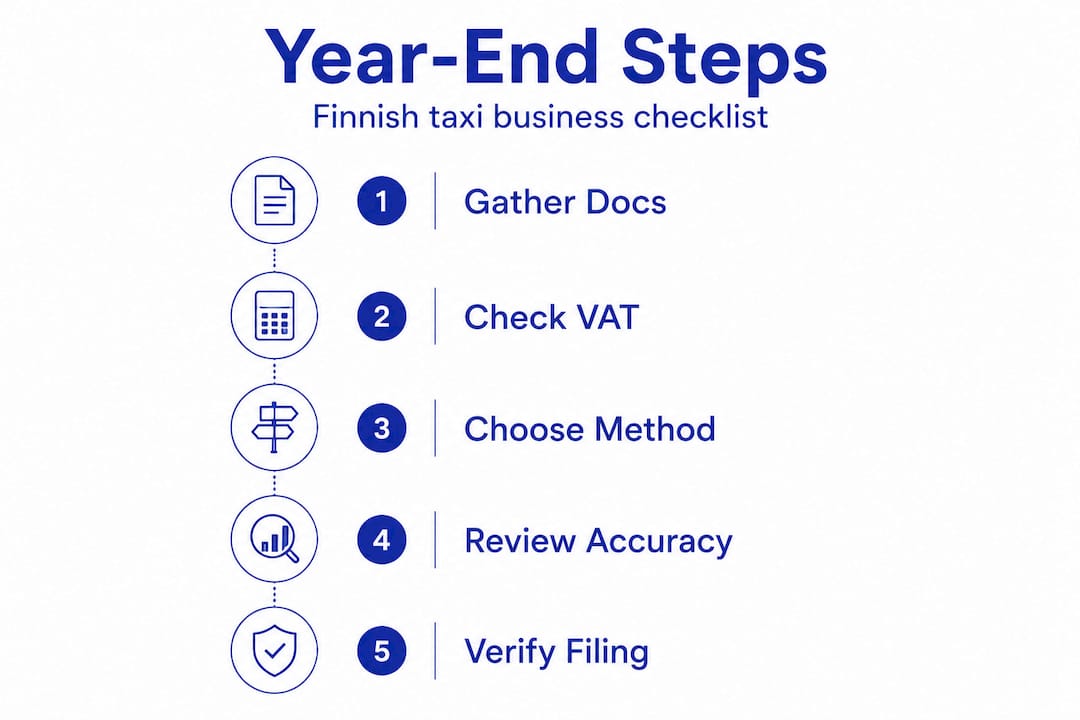
Common pitfalls and how to avoid them in your year-end process
Even experienced taxi entrepreneurs make avoidable errors at year-end. Knowing these pitfalls in advance gives you a clear advantage.
-
Inactive Suomi.fi authorisation. A missing Suomi.fi business authorisation is one of the most common obstacles to electronic filing, risking late penalties if not resolved promptly. Check it in January, not March.
-
Incomplete or inaccurate driving logs. Mileage deductions are one of the largest available to taxi drivers. Without a log that records each trip in full, the tax authority can disallow the deduction completely. Reconstruct gaps using taxi app data or dispatch records where possible.
-
Wrong VAT rate applied. As of 2026, the VAT rate for passenger transport, including taxi services, is 10% in Finland. If your taxi meter software was not updated to reflect this rate at the correct cut-off date, your VAT return will not reconcile with your meter reports. Correct this before filing.
-
Missing the 1 April deadline. Late filing generates interest charges automatically. If you know you will struggle to file on time, contact the tax authority in advance. In most cases, extensions are not available for personal or business tax returns, so early preparation is the only reliable protection.
-
Staying just under the VAT threshold by choice. Some taxi entrepreneurs deliberately keep turnover under €20,000 to avoid VAT registration. This approach actually costs money. Voluntary registration below the threshold allows you to reclaim input VAT on all business expenses, including fuel, tyres, and vehicle servicing.
"Voluntary VAT registration is often more financially beneficial than avoiding the threshold. The input VAT you recover on business expenses frequently outweighs the administrative effort of quarterly filing."
Pro Tip: Review your essential tax tips for Finnish entrepreneurs annually. Tax rates, allowances, and filing procedures change. What was accurate last year may not apply in 2026.
Having avoided these pitfalls, it is time to review the expected outcomes and key verifications after filing.
Verifying your filed returns and preparing for audits
Filing your returns is not the final step. Confirming accuracy and preparing for a potential audit is equally important for any taxi financial year-end process.
- Check OmaVero for a confirmation of submission within 24 to 48 hours of filing. Save or print this confirmation.
- Cross-reference the tax assessment notice (verotuspäätös) when it arrives. Compare the figures against your own records line by line.
- Organise your physical and digital records by tax year. Separate folders for income records, expense receipts, VAT filings, and driving logs make any audit query much easier to answer.
- Reconcile your taxi meter data with your VAT return figures. Any discrepancy between metered fares and declared VAT income is a common audit trigger.
- Understand that all invoices and driving logs must be retained for six years for audit purposes, even though driving logs are not submitted with the tax return itself.
Record retention reference table
| Document type | Retention period | Format accepted |
|---|---|---|
| Tax return and confirmation | 6 years | Digital or paper |
| Driving log (ajopäiväkirja) | 6 years | Digital or paper |
| Expense receipts and invoices | 6 years | Digital accepted if legible |
| VAT return confirmations | 6 years | Digital or paper |
| Bank statements | 6 years | Digital accepted |
Keeping your records in order throughout the year, rather than at year-end only, significantly reduces audit risk. Review the accounting cycle for Finnish SMEs to understand how regular monthly bookkeeping connects to a smooth year-end close. Our entrepreneur finance tips resource also covers practical habits that protect you in an audit.
With verification complete, here is a perspective on how to approach your accounting beyond compliance alone.
Rethinking year-end accounting for your taxi business: expert insights
Most guides on the year-end accounting process for taxi businesses focus purely on compliance. File by the deadline, keep your receipts, declare your income. That framing is not wrong, but it leaves significant financial value on the table.
The most overlooked area is VAT optimisation for taxis where the driver uses a private vehicle. If your car is used less than 50% for business purposes, standard VAT rules restrict how much input VAT you can recover. However, using a dedicated fuel card for business travel combined with detailed mileage logs helps preserve partial VAT deductions and supports expense claims despite those limits. Many taxi entrepreneurs do not take this step and lose recoverable input VAT year after year.
There is also the question of voluntary VAT registration. Operators just under the €20,000 threshold often assume registration brings only administrative burden. In practice, recovering input VAT on fuel, vehicle maintenance, and professional fees frequently generates a net financial benefit, particularly for drivers with high operating costs. Consider running the numbers before the next tax year begins.
The third insight is about timing. The entrepreneurs who find year-end accounting stressful almost always delayed their bookkeeping through the year. Monthly reconciliation of income, expenses, and driving logs takes under an hour when done consistently. Compressing twelve months of records into two weeks in March costs far more in time, risk, and professional fees.
We view the accounting process as a cash flow management tool, not just a compliance exercise. If your year-end accounts show where money is going, which expense categories are growing, and what your effective tax rate is, you can make better decisions for the year ahead. That is the real purpose of getting this right.
Professional accounting support for your taxi business
Year-end accounting does not have to be something you manage alone. We work with taxi and courier entrepreneurs across Finland, providing bookkeeping, VAT filing, and tax return support tailored to toiminimi structures.

Our accounting services for taxi businesses cover everything from maintaining driving logs and expense records to filing Form 5 via OmaVero and managing your Suomi.fi authorisation. We help you identify every allowable deduction, apply the correct VAT rate, and meet the 1 April deadline without the last-minute pressure. If you are a courier or light entrepreneur managing your own invoicing, we offer flexible service packages that match your volume and budget. Reach out to discuss how we can take the complexity out of your year-end process and keep your finances accurate throughout the year.
Frequently asked questions
When is the tax return deadline for Finnish taxi entrepreneurs?
The business and personal tax returns for the 2025 tax year must be filed via OmaVero by 1 April 2026. This applies to all toiminimi taxi entrepreneurs filing for the 2025 financial year.
What VAT rate applies to taxi services in Finland in 2026?
Taxi services use a reduced VAT rate of 10% for passenger transport in Finland as of 2026. Confirm your taxi meter software reflects this rate at the correct cut-off date.
Do I have to keep a driving log for my taxi business?
Yes. Maintaining a detailed driving log is essential to claim mileage deductions and to substantiate those deductions in the event of an audit by the Finnish Tax Administration.
Can I file my tax returns electronically without Suomi.fi authorisation?
No. An active Suomi.fi business authorisation is required to file electronically via OmaVero. Without this authorisation, electronic filing is blocked, which significantly increases the risk of missing your filing deadline.