

TL;DR:
- Tax liability is the total tax owed after applying deductions and credits based on taxable income in Finland.
- Understanding this amount helps individuals and businesses plan finances and avoid penalties.
Tax liability is defined as the total amount of tax a person or business legally owes to the government within a given tax year, calculated after applying all relevant deductions and credits. In Finland, this obligation spans several tax categories, including state income tax, municipal tax, church tax, and social insurance contributions. For sole traders and limited companies alike, income tax liability includes national, municipal, church, and social insurance components. Understanding your tax liability is not simply a compliance exercise. It is the foundation of sound financial planning.
What is tax liability and how does it work in Finland?
Tax liability is the legally binding amount you owe to the Finnish Tax Administration (Vero) after your taxable income has been established and all permitted deductions have been applied. The tax liability definition covers both individuals earning employment income and business owners reporting profits from their operations. Finland operates a progressive tax system, meaning the rate you pay rises as your income increases. This structure makes understanding tax liability particularly important for anyone whose income fluctuates year to year.
For individuals, the Finnish state income tax scale begins at 0% for lower income bands and rises incrementally for higher earners. Municipal tax rates vary by municipality but typically fall between 4.9% and 10.8%. Church tax applies to members of the Evangelical Lutheran or Orthodox churches. Social insurance contributions, including health insurance and pension payments, add further to the total burden. Together, these components form your complete tax liability for the year.
For business owners, the picture is more layered. A sole trader (toiminimi) pays tax on business profits as personal income using the same progressive scale. A limited company (osakeyhtiö) pays corporate income tax at a flat rate of 20%, and any dividends drawn by the owner are taxed separately. Knowing which structure you operate under directly shapes how your liability is calculated and what planning options are available to you.
How is tax liability calculated in Finland?
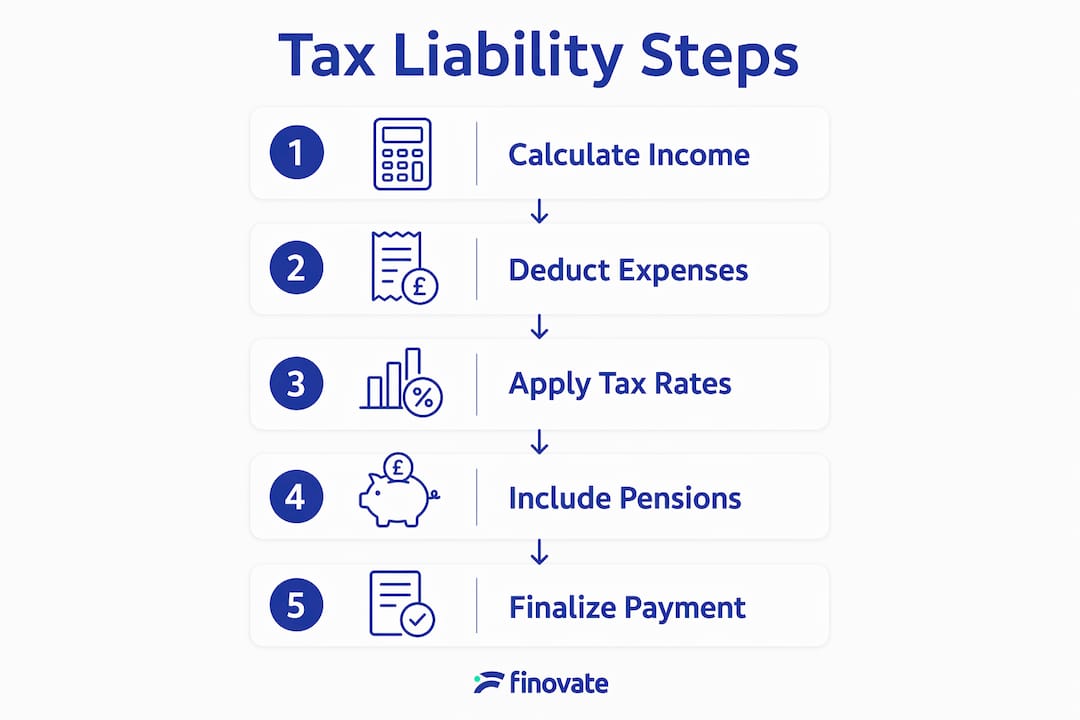
Calculating your tax liability in Finland follows a clear sequence. Working through each step methodically reduces the risk of error and helps you anticipate what you will owe before the assessment arrives.
- Determine gross income. Add together all sources of income: employment wages, business profits, rental income, capital gains, and any other taxable receipts.
- Apply deductions. Subtract permitted deductions from gross income to arrive at taxable income. Common deductions in Finland include work-related expenses, pension contributions, and travel costs between home and work.
- Apply the progressive tax scale. Calculate state income tax using the current national tax table. Add municipal tax at your local rate, church tax if applicable, and social insurance contributions.
- Subtract tax credits. Credits reduce the tax payable directly, unlike deductions which reduce taxable income. The earned income credit and the household deduction (kotitalousvähennys) are two widely used credits.
- Account for prepayment taxes. Entrepreneurs must estimate their annual profits at registration and pay prepayment taxes (ennakkovero) during the year. Failure to pay prepayment taxes results in penalties and interest charges.
Example: A sole trader with €60,000 in gross business income, €8,000 in deductible expenses, and €2,000 in pension contributions arrives at a taxable income of €50,000. State tax, municipal tax, and social insurance contributions are then applied to that figure. The resulting sum, minus any credits, is the final tax liability.
Pro Tip: If you are a sole trader, review your prepayment tax estimate mid-year. If your profits are tracking higher than expected, request an adjustment from Vero to avoid a large settlement payment and potential interest.
What factors affect tax liability in Finland?
Several variables determine how much tax you ultimately owe. Understanding these factors gives you genuine control over your financial position.
- Income level. The progressive tax scale means that each additional euro earned above a threshold is taxed at a higher rate. A jump from €40,000 to €60,000 in annual income does not simply add 20% more tax. It pushes a portion of income into a higher band.
- Business structure. Sole traders cannot pay themselves a salary; they take withdrawals and pay tax on all business profits as personal income. Limited companies pay corporate tax at 20% on profits, giving owners more flexibility in how and when they extract income.
- Deductions and credits. Tax deductions and credits are the most direct tools for reducing liability. Missing a legitimate deduction, such as a home office expense or professional subscription, means paying more tax than the law requires.
- Church membership. Belonging to a registered religious community adds church tax to your bill. Leaving the church removes this component from your liability entirely.
- International income and tax treaties. Finland has tax treaties with numerous countries to prevent double taxation. The 183-day rule is central to determining residency status and which country has the right to tax your income.
- Penalties and surcharges. Administrative penalties (veronkorotus) increase your total liability. These can arise from incomplete filings, late submissions, or inaccurate declarations, even without any intent to deceive.
"Finnish tax law demands a high level of diligence from taxpayers; penalties can be imposed for negligence without proof of intentional fraud." — Castrén & Snellman
Pro Tip: YEL pension insurance is mandatory for sole traders if annual estimated work income exceeds €9,208.43. YEL contributions are deductible, so paying the correct amount reduces your taxable income while satisfying a legal obligation.
How do Finnish tax compliance and reporting duties connect to tax liability?
Your tax liability is only as accurate as the information you report. The Finnish Tax Administration pre-fills tax returns using data from employers, banks, and pension providers. However, this pre-filled return is a starting point, not a finished document.
Finnish tax experts emphasise that taxpayers bear full responsibility for verifying accuracy and adding any missing information. If income is omitted and not declared, it may be treated as fiscal fraud. Equally, failing to claim deductions you are entitled to means you overpay tax unnecessarily.
Key compliance responsibilities include:
- Verifying the pre-filled return. Check every line against your own records. Employers, banks, and investment platforms all report data to Vero, but errors occur.
- Adding missing income. Freelance payments, rental income, and foreign-source income often do not appear automatically. You must add these yourself.
- Claiming all eligible deductions. Accurate tax filing requires reconciling pre-filled information with your own records. Unclaimed deductions result in overpayment.
- Meeting deadlines. Individuals typically have a personal deadline in spring, staggered by personal identity number. Businesses have separate filing schedules. Missing a deadline triggers automatic penalties.
- Maintaining bookkeeping records. Businesses must keep accounts that support every figure declared. Poor record-keeping is one of the most common causes of incorrect tax liability calculations.
| Compliance area | Consequence of failure |
|---|---|
| Missing income declaration | Risk of fiscal fraud investigation |
| Late filing | Automatic penalty surcharge |
| Incorrect deductions claimed | Tax assessment revision and possible penalty |
| Poor bookkeeping | Inability to defend figures during a tax audit |
| Unpaid prepayment taxes | Interest charges and penalty payments |
For a detailed walkthrough of the filing process, the Finovate guide on Finnish entrepreneurs' tax filing covers each step clearly.
How can understanding tax liability improve financial planning?
Knowing your tax liability in advance transforms it from a surprise bill into a manageable line item in your annual budget. This is where understanding tax liability moves from theory into practical financial advantage.

Accurate profit estimation for entrepreneurs. Sole traders and business owners who estimate their annual profits carefully can set prepayment tax amounts that reflect reality. Overestimating ties up cash unnecessarily. Underestimating leads to penalties. Reviewing your profit trajectory quarterly and adjusting your prepayment tax accordingly keeps cash flow predictable.
Strategic use of deductions. Deductions are not automatic. You must identify, document, and claim them. Work-related travel, professional development courses, home office costs, and equipment purchases can all reduce your taxable income. Planning major expenditure before the year-end, when it makes business sense, can shift your liability meaningfully.
Choosing the right business structure. The table below illustrates how structure affects tax liability for a business generating €80,000 in annual profit.
| Business structure | Tax treatment | Key consideration |
|---|---|---|
| Sole trader (toiminimi) | Progressive personal income tax on all profits | Simpler administration, higher personal tax rate at upper income levels |
| Limited company (osakeyhtiö) | 20% corporate tax on profits; dividend tax on withdrawals | More flexibility in income timing; higher administrative costs |
| Light entrepreneur | Tax withheld at source from payments | Simplest compliance; fewer deductibility options |
Pro Tip: If your annual profits consistently exceed €50,000, compare your total tax liability as a sole trader against operating as a limited company. The difference in effective tax rate can be significant, and the decision is worth modelling with a qualified accountant before the next tax year begins.
For broader guidance on tax planning strategies tailored to Finnish businesses, Finovate's resources cover the key approaches in detail.
Tax liability in Finland: what I have learned from working with Finnish taxpayers
Working with individuals and business owners across Finland, I have noticed one pattern more than any other: people treat tax filing as something to get through rather than something to get right. That distinction costs them money every year.
The Finnish system is genuinely fair in its design. The pre-filled return, the clear deduction categories, and the accessible Vero online portal give taxpayers real tools to manage their liability. Yet the tax burden in Finland is high, and it funds extensive social services not commonly provided elsewhere. That context matters. When you understand what your tax pays for, the obligation feels less arbitrary and more like a transaction with clear terms.
What I find most underappreciated is the cost of passivity. Failing to claim a legitimate deduction is not a neutral act. It is a decision to pay more than the law requires. I have seen sole traders miss thousands of euros in deductible YEL contributions simply because they did not know the contributions were deductible. I have seen business owners accept their pre-filled return without checking, only to discover later that rental income from a property abroad had not been captured.
My honest advice is this: treat your annual tax review as a financial audit of the past year. Pull your records, check every figure, and claim every deduction you are entitled to. If the process feels uncertain, that is precisely when professional advice pays for itself. The compliance obligations for Finnish businesses are real, but they are manageable with the right support.
— Busayo
How Finovate can help you manage your tax liability in Finland
Managing your tax liability accurately takes time, knowledge, and attention to detail. Finovate provides accounting and tax services designed specifically for individuals and business owners in Finland, covering bookkeeping, VAT reporting, payroll processing, and full tax compliance support.

Whether you are a sole trader trying to set the right prepayment tax amount, a limited company owner planning your dividend strategy, or a light entrepreneur needing help with invoicing and reporting, Finovate's team understands Finnish tax law in depth. We reduce the administrative burden so you can focus on your work, confident that your tax position is accurate and compliant. Visit Finovate's accounting services to find the right support for your situation, or explore our light entrepreneur accounting package if you operate through an invoicing service.
Key takeaways
Tax liability in Finland is determined by income level, business structure, available deductions, and compliance accuracy, making proactive planning the most effective way to manage what you owe.
| Point | Details |
|---|---|
| Tax liability definition | Tax liability is the total tax owed after deductions and credits are applied to your taxable income. |
| Progressive tax structure | Finland taxes income at rising rates across state, municipal, church, and social insurance components. |
| Business structure matters | Sole traders pay personal income tax on all profits; limited companies pay 20% corporate tax with separate dividend taxation. |
| Deductions reduce liability | Work expenses, pension contributions, and travel costs are deductible and must be actively claimed to reduce your bill. |
| Compliance is your responsibility | Pre-filled returns are a starting point; taxpayers must verify, correct, and complete them to avoid penalties or overpayment. |
FAQ
What is the tax liability definition in simple terms?
Tax liability is the legally owed amount of tax after all deductions and credits have been applied to your gross income. It represents your final obligation to the tax authority for a given year.
How do sole traders in Finland calculate their tax liability?
Sole traders pay tax on business profits as personal income using Finland's progressive tax scale. They must also pay mandatory YEL pension insurance if annual estimated work income exceeds €9,208.43, and this contribution is deductible from taxable income.
What happens if I underestimate my prepayment taxes in Finland?
Failure to pay sufficient prepayment taxes results in interest charges and penalty payments when the final tax assessment is issued. Reviewing and adjusting your estimate during the year prevents this outcome.
Can penalties increase my tax liability in Finland?
Yes. Administrative penalties (veronkorotus) are added to your tax bill for incomplete, late, or inaccurate filings, even when there is no intent to deceive. Finnish tax law imposes these sanctions on the basis of negligence alone.
What deductions are available to reduce tax liability in Finland?
Common deductions include work-related expenses, commuting costs, pension contributions, and home office costs. Tax credits such as the earned income credit and the household deduction further reduce the amount payable directly.