

TL;DR:
- Tax deductions reduce taxable income, thereby lowering the amount of tax owed. In Finland, individuals and small businesses can claim various deductions, such as household and business expenses, to maximize savings. Proper documentation and strategic planning are essential for optimizing deduction benefits and avoiding missed opportunities.
A tax deduction is a specific amount you subtract from your gross income to reduce your taxable income, which in turn lowers the total tax you owe. This is the foundational principle behind tax deductions: they do not reduce your tax bill directly, but they shrink the income figure on which your tax is calculated. In Finland, both individuals and small business owners have access to a range of deductions, from the household deduction (kotitalousvähennys) to business expense write-offs and YEL insurance contributions. Understanding which deductions apply to you, and how to claim them correctly, is one of the most practical ways to reduce your annual tax liability.
How do tax deductions work in finland?
A tax deduction works by reducing the portion of your income that is subject to tax. If you earn €60,000 and claim €5,000 in deductions, the Finnish Tax Administration calculates your tax on €55,000 instead. That difference can translate into hundreds of euros saved each year.

In Finland, many deductions are processed automatically through the OmaVero portal, which is the Finnish Tax Administration's online service. Others require you to submit supporting documentation manually. Knowing which category your deduction falls into prevents missed claims and avoids errors on your tax return.
For individuals, the most notable deduction is the kotitalousvähennys (household deduction). This allows you to deduct 35% of labour costs for home renovation and maintenance, up to €1,600 per person annually, or €3,200 for couples. A special rate of 60% applies to oil heating replacement work, with a maximum of €3,500 per person. This is not a minor saving. A couple renovating a bathroom and replacing an oil boiler could claim close to the full €3,200 combined limit.
For the deduction to apply automatically, payment must be made by bank transfer or card, with a proper invoice from the service provider. If the provider reports the work to the Finnish Tax Administration, the deduction appears in your pre-completed tax return. If not, you can claim it manually via OmaVero by entering the details and uploading the invoice.
For sole proprietors and limited companies, the rules differ. Finnish businesses can deduct expenses directly related to earning income. These include:
- Office supplies and equipment
- Software subscriptions and digital tools
- Marketing and advertising costs
- Accounting and legal fees
- YEL (self-employed person's pension insurance) premiums
Small procurements up to €1,200 each may be deducted immediately within a cumulative annual cap of €3,600. This rule makes it straightforward to write off routine business purchases without complex depreciation calculations.
Pro Tip: Keep every receipt and invoice in a dedicated folder, digital or physical, throughout the year. Reconstructing records at tax time is time-consuming and increases the risk of missing valid deductions.
What are the common types of tax deductions in finland?
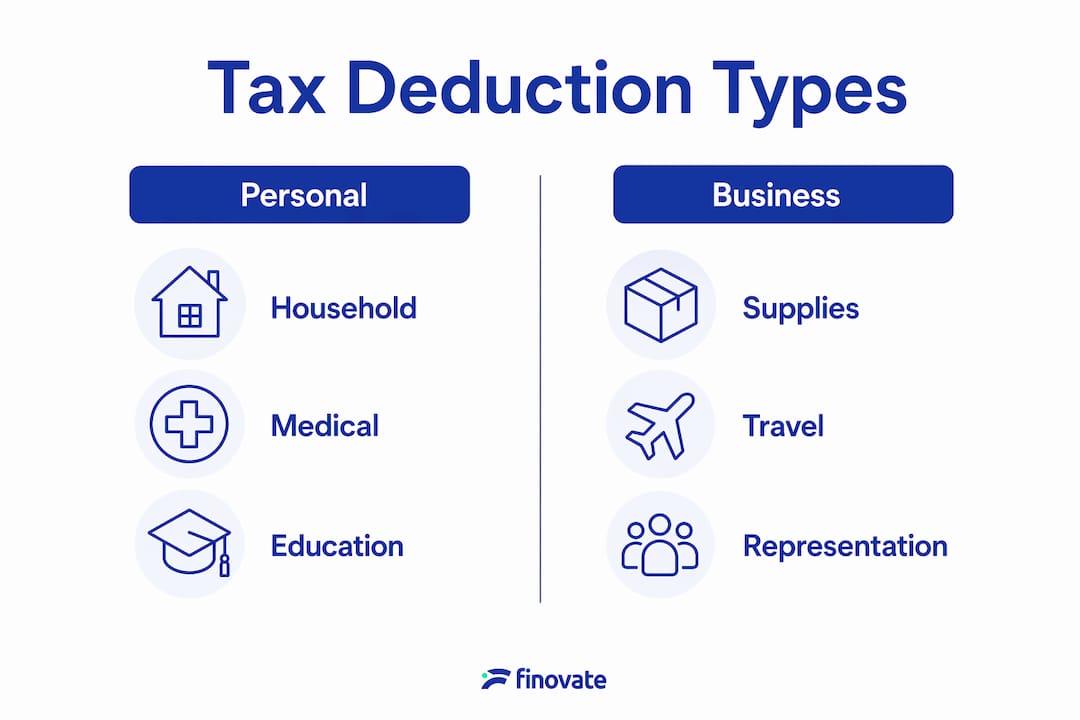
Understanding the types of tax deductions available helps you plan ahead rather than scramble at filing time. Finnish deductions split broadly into personal deductions and business deductions, each with its own conditions and limits.
Personal deductions for individuals
The household deduction (kotitalousvähennys) covers a wide range of services performed at your home. Qualifying examples include:
- Renovation and repair work (plumbing, electrical, carpentry)
- Cleaning and domestic maintenance services
- Care work for elderly or disabled household members
- Oil heating system replacement (at the higher 60% rate)
The service must be provided by a registered company or self-employed professional. Work you perform yourself does not qualify. This distinction catches many taxpayers off guard.
Business deductions for entrepreneurs
Finnish sole proprietors and limited companies can deduct a broad range of operating costs. The table below summarises the most common categories and their conditions.
| Deduction Type | Condition | Limit |
|---|---|---|
| Office supplies and equipment | Must be used for business purposes | Small items ≤€1,200 deducted immediately; cumulative cap €3,600 |
| YEL insurance premiums | Paid by entrepreneur or company | Fully deductible; deduction location affects tax outcome |
| Representation expenses | Client entertainment and hospitality | 50% deductible under Finnish Business Tax Act |
| Marketing and advertising | Directly related to business income | Fully deductible with no stated cap |
| Accounting and advisory fees | Professional services for the business | Fully deductible |
Representation expenses are a common source of confusion. Client dinners, gifts, and hospitality events are only 50% deductible under Finnish law. Many entrepreneurs claim the full amount and later face corrections during tax review. Knowing the 50% rule in advance saves you from that problem.
Pro Tip: If you use a personal vehicle for business travel, keep a mileage log. The Finnish Tax Administration allows a per-kilometre deduction for business use, but only with documented records.
Tax deduction vs credit: what is the difference?
A tax deduction reduces taxable income, while a tax credit reduces the actual tax you owe. A tax exemption removes a specific portion of income from taxation entirely. These three mechanisms work at different points in the tax calculation, and confusing them leads to inaccurate expectations about your tax bill.
Here is a practical illustration of how each works:
- Deduction: You earn €40,000. A €2,000 deduction reduces your taxable income to €38,000. Your tax is calculated on €38,000.
- Credit: Your calculated tax is €8,000. A €500 tax credit reduces that bill directly to €7,500.
- Exemption: A specific income source, such as certain social benefits, is excluded from your taxable income altogether before any calculation begins.
The practical implication is clear. A deduction saves you a percentage of its value, depending on your marginal tax rate. A credit saves you its full face value, euro for euro. For a taxpayer in a 40% marginal tax bracket, a €1,000 deduction saves €400. A €1,000 credit saves €1,000.
This distinction matters when you are comparing tax planning options. Prioritising credits over deductions, where both are available, produces a larger direct saving. In Finland, most available reliefs for individuals and small businesses take the form of deductions rather than credits, which makes understanding your marginal tax rate central to calculating the real value of each claim.
Pro Tip: Use OmaVero's tax calculator to model the impact of different deduction amounts on your final tax bill. This takes the guesswork out of planning and helps you decide which expenses are worth documenting carefully.
How can finnish entrepreneurs use tax deductions strategically?
Strategic use of deductions goes beyond simply listing expenses. For Finnish entrepreneurs, the most significant decisions involve where and how to claim certain deductions, particularly YEL insurance contributions.
YEL contributions can be deducted in personal taxation, a spouse's taxation, or company taxation. The optimal choice depends on your income level and effective tax rate. Deducting through the company means the company pays and claims the expense, reducing corporate taxable income. Deducting personally reduces your earned income tax base. The right route depends on where the higher marginal rate applies.
The entrepreneur's deduction automatically reduces taxable business income by 5%, with no separate application required. On €50,000 of business income, this brings the taxable amount down to €47,500. That saving is applied before your tax rate is calculated, making it one of the simplest reliefs available.
For 2026, the corporate tax rate in Finland stands at 20%, with a planned reduction to 18% in 2027. This upcoming change has a direct bearing on deduction strategy. Expenses deducted in 2026 at the 20% rate produce a larger tax saving than the same expenses deducted in 2027 at 18%. Accelerating deductible expenditure into 2026 where possible is a sound approach for limited companies.
Key practices for maximising deductions as an entrepreneur include:
- Reviewing your deductible expenses at least quarterly, not just at year-end
- Separating personal and business accounts to avoid mixed-use disputes
- Documenting the business purpose of every expense at the time it occurs
- Consulting a tax professional before making large capital purchases to confirm deductibility
- Reviewing your business structure annually, as the optimal deduction route can shift with income changes
For a detailed walkthrough of the filing process, Finovate's guide on tax filing for Finnish entrepreneurs covers each step from record-keeping to submission.
Key takeaways
Tax deductions reduce your taxable income, not your tax bill directly, making your marginal tax rate the key variable in calculating their true value.
| Point | Details |
|---|---|
| Definition of a deduction | A tax deduction lowers taxable income, reducing the amount on which tax is calculated. |
| Household deduction limits | Individuals can claim 35% of labour costs up to €1,600 per person, or €3,200 for couples, annually. |
| Business expense rules | Small purchases up to €1,200 each are deductible immediately, within a €3,600 annual cumulative cap. |
| Deduction vs credit | A deduction saves a percentage of its value; a credit reduces your tax bill by its full amount. |
| YEL deduction strategy | Choosing where to deduct YEL contributions, personally or via the company, affects your total tax outcome significantly. |
Why most taxpayers leave money on the table
From my experience working with Finnish individuals and entrepreneurs, the single most common mistake is treating tax deductions as an afterthought. People gather receipts in a panic during April rather than maintaining records throughout the year. By that point, legitimate expenses have been forgotten, invoices are missing, and the household deduction goes unclaimed simply because payment was made in cash rather than by bank transfer.
The kotitalousvähennys is particularly underused. Many homeowners do not realise that regular cleaning services, not just major renovations, qualify for the deduction. A family spending €200 per month on a cleaning service could claim a meaningful deduction annually, yet most never do because they assume it only applies to building work.
For entrepreneurs, the YEL deduction decision is where I see the most value left unclaimed. Most people default to deducting contributions personally without modelling the alternative. In some cases, deducting through the company produces a materially better outcome, especially when personal income is already in a higher tax bracket.
My advice is straightforward. Review your deduction position once per quarter. Keep a simple spreadsheet of business expenses with the date, amount, and business purpose noted at the time. And once a year, sit down with a tax professional to review whether your current business structure and deduction strategy still fits your income level. Tax rules change, and what worked in 2024 may not be optimal in 2026.
— Busayo
Let Finovate handle your tax deductions
Managing deductions correctly takes time, attention to detail, and up-to-date knowledge of Finnish tax rules. Finovate provides accounting, bookkeeping, and tax planning services designed specifically for individuals and small business owners in Finland.
Whether you are a sole trader tracking business expenses or a limited company preparing for the 2026 filing season, Finovate's team ensures you claim every deduction you are entitled to, without the risk of errors or missed deadlines. Our invoicing service for entrepreneurs keeps your records organised and compliant throughout the year. For full accounting and tax support, visit Finovate's accounting services to find the right plan for your situation.
FAQ
What is a tax deduction in simple terms?
A tax deduction is an amount subtracted from your gross income to reduce the portion of your income that is taxed. The lower your taxable income, the less tax you owe.
What qualifies for a tax deduction in finland?
Common qualifying deductions include household service costs under kotitalousvähennys, business operating expenses, YEL insurance premiums, and office equipment purchases. Each deduction has specific eligibility conditions and documentation requirements.
What is the difference between a tax deduction and a tax credit?
A deduction reduces taxable income, while a credit reduces the actual tax you owe. Credits provide a direct euro-for-euro reduction in your tax bill, making them more valuable than an equivalent deduction.
How do i claim the household deduction in finland?
Pay for qualifying services by bank transfer or card and obtain a proper invoice. If the provider reports the work to the Finnish Tax Administration, the deduction appears automatically in your pre-completed return. Otherwise, claim it manually through OmaVero.
Can finnish entrepreneurs deduct YEL insurance contributions?
Yes. YEL contributions are deductible in personal taxation, a spouse's taxation, or company taxation. The most tax-efficient option depends on your income level and applicable tax rates.