

TL;DR:
- Practicing weekly cash flow forecasting, automating invoice payments, and establishing a cash buffer can significantly improve financial stability.
- Aligning HMRC compliance, recordkeeping, and government-backed funding streamlines growth and reduces risk for small UK businesses.
Six practical actions will materially improve your financial planning within 30 days. Start here, and work through them in order.
- Build a 13-week cash flow forecast and update it every week
- Open a dedicated business bank account and enable Open Banking bank feeds
- Automate invoicing and tighten payment terms to 14 days or fewer
- Create a separate VAT and tax reserve account and fund it monthly
- Renegotiate at least three supplier contracts for better terms or payment dates
- Set a one-month cash buffer target, then plan how to fund it
According to HMRC's Making Tax Digital requirements, digital recordkeeping is no longer optional for VAT-registered businesses. The British Business Bank and its programmes give you access to government-backed funding once your records are in order. Getting both right, quickly, is the foundation of everything else in this guide.
A guide to financial management for SMEs confirms what most business owners discover too late: small businesses fail because of poor cash management, not lack of demand.
Table of Contents
- What does a 30-day financial planning action plan look like?
- How do you build a 13-week cash flow forecast and protect your buffer?
- What do you need to set up for HMRC and Making Tax Digital?
- How should you run monthly financial governance?
- When should you bring in an accountant, bookkeeper, or CFO?
- Which budgeting techniques work best for small UK businesses?
- How do you manage credit control and reduce bad debt?
- What business insurance do UK small businesses need to plan for?
- How should you budget for employee salaries and benefits?
- What succession planning should small business owners consider?
- Key takeaways
- A note from Finovate on how we can help
- Useful official sources and further reading
- What does good financial planning look like in practice?
What does a 30-day financial planning action plan look like?
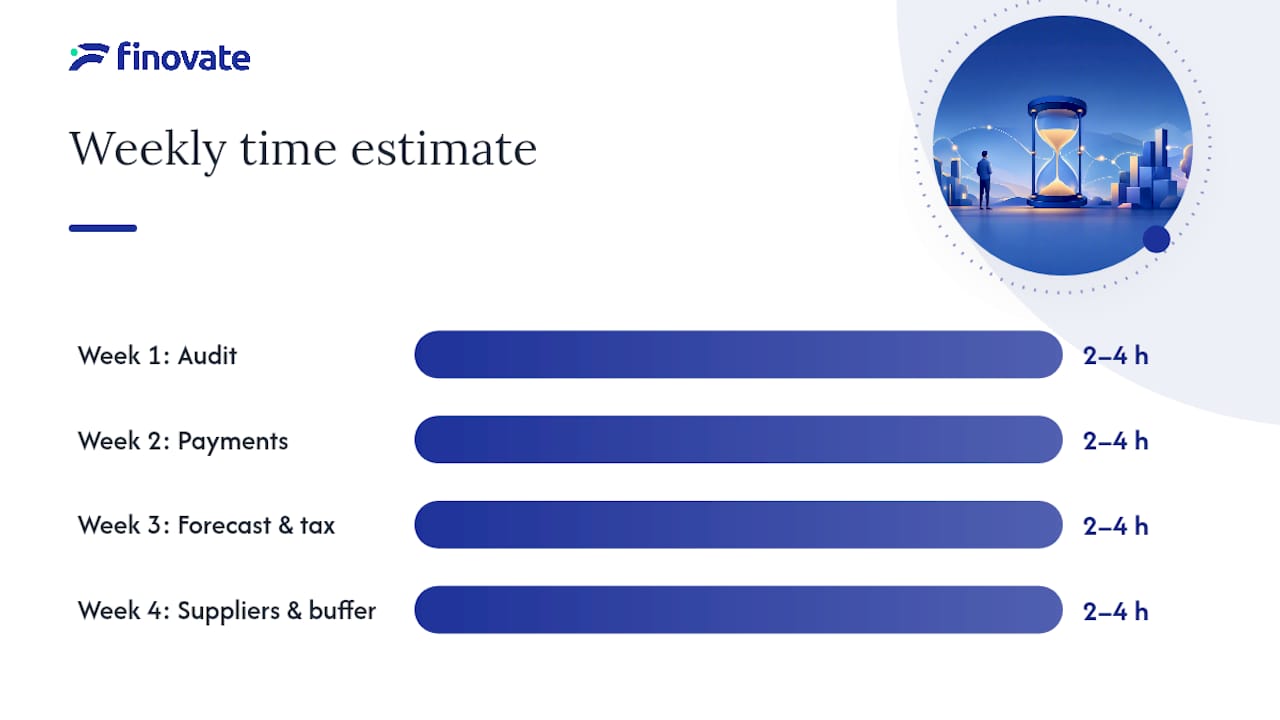
Follow this week-by-week schedule. Each week has a clear focus and takes roughly two to four hours of your time.
Week 1: Financial audit
- Pull three months of bank statements and produce a one-line profit and loss summary.
- List every active subscription and recurring cost; cancel anything unused.
- Identify all open invoices and their ages.
- Connect your bank account to your accounting software via Open Banking.
- Assign one person as the owner of financial records.
Week 2: Tighten payments and automate
- Switch to invoicing on completion of every job or delivery.
- Set standard payment terms to 14 days on all new invoices.
- Configure automated payment reminders at day 7, day 14, and day 1 overdue.
- Review your business structure if you are still trading as a sole trader with growing turnover.
Week 3: Forecast, tax reserve and finance review
- Build your 13-week cash flow forecast in a spreadsheet (see Section 4 for the template).
- Open a separate savings account labelled "VAT and Tax Reserve."
- Transfer 20% of every customer receipt into that account on the day it arrives.
- Review any existing overdraft, loan, or credit facilities and note their renewal dates.
Week 4: Suppliers, forecast update and buffer plan
- Contact three suppliers and request extended payment terms or a small discount for prompt payment.
- Update your revenue forecast using actual figures from the quarter so far.
- Decide on a concrete buffer-building step: reduce DSO, draw down a facility, or apply for a government-backed loan.
Pro Tip: Book a 30-minute call with an accountant or advisor at the end of Week 4. Bring your updated forecast and your VAT reserve balance. That single conversation will identify the next three priorities faster than any checklist.
How do you build a 13-week cash flow forecast and protect your buffer?
Prioritise the 13-week forecast above every other planning tool. Monthly accounts show you what happened; a rolling 13-week forecast shows you what is coming. Once set up, it takes roughly 10 minutes a week to maintain, yet it is the single most effective way to preserve options and avoid last-minute funding gaps.
Build the spreadsheet in five steps:
- List all fixed outgoings by week: rent, payroll, loan repayments, HMRC payments.
- Enter realistic expected receipts, based on confirmed orders and historical payment patterns.
- Mark uncertain receipts in a separate column so you can see your worst-case position clearly.
- Run two scenarios: one where your three slowest-paying customers are two weeks late, and one where they pay on time.
- Highlight any week where the closing balance falls below your one-month cost base.
Tighten your payment process alongside the forecast:
- Issue invoices the same day work is completed, not at month end.
- State payment terms clearly on every invoice: "Payment due within 14 days."
- Send an automated reminder three days before the due date, not after it.
- Chase overdue invoices by phone on day one of being late; email alone is too easy to ignore.
Your buffer target should be one month of fixed costs to start, then three months once cash flow stabilises. Fund it by reducing your debtor days (DSO) first, then by negotiating supplier payment terms, and finally by drawing on invoice finance if a specific gap requires it.
Pro Tip: Match loan or facility repayment dates to your cash peaks, not your cash troughs. If your busiest payment month is March, schedule annual repayments for April.
What do you need to set up for HMRC and Making Tax Digital?
Register the right taxes and choose MTD-compatible software now. Delay costs money in penalties and creates a backlog that is harder to clear later. Early separation of business banking and up-to-date records simplify compliance and improve credibility with lenders.
Compliance checklist:
- Register for Corporation Tax within three months of starting to trade.
- Register for VAT once your taxable turnover exceeds the current threshold (£90,000 in a rolling 12-month period).
- Register for PAYE as soon as you take on an employee or pay yourself a salary above the Lower Earnings Limit.
- Open a dedicated VAT reserve account and automate a monthly transfer of 20% of net receipts.
- Assign one person internally to own each submission deadline.
UK companies must keep adequate accounting records for at least six years, and statutory frameworks affect which reporting standards apply to your business. If your business holds leases or has significant contracts, note that FRS 102 amendments effective for periods beginning on or after 1 January 2026 change lease and revenue recognition rules — review your contracts now.
For MTD compliance, your accounting software must connect directly to HMRC via a digital link. Manual re-keying of figures from a spreadsheet into a separate VAT return no longer satisfies MTD requirements. Set up your recordkeeping workflow before your next VAT period closes.
| Task | Deadline trigger | Owner |
|---|---|---|
| Corporation Tax registration | Within 3 months of trading | Director |
| VAT registration | Turnover exceeds £90,000 | Director / accountant |
| MTD-compatible software setup | Before next VAT return | Bookkeeper |
| VAT reserve account funding | Monthly, on receipt | Finance lead |
| Six-year record retention | Ongoing | Bookkeeper |
How should you run monthly financial governance?
Produce short monthly management accounts and a KPI dashboard every month without exception. Timely, accurate management information increases your access to finance and reduces friction with lenders.
Essential KPIs to track monthly:
- Cash runway: weeks of operating costs covered by current cash balance
- Gross margin: gross profit as a percentage of revenue
- DSO (debtor days): average number of days customers take to pay
- Burn rate: total monthly cash outflow (for pre-profit or early-stage businesses)
- Revenue vs forecast variance: actual sales against your monthly target
Simple scenario modelling in three steps:
- Take your base-case forecast and reduce revenue by 20% for a downside scenario.
- Increase your three largest cost lines by 10% in the same downside model.
- Identify the month where cash goes negative and plan your response now, not then.
A monthly governance meeting need not take more than 45 minutes. Attendees: the business owner, the bookkeeper or accountant, and any co-director. Agenda: cash position and runway, revenue vs forecast, top three cost variances, one decision or action for the coming month.
When should you bring in an accountant, bookkeeper, or CFO?
Bring in external help when you lack the capacity or expertise to stay MTD-compliant, manage cash, or produce credible forecasts for lenders. That is the direct answer. The financial planning steps that work consistently are the ones with clear ownership and a regular review cadence — which is harder to maintain alone as a business grows.
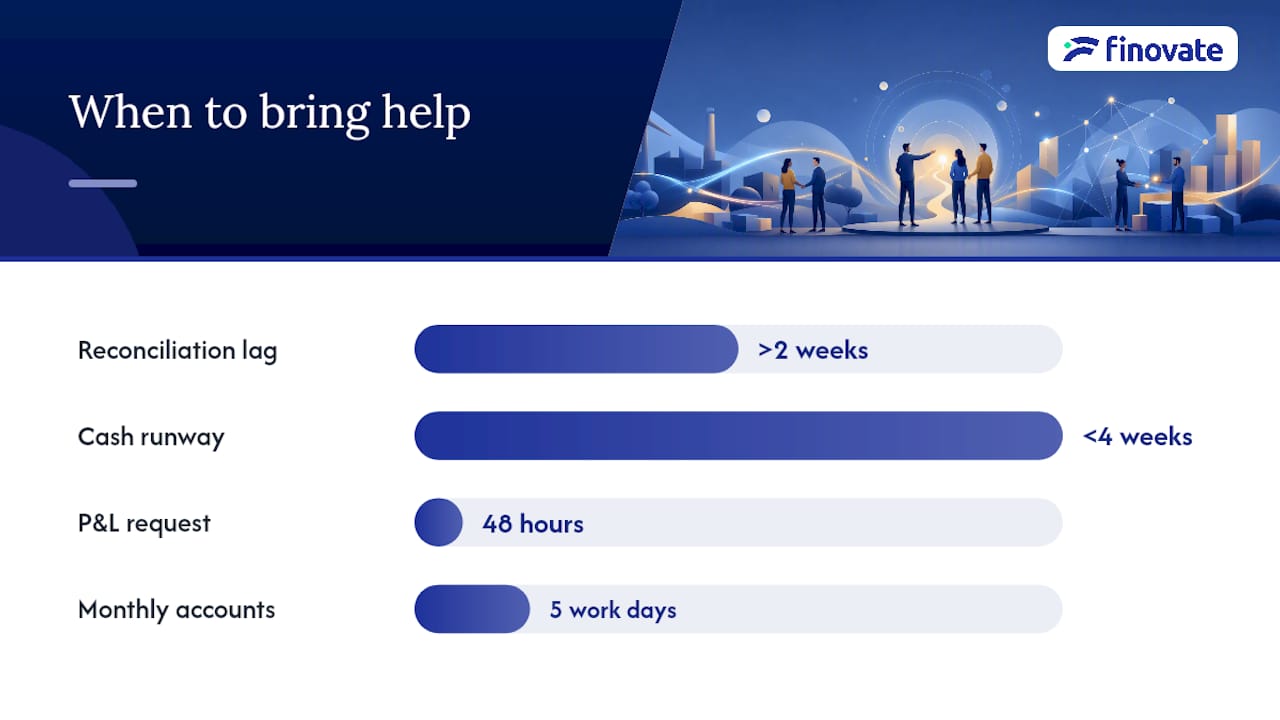
Red flags that mean you need help now:
- Bank feeds are not connected and reconciliation is more than two weeks behind.
- Cash runway is below four weeks with no facility in place.
- You have missed a VAT filing or received a late-filing notice from HMRC.
- You cannot produce a profit and loss statement within 48 hours of being asked.
Questions to ask a prospective provider:
- Are you registered with HMRC as an agent and can you handle MTD submissions on our behalf?
- Which accounting software do you work with, and will you set up our bank feeds?
- Can you produce monthly management accounts within five working days of month end?
- Do you offer CFO-as-a-service or advisory support beyond compliance?
Prepare three months of bank statements, your most recent VAT return, and a list of your current facilities before the first meeting. Transition from bookkeeping to outsourced CFO support when your revenue exceeds roughly £500,000 or when you are preparing for external investment or a significant loan application. Finovate's accounting services cover both levels of support.
Which budgeting techniques work best for small UK businesses?
Zero-based budgeting and rolling forecasts are the two most practical approaches for small UK businesses. Zero-based budgeting requires you to justify every cost line from scratch each year rather than simply adding a percentage to last year's figures. It is time-consuming once, but it eliminates the budget creep that quietly erodes margins over several years.
Rolling forecasts update your 12-month view every month, dropping the oldest month and adding a new one. Combined with your 13-week cash flow model, this gives you both a short-term operational view and a medium-term strategic picture. For seasonal businesses, a rolling forecast is particularly valuable because it captures the revenue and cost peaks that an annual budget smooths over.
A practical starting point: use zero-based budgeting for your annual cost review in Q4, then maintain a rolling 12-month revenue and cost forecast updated monthly. Keep the two models in the same spreadsheet so variances are visible in one place.
How do you manage credit control and reduce bad debt?
Credit control starts before you issue the invoice. Agree payment terms in writing before work begins, include them in your contract or terms of business, and state them clearly on every invoice. Businesses that skip this step spend disproportionate time chasing payments that were never formally agreed.
A standard credit control cadence: automated reminder at day 7, a second reminder at day 14, a personal phone call on day 1 overdue, a formal letter before action at day 30, and referral to a debt collection agency or solicitor at day 60 if payment has not been received. Most late payments resolve at the phone-call stage.
For larger customers, consider requesting a purchase order number before starting work. This removes the most common dispute: "We never approved this." Credit checking new customers via a service such as Companies House or a credit reference agency before extending significant credit is also worth the small cost.
What business insurance do UK small businesses need to plan for?
Insurance is a fixed cost that belongs in your budget from day one, not an afterthought. The minimum cover most UK small businesses need includes public liability insurance, professional indemnity insurance (if you provide advice or services), and employers' liability insurance (legally required the moment you hire anyone, including part-time staff).
Budget for insurance annually and review it each year as your revenue and headcount change. Under-insuring to save on premiums is a false economy: a single uninsured claim can exceed several years of premium savings. Get at least three quotes each renewal cycle and check that your policy covers the specific activities your business carries out, not just your general trade description.
How should you budget for employee salaries and benefits?
Payroll is typically the largest single cost line for a service business, and it is also the least flexible in the short term. Budget for the full employment cost, not just the gross salary: add employer National Insurance contributions (currently 15% on earnings above the secondary threshold) and any pension contributions under auto-enrolment (minimum 3% employer contribution on qualifying earnings).
Benefits such as private medical insurance, enhanced pension contributions, or flexible working arrangements have a cost that should appear in your budget before you offer them. The most common budgeting error is committing to a salary package and discovering the total employment cost is 20–25% higher than the gross figure. Build a simple payroll cost model that shows gross salary, employer NI, pension, and any benefits in kind for each role.
What succession planning should small business owners consider?
Succession planning is the part of financial planning most owners defer until it is urgent. The two most common triggers are a health event and an unexpected offer to buy the business. Neither gives you time to plan properly if you have not started.
At a minimum, document who holds each key financial relationship: the bank, HMRC agent authorisation, the accountant, and any major customer contracts. If you are the sole director and signatory, the business cannot function without you. Appoint a second signatory on the business bank account and ensure at least one other person can access accounting software and file returns.
For longer-term succession, consider whether you want to pass the business to a family member, sell to a third party, or implement a management buyout. Each route has different tax implications under UK law, and the earlier you plan, the more options you retain. A business advisory conversation with Finovate can help map the financial implications of each route before you need to act.
Key takeaways
A cash-first approach, combined with MTD-compliant recordkeeping and a 13-week rolling forecast, gives UK small businesses the clearest path to financial stability within 30 days.
| Point | Details |
|---|---|
| Cash flow is the priority | Build a 13-week forecast and update it weekly to spot tight periods before they arrive. |
| Tax compliance starts now | Register for Corporation Tax, VAT, and MTD-compatible software before your next filing deadline. |
| Government funding is expanding | The British Business Bank's capacity has been set at £25.6 billion; Start Up Loans and the Growth Guarantee Scheme are accessible routes. |
| Monthly governance matters | Track cash runway, gross margin, and DSO every month to catch problems early and satisfy lenders. |
| Get help before the red flags appear | Bring in an accountant or bookkeeper before cash runway falls below four weeks or a VAT filing is missed. |
A note from Finovate on how we can help
At Finovate, we work with small business owners and entrepreneurs who need more than a compliance service. We handle bookkeeping, VAT reporting, payroll, and MTD registration, and we produce monthly management accounts that give you the numbers you need to make decisions, not just to file returns. For businesses at a growth inflection point, our advisory and CFO-as-a-service support covers cash flow modelling, funding applications, and scenario planning.
If the 30-day plan in this guide feels like a lot to manage alongside running your business, we can take the implementation off your plate.

Talk to Finovate about bookkeeping, MTD compliance, or financial planning support for your business.
This article provides general information only and does not constitute financial, tax, or legal advice. Confirm current rules and thresholds with HMRC or a qualified professional before acting.
Useful official sources and further reading
- A guide to financial management for SMEs
- Our plan for small and medium‑sized businesses
- Your 2026 financial setup guide – startup accounting essentials for UK founders
- 2026 planning guide
- UK business financial planning
- Accountancy processes: Statutory accounting requirements - BDO
- The FRS 102 rules are changing again: How will they affect you? - Galloways
- Financial planning steps - Fidelity
What does good financial planning look like in practice?
Most business owners know they should be doing more with their numbers. The honest gap is not knowledge — it is the weekly discipline of updating a forecast, reconciling the bank, and sitting with the numbers for 30 minutes before making a decision. The businesses that manage cash well are not necessarily the ones with the most sophisticated tools. They are the ones that look at their position every week, act on what they see, and do not wait for the accountant's annual call to find out they have a problem.
The 13-week forecast is the single most underused tool in small business finance. It is not complex. It does not require specialist software. It requires honesty about when customers actually pay and when costs actually land. Build it once, maintain it weekly, and it will tell you more about your business than any management report produced after the fact.