

TL;DR:
- Choosing between sole trader, partnership, LLP, or Ltd depends on profit, liability risk, and administrative capacity. Start simple as a sole trader and switch to a limited structure when profits or liability concerns justify it. Consulting official guidance and professionals can ensure the right decision as your business grows.
The four common UK business structures are sole trader, partnership, limited liability partnership (LLP) and private limited company (Ltd). The practical rule of thumb: start as a sole trader if you want minimal administration and low startup costs, then move to a Ltd or LLP when liability exposure, tax planning or investor requirements make it worthwhile. Practitioners commonly cite the £30,000 to £50,000 profit band as the range where incorporation often starts to pay off, though your personal circumstances will always affect the precise point.
The three authoritative institutions to consult for formal registration and compliance are:
- HMRC — for Self Assessment registration, Corporation Tax, PAYE and VAT
- Companies House — for incorporation, annual accounts, Confirmation Statements and LLP filings
- Business.gov.uk — for practical how-to guidance on setting up and running each structure
Choosing the right structure is one of the most consequential early decisions you will make. It affects how much tax you pay, what personal assets are at risk, how much paperwork you carry, and whether investors or lenders will engage with you.
Table of Contents
- How do the four UK structures compare at a glance?
- Sole trader: what it means, how tax works and how to register
- Partnerships: shared ownership, tax and what your agreement must cover
- Limited liability partnership (LLP): how it differs and who uses it
- Private limited company (Ltd): incorporation, tax and directors' duties
- How to choose the right structure: a practical decision checklist
- When and how to change structure: timing, steps and tax consequences
- Key takeaways
- The structure decision most founders get wrong
- Authoritative sources and further reading
How do the four UK structures compare at a glance?
The table below covers the decision dimensions that matter most. Use it to narrow your options before reading the per-structure detail that follows.
| Sole trader | Partnership | LLP | Private limited company (Ltd) | |
|---|---|---|---|---|
| Best for | Solo founders, freelancers, tradespeople | Two or more founders sharing management | Professional services with multiple partners | Founders wanting limited liability, tax planning or investment |
| Legal status / liability | No separate legal entity; unlimited personal liability | No separate entity; joint and several liability for all partners | Separate legal entity; members' liability limited to their investment | Separate legal entity; shareholders' liability capped at share value |
| Tax treatment | Income Tax (20%–45%) plus Class 2/4 National Insurance on profits | Each partner pays Income Tax and NI on their profit share | Each member pays Income Tax and NI on their share; no Corporation Tax | Company pays Corporation Tax (19%–25%); owners pay Income Tax on salary and dividend tax on extracted profits |
| Setup & registration | Register for Self Assessment with HMRC | Register partnership and each partner for Self Assessment with HMRC | Register at Companies House; each member registers for Self Assessment | Incorporate at Companies House; register for Corporation Tax with HMRC |
| Ongoing admin and filing | One Self Assessment return per year | Partnership Tax Return plus individual Self Assessment returns | Annual accounts and Confirmation Statement at Companies House; Partnership Tax Return | Annual accounts, Confirmation Statement and CT600 at Companies House/HMRC; PAYE if staff are employed |
| Typical costs (setup and ongoing) | Free to register; minimal ongoing costs | Free to register; legal costs for a partnership agreement recommended | £40 to incorporate online; accountancy fees for annual accounts | £50 to incorporate online; accountancy and filing fees ongoing |
| When to choose / when to switch | Starting out, low turnover, low risk | Two or more founders, simple shared business | Professional firms needing limited liability with partnership tax | Profits above £30,000–£50,000, liability concerns, seeking investment |
Liability warning: Limited liability is not absolute. Personal guarantees given to banks, landlords or major suppliers can expose your personal assets even inside a Ltd or LLP. HMRC can also issue Personal Liability Notices against directors where fraud or neglect is proven.
Pro Tip: The £30,000–£50,000 profit band is a starting point for the conversation, not a firm rule. How much profit you retain inside the company, your salary level and your dividend allowance all shift the breakeven. Run the numbers with an accountant before you incorporate.
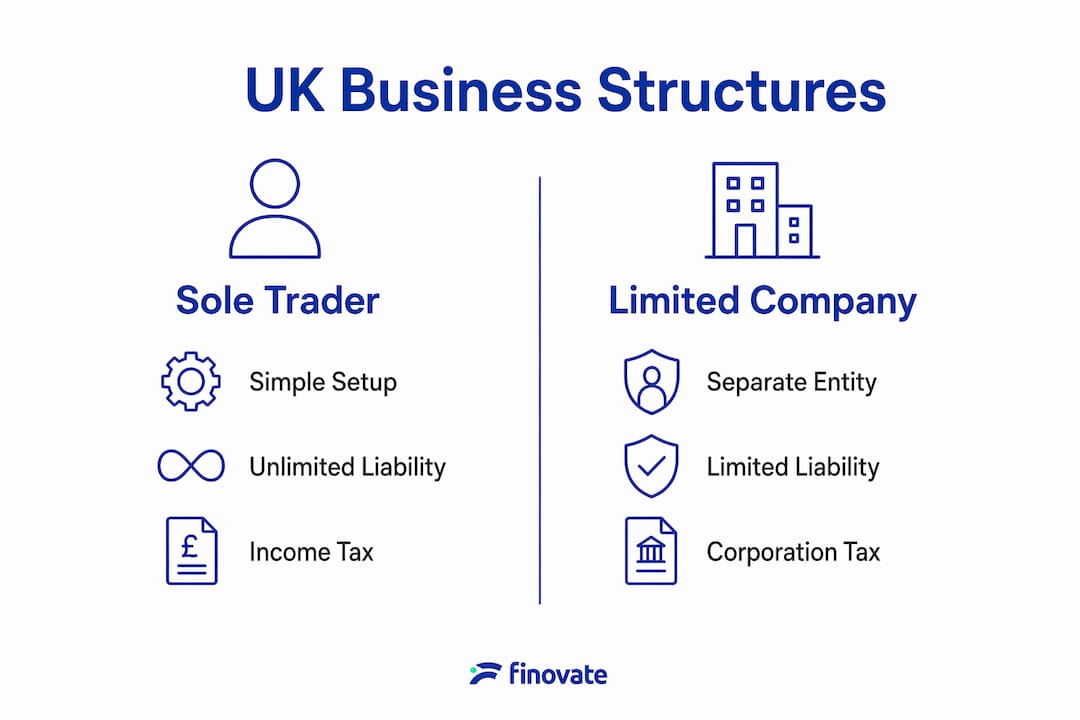
Sole trader: what it means, how tax works and how to register
A sole trader is the simplest UK business structure. You and the business are the same legal person, which means there is no separation between your personal finances and your business finances.

Tax and National Insurance
You pay Income Tax on your taxable profits at the standard rates (20%, 40% or 45% depending on your income band) plus Class 2 and Class 4 National Insurance. You report everything through a Self Assessment tax return, which covers your self-employment income, any other income and your NI liability. HMRC issues you a Unique Taxpayer Reference (UTR) when you register.
Liability
There is no legal shield between you and the business. If the business cannot pay a debt, creditors can pursue your personal assets, including your home and savings. This is the single biggest practical risk of trading as a sole trader, and it is worth taking seriously before you take on large contracts or significant credit.
Pros and cons
- Minimal paperwork and no Companies House filings
- Full control over decisions and profit
- Simple, low-cost setup with no incorporation fee
- Unlimited personal liability
- Limited appeal to investors (you cannot issue shares)
- Can appear less credible to larger corporate clients
How to register as a sole trader
- Register for Self Assessment on the HMRC website — do this by 5 October in the second tax year of trading.
- Keep records of all income and expenses from day one.
- Open a dedicated business bank account (not legally required, but strongly recommended to keep records clean).
- Register for VAT with HMRC if your taxable turnover exceeds £90,000 in any 12-month period.
- Submit your Self Assessment return by 31 January following the end of each tax year and pay any tax owed.
Pro Tip: Even if your turnover is well below the VAT threshold, registering voluntarily for VAT can make you appear more established to business clients and lets you reclaim VAT on purchases. Weigh the admin cost against the commercial benefit.
Sole trader status suits tradespeople, freelancers and consultants who are starting out, keeping turnover modest or simply want to test a business idea before committing to the cost and administration of a company.
Partnerships: shared ownership, tax and what your agreement must cover
An ordinary partnership is the default structure when two or more people go into business together without incorporating. Each partner is typically self-employed for tax purposes, and the business itself has no separate legal identity.
Tax mechanics
The partnership files a Partnership Tax Return with HMRC each year, which reports the total profits and how they are divided. Each partner then reports their individual share on their own Self Assessment return and pays Income Tax and National Insurance accordingly. There is no Corporation Tax.
Liability
Partners in an ordinary partnership carry joint and several liability. That means each partner can be held personally responsible for the full debts of the business, not just their own share. If one partner runs up a debt, all partners are exposed. This is a material risk that a formal partnership agreement and professional indemnity insurance can help manage, but cannot eliminate.
What a partnership agreement should cover
- How profits (and losses) are split between partners
- Who has authority to make decisions and at what threshold
- What happens when a partner wants to leave or retire
- How a new partner can join and on what terms
- Dispute resolution process
- What happens if a partner dies or becomes incapacitated
Registration and recordkeeping steps
- Register the partnership for Self Assessment with HMRC (the nominated partner does this).
- Each partner registers individually for Self Assessment.
- Keep separate partnership accounts and records of each partner's drawings.
- Register for VAT if combined taxable turnover exceeds £90,000.
- Draft and sign a formal partnership agreement before trading begins.
A partnership agreement is not legally required, but trading without one is a significant risk. Without it, the Partnership Act 1890 applies by default, which may not reflect what you and your partners actually intend.
Limited liability partnership (LLP): how it differs and who uses it
An LLP sits between a partnership and a limited company. It is a separate legal entity registered at Companies House, which means it can own assets, enter contracts and be sued in its own name. Members' personal liability is limited to the amount they have invested in the LLP, unlike in an ordinary partnership.

Tax treatment
Despite the corporate registration, an LLP is transparent for tax. Each member pays Income Tax and National Insurance on their share of the profits, exactly as in an ordinary partnership. There is no Corporation Tax at the LLP level. This combination of limited liability with partnership tax treatment is why professional services firms — solicitors, accountants, architects and surveyors — commonly choose the LLP structure.
Filing and governance
An LLP must have at least two designated members at all times. Designated members carry additional legal responsibilities: they must keep accounting records, prepare and file annual accounts with Companies House, send a Confirmation Statement, and register the LLP for Self Assessment with HMRC. Every member, designated or not, must register individually for Self Assessment.
Pros and cons
- Members' personal liability is limited to their investment
- Partnership tax transparency (no Corporation Tax)
- Suits multi-partner professional practices
- More administration than an ordinary partnership
- Accounts are publicly available at Companies House
- Requires at least two members at all times
How to register an LLP
- Choose a name and check availability at Companies House.
- Confirm a registered office address (this will be publicly visible).
- Appoint at least two designated members.
- Draft an LLP agreement covering profit sharing, decision rights and member exit.
- Register the LLP at Companies House — the online fee is £40.
- Register the LLP and each member individually for Self Assessment with HMRC.
- Register for VAT if taxable turnover is expected to exceed £90,000.
Private limited company (Ltd): incorporation, tax and directors' duties
A private limited company is a separate legal entity. It can own property, enter contracts and incur debts in its own name. Shareholders and directors are distinct roles, though in small companies one person often fills both.
Legal mechanics and liability
Shareholders' liability is capped at the nominal value of their shares. If the company fails, shareholders lose their investment but their personal assets are generally protected. The important caveat: banks, landlords and major suppliers routinely ask directors to provide personal guarantees, which can remove that protection for specific debts.
Tax mechanics
The company pays Corporation Tax on its profits. The rate is set to vary with profits, starting at a lower rate for smaller profits and increasing for higher profits, with marginal relief in between. Directors who are also shareholders typically draw a modest salary (to preserve their National Insurance record) and extract further profits as dividends, which are taxed at lower rates than employment income. This salary-plus-dividends approach is the primary tax efficiency argument for incorporation, though IR35 rules can negate it for contractors whose engagements are treated as disguised employment.
Directors' responsibilities
Directors have legal duties under the Companies Act 2006. In practice, the recurring obligations are:
- File a Confirmation Statement at Companies House at least once a year
- Prepare and file annual accounts with Companies House
- Submit a Corporation Tax return (CT600) to HMRC within 12 months of the accounting year end
- Pay Corporation Tax within nine months and one day of the year end
- Register for PAYE and file Real Time Information (RTI) submissions if the company employs staff
Step-by-step incorporation checklist
- Choose a company name and check it is available at Companies House.
- Confirm a registered office address in the UK.
- Appoint at least one director (and identify any People with Significant Control).
- Issue at least one share to at least one shareholder.
- Prepare a Memorandum and Articles of Association.
- Register the company at Companies House — the online fee is £50.
- Register for Corporation Tax with HMRC within three months of starting to trade.
- Register for PAYE if you intend to pay yourself or any employee a salary.
- Register for VAT if taxable turnover exceeds £90,000.
Pro Tip: Keep a clear record of all transactions between you and the company from day one. Mixing personal and company money creates director's loan account complications that can become expensive to unwind, particularly if the company is later wound up.
How to choose the right structure: a practical decision checklist
Work through these questions in order. Your answers will point you to the right structure without needing to read every section again.
- Are you trading alone or with others? If alone, sole trader or Ltd. If with others, partnership, LLP or Ltd.
- How significant is your personal liability risk? High-risk trades (construction, professional advice, significant contracts) warrant limited liability from the outset.
- What is your expected annual profit? Below £30,000: sole trader is usually simpler. Above £50,000: the tax case for a Ltd strengthens; between £30,000 and £50,000: consider incorporation, as this is commonly cited as the range where incorporation pays off.
- Do you intend to retain profits inside the business? A Ltd lets you leave profits in the company and pay Corporation Tax rather than Income Tax, deferring personal tax.
- Will you seek external investment or business loans? Investors typically require a Ltd structure; lenders often prefer it too.
- Are you a contractor? Assess your IR35 position before assuming a Ltd will save tax. If your engagements are likely inside IR35, the advantage largely disappears.
- How much administration can you manage? A Ltd carries significantly more filing obligations than a sole trader. Budget for accountancy fees.
- Do you need to protect a business name? Registering a Ltd or LLP at Companies House protects your name nationally; a sole trader name has no equivalent statutory protection.
| Your answer | Points towards |
|---|---|
| Solo, low turnover, low risk | Sole trader |
| Two or more people, simple shared business | Ordinary partnership |
| Professional practice, multiple partners, limited liability needed | LLP |
| Profits above £30,000–£50,000, liability concerns, or seeking investment | Private limited company (Ltd) |
| Contractor with likely inside-IR35 engagements | Sole trader or review with an adviser |
When to consult a professional: if your profit is approaching the £30,000–£50,000 band, if you are taking on your first employee, or if you are entering a contract that creates significant liability, book a meeting with an accountant or solicitor. Bring your last 12 months of income and expense records, any existing contracts, and a note of how much profit you expect to retain.
When and how to change structure: timing, steps and tax consequences
Changing structure is common and entirely manageable with the right preparation. The most frequent transition is sole trader to private limited company, and the steps below reflect that path.
Typical timeline and sequence
- Incorporate the new limited company at Companies House (allow one to two working days for online registration).
- Open a company bank account before transferring any business activity.
- Notify clients and suppliers of the new contracting entity and update contracts where necessary.
- Transfer business assets to the company — document the transfer price carefully, as this may create a taxable event.
- Cease self-employment trading and notify HMRC that your sole trader business has ended, including the cessation date.
- File a final Self Assessment return covering the period up to cessation, including any cessation profits.
- Register the company for Corporation Tax with HMRC within three months of starting to trade.
- Set up PAYE if you will pay yourself a salary through the company.
Tax consequences to watch
- Cessation profits: any work in progress or accrued income at the point you stop trading as a sole trader is taxable in that final year.
- Asset transfers: transferring assets (equipment, intellectual property, goodwill) to the company at below market value can trigger Capital Gains Tax or Income Tax charges.
- Director's loan account: if you transfer personal funds into the company or the company pays personal expenses, these must be recorded as a director's loan. Overdrawn loan accounts attract a Corporation Tax charge (Section 455 tax) if not repaid within nine months of the accounting year end.
Pro Tip: Many advisers recommend incorporating at the start of a new tax year (6 April) to keep the sole trader cessation accounts clean and avoid splitting income across two structures in the same tax year. It also simplifies your final Self Assessment return.
Common pitfalls to avoid
- Continuing to use your personal bank account for company transactions after incorporation
- Failing to update client contracts to reflect the new legal entity
- Missing the three-month window to register for Corporation Tax with HMRC
- Overlooking the need to re-register for VAT under the new company (your sole trader VAT registration does not transfer automatically)
Key takeaways
The right UK business structure depends on your profit level, liability exposure and appetite for administration — and it can always be changed as your business grows.
| Point | Details |
|---|---|
| Start simple, review regularly | Sole trader is the lowest-cost starting point; review when profits approach a moderate level or liability risk rises. |
| Limited liability has limits | Personal guarantees to lenders and landlords can expose personal assets even inside a Ltd or LLP. |
| Tax differs materially by structure | Sole traders pay Income Tax and NI; limited companies pay Corporation Tax, with owners taxed separately on salary and dividends. |
| Administration increases with complexity | A Ltd carries annual accounts, Confirmation Statement and CT600 obligations; budget for accountancy support from the outset. |
| Seek professional advice before switching | Changing structure mid-year creates cessation profits, asset transfer issues and registration timing risks that an accountant can help you manage. |
The structure decision most founders get wrong
Most of the founders we speak to at Finovate make the same two mistakes. The first is incorporating too early, drawn by the idea of limited liability before the business has meaningful liability to protect against. The second is waiting too long, continuing as a sole trader well past the point where the tax and liability case for a company is clear.
The liability argument is the one that deserves more weight than it typically gets. Unlimited personal liability as a sole trader is not an abstract risk. If you take on a significant contract, employ someone, or hold client money, the exposure is real and immediate. A Ltd or LLP does not eliminate that risk entirely, but it creates a meaningful legal separation that is worth having before something goes wrong rather than after.
On tax, the salary-plus-dividends model inside a Ltd is genuinely efficient at the right profit level, but it requires discipline. The moment you start treating the company account as a personal account, you create director's loan complications that cost more to fix than the tax you saved. Keep the accounts clean from day one.
The timing of a switch also matters more than most guides acknowledge. Moving at the start of a tax year (6 April) keeps your cessation accounts straightforward and avoids the administrative complexity of two structures running in the same tax year. If you are approaching the point where incorporation makes sense, plan the transition rather than reacting to it.
Finally, a partnership agreement is not optional paperwork. We have seen partnerships dissolve acrimoniously because the profit split, exit terms and decision rights were never written down. The Partnership Act 1890 default rules are unlikely to reflect what you and your partners actually agreed. Spend the money on a solicitor at the start.
Authoritative sources and further reading
These official resources are the right starting point for each registration and compliance task.
- HMRC Self Assessment registration — use this when you are setting up as a sole trader or partner and need to register for a UTR and file tax returns.
- Corporation Tax rates and allowances (GOV.UK) — the primary source for current Corporation Tax rates; check here before making any incorporation decision based on tax rates.
- Set up a private limited company (GOV.UK) — the step-by-step Companies House incorporation process, including articles of association, director appointments and share structure.
- Set up and run an LLP (GOV.UK) — covers designated member responsibilities, LLP agreements and annual filing obligations.
- Companies House blog: choosing the right structure — a plain-English overview of the four main structures and their legal requirements, useful for a quick reference before you register.
- Director information hub: personal guarantees (GOV.UK) — read this before signing any personal guarantee as a director; it explains exactly what you are agreeing to and the consequences.
Where this guide recommends professional advice, we mean it. The registration steps above are straightforward; the tax planning, asset transfer and liability decisions that surround them are not. If you are unsure which structure fits your situation, or you are planning a transition, Finovate's accounting and advisory services can help you work through the numbers and the paperwork without the guesswork.