

For a Finnish online store, verkkokaupan kirjanpito must reconcile platform payouts, VAT, inventory and bank deposits every single month. The single best next step is to link your payout reports to an accounting clearing account and reconcile it monthly, rather than waiting until year end. Get that habit right, and Finovate can help build the rest around it.
TL;DR:
- Linking payout reports to a clearing account and reconciling monthly prevents revenue and VAT reporting errors caused by lumped sales figures.
- Automating transaction imports via store and accounting software connectors reduces manual work, but human review remains essential to catch misclassifications early.
- Finnish VAT obligations depend on turnover, sales location, and cross-border activities, requiring careful monitoring of registration thresholds and reporting schemes.
- Accurate inventory tracking, including stock across multiple locations and returns, is vital for reliable cost of goods sold calculation and margin analysis.
- Regular monthly closing of financial statements and setting ownership ensures early detection of issues, while outsourcing is advisable when transaction volume or cross-border VAT complexity rises.
Table of Contents
- What must ecommerce bookkeeping record, and why does it matter?
- Which integrations actually cut your bookkeeping workload?
- What are Finland's VAT rules for online sellers?
- How should you account for inventory and cost of goods sold?
- What belongs on your monthly close checklist?
- When should you outsource your ecommerce bookkeeping?
- How do you account for shipping costs and logistics expenses?
- How should discounts, coupons and promotional sales be booked?
- Why bookkeeping is a growth lever, not just a compliance chore
- How Finovate supports your online store's finances
- Sources
What must ecommerce bookkeeping record, and why does it matter?
A Shopify or WooCommerce payout is never one clean number. It's a bundle of sales, refunds, fees and tax collected, all netted together before the money lands in your bank account. Recording that lump sum as “sales” is the single most common mistake we see among Finnish online sellers, and it quietly distorts both your margin and your VAT return.
The fix is a clearing account: a temporary holding account that captures the raw payout, then splits it into its real components before anything hits your profit and loss. This decomposition approach is what most ecommerce bookkeeping guidance recommends as the source of truth for accurate revenue and liability recording.
Each month, someone in your business needs to own these tasks:
- Booking gross sales separately from the net payout received
- Recording refunds and chargebacks against the original sale, not as a blanket expense
- Separating merchant fees, shipping income and discounts from gross revenue
- Matching every bank deposit back to its corresponding settlement report
If you're a sole trader handling this alone, block out the same day each month. If you have staff, assign the reconciliation to one named person. Shared ownership with no deadline is how errors survive for six months undetected.
Which integrations actually cut your bookkeeping workload?
Manual data entry is where most ecommerce owners lose their evenings. Shopify's own guidance points sellers towards connecting their store to accounting software rather than exporting spreadsheets by hand, and for good reason: connector apps post transactions and update inventory automatically, cutting hours off your monthly close.
Set it up in this order:
- Connect your store platform (Shopify, WooCommerce) to your accounting software first, before adding payment connectors.
- Add a payout decomposition tool or clearing account workflow so settlements split correctly into sales, fees and refunds.
- Set a weekly review cadence to catch miscategorised transactions before they compound.
- Pull your payout report, settlement report and merchant statement every month end, and reconcile all three against each other.
Connector apps can reach strong first-import accuracy, but they still need a human eye. Treat automation as an assistant, not a replacement for judgement.
Pro Tip: Reconcile transactions promptly to catch miscoded refunds early, as addressing errors soon after they occur saves time compared to waiting longer periods.
What are Finland's VAT rules for online sellers?
VAT registration becomes mandatory once your turnover exceeds your country's threshold, with different rules applying depending on whether sales are domestic, inside the EU, or involve imports from outside the bloc. Marketplace sales, intra-EU distance sales and imports each carry separate treatment, and platform default settings rarely get this right without local checking.
Finnish sellers routinely rely on platform tax settings alone, then discover at filing time that intra-EU distance sales needed separate reporting under the One Stop Shop scheme.
Watch for these points specifically:
- Confirm your VAT filing frequency (monthly, quarterly or annual) matches your actual turnover band
- Treat marketplace-facilitated sales differently from direct store sales, since liability can shift to the platform
- Keep invoices, settlement reports and customs documentation for cross-border shipments
- Get local tax advice before assuming a platform's built-in VAT logic covers your situation
Local, Finland-focused guidance is consistent on one point: don't treat generic platform settings as a substitute for checking your own filing obligations.
How should you account for inventory and cost of goods sold?
Your profit figure is only as reliable as your inventory records. Without tracking opening stock, purchases, returns and closing stock properly, your cost of goods sold (COGS) becomes a guess dressed up as an accounting entry.
Many SMEs use standard costing methods like FIFO (first in, first out) or weighted average costing, as both are relatively straightforward for modest product ranges. Whichever method you choose, apply it consistently. Switching methods between periods makes your margin trend meaningless.
Three things distort inventory figures if left unmanaged:
- Stock held across multiple fulfilment locations without a consolidated count
- Fulfilment and warehousing fees booked as general expenses instead of linked to COGS
- Marketplace returns sitting in limbo, neither restocked nor written off
Run a monthly stock reconciliation alongside your bank reconciliation. A Finland-focused ecommerce guide stresses that accurate inventory records become essential once a store moves past its first year and volumes start climbing.
What belongs on your monthly close checklist?
A repeatable monthly close protects you from cash-flow surprises and VAT liabilities that show up too late to fix cheaply. The minimum reporting pack worth producing every month includes:
- Trial balance, checked for anything posted to the wrong account
- Profit and loss statement, reviewed against the prior month
- Balance sheet, confirming assets and liabilities are accurately stated
- Cash-flow summary, showing what actually moved versus what was invoiced
Alongside the statements, reconcile your bank account, clearing accounts, merchant payouts and inventory count. Then check three numbers that actually drive decisions: gross margin, refund rate, and advertising spend against returns generated.
Set a fixed deadline, such as the tenth working day of the following month, and assign ownership to one person. Regular bookkeeping done on a schedule, rather than in a scramble before tax deadlines, is what separates businesses that catch problems early from those that discover them at year end.
When should you outsource your ecommerce bookkeeping?
Three signals usually mean it's time to bring in outside help: transaction volume that's outpacing your available hours, selling across multiple channels with different payout structures, or VAT exposure that now spans borders.
When evaluating a bookkeeping partner, look for:
- Genuine ecommerce experience, not just general SME bookkeeping
- Support for the connectors your platform already uses
- Monthly management reporting, not just annual compliance filing
- Transparent, upfront pricing with no vague scope
Ask prospective firms how they handle payout decomposition and cross-border VAT specifically. A firm that can't answer clearly is a red flag. Finovate builds its accounting services around Finnish small businesses, with ecommerce clients specifically in mind.
Pro Tip: Ask any prospective bookkeeper for a sample monthly report before signing. If they can't show you one, they probably don't produce one regularly.
How do you account for shipping costs and logistics expenses?
Shipping money moves in two directions, and mixing them up quietly wrecks your margin reporting. What you charge customers for delivery is shipping income; what you pay carriers, warehouses and fulfilment partners is a logistics expense. Both need their own line, never netted against each other before they reach your P&L.
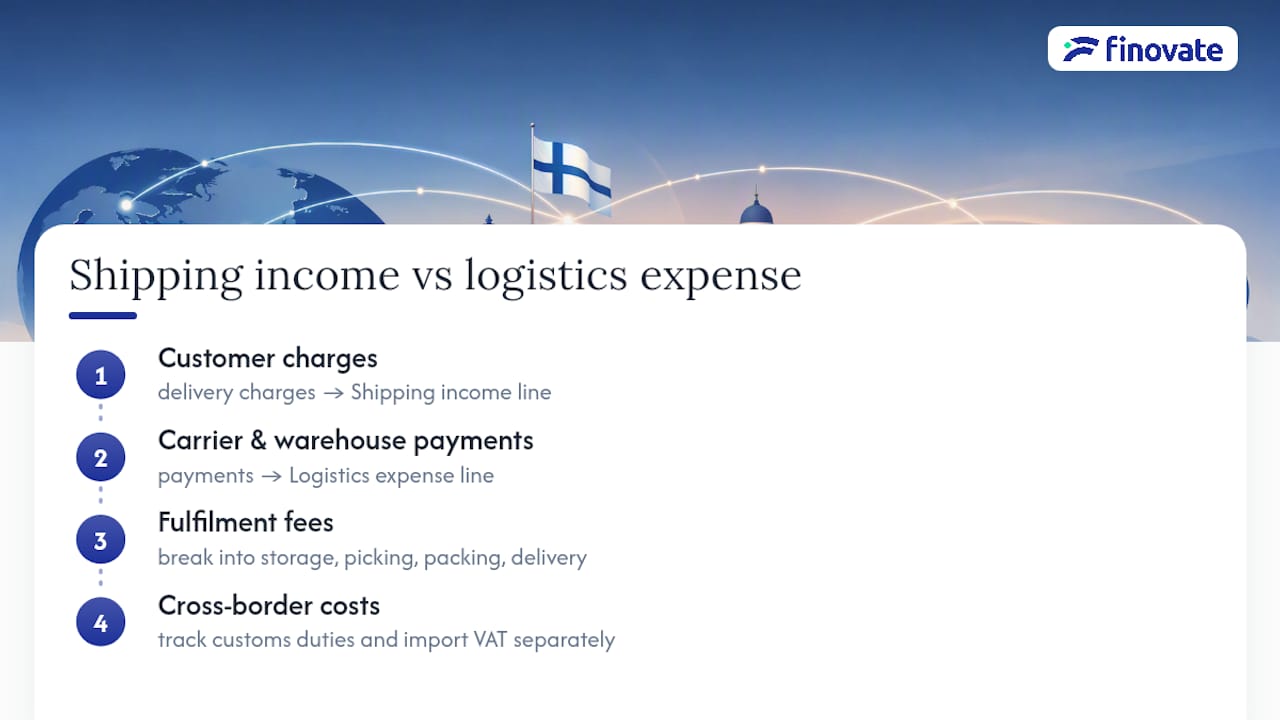
Free shipping offers are the trap most sellers fall into. If you absorb delivery costs to win a sale, that cost still needs booking as an expense, not as a silent reduction to revenue. Otherwise your gross margin looks healthier than it actually is, and you'll misprice future promotions based on a number that was never real.
Fulfilment fees deserve particular care if you use a third-party warehouse or a marketplace's own logistics service. These fees often bundle picking, packing, storage and delivery into one settlement line. Break them apart where you can, because storage costs behave differently to per-order delivery costs. Storage scales with how much stock you hold; delivery scales with how many orders you ship. Treating them as one blended expense makes it far harder to spot when storage costs are creeping up because of slow-moving stock.
Cross-border shipments add customs duties and import VAT into the mix, and these need separate tracking from the shipping cost itself. A multichannel bookkeeping guide covering profit reporting beyond basic platform metrics is a useful reference for sellers who fulfil orders across more than one channel or country, since the reporting gaps in standard dashboards tend to hide exactly these costs.
How should discounts, coupons and promotional sales be booked?
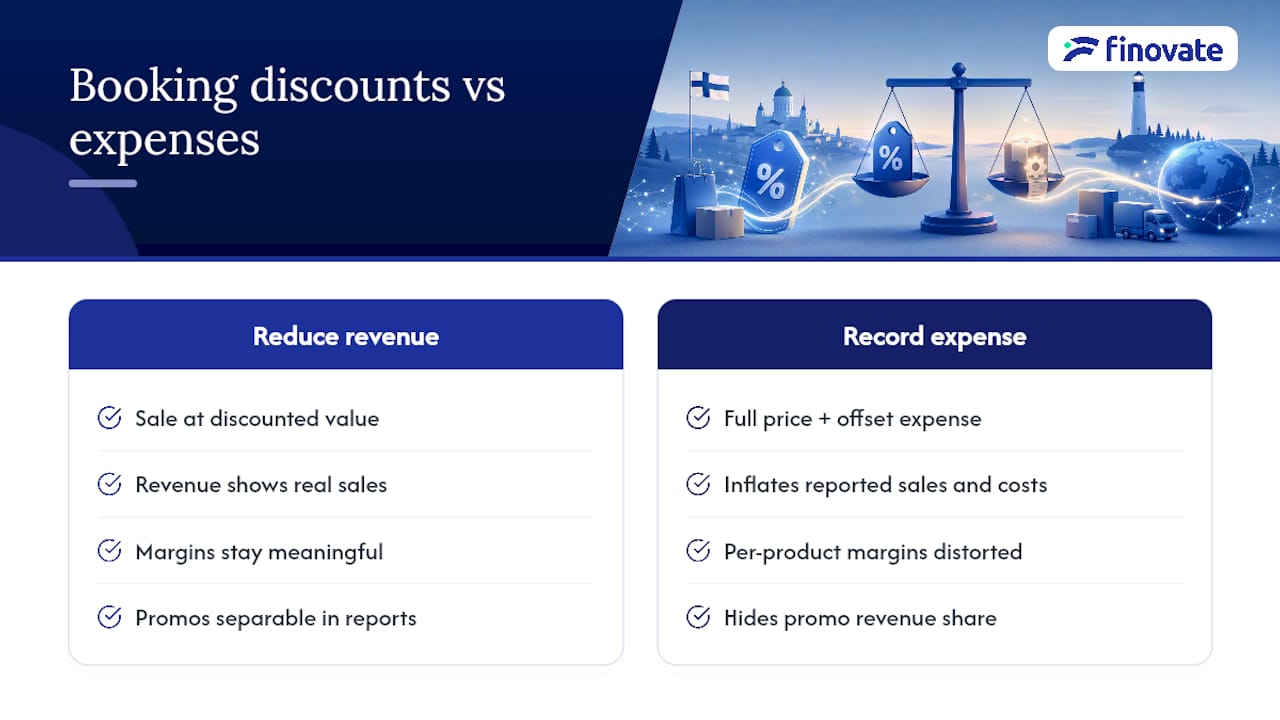
A discount is not an expense; it's a reduction to revenue. That distinction changes how your accounts read, and getting it wrong inflates both your reported sales and your apparent marketing costs.
When a customer applies a 20% coupon code, record the sale at its discounted value, not at full price with a matching expense line. Booking the full price and then an offsetting "discount expense" is a common workaround, but it overstates both revenue and costs on your P&L even though profit nets out the same. Tax authorities and lenders reading your accounts want to see real sales figures, not gross figures propped up by cosmetic entries.
Buy-one-get-one and bundle promotions need slightly different handling. Split the bundled price across the items involved based on their normal selling price, so your per-product margin data stays meaningful. If you sell three products and give one away free as part of a promotion, allocate revenue across all three at a proportional discount rather than showing two full-price sales and one zero-value line.
Track promotional sales separately from full-price sales in your reporting, even if they land in the same revenue account. Knowing what percentage of monthly revenue came from discounted transactions tells you whether a promotion actually grew sales or just shifted the timing of purchases customers would have made anyway. Successful ecommerce sellers use this kind of detail to time future marketing spend and restocking decisions, not only to file an accurate tax return.
Why bookkeeping is a growth lever, not just a compliance chore
Most sellers treat bookkeeping as the thing you tidy up before a VAT deadline. That's backwards. The businesses that scale fastest use their monthly numbers to decide when to increase ad spend, when to renegotiate a fulfilment contract, and which product lines are quietly losing money behind a healthy top-line figure.
Finovate works with Finnish ecommerce clients precisely because the platforms, payout structures and VAT rules keep shifting, and a firm that tracks those changes closely is worth more than a spreadsheet template. Treat your books as a live dashboard, not a year-end formality.
— Busayo
How Finovate supports your online store's finances
Running an online store means juggling payouts, VAT deadlines and inventory records alongside actually selling products. That's exactly where a dedicated accounting partner earns its place. Finovate provides monthly bookkeeping, VAT filing, payroll and integration support built around Finnish SMEs, including sellers on Shopify and WooCommerce who need their payout reports reconciled properly rather than dumped into a spreadsheet once a quarter.

If invoicing and cash collection are eating your time, Finovate's monthly invoicing service handles billing so you can focus on stock and marketing decisions. Higher-volume sellers may fit better with the Pro invoicing tier, while smaller operations often start with the Light tier. Pricing is transparent and scaled to your transaction volume rather than a flat retainer regardless of size.
Book a discovery call through Finovate's service catalogue to see which package matches your store's current stage.
Sources
- Ecommerce Bookkeeping: The Complete Guide | Growthy
- Verkkokaupan kirjanpito pienyrityksille: Vaiheittainen opas (2026)
- Kirjanpidon ja verotuksen perusteet verkkokauppiaille | Ecommerce Fastlane
This article is general information, not a substitute for advice from a qualified financial advisor. Consult a qualified financial professional about your own circumstances before acting on anything here.