
TL;DR:
- Regular bank reconciliation is essential for Finnish SMEs to ensure accurate financial records and compliance.
- Using automated software like Xero, Procountor, or Visma Netvisor simplifies reconciliation and reduces errors.
- Outsourcing reconciliation tasks can save time, lower errors, and improve financial oversight for small businesses.
Bank reconciliation has a reputation for being a tedious, time-consuming chore that pulls Finnish SME owners away from running their businesses. That reputation is largely undeserved. When approached correctly, reconciliation is one of the most powerful tools you have for protecting your finances, catching errors early, and staying compliant with Finnish accounting requirements. This article walks you through exactly what bank reconciliation involves, how to do it efficiently, which tools work best for Finnish SMEs, and whether outsourcing might save you significant time and money.
Table of Contents
- What is bank reconciliation and why does it matter?
- Step-by-step process for bank reconciliations
- Tools and software for efficient reconciliations
- Should you outsource bank reconciliations?
- The truth: Most SMEs waste time reconciling
- Get support for seamless reconciliations
- Frequently asked questions
Key Takeaways
| Point | Details |
|---|---|
| Reconciliations prevent errors | Matching bank statements to records reduces fraud and costly mistakes. |
| Monthly checks are essential | Regular reconciliations keep your business finances compliant and up to date. |
| Tech and outsourcing help | Automation software and outsourcing can save time and money for Finnish SMEs. |
| Choose the right approach | Select in-house, digital tools, or outsourcing based on your business needs. |
What is bank reconciliation and why does it matter?
Bank reconciliation is the process of comparing your internal financial records against your bank statement to confirm they match. Every transaction that appears in your accounting software or ledger should correspond to a transaction on your bank statement. If there are differences, you investigate and resolve them before closing your books.
For Finnish SMEs, this process is not optional. Finnish accounting legislation requires businesses to maintain accurate, up-to-date financial records. Reconciliation is the mechanism that keeps those records honest. Without it, errors accumulate silently, and by the time they surface, they can be costly to fix.
Here is what can go wrong when reconciliations are skipped or delayed:
- Undetected duplicate payments to suppliers, draining cash without anyone noticing
- Missed incoming payments that distort your receivables and give a false picture of cash flow
- Fraudulent transactions that go unnoticed because no one is comparing records regularly
- VAT reporting errors that trigger penalties from the Finnish Tax Administration (Verohallinto)
- Inaccurate profit figures that lead to poor business decisions
As bank reconciliation explained on AccountingTools confirms, undetected errors and fraud are direct consequences of failing to reconcile bank statements regularly. This is not a theoretical risk. Finnish SMEs that skip monthly reconciliations often discover discrepancies only during annual audits, at which point correcting them is far more disruptive.
"Accurate bank reconciliation is not just good practice. It is the foundation of reliable financial reporting for any business operating in Finland."
In most Finnish SMEs, the responsibility for reconciliation falls on the business owner, an in-house bookkeeper, or an external accounting firm. Whoever handles it, the process must be consistent and timely.
Step-by-step process for bank reconciliations
Understanding the importance sets the stage. Now let's detail how any SME can complete a bank reconciliation efficiently. The process is straightforward when you follow a clear sequence.
- Retrieve your bank statement. Download or print your bank statement for the period you are reconciling, typically the previous calendar month.
- Open your internal records. Access your accounting software or ledger for the same period. Ensure all transactions have been entered.
- Match transactions one by one. Go through each transaction on the bank statement and confirm it appears in your internal records with the same amount and date.
- Identify unmatched items. Flag any transaction that appears in one record but not the other. These are your discrepancies.
- Investigate discrepancies. Common causes include timing differences (a payment issued but not yet cleared), data entry errors, or bank charges not yet recorded internally.
- Make corrections. Adjust your internal records where necessary. Do not alter bank statement figures.
- Confirm the closing balance matches. Once all items are resolved, your adjusted internal balance should equal the bank statement closing balance.
- Document and save. Keep a record of the completed reconciliation, including any adjustments made and their explanations.
As reconciliation basics from Xero confirms, monthly reconciliation cycles are critical for accurate record-keeping. For most Finnish SMEs, monthly is the minimum. Businesses with high transaction volumes, such as retail or e-commerce operations, benefit from weekly reconciliations.
Common errors to watch for include transposed numbers (e.g., recording 1,540 instead of 1,450), missing bank fees, and foreign currency transactions recorded at the wrong exchange rate.
For step-by-step bookkeeping guidance that complements your reconciliation process, we recommend reviewing structured bookkeeping frameworks designed for Finnish businesses.
Pro Tip: Create a simple reconciliation checklist or template and reuse it every month. Consistency reduces the time spent on each cycle and makes it easier to spot unusual patterns.
Tools and software for efficient reconciliations
Having walked through the manual checklist, let's look at software that can take bank reconciliations from hassle to almost hands-off.
The right tool depends on your transaction volume, budget, and how much automation you want. Here is a comparison of the most relevant options for Finnish SMEs:
| Software | Finnish bank integration | Automation level | Ease of use | Approx. monthly cost |
|---|---|---|---|---|
| Xero | Yes (via bank feeds) | High | Very easy | From €30 |
| Procountor | Yes (native) | High | Moderate | From €40 |
| Visma Netvisor | Yes (native) | High | Moderate | From €30 |
| Excel | Manual import | None | Varies | Free |
Xero, Procountor, and Visma Netvisor all support direct bank feed connections with major Finnish banks, which means transactions are imported automatically. This eliminates manual data entry, the single largest source of reconciliation errors.
When evaluating which tool fits your business, consider these factors:
- Transaction volume: Higher volumes demand higher automation to stay manageable
- Integration with VAT reporting: Finnish SMEs need software that aligns with Verohallinto requirements
- Multi-user access: If you work with an external accountant, shared access is essential
- Support in Finnish or English: Practical for day-to-day use and troubleshooting
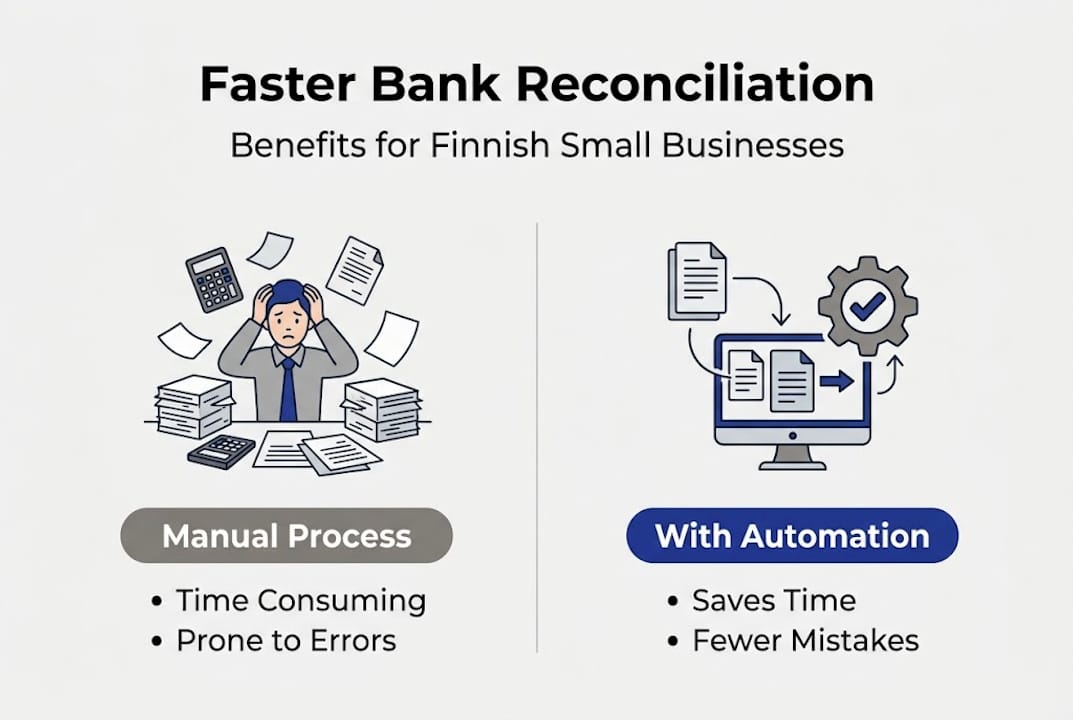
As noted in our guide on automation benefits, automating reconciliations can reduce errors and save up to 50% of bookkeeping effort. That is a significant return for a relatively modest software investment.
For guidance on selecting the right solution, our article on choosing accounting services covers what Finnish SMEs should prioritise. You can also review bookkeeping best practices to ensure your wider financial processes support accurate reconciliation.
Pro Tip: Connect your bank feed directly to your accounting software. Automated transaction imports mean your records are always current, and matching becomes a matter of reviewing rather than re-entering data.
Should you outsource bank reconciliations?
Even with great tools, not every SME wants or should do reconciliations internally. Let's honestly weigh your options.
Outsourcing reconciliations to a professional accounting firm means handing the process to someone who does this every day. The benefits are clear, but so are the trade-offs.
Benefits of outsourcing:
- Consistent, accurate reconciliations completed on schedule
- Reduced risk of errors and compliance issues
- Frees your time to focus on core business activities
- Access to professional advice when discrepancies arise
- Scalable as your transaction volume grows
Considerations when keeping it in-house:
- You retain full visibility and control
- Lower direct cost if you already have capable staff
- Requires ongoing training and time investment
Here is a practical comparison to help you decide:
| Factor | In-house | Outsourced |
|---|---|---|
| Monthly time required | 4 to 10 hours | Near zero |
| Error risk | Moderate to high | Low |
| Cost (approx.) | Staff time + software | From €80 to €200/month |
| Compliance assurance | Depends on expertise | High |
| Scalability | Limited | High |
When choosing a Finnish outsourcing partner, look for firms that are authorised by the Finnish Association of Accounting Firms (Taloushallintoliitto), have experience with businesses in your sector, and use software compatible with your existing systems.
Warning signs that you need outside help include reconciliations that are consistently completed late, recurring discrepancies you cannot explain, or VAT filings that require frequent corrections.
As our guide on outsource bookkeeping explains, outsourcing bookkeeping can save up to 50% in SME costs. For many Finnish SMEs, the maths strongly favour professional support. You can explore the full range of support options through Finovate accounting services.
The truth: Most SMEs waste time reconciling
Here is something we see consistently in our work with Finnish SMEs: the businesses spending the most time on reconciliation are rarely the ones doing it best. They are often the ones clinging to manual processes out of habit, not necessity.
Many owners believe that doing reconciliations themselves means they stay in control of their finances. In practice, spending four to eight hours a month on manual matching often means less time reviewing what the numbers actually tell you. Control comes from understanding your financial position, not from performing the data entry yourself.
We have seen Finnish SMEs cut their reconciliation time by more than half simply by connecting a bank feed and adopting a basic template. The improvement was not dramatic or expensive. It was a small change that compounded over time.
Our honest recommendation: review your current reconciliation process against what we have outlined here. If it takes more than two hours per month for a business with moderate transaction volumes, something can be improved. Start with one change, whether that is a bank feed connection or a structured checklist, and build from there. You can find practical guidance on how to optimise bookkeeping workflow in our dedicated resource for Finnish SMEs in 2026.
Get support for seamless reconciliations
If your reconciliation process still feels like a burden, you do not have to solve it alone. At Finovate, we work with Finnish SMEs every day to make bookkeeping and bank reconciliation accurate, timely, and as effortless as possible.
Whether you are a light entrepreneur looking for straightforward support through our Invoicing Service Pro, a small business that needs structured accounting for light entrepreneurs, or an SME ready to hand over your bookkeeping entirely, we have a solution that fits. Visit Finovate to speak with one of our accounting experts and find out how we can take reconciliation off your plate for good.
Frequently asked questions
How often should I perform bank reconciliations in Finland?
Monthly reconciliations are recommended for most Finnish SMEs to maintain accuracy and meet Finnish accounting compliance requirements. Businesses with high transaction volumes may benefit from weekly reviews.
What are the main causes of discrepancies in bank reconciliations?
Discrepancies often result from data entry errors, timing differences between when transactions are recorded and when they clear, missing transactions, and bank fees not yet posted in your internal records.
Can I automate the reconciliation process for my Finnish SME?
Yes. Accounting platforms such as Xero, Procountor, and Visma Netvisor offer automation tools that import bank transactions directly, and automating reconciliations significantly reduces both errors and time spent.
Is outsourcing bank reconciliations cost-effective for small businesses?
Outsourcing can be highly cost-effective. Outsourcing bookkeeping can save up to 50% of SME bookkeeping costs in Finland, particularly when you factor in the value of time freed for business-critical activities.