

TL;DR:
- Taxi and private hire vehicle operators must register for VAT once their rolling 12-month taxable turnover exceeds £90,000. They need to track full fares including deductions and choose between standard VAT or the Flat Rate Scheme, with proper digital recordkeeping under MTD. Professional support can help operators avoid penalties, optimize scheme choices, and ensure compliance with HMRC regulations.
If your taxable turnover from taxi or private hire vehicle (PHV) work exceeds £90,000 in any rolling 12-month period, you must register for VAT with HMRC. Once registered, your fares and most related charges are standard-rated at 20%. The immediate actions are straightforward:
- Check your rolling 12-month turnover now against the current VAT registration threshold.
- Start digital bookkeeping using Making Tax Digital (MTD)-compatible software before you register.
- Apply to HMRC within 30 days of the month in which your threshold is breached, or sooner if you expect to exceed it within the next 30 days.
- Not yet at the threshold? Monitor monthly and consider voluntary registration if you have significant capital purchases planned.
If you are unsure where you stand, speak to an accountant before the deadline passes.
Table of Contents
- Who needs to register for VAT as a taxi operator?
- How does VAT apply to taxi and PHV fares?
- Is the Flat Rate Scheme right for your taxi business?
- How to file VAT returns under Making Tax Digital
- What records and invoices must you keep?
- Reclaiming VAT on vehicles and capital equipment
- Common VAT mistakes taxi operators make
- Your 30/90-day compliance checklist
- Key takeaways
- Why professional VAT help pays for taxi operators
- How Finovate supports taxi operators with VAT compliance
- Useful sources and official guidance
Who needs to register for VAT as a taxi operator?
VAT registration for taxi drivers follows the same rolling 12-month rule that applies to all UK businesses, but the calculation has a catch specific to this trade.
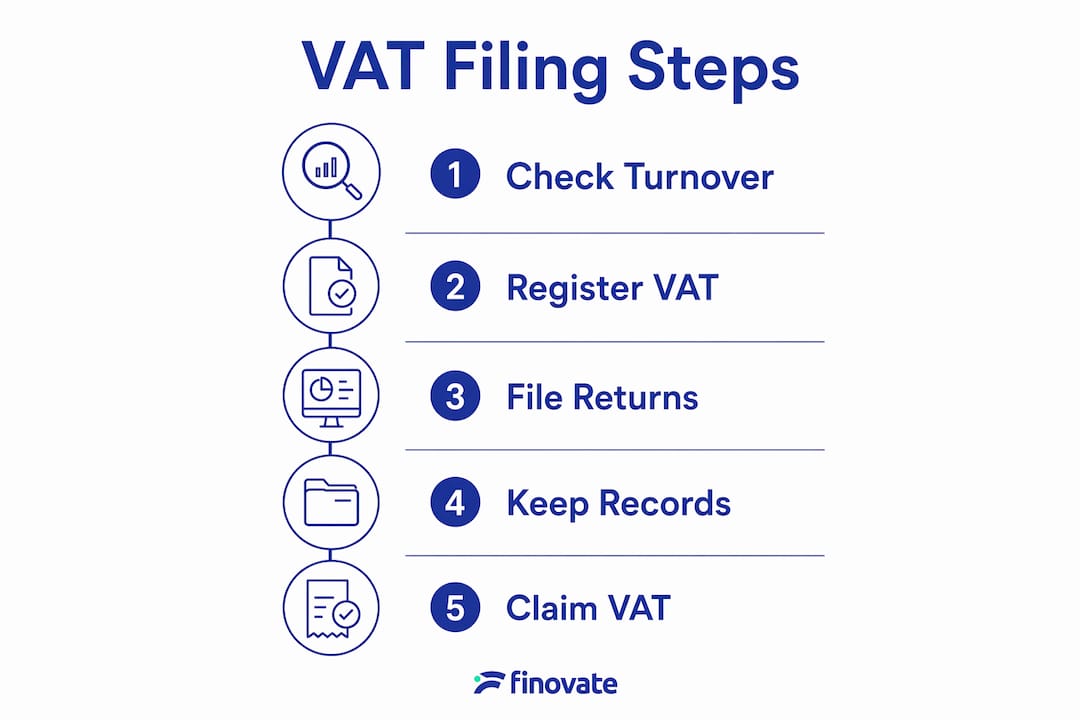
When working out your taxable turnover, you must include the full fare charged to the passenger, not just the net amount deposited in your bank account. Amounts deducted by an operator before paying you, such as vehicle rental fees, radio hire, or agency commissions, must be added back into your turnover figure. Looking at bank deposits alone routinely understates turnover and can lead to late registration.
The registration rules in order:
- At the end of any month, if your taxable supplies in the preceding 12 months have exceeded £90,000, you must notify HMRC.
- If you expect your taxable supplies to exceed £90,000 in the next 30-day period alone, you must notify HMRC immediately, before that 30-day window closes.
- Apply within 30 days of the end of the month in which the threshold was breached. HMRC typically issues registration numbers within 14 working days.
- Voluntary registration is permitted below the threshold and can be worthwhile if you want to reclaim VAT on a new vehicle or significant capital equipment.
Pro Tip: To calculate your rolling 12-month turnover, add up all taxable fares and charges for the most recent 12 calendar months at the end of each month. Include amounts deducted by your operator or platform before you are paid. Set a monthly calendar reminder to repeat this check.
How does VAT apply to taxi and PHV fares?
VAT Notice 700/25 is the primary reference for taxi and PHV VAT treatment. Fares, waiting-time charges, and booking fees shown to customers are all standard-rated supplies where the supplier is VAT-registered.
The accounting consequences depend on whether you act as principal or agent:
- Principal: You contract directly with the passenger and are responsible for accounting for VAT on the full fare, regardless of how much you pay a driver.
- Agent acting in your own name: You may account for VAT on your margin only, but the HMRC internal guidance VTAXPER77200 sets out specific conditions that must be met.
- Employee drivers: Output tax is the operator's responsibility; the driver's wages are not a VAT supply.
- Self-employed owner-drivers: Each driver who exceeds the threshold must register individually.
The 2026 policy change matters here. From 2 January 2026, PHV and taxi suppliers are excluded from the Tour Operators' Margin Scheme (TOMS). The government also decided not to create a broad agent-for-VAT concession for private hire vehicle operators (PHVOs). Standard VAT accounting at 20% is the baseline for all VAT-registered suppliers.
Pro Tip: Check your platform or operator contract carefully. If the contract says you act as agent but you actually control pricing and bear the commercial risk, HMRC may treat you as principal. Get this confirmed in writing before your first VAT return.
Is the Flat Rate Scheme right for your taxi business?
The VAT Flat Rate Scheme (FRS) sets the rate for taxi services at 10% of gross (VAT-inclusive) turnover. You pay that percentage to HMRC and keep the difference between what you charge customers (20% VAT) and what you remit (10% of gross). The trade-off is that you generally cannot reclaim input VAT, except on individual capital purchases costing more than £2,000.

| Feature | Flat Rate Scheme (10%) | Standard VAT accounting |
|---|---|---|
| Admin burden | Lower — one percentage applied to gross turnover | Higher — track all input and output VAT separately |
| Input VAT reclaim | Not permitted (except capital items over £2,000) | Full reclaim on qualifying business purchases |
| Vehicle purchase reclaim | Only if single item exceeds £2,000 | Full reclaim where vehicle used wholly for business |
| Fuel VAT reclaim | Not permitted under FRS | Permitted with fuel scale charge or mileage evidence |
| Best suited to | Low-overhead, high-turnover sole operators | Operators with significant vehicle or fuel costs |
Simple example: If your gross VAT-inclusive turnover is £120,000, you charge customers £20,000 in VAT (20% of £100,000 net). Under FRS you remit £12,000 (10% of £120,000), retaining £8,000. Under standard accounting, if you have £15,000 of reclaimable input VAT, you would remit only £5,000 — making standard accounting more favourable in that scenario.
Pro Tip: FRS suits operators with minimal fuel and vehicle costs. If you are buying a new vehicle, leasing, or claiming significant fuel costs, run the numbers under both schemes before committing. Switching schemes later is possible but requires HMRC notification.
How to file VAT returns under Making Tax Digital
All VAT-registered businesses must submit returns via MTD-compatible software. Adopting software before you register avoids a rushed conversion when the threshold is near.
Step-by-step filing process:
- Choose MTD-compatible accounting software that handles daily takings imports, split fares, multi-driver tracking, and fuel or vehicle expense categorisation.
- Keep digital records of every transaction from your registration date, including cash fares, card payments, and platform-collected receipts.
- Link your software to HMRC via the Government Gateway using your VAT registration number.
- Reconcile your records at the end of each VAT period (usually quarterly) and review the figures your software generates for Box 1 (output tax) through Box 9.
- Submit the VAT return directly from your software. HMRC will confirm receipt electronically.
- Pay HMRC by the deadline: one calendar month and seven days after the end of your VAT period.
Essential software features for taxi operators:
- Daily takings import from dispatch systems or ride-hailing platforms
- Separate tracking of cash and card receipts
- Fuel and vehicle expense categorisation
- FRS or standard VAT calculation toggle
- Direct MTD submission to HMRC
Pro Tip: After your first live submission, download and save HMRC's confirmation receipt. If a submission is ever queried, that receipt is your proof of timely filing.
What records and invoices must you keep?
Good recordkeeping is the foundation of tax compliance for taxi businesses. HMRC requires you to keep digital records under MTD, and VAT-registered customers can request a VAT invoice.
Mandatory records to maintain:
- Daily takings summary (cash and card separately)
- VAT invoices issued to business customers on request
- Supplier invoices for any purchases where you reclaim input VAT
- Mileage logs where private use apportionment is needed
- Platform or operator statements showing gross fares and deductions
VAT invoice fields required when a business customer requests one:
| Field | Requirement |
|---|---|
| Your business name and address | As registered with HMRC |
| VAT registration number | Prefixed with "GB" |
| Invoice number | Sequential |
| Invoice date | Date of supply or tax point |
| Customer name and address | The VAT-registered customer |
| Description of supply | e.g. "Taxi hire, London, 14 March 2026" |
| Net amount | Excluding VAT |
| VAT rate and amount | e.g. 20%, £X |
| Gross total | Including VAT |
Pro Tip: Export a daily takings summary from your dispatch system or app each evening. A consistent daily export habit means your MTD records are always current and reconciliation at quarter-end takes minutes rather than hours.
Reclaiming VAT on vehicles and capital equipment
Under standard VAT accounting, you can reclaim VAT on a new vehicle used wholly for business. Any private use reduces the reclaim proportionally, and you must keep mileage evidence to support the apportionment.
- Leased vehicles: You can typically reclaim 50% of the VAT on lease payments where there is any private use element, and 100% where the vehicle is used exclusively for business.
- FRS operators: You can only reclaim input VAT on a single capital purchase exceeding £2,000. Routine running costs, fuel, and servicing are not reclaimable under FRS.
- Selling a taxi: If you reclaimed input VAT on purchase, you must account for VAT on the full selling price when you sell.
- Vehicle servicing and parts: Reclaimable under standard accounting with a valid VAT invoice; not reclaimable under FRS.
| Purchase type | Standard accounting | FRS |
|---|---|---|
| New vehicle (100% business use) | Full VAT reclaim | Not permitted |
| Leased vehicle (some private use) | 50% VAT reclaim on payments | Not permitted |
| Capital item over £2,000 | Full reclaim | Reclaim permitted |
| Fuel (business use) | Reclaim with scale charge or log | Not permitted |
Gather original supplier invoices and mileage evidence before submitting any reclaim. HMRC may request these during a compliance check.
Common VAT mistakes taxi operators make
- Understating turnover by using net bank deposits rather than gross fares, missing the registration threshold until it is too late.
- Late registration after the 30-day deadline, which triggers a penalty based on the VAT that should have been paid from the effective date of registration.
- Late filing or payment, which attracts surcharges under HMRC's penalty points regime.
- Incorrect FRS use, particularly continuing on FRS when high capital expenditure makes standard accounting more cost-effective.
- Poor digital records that fail MTD requirements, leaving operators unable to substantiate reclaims or returns.
If you discover an error, a voluntary disclosure to HMRC before they contact you typically results in lower penalties. Correcting errors on the next VAT return is permitted for net errors below £10,000. Larger errors require a separate disclosure. For guidance on avoiding tax penalties, acting early is consistently the most effective approach.
Pro Tip: Voluntary registration below the current VAT registration threshold can protect against a sudden registration trigger, but it also creates quarterly MTD filing obligations. Weigh the administrative cost against the capital reclaim benefit before registering voluntarily.
Your 30/90-day compliance checklist
30-day actions:
- Calculate your rolling 12-month taxable turnover, including amounts deducted by your operator or platform.
- Sign up for MTD-compatible accounting software and begin keeping digital records immediately.
- Review your platform or operator contract to confirm whether you act as principal or agent for VAT purposes.
- If your turnover exceeds or is close to £90,000, apply for VAT registration via HMRC's online service.
- Decide provisionally whether FRS or standard VAT accounting suits your cost structure.
90-day actions:
- Reconcile three months of takings records and confirm they match platform statements.
- Complete a test submission via your MTD software and save the HMRC confirmation.
- Finalise your VAT scheme choice (FRS or standard) and notify HMRC if switching.
- Consult an accountant if your situation involves multiple drivers, mixed supplies, or significant capital purchases.
Pro Tip: Schedule a 15-minute monthly turnover check in your calendar. Catching a threshold breach early gives you the full 30-day window to register without penalty.
Key takeaways
UK taxi and PHV operators must register for VAT once taxable turnover exceeds £90,000 in any rolling 12-month period, file returns via MTD-compatible software, and account for fares at the standard 20% rate.
| Point | Details |
|---|---|
| Registration threshold | Register within 30 days once taxable turnover exceeds £90,000 in any rolling 12-month period. |
| Standard VAT rate | Fares and most additional charges are standard-rated at 20% for VAT-registered operators. |
| Flat Rate Scheme | Taxi services qualify for a 10% FRS rate; input VAT reclaim is restricted except for capital items over £2,000. |
| MTD requirement | All VAT-registered operators must file returns using MTD-compatible software; adopt it before registering. |
| Finovate support | Finovate handles VAT registration, MTD onboarding, and bookkeeping so operators can focus on driving. |
Why professional VAT help pays for taxi operators
The operators who run into trouble with HMRC are rarely those who made a deliberate error. They are usually busy sole traders who underestimated their turnover, missed the registration window, or chose the wrong VAT scheme without realising the cost. The administrative weight of MTD, quarterly filings, and scheme decisions is real, and it compounds quickly when you are also managing fares, drivers, and vehicle costs.
From a practical standpoint, the cost of getting VAT wrong, whether through late registration penalties, incorrect FRS use, or a failed reclaim, almost always exceeds the cost of professional support. Specialist accounting help for taxi and transport operators is not a luxury. For most operators, it is the more cost-effective choice once you account for the time saved and the penalties avoided.
How Finovate supports taxi operators with VAT compliance
VAT registration, MTD setup, and quarterly filing are exactly the kind of tasks that pull operators away from their core work. Finovate takes that burden off your hands with a clear, structured service: we handle VAT registration with HMRC, set up your MTD-compatible bookkeeping, manage quarterly returns, and advise on scheme selection so you are never paying more than you should.

Whether you are approaching the current VAT registration threshold for the first time or need to correct an existing filing position, we give you a straightforward path to compliance. Our monthly invoicing and bookkeeping service is designed for operators who want ongoing support without the overhead of managing it themselves. Get in touch with Finovate today and we will confirm your registration status, recommend the right VAT scheme, and get your records MTD-ready.
Useful sources and official guidance
- VAT Notice 700/25: How VAT applies to taxis and private hire cars — covers fares, agent/principal rules, motoring expenses, and invoicing requirements.
- VAT registration thresholds — GOV.UK — the VAT registration threshold rolling threshold and calculation rules.
- Register for VAT — GOV.UK — HMRC's online registration service and the 30-day deadline rules.
- VAT Flat Rate Scheme: how it works — GOV.UK — the 10% rate for taxi services and capital purchase exceptions.
- Government response: VAT treatment of private hire vehicles — GOV.UK — the 2026 TOMS exclusion and principal/agent policy position.
- VAT Notice 700/1: Who should register for VAT — GOV.UK — detailed registration rules and timing.
- VTAXPER77200: Particular trades — taxi and hire cars — HMRC internal manual — HMRC's internal guidance on output tax responsibilities for different driver and operator arrangements.
This article provides general information about UK VAT obligations and is not a substitute for professional tax advice. Tax rules can change and individual circumstances vary. Confirm your position with HMRC or a qualified tax adviser before making registration or scheme decisions.