

TL;DR:
- Specialized accountants support courier businesses with route profitability, expense tracking, and compliance with Making Tax Digital. They help improve cash flow, ensure accurate deductions, and integrate software for efficient record-keeping, giving companies a competitive edge. Relying solely on general accountants or manual records leads to missed opportunities, financial errors, and regulatory penalties.
Running a courier business means managing more than just deliveries. The role of accountants for couriers extends well beyond filing an annual tax return. From tracking cost per mile to navigating Making Tax Digital requirements landing in April 2026, your financial operations directly affect your margins and your compliance standing. Many courier entrepreneurs carry these responsibilities alone, often missing deductions, misreading cash flow, or falling behind on digital record-keeping. This guide explains what specialised accounting actually does for courier businesses and how to use it to your advantage.
Table of Contents
- Key takeaways
- The role of accountants for couriers
- Making Tax Digital: what couriers must know
- Profitability optimisation through financial management
- Common accounting mistakes couriers make
- Integrating accounting into your courier business
- My view: why specialist accounting changes everything
- How Finovate supports courier entrepreneurs
- FAQ
Key takeaways
| Point | Details |
|---|---|
| Accountants go beyond tax | Specialist accountants support cash flow forecasting, route profitability, and cost management for your operation. |
| MTD 2026 changes record-keeping | From April 2026, couriers earning above £50,000 must keep digital records and submit quarterly returns to HMRC. |
| Missed deductions cost real money | Many couriers overlook allowable expenses, losing significant amounts in unnecessary taxable income each year. |
| Software integration matters | Linking accounting tools with delivery management systems reduces manual errors and speeds up invoicing. |
| Specialist knowledge pays off | General accountants may miss industry-specific nuances that only courier-focused financial professionals will catch. |
The role of accountants for couriers
Accounting services for couriers are not a one-size-fits-all category. Your business generates high transaction volumes, operates with thin margins, and deals with daily cash flow complexity. General accountants may miss the industry-specific deductions and nuances that directly affect your bottom line. A specialist brings far more to the table.
Here is what dedicated accounting support typically covers for a courier operation:
- Bookkeeping tailored to deliveries: Categorising income by route, client, or delivery zone gives you a clear picture of where money is actually coming in and where it is leaking out.
- Expense tracking: Fuel, vehicle maintenance, insurance, and equipment purchases must all be recorded accurately to capture every allowable deduction.
- Payroll and wage modelling: If you manage a team of drivers, your accountant calculates wages, handles PAYE obligations, and models the cost impact of adding or removing staff.
- VAT registration and filing: Many courier businesses cross the VAT threshold without realising it. An accountant monitors your turnover and handles registration and returns before penalties arise.
- Tax return preparation: From self-assessment to corporation tax, your accountant prepares accurate submissions on time.
Pro Tip: Ask any prospective accountant whether they have worked with courier or logistics clients before. The terminology, the cost structures, and the allowable expense categories are different from retail or services businesses.
Software integration is another area where specialist accounting adds measurable value. Linking delivery management with accounting software reduces manual entry, increases accuracy, and accelerates invoicing and tax filings. Platforms that pull delivery data directly into your accounts cut reconciliation time significantly and reduce the risk of human error.
Making Tax Digital: what couriers must know
The 2026 deadline for Making Tax Digital for Income Tax is not a distant concern. It is a concrete operational change that will affect how you record transactions and report to HMRC every quarter.
Here is what the changes mean in practice:
- Who is affected first: MTD for Income Tax applies to self-employed sole traders and partnerships earning above £50,000 from 6 April 2026. The threshold drops to £30,000 in April 2027, pulling in more couriers and small fleet operators.
- Digital record-keeping is mandatory: You can no longer rely on paper records or basic spreadsheets. Every transaction must be recorded in MTD-compatible software throughout the tax year.
- Quarterly submissions replace annual returns: Instead of one annual self-assessment, you will submit a summary of your income and expenses to HMRC four times per year, with a final end-of-year declaration.
- Software selection matters: Not all accounting programs are MTD-compliant. Your accountant helps you identify and configure the right tool for your workflow and transaction volume.
- Bridging software is a temporary option: If you currently use spreadsheets, bridging software can link them to HMRC's system short-term, but this is not a long-term solution for an active courier business.
"Thousands of small freight operators have already adopted MTD successfully through digital bookkeeping and quarterly reporting. Software compatibility and accountant support are the two factors that make the transition smooth rather than stressful."
The practical changes go beyond software. You will need clear internal procedures for recording every delivery income and business expense at the point it occurs. Your accountant helps you build these procedures into your daily routine so that quarterly submissions become a straightforward process rather than a quarterly scramble.
For further guidance on your obligations as a Finnish entrepreneur under updated digital compliance rules, the resource on tax tips for entrepreneurs covers relevant reporting requirements worth reviewing.
Profitability optimisation through financial management
Financial management for delivery services is where accounting shifts from compliance to competitive advantage. The numbers your accountant produces are not just for the tax office. They tell you which parts of your operation are profitable and which are draining resources.
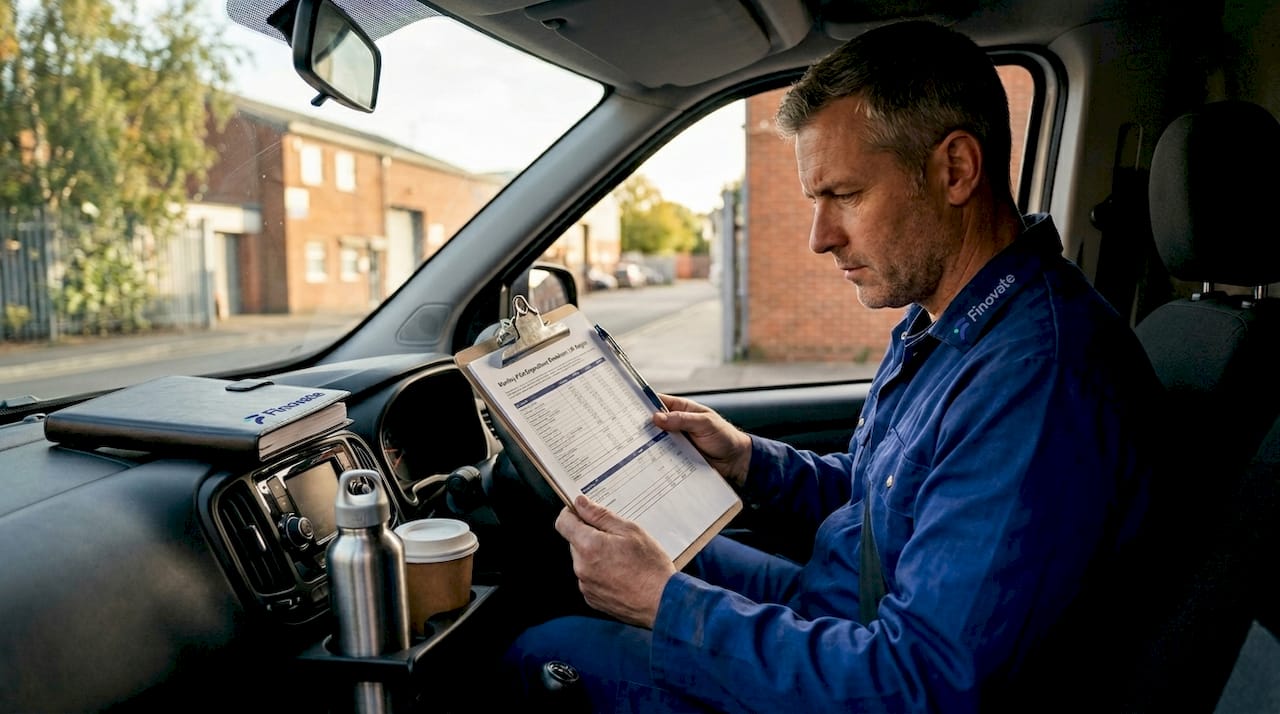
Consider cost per mile (CPM), one of the most telling metrics in courier accounting. The industry benchmark sits at £2.26 per mile for operating costs. A difference of just £0.20 per mile, multiplied across thousands of miles per month, produces a material change in your annual profit. Without accurate accounting data, you cannot calculate your CPM, which means you cannot price your services correctly or identify inefficient routes.
| Without specialist accounting | With specialist accounting |
|---|---|
| No visibility on route-level profitability | Profit and loss broken down by delivery zone or client |
| Fuel and maintenance costs lumped together | Individual expense categories tracked and benchmarked |
| Cash flow managed reactively | Forward-looking cash flow forecasts based on delivery volume trends |
| Tax surprises at year end | Quarterly income tracking removes end-of-year guesswork |
| Pricing based on market rate alone | Pricing informed by actual cost data and margin targets |
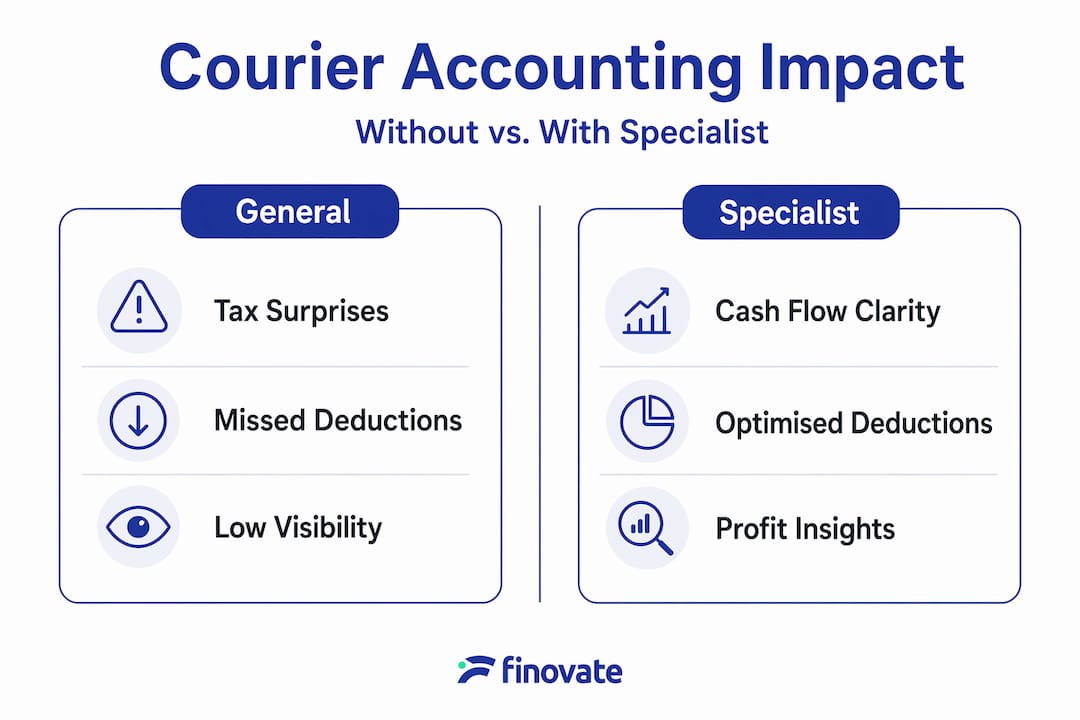
Good accounting changes decision-making and reduces tax surprises, producing steadier cash flow throughout the year. For couriers managing multi-channel income from multiple platforms or clients, this clarity is genuinely useful on a weekly basis, not just once a year.
Pro Tip: Ask your accountant to produce a monthly cost report broken down by vehicle or route. This single report often reveals one or two loss-making areas that, once corrected, meaningfully improve your overall margin.
Meal and per diem deductions are another area where specialist knowledge pays off. Owner-operators and delivery drivers who know their allowable daily meal deductions can reduce their taxable income by thousands each year. These deductions are legal, documented, and consistently missed by couriers without professional accounting guidance.
Common accounting mistakes couriers make
Many of the financial problems courier businesses encounter are avoidable. They stem from a handful of recurring errors that a professional accountant helps you sidestep.
- Relying on manual records past a certain scale: Manual bookkeeping with spreadsheets becomes a liability once your daily delivery volume grows. Reconciliation errors accumulate, and correcting them takes far longer than preventing them.
- Mixing personal and business finances: Running business expenses through a personal account makes it extremely difficult to produce clean financial records. It also raises questions during any HMRC inquiry.
- Missing allowable deductions: Vehicle depreciation, phone bills, specialist clothing, and professional subscriptions may all be deductible. Couriers without specialist support frequently leave these unclaimed.
- Late or incomplete tax submissions: HMRC penalties for late filings begin immediately after the deadline. A pattern of late submissions can also trigger further scrutiny of your accounts.
- Underestimating quarterly cash flow needs: Many courier entrepreneurs calculate profit on an annual basis and then face a cash shortfall when a tax payment or VAT bill arrives. Regular cash flow forecasting prevents this.
Consistent, accurate bookkeeping improves confidence in business decisions and reduces the stress of tax season. That is not a minor benefit. When you know your numbers are correct and your filings are on time, you make clearer decisions about pricing, hiring, and investment.
For a broader look at how accounting supports small businesses at the structural level, this resource covers the core services most relevant to growing sole traders and small operators.
Integrating accounting into your courier business
Knowing that you need accounting support is one thing. Building it into your operation effectively is another. These steps make the integration straightforward.
- Choose a specialist, not a generalist. Seek an accountant with experience in courier, transport, or logistics businesses. They understand your cost structure and know which deductions apply to your work.
- Connect your accounting software to your delivery operations. If you use a dispatch or delivery management platform, check whether it integrates with accounting tools. Automated data transfer removes duplicate entry and speeds up your monthly close.
- Establish clear bookkeeping procedures. Decide who records receipts, how often accounts are updated, and where documents are stored. Consistent habits prevent the end-of-month pile-up that leads to errors.
- Schedule monthly financial reviews. A brief monthly review of your profit and loss, cash flow, and outstanding invoices keeps you informed and allows you to act on problems before they grow.
- Plan for tax deadlines in advance. Your accountant should map out every relevant deadline at the start of the year, from quarterly MTD submissions to VAT returns and annual filings. Build these into your calendar.
The role of finance in logistics is not administrative overhead. It is information infrastructure. When your accounts are accurate and your reports are current, every operational decision you make rests on solid ground.
My view: why specialist accounting changes everything
I have observed a consistent pattern in courier businesses before and after they adopt professional accounting. Before, the finances are reactive. Owners check their bank balance to assess whether things are going well. After, they check their reports. That shift sounds simple, but its practical impact is significant.
In my experience, the businesses that grow confidently are not necessarily the ones with the best routes or the most clients. They are the ones that understand their numbers. When you know your cost per mile, your margin by client, and your projected tax liability for the next quarter, you are managing a business. When you are guessing, you are just operating.
What I have also seen is the hidden cost of using a general accountant who does not specialise in courier or logistics work. The filings may be correct, but the advice is generic. The deductions that apply specifically to your sector get missed. The pricing conversations never happen because there is no route-level profitability data to support them.
Many courier startups underestimate the operational value accountants bring beyond tax season, and the cost of that underestimation compounds quietly over years. The money is not lost in one dramatic mistake. It disappears gradually in missed deductions, mispriced routes, and avoidable penalties.
My strongest advice: treat accounting as an operating function, not a seasonal task. The couriers I have seen thrive are the ones who review their numbers monthly and act on what they find.
— Busayo
How Finovate supports courier entrepreneurs
Managing the financial side of a courier business takes time and specialist knowledge. Finovate provides accounting services designed for entrepreneurs who need accuracy, compliance, and practical financial insight without the overhead of an in-house finance team.

Whether you are a sole trader preparing for MTD obligations or a growing delivery operation needing structured bookkeeping and invoicing support, Finovate has packages built for your situation. Our monthly invoicing service handles your billing reliably, while our accounting for delivery partners covers tax compliance, digital submissions, and ongoing financial management. Get in touch with Finovate today to find the right level of support for your courier business.
FAQ
What does an accountant actually do for a courier business?
An accountant handles bookkeeping, tax returns, VAT filings, payroll, and cash flow forecasting. For couriers specifically, they also track route-level profitability and identify missed deductions on vehicle and operating costs.
When does Making Tax Digital apply to self-employed couriers?
MTD for Income Tax applies from 6 April 2026 for couriers with income above £50,000, and from April 2027 for those earning above £30,000. Quarterly digital submissions to HMRC become mandatory at these thresholds.
How do I know if I need a specialist courier accountant?
If your business involves daily deliveries, multiple income sources, vehicle costs, or a team of drivers, a specialist will identify deductions and profitability insights that a general accountant typically will not. Courier businesses need specialist accountants due to thin margins and high transaction volume.
What accounting mistakes do couriers most commonly make?
The most frequent errors are mixing personal and business finances, missing allowable deductions, filing tax returns late, and relying on manual spreadsheets beyond a manageable volume. Each of these carries a direct financial cost.
Can accounting software replace a professional accountant for couriers?
Software handles record-keeping and reporting efficiently, but it cannot advise on tax strategy, identify sector-specific deductions, or represent you in an HMRC inquiry. Most courier businesses benefit from using both software and a qualified accountant together.