

The five principal types of business funding available to UK businesses are internal/self-funding, debt finance, equity finance, grants and public funding, and alternative finance. Choosing between them depends on your business stage, growth ambition, and how much control you are prepared to share.
Here is a one-line steer for each route:
- Self-funding/bootstrapping: Best for early validation and low-burn models where you want to retain full control.
- Debt finance (loans, overdrafts, credit cards): Best when you have proven cashflows and can service repayments without straining operations.
- Equity finance (angels, VC, crowdfunding): Best for high-growth businesses that need significant capital and can accept dilution.
- Grants and public funding: Best for R&D projects, regional development, and innovation where repayment-free capital is available.
- Alternative finance (invoice finance, peer-to-peer, trade credit): Best when you need speed, flexibility, or have assets and receivables to leverage.
If you need capital this quarter, take these three steps first:
- Check Gov for grants and loan schemes you may already qualify for.
- Speak to your bank about a term loan or overdraft facility, and gather 12 months of management accounts before that conversation.
- Review your outstanding invoices — if you have unpaid receivables, invoice finance may release cash within days.
Key takeaways
The most effective approach to business funding is to match the funding type to your business stage, cashflow position, and growth ambition, starting with internal funds before moving to debt, then equity.
| Point | Details |
|---|---|
| Internal funds dominate | Around 83% of UK firms use retained earnings as their primary funding source, per Manchester School research. |
| Debt before equity | Interest on business loans is tax-deductible and preserves ownership; use equity only when debt cannot meet the need. |
| Grants are non-repayable | UK public schemes range from small innovation vouchers to awards of £150,000–£3 million (e.g. Critical Minerals Accelerator). |
| Stage determines route | Pre-seed suits bootstrapping and grants; seed suits angels; growth suits bank debt and VC; established SMEs suit bank facilities and asset finance. |
| Clean financials are the foundation | Lenders and investors assess your accounts first; accurate, up-to-date records materially improve every application. |
Table of Contents
- How the main funding routes differ from each other
- 1. Self-funding and bootstrapping: what it means and when it works
- 2. Debt finance: loans, overdrafts, credit cards and lines of credit
- 3. Invoice finance, factoring and merchant cash advances
- 4. Asset finance, leasing and hire purchase
- 5. Equity finance: angel investment, venture capital and equity crowdfunding
- 6. Grants and public/regional funding in the UK
- 7. Peer-to-peer lending, trade credit and other alternative finance
- How funding types compare: suitability, cost and control
- How to choose the right funding for your business
- Which funding route suits which business stage?
- What UK research and data say about how businesses fund themselves
- An editorial perspective on funding choices for UK small businesses
- Sources
How the main funding routes differ from each other
Every business financing option sits somewhere on two axes: how much it costs you and how much control you give up. Understanding that trade-off before you apply saves considerable time and avoids mismatched expectations.
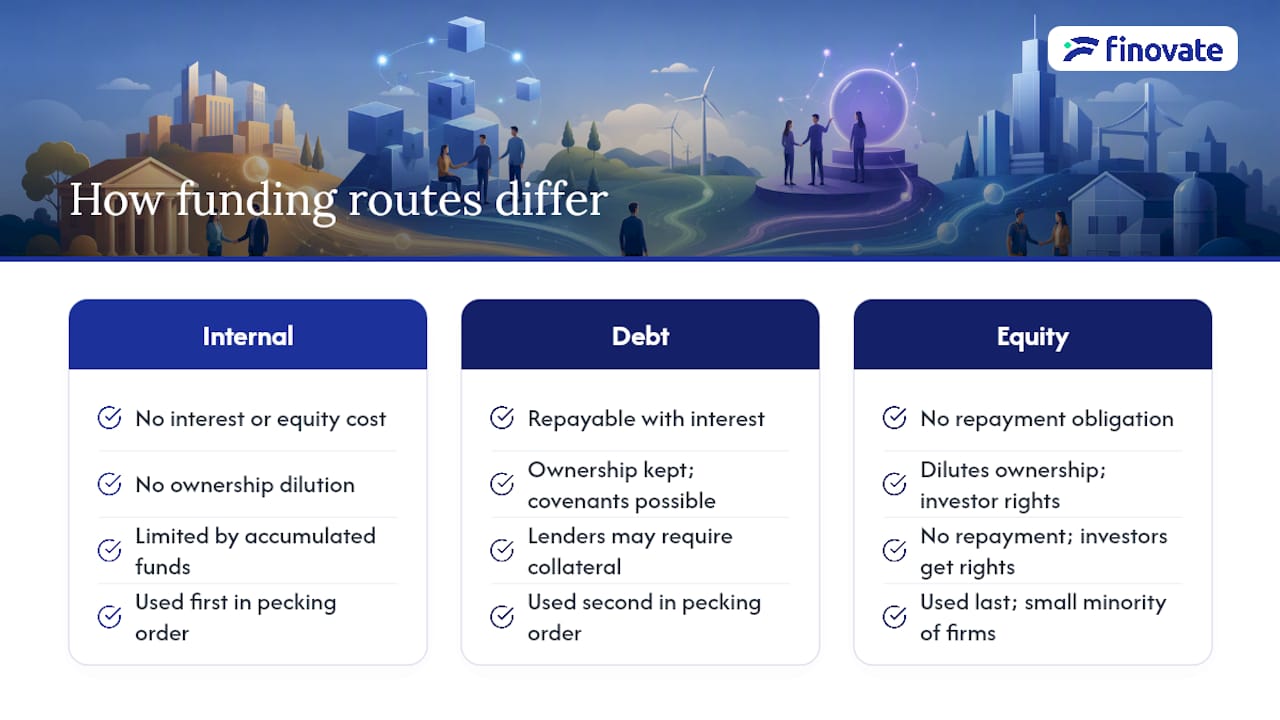
Internal finance means using retained profits, owner savings, or cash already in the business. It costs nothing in interest or equity, but it is limited by what you have accumulated.
Debt finance means borrowing money you must repay with interest. You keep ownership, but lenders often require collateral or impose covenants that restrict what you can do with the business.
Equity finance means selling a share of the business to investors. There is no repayment obligation, but you dilute your ownership and give investors rights over decisions, exits, and sometimes strategy.
Grants and public funding are non-repayable awards from government bodies, development banks, or public programmes. They are the most attractive on paper, but competition is high and conditions are strict.
Alternative finance covers everything from invoice discounting to peer-to-peer lending. These products sit between traditional debt and internal cash, often filling gaps that banks will not.
A note on tax implications: Interest on business loans is generally tax-deductible, reducing your Corporation Tax bill. Equity investment is not deductible, but investors may benefit from SEIS or EIS tax relief, which can make your raise more attractive. Grant income is usually taxable as trading income unless the grant conditions specify otherwise. Always confirm the tax position with a qualified adviser before drawing funds.
Academic research on UK business finance confirms a clear pecking order: firms use internal funds first, outside debt second, and outside equity only as a last resort. A large survey of 2,886 UK firms found that a large share of businesses rely on retained earnings as their primary source of new investment, while outside equity is used by a small minority of firms overall. That pattern shapes realistic funding pathways for most small UK businesses: start with what you have, borrow when you can demonstrate repayment capacity, and pursue equity only when the growth opportunity genuinely justifies the dilution.
1. Self-funding and bootstrapping: what it means and when it works
Self-funding covers three internal routes: retained earnings (profits left in the business), owner injections (personal savings transferred into the company), and personal assets used as security. None of these carry an interest rate or require you to give up equity.
Advantages:
- Full control over decisions, strategy, and timing.
- No interest costs or repayment schedules to manage.
- Demonstrates financial discipline to future lenders or investors.
- No dilution of ownership.
Limitations:
- Capital is finite and tied to personal financial resilience.
- Scaling quickly is difficult without external capital.
- Personal risk is real: mixing personal and business finances creates liability exposure.
Bootstrapping works best at the validation stage, when you are testing whether a product or service has genuine demand before committing larger sums. Low-burn models — consulting, professional services, digital products — are well suited to it. Capital-intensive businesses (manufacturing, logistics, hospitality) will hit the ceiling of internal finance quickly.
Pro Tip: Open a dedicated business current account from day one and pay yourself a fixed director's salary rather than drawing cash ad hoc. This keeps your business finances clean, which matters enormously when a lender or investor reviews your accounts later. Read more on why separating business finances protects you from the start.
2. Debt finance: loans, overdrafts, credit cards and lines of credit
Debt is the most widely used form of external business financing in the UK, and for good reason: you keep ownership, interest is tax-deductible, and the product range is broad enough to match most cashflow needs. Business term loans, overdrafts, leasing, and hire purchase as the most common debt products for UK businesses.
Common debt products and how each is used:
- Term loans: A fixed sum repaid over an agreed period (typically 1–10 years) with a fixed or variable interest rate. Used for capital expenditure, acquisitions, or working capital top-ups.
- Overdrafts: A revolving facility attached to your current account, useful for short-term cashflow gaps. Interest accrues only on the drawn balance.
- Business credit cards: Short-term revolving credit for day-to-day purchases. Useful for managing supplier payments but expensive if balances are carried month to month.
- Lines of credit: A pre-approved borrowing limit you draw on as needed, similar to an overdraft but often structured as a separate facility. Suits businesses with seasonal or irregular revenue.
The OECD's 2026 Global Debt Report notes that corporate lending conditions remain sensitive to macro uncertainty, which means lenders are scrutinising cashflow projections more carefully than in previous cycles. Expect a bank term loan to take 4–12 weeks from application to drawdown; an overdraft renewal is typically faster.
Eligibility and collateral: Most lenders want at least two years of filed accounts, a clean credit history, and evidence of consistent revenue. Secured loans require collateral (property, equipment, or a personal guarantee). Covenants — contractual conditions such as maintaining a minimum interest cover ratio — are common on larger facilities and restrict financial flexibility.
Debt makes sense when your cashflow can comfortably service the repayments.
3. Invoice finance, factoring and merchant cash advances
These products release cash tied up in your business's receivables or future card sales, making them particularly useful for businesses that invoice on credit terms or process high volumes of card transactions.
How each works:
- Invoice discounting: You borrow against the value of your unpaid invoices, typically receiving 70–90% of the invoice value upfront. You collect payment from your customers yourself, then repay the advance plus a fee. Your customers do not know a lender is involved.
- Invoice factoring: Similar to discounting, but the lender takes over your sales ledger and collects payment directly from your customers. The advance rate is similar, but the lender's involvement is visible to clients.
- Merchant cash advance (MCA): A lump sum advanced against your future card takings, repaid as a fixed percentage of daily card sales. Speed is the main advantage; cost is the main drawback.
Pros and cons:
- Speed: Invoice finance can release funds within 24–48 hours of invoice submission. MCAs can fund within days.
- Cashflow benefit: Turns a 60-day payment cycle into near-immediate cash.
- Cost: Fees typically include a service charge (0.5–3% of turnover) and a discount charge (interest on the drawn amount). MCAs carry an effective annual rate that can be significantly higher than a bank loan.
- Eligibility: Invoice finance suits B2B businesses with creditworthy customers. MCAs suit retail or hospitality businesses with consistent card revenue.
The British Business Bank confirms that invoice finance and asset finance remain practical short-term tools for working capital and equipment procurement, especially where banks are cautious about unsecured lending.
Pro Tip: Before signing an invoice finance agreement, check whether the contract is whole-ledger (all invoices must go through the facility) or selective (you choose which invoices to advance). Whole-ledger contracts offer lower rates but less flexibility. Selective facilities cost more per invoice but suit businesses with a mixed customer base.

4. Asset finance, leasing and hire purchase
Asset finance lets you acquire equipment, vehicles, or machinery without paying the full purchase price upfront. Instead, you spread the cost over the asset's useful life, preserving working capital for operations.
How the main products are structured:
- Finance lease: The lender buys the asset and leases it to you for most of its useful life. You make fixed monthly payments and bear the risk of the asset's value. At the end of the term, you may sell the asset and retain a share of the proceeds.
- Operating lease: A shorter-term rental arrangement where the lender retains ownership and residual value risk. Common for vehicles and IT equipment where technology obsolescence is a concern.
- Hire purchase (HP): You pay a deposit and fixed instalments over an agreed term. Ownership transfers to you at the end. The asset appears on your balance sheet from day one, and you can claim capital allowances.
Asset finance is common across manufacturing (CNC machinery, production lines), haulage (HGVs, trailers), and hospitality (commercial kitchen equipment, refrigeration). Eligibility is generally tied to the asset itself rather than your trading history, which makes it accessible to younger businesses that cannot yet secure unsecured bank lending.
Payments are predictable, which simplifies cashflow forecasting.
5. Equity finance: angel investment, venture capital and equity crowdfunding
Equity finance means exchanging a share of your business for capital. There are no repayments, but investors expect a return through growth, dividends, or an eventual exit. The mechanics and expectations differ significantly across the three main equity routes.
Angel investors are typically high-net-worth individuals who invest their own money, usually at pre-seed or seed stage. Deals commonly range from £25,000 to £500,000. Angels often bring sector expertise and networks alongside capital, and many invest through SEIS or EIS, which gives them significant tax relief and makes your raise more attractive to them.
Venture capital (VC) funds invest institutional money into high-growth businesses, typically from seed through to Series B and beyond. Minimum deal sizes are usually £500,000 and often £2 million or more. They are suited to technology, life sciences, and high-growth consumer businesses with large addressable markets.
Equity crowdfunding platforms such as Crowdcube and Seedrs allow you to raise from a large pool of retail and professional investors simultaneously. Typical raises on these platforms range from £150,000 to £5 million. The public nature of the campaign doubles as a marketing exercise, but it requires significant preparation: a compelling pitch deck, a credible valuation, and a clear use-of-funds narrative.
Preparing for equity:
- Agree a realistic valuation before approaching investors. Overvaluing at seed stage creates a down-round risk later.
- Prepare a data room: two to three years of accounts (or management accounts if early stage), a 3-year financial model, cap table, and key contracts.
- Understand what rights you are granting: pro-rata rights, anti-dilution clauses, and drag-along provisions all affect your future flexibility.
Pro Tip: If you are raising equity for the first time, speak to a solicitor who specialises in startup investment before you sign a term sheet. The commercial terms matter less than the legal protections buried in the shareholder agreement. A £500 legal review can prevent a £50,000 mistake.
6. Grants and public/regional funding in the UK
Grants are non-repayable awards from government bodies, development banks, or public programmes. They are the most capital-efficient form of external funding, but competition is high and the application process demands rigour.
Where to find UK grants:
- GOV.UK's business finance support hub lists over 100 regional and national schemes, including targeted loans, grant programmes, and signposts to local growth hubs and development bank services. It is the single most useful starting point for any UK business.
- The British Business Bank administers several programmes and co-invests with private funds through its Enterprise Capital Funds, which back early-stage businesses that struggle to attract purely private equity.
- The Development Bank for Wales provides loans, equity, and mezzanine finance specifically for Welsh businesses, with products ranging from small business loans to growth capital for scaling firms.
- Local Enterprise Partnerships (LEPs) and regional growth hubs offer area-specific grants, often tied to job creation, skills, or sector priorities.
Example programme: Critical Minerals Accelerator
The Critical Minerals Accelerator is a competitive UK grant scheme with an overall budget of up to £25 million. Grant awards typically range from £150,000 to £3 million, with project delivery expected by March 2030. It illustrates the specificity of most public grant schemes: they target defined sectors, require detailed delivery plans, and assess value for money rigorously.
Practical steps to apply:
- Use the GOV.UK finance hub to filter by region, sector, and business size.
- Read the eligibility criteria before investing time in an application. Most schemes exclude businesses that have already received state aid above a certain threshold.
- Prepare a detailed budget and a clear statement of what the grant will deliver. Grant assessors look for evidence that you are requesting the minimum funding needed to achieve the project's objectives.
- Allow 3–6 months from application to decision for competitive grant rounds.
Common pitfalls: Applying for grants that require match funding without having that match confirmed; underestimating the reporting burden once a grant is awarded; and treating grant income as unrestricted cash when conditions attach to how it must be spent.
7. Peer-to-peer lending, trade credit and other alternative finance
Alternative finance has expanded the range of business financing options available to UK SMEs considerably over the past decade. Research from the Manchester School notes that alternative debt providers, including peer-to-peer and non-bank lenders, have increased the supply of outside debt and made it more accessible for smaller firms than it was previously.
Peer-to-peer (P2P) lending: Online platforms match borrowers directly with individual or institutional lenders. Rates are often competitive with bank loans for creditworthy borrowers, and decisions can be faster. Loan sizes typically range from £5,000 to £500,000. The FCA regulates P2P platforms in the UK, so check that any platform you use holds the appropriate authorisation.
Trade credit: Suppliers extend credit terms (typically 30, 60, or 90 days) that effectively give you an interest-free short-term loan. It is one of the most overlooked sources of working capital for small businesses. Negotiating extended payment terms with key suppliers can free up significant cash without any formal borrowing.
Revenue-based financing: A lender advances a lump sum repaid as a fixed percentage of monthly revenue until a predetermined total is repaid. It suits businesses with predictable recurring revenue (SaaS, subscription models) and avoids fixed monthly repayments that strain cashflow in slow months.
Pros and cons of alternative routes:
- Speed: Most alternative lenders make decisions in days rather than weeks.
- Flexibility: Products are often tailored to specific business models (card revenue, invoices, subscriptions).
- Cost: Rates are generally higher than secured bank lending. Always calculate the effective annual rate, not just the headline fee.
- Regulation: Non-bank lenders are subject to varying levels of FCA oversight. Verify authorisation before committing.
Pro Tip: Trade credit is free money if you pay within terms. Before approaching any external lender, audit your supplier agreements and ask for extended payment terms. Even moving from 30-day to 60-day terms with two or three key suppliers can improve your monthly cashflow position without any interest cost.
How funding types compare: suitability, cost and control
The table below covers the key dimensions for each major funding route. Use it to narrow your shortlist before speaking to lenders or advisers.
How to read this table: No single route wins on every dimension. The goal is to match the funding type to your current stage, cashflow profile, and growth plan. Many businesses use two or three routes simultaneously: for example, a bank term loan for capital expenditure, invoice finance for working capital, and a grant for an R&D project.
Pro Tip: Combining debt and equity is not a sign of weakness. A business that uses a modest bank loan to fund equipment (preserving equity) while raising angel investment for growth capital is making a structurally sound decision. Equity is expensive in the long run; use it for what debt cannot fund.
How to choose the right funding for your business
The right choice depends on four variables: how much you need, how quickly you need it, how much control you are prepared to share, and whether your business can demonstrate repayment capacity.
A decision checklist:
- Quantify your need: How much capital do you need, and for what specific purpose? A precise figure with a clear use-of-funds narrative is the foundation of any application.
- Assess your runway: How many months of operating costs do you have in reserve? If fewer than three, speed matters more than cost.
- Check your cashflow: Can you service debt repayments from existing revenue? If not, equity or grants are more appropriate.
- Consider control: Are you willing to give investors board rights and reporting obligations? If not, debt or grants are preferable.
- Map your collateral: Do you have assets, property, or receivables that can secure a loan? If not, unsecured or alternative routes may be necessary.
- Review your accounts: Are your financial records clean, up to date, and filed on time? Lenders and investors will check. Improving your financial planning before you apply materially improves your chances.
Questions to ask lenders and investors:
- What is the total cost of the facility, including all fees, not just the headline rate?
- What covenants or conditions apply, and what triggers a breach?
- What happens if I want to repay early?
- What rights do you require as an investor, and how are decisions made if we disagree?
Red flags to watch for:
- Lenders who charge large upfront arrangement fees before credit approval.
- Investors who promise a valuation without reviewing your accounts or model.
- Contracts with personal guarantee clauses that are not clearly explained.
- Grant schemes that require match funding you have not yet secured.
Business.gov.uk guidance advises businesses to seek local growth hub support when navigating eligibility, particularly for public schemes where criteria can be complex.
Which funding route suits which business stage?
Funding needs change as a business matures. Applying for the wrong type at the wrong stage wastes time and can damage your credibility with lenders or investors you may need later.
Pre-seed (idea to first revenue):
- Personal savings and owner injections are the primary source.
- Small grants (innovation vouchers, local enterprise grants) can fund early R&D without dilution.
- Friends and family investment is common but should be documented formally to avoid future disputes.
- Typical funding size: £5,000–£50,000.
Seed (first revenue to product-market fit):
- Angel investors and SEIS-eligible raises are the most common equity route.
- Accelerator programmes (such as Innovate UK EDGE or sector-specific cohorts) provide non-dilutive support alongside small grants.
- Early invoice finance may be appropriate if you have B2B customers on credit terms.
- Typical funding size: £50,000–£750,000.
Growth (scaling revenue and team):
- Bank term loans and asset finance become viable as trading history and cashflow strengthen.
- VC investment suits businesses with a proven model and a large addressable market.
- Invoice finance and revolving credit facilities support working capital as the order book grows.
- Equity crowdfunding can work well for consumer-facing brands with an engaged audience.
- Typical funding size: £250,000–£5 million.
Established SME (profitable, stable):
- Bank facilities (term loans, overdrafts, revolving credit) are the primary debt route.
- Asset finance for equipment replacement or fleet expansion.
- Trade credit and supplier financing for working capital management.
- Bonds or private placements for larger capital needs (typically £5 million+).
- Typical funding size: £500,000 upwards.
Sequencing advice: Avoid raising equity too early. Diluting ownership at pre-seed stage, before you have demonstrated any traction, means giving away a disproportionate share of the business for a relatively small sum. Use internal funds and grants to reach the first meaningful milestone, then raise equity from a stronger negotiating position. Similarly, avoid over-leveraging at the growth stage: taking on more debt than your cashflow can service creates fragility at exactly the moment you need operational flexibility. For guidance on financial milestones that signal funding readiness, mapping your progress against clear targets helps you time applications more effectively.
What UK research and data say about how businesses fund themselves
The evidence on UK business finance is consistent and instructive. The Manchester School's 2025 survey of 2,886 UK firms found that around 83% of businesses use retained earnings as their primary source of new investment. Owner capital and bank debt follow as the next most common sources.
This pattern aligns with what economists call the pecking-order theory: firms prefer internal finance because it carries no information asymmetry costs (no need to convince an outsider of your business's value), followed by debt (which is cheaper than equity and preserves ownership), with equity as the last resort.
What this means for small UK businesses:
- Most businesses fund most of their growth from profits. Building a profitable core before seeking external capital is not conservative; it is the statistically dominant strategy.
- Bank debt is the most common external route, which means your relationship with your bank and the quality of your financial records are more important than most founders realise.
- Equity is genuinely rare at the small business level. If an investor is approaching you unsolicited with equity offers, scrutinise the terms carefully.
The British Business Bank's guidance on other forms of finance confirms that debt finance remains the most widely used external option, while invoice finance, leasing, and peer-to-peer lending have grown as accessible alternatives for businesses that do not qualify for traditional bank lending.
An editorial perspective on funding choices for UK small businesses
Most small business owners spend too much time thinking about which funding type sounds most exciting and too little time thinking about what their financial records actually support. An angel investor or a bank manager will form their first impression of your business from your accounts, not your pitch. Clean, accurate, up-to-date financials are the single most controllable factor in a successful funding application.
The pecking-order evidence is worth taking seriously. For most small businesses, the most productive use of time is not searching for investors but improving margins and cashflow so that internal funds stretch further.
When external capital is genuinely needed, the sequencing matters. Grants first (free money, no dilution, no repayment), then debt (preserves ownership, tax-deductible interest), then equity (only when the growth opportunity is large enough to justify the permanent cost of dilution). That order is not arbitrary; it reflects both the research evidence and the practical experience of businesses that have navigated multiple funding rounds.
One practical tip that applies across every funding type: prepare a 12-month cashflow forecast before any conversation with a lender or investor. Not because they will always ask for it, but because the process of building it forces you to confront the assumptions underlying your funding request. A forecast that cannot survive scrutiny is a signal that the funding plan needs revision before the application does.
Sources
These are the most reliable starting points for UK businesses researching or applying for funding.
- How Do Businesses Finance New Investment? (The Manchester School / 2025)
- Business
- Gov
- Other forms of finance | British Business Bank
- Global debt report 2026 (OECD)
For businesses that want support preparing financial records, forecasts, or funding applications, Finovate's advisory and financial planning services can help you present your business in the strongest possible light before you approach lenders or investors.

This article is general information, not a substitute for advice from a qualified financial advisor. Consult a qualified financial professional about your own circumstances before acting on anything here.