

TL;DR:
- Tax residency defines which country can tax your worldwide income and depends on domestic rules and treaties. Finnish entrepreneurs must accurately determine their status to avoid double taxation and penalties, especially when relocating or splitting time between countries. Proper documentation of personal, economic, and social ties is essential for proving residency and handling cross-border tax obligations.
Tax residency is the legal status that determines which country has the right to tax your worldwide income, based on domestic rules and international agreements. For entrepreneurs and business owners in Finland, understanding this status is not optional. Get it wrong and you risk double taxation, penalties, or an unexpected tax bill from a jurisdiction you thought you had left behind. This guide covers the core criteria for tax residency, how dual residency works, what changing your status actually involves, and how to prove your position to the Finnish Tax Administration, known as Vero Skatt.
What is tax residency explained in practical terms?
Tax residency is a legally determined status, not a subjective judgement about where you feel at home. Every country sets its own domestic rules to decide whether you qualify as a resident for tax purposes. Finland follows this pattern, and the consequences of being classified as a Finnish tax resident are significant: you become liable to pay Finnish income tax on your worldwide income, not just income earned within Finland.
The term "tax residency" differs from concepts like citizenship or permanent residence permits. You can hold a Finnish residence permit without being a Finnish tax resident, and vice versa. What matters to Vero Skatt is whether your life, in economic and personal terms, is centred in Finland.
Pro Tip: Register your correct tax residency status with Vero Skatt as soon as your circumstances change. Delays create retrospective liabilities that are far harder to resolve than prospective ones.
How do countries determine tax residency?
The 183-day rule: common but not definitive
The 183-day rule is the most widely cited test, but no universal 183-day rule exists. Many countries use it as one factor among several, including permanent home availability and family ties, which can establish residency with fewer than 183 days of physical presence. That means spending 182 days in Finland does not automatically make you a non-resident.
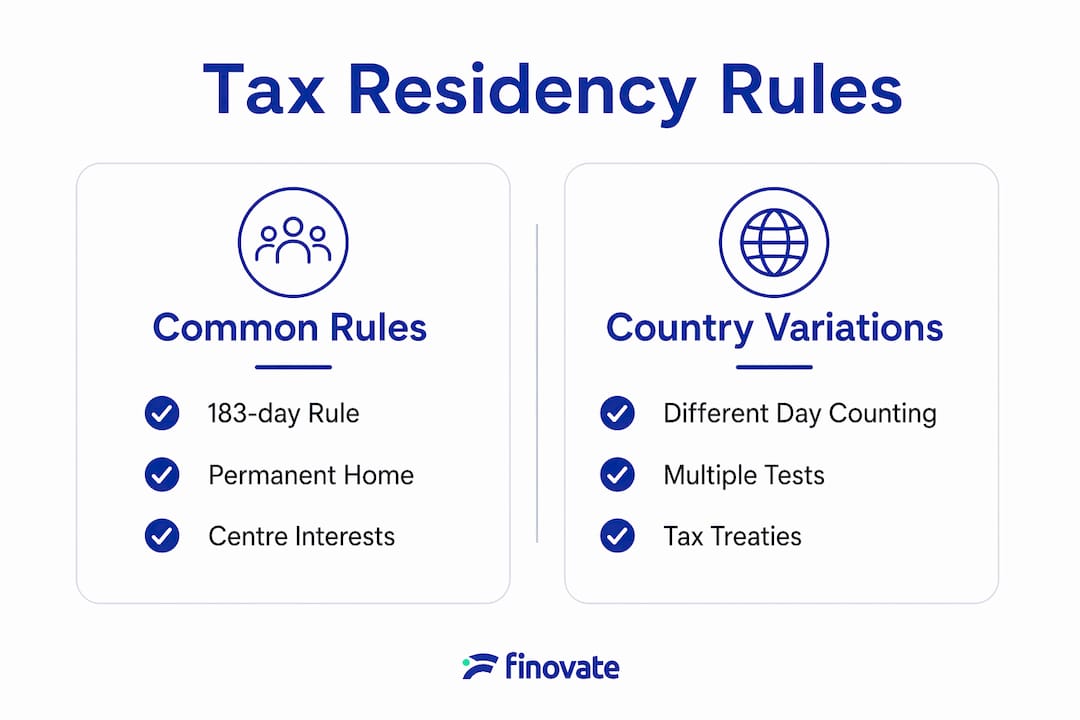
Countries also count days differently. Some use the calendar year, others use a rolling 12-month period, and the United States applies a weighted formula called the Substantial Presence Test. These differences matter enormously if you split your time between countries.
Key criteria used across jurisdictions
Most countries, including Finland, assess residency using a combination of the following factors:
- Permanent home: Do you own or rent a home available to you on a continuous basis?
- Centre of vital interests: Where are your family, social, and economic ties strongest?
- Habitual abode: In which country do you spend the most time over a given period?
- Nationality: Used as a last resort in tie-breaker situations under most tax treaties.
The UK's Statutory Residence Test illustrates how far this can go. A person can be deemed UK resident with as few as 16 days if multiple ties such as family, accommodation, and work are present. That is a striking example of how day counts alone tell an incomplete story.
How Finnish residency criteria work in practice
| Factor | Finnish tax residency relevance |
|---|---|
| Permanent home in Finland | Strong indicator of Finnish tax residency |
| Continuous stay exceeding 6 months | Triggers Finnish resident status |
| Centre of vital interests in Finland | Overrides shorter physical presence |
| Finnish nationality abroad | May sustain residency for up to 3 years after departure |

Finnish law also applies a three-year rule: Finnish nationals who move abroad remain Finnish tax residents for three years after departure unless they can prove their ties to Finland have been severed. This rule catches many entrepreneurs off guard when they relocate for business reasons.
Pro Tip: Tax authorities reconstruct your life circumstances retrospectively, examining where you sleep, work, and maintain connections. Keep a contemporaneous record of your location and activities throughout the year.
What happens when you qualify as a tax resident in two countries?
Dual residency occurs when two countries each claim you as a tax resident under their domestic rules. This is more common than most entrepreneurs expect, particularly those running businesses across borders or relocating mid-year. Dual residents arise when two countries claim residency by domestic law, and the conflict is resolved through Double Taxation Agreements, known as DTAs.
Finland has an extensive network of DTAs based on the OECD Model Tax Convention. When a conflict arises, the treaty applies a tie-breaker cascade in a fixed order:
- Permanent home: The country where you have a permanent home available to you takes priority.
- Centre of vital interests: If you have a permanent home in both countries, the country with which your personal and economic ties are closer prevails.
- Habitual abode: If the centre of vital interests cannot be determined, the country where you habitually reside is used.
- Nationality: If you are a national of both or neither country, the competent authorities resolve the matter by mutual agreement.
Tax residency is determined through a hierarchy of tests, with permanent home and centre of vital interests predominating. Nationality is genuinely a last resort.
A tax treaty allocates taxing rights between two countries. It does not remove your obligation to file a tax return in either jurisdiction. Many Finnish entrepreneurs assume that a treaty resolves all compliance duties. It does not. You may still need to file returns in both countries, even if you only pay tax in one.
Tax treaties resolve dual residency conflicts but do not automatically eliminate obligations to file returns where domestic residency conditions are met. This misperception is one of the most costly mistakes Finnish entrepreneurs make when operating internationally. For a broader view of your filing duties, the Finovate guide on tax compliance for Finnish businesses covers dual-jurisdiction obligations in practical detail.
How does changing tax residency affect your tax liability?
Residency change is a legal shift, not a physical one
Changing tax residency is a significant legal and fiscal shift, not merely a matter of moving abroad and updating your address. To exit Finnish tax residency, you must meet specific exit conditions. Simply spending more time outside Finland is not sufficient.
The key requirements for severing Finnish tax residency include:
- Closing or transferring your permanent home in Finland.
- Relocating your family and social life to the new country.
- Moving your business activities and economic interests abroad.
- Registering as a resident in the new country and obtaining documentary evidence.
Failing to meet these conditions means Finnish tax residency continues, and Vero Skatt retains the right to tax your worldwide income. Entrepreneurs who relocate for business but leave a family home in Finland, or maintain Finnish business accounts, frequently discover this to their cost.
Common pitfalls when changing residency
Many entrepreneurs underestimate the scrutiny that Vero Skatt applies to residency change claims. Tax authorities require concrete proof of permanent home relocation and economic life transfer. A lease agreement in a new country is not sufficient on its own. Authorities look at the full picture: school enrolments, club memberships, utility contracts, and bank account activity.
The United States presents a particular complication for any entrepreneur with US citizenship. The US taxes worldwide income regardless of physical residence, based on citizenship rather than residency. A US citizen living and working in Finland remains liable to file US federal tax returns, regardless of their Finnish residency status.
Pro Tip: Successful residency change requires documented evidence including contracts, utility bills, and proof of social integration in the new country. Compile this evidence from day one of your relocation, not retrospectively.
How to determine and prove your tax residency status in Finland
Assessing your own residency status accurately is the first step towards compliance. The following steps give you a practical framework:
- Map your physical presence. Count the days you spend in Finland and in each other country, using both calendar year and rolling 12-month calculations.
- Assess your permanent home. Identify where you have a home available to you on a continuous basis, not just where you own property.
- Evaluate your centre of vital interests. Consider where your family lives, where your business is registered, where your bank accounts are held, and where your social life is based.
- Gather documentary evidence. Collect lease agreements, utility bills, employment contracts, school records, and bank statements that support your claimed residency position.
- Check treaty provisions. If you have ties to another country with a DTA with Finland, review the tie-breaker rules to understand which country holds primary taxing rights.
| Evidence type | What it demonstrates |
|---|---|
| Lease or mortgage documents | Permanent home location |
| Utility and phone bills | Habitual place of residence |
| Bank statements | Centre of economic activity |
| Family school enrolment | Centre of personal life |
| Business registration documents | Economic ties and activity location |
Tax authorities reconstruct residency retrospectively, so the strength of your documentation determines the outcome of any dispute. Seeking advice from a qualified tax adviser before you change your circumstances, rather than after, is the most effective way to protect your position. The Finovate resource on the role of a tax adviser explains when and why professional support makes a material difference for Finnish business owners.
Key takeaways
Tax residency is a legally determined status based on permanent home, centre of vital interests, and physical presence, not simply the number of days spent in a country.
| Point | Details |
|---|---|
| 183-day rule is not universal | Many countries establish residency with fewer days if other ties are present. |
| Dual residency requires treaty analysis | OECD tie-breaker rules allocate taxing rights; filing duties in both countries may still apply. |
| Residency change demands documentation | Severing Finnish residency requires proof of economic and personal relocation, not just physical absence. |
| Finnish nationals face a three-year rule | Finnish citizens remain tax residents for up to three years after departure unless ties are formally severed. |
| Professional advice prevents costly errors | Residency disputes are resolved on evidence; a tax adviser helps you build and maintain that evidence. |
Why Finnish entrepreneurs consistently underestimate tax residency complexity
I have worked with Finnish entrepreneurs across a wide range of business structures, and the pattern is consistent. The 183-day rule gets treated as a safe harbour. Entrepreneurs count days, conclude they are below the threshold, and assume the matter is settled. It rarely is.
The reality is that entrepreneurs often mistakenly rely on the 183-day rule, ignoring the other factors that determine residency. A Finnish entrepreneur who spends four months a year in Helsinki, maintains a family home there, and holds Finnish business accounts is almost certainly a Finnish tax resident, regardless of where they spend the remaining eight months.
What I find most underappreciated is the retrospective nature of residency assessment. Vero Skatt does not ask where you planned to live. It asks where you actually lived, based on the evidence available. That distinction changes everything about how you should approach record-keeping.
The entrepreneurs who handle this well are not necessarily those with the simplest situations. They are the ones who treat residency as a live compliance question, not a one-time administrative task. They keep records, review their position annually, and take professional advice before making changes, not after the fact. For a practical starting point, the Finovate guide on tax tips for Finnish entrepreneurs covers the most common residency misconceptions in plain terms.
— Busayo
How Finovate supports Finnish entrepreneurs with tax residency
Residency questions rarely exist in isolation. They connect to your income tax position, your VAT obligations, your payroll structure, and your broader business compliance.

Finovate provides expert accounting and tax services for entrepreneurs and business owners in Finland, covering tax residency determination, bookkeeping, VAT, payroll processing, and business advisory. Whether you are assessing your current residency status, planning a relocation, or managing cross-border obligations, we give you clear, accurate guidance grounded in Finnish tax law. Contact Finovate to discuss your situation and get the clarity you need to stay fully compliant.
FAQ
What is tax residency and why does it matter?
Tax residency is the legal status that determines which country taxes your worldwide income. For Finnish entrepreneurs, being classified as a Finnish tax resident means Vero Skatt can tax all your global earnings, not just Finnish-source income.
Does the 183-day rule determine Finnish tax residency?
The 183-day rule is one factor, not a definitive test. Finland also considers permanent home availability, centre of vital interests, and economic ties, any of which can establish residency independently of day counts.
Can you be a tax resident in two countries at once?
Yes. Dual residency occurs when two countries each claim you under their domestic rules. A Double Taxation Agreement between the two countries then applies OECD tie-breaker rules to allocate primary taxing rights.
Do tax treaties remove the need to file returns in both countries?
No. Tax treaties determine which country has primary taxing rights but do not automatically eliminate domestic filing obligations. You may need to file returns in both countries even if tax is only due in one.
How do you formally exit Finnish tax residency?
You must sever your personal and economic ties to Finland, including your permanent home, family connections, and business interests, and provide documentary evidence of your new residency. Finnish nationals are also subject to a three-year rule that sustains residency after departure unless ties are formally broken.