

TL;DR:
- Finnish entrepreneurs can reduce their taxable income by claiming over 60 deductible expenses, including office costs, vehicle use, and marketing. Proper documentation, early planning, and professional support are essential to maximize deductions and avoid audit issues. The automatic 5% entrepreneur deduction simplifies tax savings, but accurate recordkeeping and YEL contribution decisions significantly impact the final tax outcome.
Tax deductions are defined as allowable business expenses that reduce your taxable income and, therefore, the amount of tax you owe. For Finnish entrepreneurs and small business owners, understanding the tax deduction process is one of the most direct ways to improve your financial position without changing how much you earn. The Finnish Tax Administration applies certain deductions automatically, but many others require you to claim them correctly. This guide covers tax deduction eligibility, documentation requirements, the step-by-step claim process, and the most common mistakes to avoid.
What common tax deductions can Finnish entrepreneurs claim?
Finnish tax law gives entrepreneurs access to over 60 deductible expense categories, spanning office costs, vehicle use, personnel expenses, marketing, training, and financing. That breadth means most genuine business costs qualify, provided they are properly documented and directly linked to earning business income.

The most significant automatic benefit is the 5% entrepreneur deduction applied by the Tax Administration for sole traders (toiminimi). On €50,000 of business income, this reduces taxable income by €2,500 without any manual filing on your part. That is money saved with zero administrative effort.
Common deductible expenses include:
- Office and workspace costs: Rent, utilities, and a proportion of home office expenses where the space is used exclusively for business
- Vehicle and travel costs: Business mileage, public transport, and accommodation for work trips
- Personnel costs: Salaries, employer contributions, and occupational health expenses
- Marketing and communications: Advertising, website costs, and professional subscriptions
- Training and development: Courses and materials directly related to your business activity
- Financing costs: Loan interest and bank charges tied to business operations
- Representation expenses: Client entertainment, subject to a 50% cap on deductibility
Private and personal expenses are not deductible under any circumstances. Mixing them with business costs is the fastest route to a deduction denial.
YEL pension insurance contributions deserve special attention. YEL contributions can be deducted either in business taxation or in personal taxation, but not in both. For many sole traders, deducting YEL in personal taxation preserves the 5% entrepreneur deduction in full, producing a better overall tax outcome.
Pro Tip: Calculate your YEL deduction in both scenarios before filing. The difference in tax saved can be meaningful, and the choice is yours to make each year.
What documentation do you need before claiming deductions?
Preparation is the foundation of a successful deduction claim. Finnish accounting law (KPL 2:10 §) requires you to retain receipts and invoices for six years. That is not a suggestion. Missing documentation means a deduction can be denied, even if the expense was entirely legitimate.
A practical documentation checklist for Finnish entrepreneurs includes:
- Receipts and invoices: Every business purchase needs a dated receipt or invoice showing the supplier, amount, and purpose
- Bank and card statements: These support your receipts and show payment was made from a business account
- Mileage logs: For vehicle deductions, a written log of dates, destinations, and business purpose is required
- Home office records: A floor plan or lease agreement showing the proportion of space used for business
- YEL insurance documents: Your annual YEL contribution statement from your pension insurer
Digital organisation matters as much as physical record keeping. Tax advisory experts confirm that maintaining a clear digital trail of expenses is more critical to securing deductions than knowing every detail of the tax code. Scan receipts immediately, store them in a named folder by month, and reconcile them against your accounts monthly rather than annually.
Separating business and personal finances is non-negotiable. Use a dedicated business bank account and business card. This single habit removes the most common source of audit risk for small business owners.
Pro Tip: Set a recurring 30-minute monthly task to reconcile your receipts against your bank statement. Year-end preparation becomes straightforward, and you will never scramble to find a missing receipt under time pressure.
How to claim your tax deductions step by step
The Finnish tax return process for entrepreneurs follows a clear sequence. Understanding each step removes the uncertainty that causes last-minute errors.
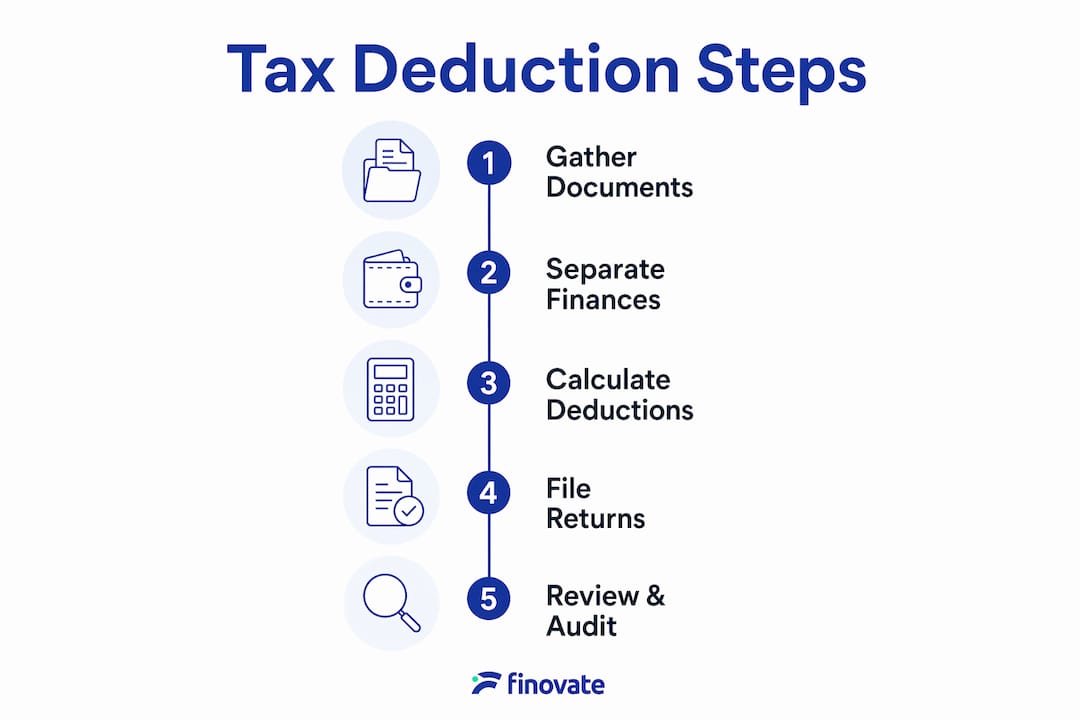
- Gather your annual figures. Compile total business income and all documented expenses by category before opening your tax return.
- Log in to MyTax (OmaVero). The Finnish Tax Administration's online portal is where sole traders and limited companies file their returns.
- Review the pre-completed return. The Tax Administration pre-fills some information, including the automatic 5% entrepreneur deduction for sole traders. Verify this has been applied correctly.
- Enter additional deductions manually. Office costs, vehicle expenses, training, marketing, and other eligible costs must be entered in the correct fields. Each category has a designated section in the return.
- Decide where to claim your YEL deduction. YEL contribution details are not automatically transferred to the Tax Administration. You must actively claim them, choosing either business or personal taxation.
- Attach supporting documents where required. For larger or unusual deductions, attach receipts or explanatory notes directly to the return.
- Review and submit before the deadline. Check every figure before submitting. Errors trigger correction requests or, in serious cases, audits.
The table below shows where key deductions appear in the tax return process:
| Deduction type | Claimed by | Filed where |
|---|---|---|
| 5% entrepreneur deduction | Tax Administration automatically | Pre-completed return |
| YEL pension contributions | Entrepreneur actively | Personal or business tax section |
| Office and workspace costs | Entrepreneur actively | Business expense fields |
| Vehicle and travel expenses | Entrepreneur actively | Business expense fields |
| Representation expenses (50% cap) | Entrepreneur actively | Business expense fields |
Incorrect filing or missing documentation can trigger audits and formal warnings from the Tax Administration. Filing accurately the first time is always less costly than correcting errors afterwards.
For a detailed walkthrough of the full filing process, the tax filing step by step guide from Finovate covers each stage in practical terms.
What mistakes should you avoid to maximise your deductions?
Most deduction problems come from a small number of recurring errors. Recognising them in advance saves you money and reduces audit risk.
- Inadequate documentation: The single most common reason deductions are denied. Every expense needs a receipt or invoice. A bank statement alone is not sufficient.
- Mixing personal and business expenses: Purchasing personal items on a business card and claiming them as deductions is a compliance failure. It also makes bookkeeping significantly harder to audit.
- Forgetting to claim YEL contributions: Because YEL deduction details are not automatically transferred to the Tax Administration, entrepreneurs who do not actively claim them lose the benefit entirely.
- Choosing the wrong YEL deduction route: Deducting YEL in business taxation when personal taxation would produce a larger saving is a costly oversight. Analyse both options each year.
- Missing the automatic entrepreneur deduction: Sole traders sometimes assume the 5% deduction has not been applied and attempt to claim it manually, creating a duplicate error.
Early tax planning and consultation with accounting professionals improves deduction maximisation and prevents compliance risks. Proactive preparation identifies untapped deductions and removes the pressure of last-minute filing.
Proactive tax planning is the most effective way to avoid these errors. Reviewing your deduction position mid-year, rather than in april when the return is due, gives you time to correct course and gather any missing records.
Pro Tip: Book a tax review with your accountant in october or november, before the financial year closes. You can still make decisions that affect your deduction position, such as bringing forward a planned purchase or adjusting your YEL contribution level.
When your business grows in complexity, the value of professional accounting support grows with it. A qualified accountant does not just file your return. They identify deductions you have missed and structure your finances to reduce your tax burden legally and reliably. Finovate's tax advisory services are designed specifically for Finnish entrepreneurs navigating exactly these decisions.
Key takeaways
The most effective tax deduction process for Finnish entrepreneurs combines accurate documentation, correct use of the automatic 5% entrepreneur deduction, and a deliberate annual decision on where to claim YEL contributions.
| Point | Details |
|---|---|
| Automatic entrepreneur deduction | The Tax Administration applies a 5% deduction for sole traders; verify it appears in your pre-completed return. |
| Six-year record retention | Finnish law requires receipts and invoices to be kept for six years; digital storage is the most reliable method. |
| YEL deduction choice | Claim YEL contributions in either personal or business taxation each year; the optimal route depends on your income level. |
| Separate finances | A dedicated business bank account removes the most common source of deduction denial and audit risk. |
| Plan early | Reviewing your tax position before the financial year closes gives you time to act on deduction opportunities. |
Why good records matter more than tax knowledge
Working with Finnish entrepreneurs over the years, I have noticed a consistent pattern. The business owners who claim the most deductions successfully are rarely those with the deepest knowledge of tax law. They are the ones who keep their records in order throughout the year.
I have seen sole traders lose legitimate deductions worth hundreds of euros simply because they could not produce a receipt at audit. The expense was real. The business purpose was clear. But without documentation, the Tax Administration had no basis to allow it. That is a painful and entirely avoidable outcome.
The YEL deduction decision is another area where I see entrepreneurs leave money on the table. Choosing between personal and business taxation for YEL contributions is not complicated once you run the numbers, but many entrepreneurs default to one method without ever comparing the two. The difference in annual tax saved can be significant.
My honest view is this: the tax deduction process in Finland is genuinely accessible for entrepreneurs who approach it methodically. The rules are clear. The automatic entrepreneur deduction is generous. The filing system through OmaVero is straightforward. What separates those who benefit fully from those who do not is preparation, not expertise.
If your business is growing and your finances are becoming more complex, that is the right moment to bring in professional support. Not because the process is beyond you, but because your time is better spent running your business than reconciling expense categories.
— Busayo
How Finovate supports Finnish entrepreneurs with tax deductions
Finovate works with entrepreneurs and small business owners across Finland to make the tax deduction process straightforward and compliant.
Our accounting services cover bookkeeping, tax return preparation, and year-round tax advisory. We organise your documentation, identify every deduction you are entitled to, and file your return accurately. We also advise on the YEL deduction decision each year, so you always choose the route that saves you the most. Whether you are a sole trader filing for the first time or a growing business with more complex needs, we are here to help. Contact Finovate to arrange a consultation and put your tax position on solid ground.
FAQ
What is the 5% entrepreneur deduction in Finland?
The Finnish Tax Administration automatically applies a 5% entrepreneur deduction to the taxable income of sole traders (toiminimi). On €50,000 of business income, this reduces taxable income by €2,500 with no manual filing required.
How long must Finnish entrepreneurs keep tax records?
Finnish accounting law (KPL 2:10 §) requires receipts, invoices, and supporting documents to be retained for six years. Digital storage is acceptable and recommended.
Can I deduct YEL contributions in both personal and business taxation?
No. YEL pension insurance contributions can be deducted in either personal taxation or business taxation, but not in both. You must actively claim the deduction in your tax return, as it is not transferred automatically.
What expenses are not deductible for Finnish entrepreneurs?
Private and personal expenses are not deductible under Finnish tax law (EVL 7 §). Representation expenses are subject to a 50% cap. Any expense without proper documentation can also be denied.
When should I seek professional accounting support for tax deductions?
Professional support is most valuable when your business income grows, your expense categories become more complex, or you are unsure about the optimal YEL deduction route. Early tax planning with a qualified accountant prevents errors and identifies deductions you may have missed.