

A generational transfer in Finland is normally taxed either as a capital gain (luovutusvoitto) for the seller or as a gift (lahjavero) for the buyer, and the price paid relative to fair market value decides which. If the buyer pays 75% or less of the fair value, gift tax rules take over; above that, it is treated as a sale. Start planning years ahead, and if the numbers are close or the stakes are high, apply for an ennakkoratkaisu before you sign anything.
TL;DR:
- Transferring a Finnish business or property below 75% of fair market value triggers gift tax rules, while paying more than 75% is treated as a sale.
- The TVL 48 exemption allows sellers to be completely tax-free if they owned the shares for at least 10 years, held at least 10% of the company, and the buyer is an immediate relative.
- Buyers paying less than 50% of the fair market value face higher gift tax, but relief under PerVL 55 significantly reduces their lahjavero liability if they operate the business for five years post-transfer.
- Proper valuation, early family and business restructuring, and obtaining advance rulings (ennakkoratkaisu) greatly reduce the risk of tax disputes during succession.
- Farm transfers have additional flexibility, such as extended payment schedules, but land used only for forestry typically does not qualify for farm-specific relief.
Table of Contents
- Sukupolvenvaihdos verotus at a glance: taxes and thresholds that decide your outcome
- How is the seller's capital gains tax calculated, and when is it tax-exempt?
- Buyer's lahjavero and huojennus: what a successor actually pays
- Farm succession and company form: rules that shift the calculation
- Planning timeline: what to do years before the transfer
- What mistakes make Verohallinto deny relief or reclassify the deal?
- What does a hands-on succession tax review actually involve?
- How Finovate supports your generational transfer from valuation to handover
- Where to check the official rules before you act
- Sources
Sukupolvenvaihdos verotus at a glance: taxes and thresholds that decide your outcome
Before you touch a share purchase agreement or a gift deed, you need to know which taxes are even in play. A Finnish sukupolvenvaihdos can trigger up to four separate tax questions, and missing one is how otherwise well‑planned transfers end up costing far more than expected.
The taxes that typically apply are:
- Luovutusvoitto (capital gains tax) on the seller's side, charged on the difference between the sale price and the original acquisition cost, unless the TVL 48 exemption applies.
- Lahjavero (gift tax) on the buyer's side, triggered whenever the consideration paid is below market value, with sukupolvenvaihdoshuojennus available to soften the bill.
- Varainsiirtovero (transfer tax) on share and property transfers bought at market price, usually 1.5% to 4% depending on the asset, though gift‑like transfers below the threshold can avoid it entirely.
- VAT, which rarely applies to a straightforward share sale but can surface if the transfer includes standalone asset sales or ongoing service arrangements.
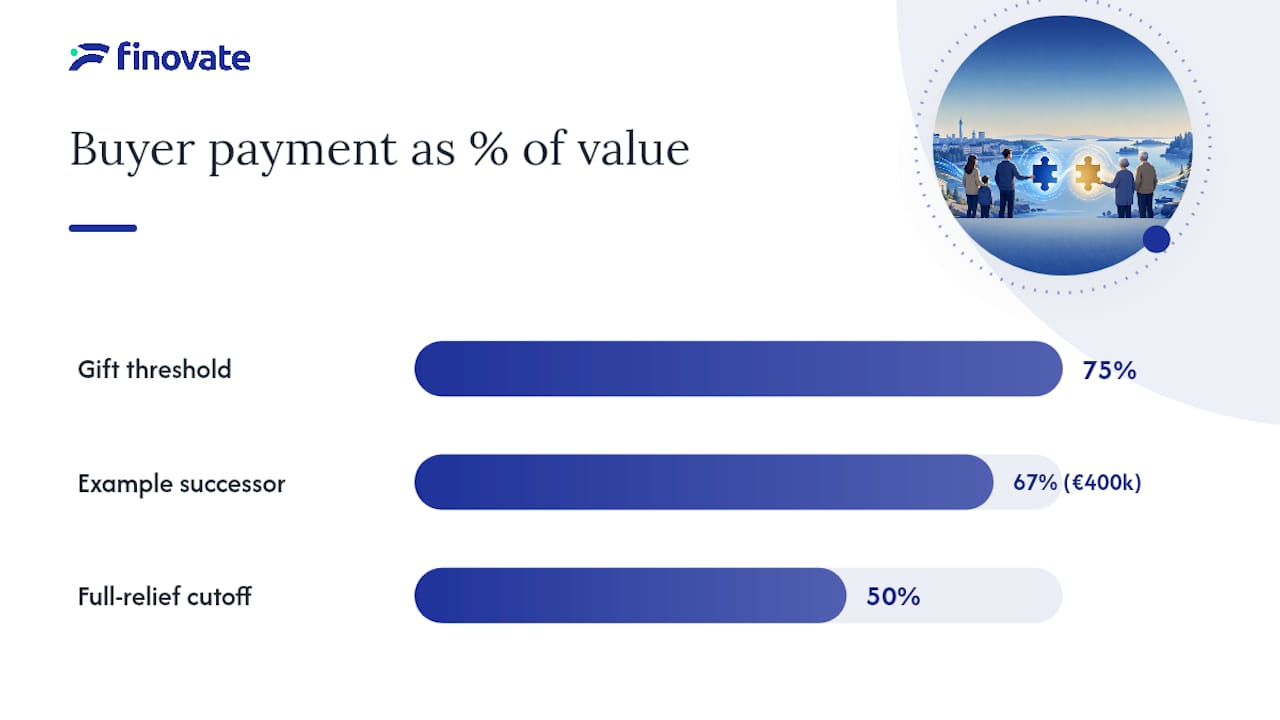
The numbers that decide everything sit in two thresholds. If the price paid is 75% or less of fair market value, the transfer counts as lahjanluonteinen kauppa, a gift‑like sale, and gift tax rules apply to the discounted portion. Pay more than 75%, and the whole thing is treated as an ordinary sale for tax purposes, with luovutusvoitto rules governing the seller's side instead.
The threshold that matters most for relief: if the buyer's payment exceeds 50% of the fair market value, the transfer can qualify for full sukupolvenvaihdoshuojennus under PerVL 55, cutting the taxable value of the gift substantially. Fall below that halfway mark, and only partial relief, or none, tends to apply.
There is a third figure worth memorising even before you start negotiating price: the five‑year retention rule. Whoever receives huojennus on either luovutusvoitto or lahjavero must keep the business running, broadly speaking, for five years. Sell or wind down the main assets before that window closes, and the relief can be clawed back, sometimes with a penalty added on top.
Pro Tip: Work out your 75% and 50% figures against a proper valuation before you agree a price verbally with family members. Renegotiating a price after Verohallinto has seen the paperwork is far harder than getting it right from the start.
Two Verohallinto pages are worth bookmarking now, because you will return to them repeatedly during planning: the syventävät vero‑ohjeet on osakeyhtiön sukupolvenvaihdos and the guidance on huojennus lahjaverossa. Both get updated periodically, and both are the primary references Verohallinto itself will cite if your case is ever queried.
How is the seller's capital gains tax calculated, and when is it tax-exempt?
For the person handing over the business, the tax question is straightforward on paper: luovutusvoitto is the difference between the sale price and the original acquisition cost (hankintameno), plus deductible expenses. In practice, three things complicate that calculation, and the biggest one is timing.
The signing date, not the completion date, generally fixes the tax year. If you sign the deed of sale in December 2026 but the money changes hands in January 2027, the gain is usually taxed as 2026 income. This catches sellers out more often than any other single detail, particularly when a transfer is timed around a calendar year‑end for other reasons.
The TVL 48 exemption: when the seller pays nothing at all
Under TVL 48 of the Income Tax Act, a share transfer within a genuine sukupolvenvaihdos can be entirely exempt from luovutusvoitto for the seller. This is the single most valuable relief available on the seller's side, and it is also the one people misunderstand most often, because it depends on meeting all three conditions together, not just one or two.
The TVL 48 exemption applies when:
- The seller has owned the shares or business for at least 10 years before the transfer.
- The shares transferred represent at least 10% ownership of the company (based on share capital or voting rights).
- The buyer is a child, grandchild, sibling, or their spouse (the qualifying relative categories are set out precisely in the statute; more distant relatives generally do not qualify).
Meet all three, and the seller can walk away without paying luovutusvoitto on shares that may have appreciated enormously over decades of ownership. Miss even one, such as owning the shares for only eight years, and the exemption falls away entirely; there is no partial version of TVL 48.
Comparing three sale structures
The tax outcome for the seller shifts sharply depending on how the price is set. Consider a business valued at €500,000, sold by a parent to their child who has worked in the company for years:
| Sale structure | Price paid | Seller's tax position |
|---|---|---|
| Full market price sale | €500,000 | Luovutusvoitto applies unless TVL 48 conditions are met; if met, fully exempt |
| Discounted sale above 75% | €400,000 | Still a sale for tax purposes; TVL 48 exemption still possible if conditions met |
| Gift‑like sale | €300,000 | Treated partly as a sale, partly as a gift; TVL 48 can still exempt the sale portion, but the discount (€200,000) is assessed for lahjavero on the buyer |
Notice that TVL 48 protects the seller regardless of price, as long as the ownership and relationship conditions hold. The price mainly decides what happens on the buyer's side, which is where lahjavero enters the picture.
Documentation the seller should prepare before claiming verovapaus under TVL 48 includes proof of ownership duration (share register extracts, original purchase agreements), a clear ownership percentage calculation, and documentation of the family relationship where it is not otherwise obvious to Verohallinto. Sellers who assemble this before filing, rather than after a query arrives, tend to have a much smoother experience.
Buyer's lahjavero and huojennus: what a successor actually pays
The buyer's tax exposure hinges on one question: how much of the fair market value did they actually pay? Everything below full price gets scrutinised as a potential gift, and Finland's gift tax scale is progressive, running higher for larger gifts and for more distant family relationships.
When a transfer becomes gift‑like: the moment the price drops to 75% or below of fair market value, the shortfall is treated as a gift for tax purposes, even though the buyer paid real money for the rest. Say a business is worth €600,000 and the successor pays €400,000 (67% of value). The €200,000 discount is assessed as a gift, and lahjavero is calculated on that portion, not on the full €600,000.
That is where sukupolvenvaihdoshuojennus under PerVL 55 becomes the buyer's most important lever.
- Check the consideration threshold. If the price paid exceeds 50% of fair market value, full relief is available, which substantially reduces the taxable value used to calculate lahjavero, not just the headline rate.
- Confirm business continuation. The buyer must continue running the business, not sell it on or liquidate it shortly after transfer; Verohallinto expects genuine operational continuity, not a paper handover.
- Apply the relief calculation. Huojennus works by substituting a lower "gift tax value" for the business assets, typically well below their fair market value, which then gets taxed at the normal progressive lahjavero rates.
- Consider payment instalments. Even after relief, a gift tax bill on a family business can be large relative to the successor's cash position. Buyers can apply for extended payment terms, spreading payment across several years rather than settling in one lump sum, which is often the difference between a successor being able to take over comfortably and being forced into a distressed sale of assets just to cover the tax.
Pay less, and relief scales down accordingly, sometimes disappearing altogether if the price is nominal.
Applying for extended payment terms early tends to be one of the more underused liquidity tools among successors. Many assume the tax has to be paid immediately in full, then discover too late that instalment arrangements were available and would have avoided an unnecessary cash squeeze during the exact period when the business needs working capital most.
The five‑year rule cuts both ways here too. If the successor disposes of the main business assets, sells the shares on, or otherwise ends the continuation within five years of receiving huojennus, Verohallinto can reclaim the relief, sometimes with an uplift of around 20% added to the reclaimed amount. This is not a theoretical risk. Successors who take over a business intending to run it, then receive an unsolicited acquisition offer within year three or four, need to weigh that offer against the tax consequences of losing relief before accepting.
Farm succession and company form: rules that shift the calculation
Farm transfers get their own layer of tax treatment on top of the general sukupolvenvaihdos rules, and the differences are substantial enough that treating a maatila transfer like a standard business sale is a common and costly mistake.
Maatilan sukupolvenvaihdos qualifies for the same PerVL 55 huojennus framework as other business transfers, but with additional practical flexibility around payment. Where the gift or inheritance tax attributable to the farm or company exceeds €1,700, Verohallinto can extend the payment schedule up to 10 annual instalments, rather than the shorter terms typically offered for non‑farm business transfers. This matters because farm succession often involves illiquid assets, land and machinery, where the successor has no easy way to raise cash quickly.
There is an important exclusion worth flagging: pure forest holdings with no active agricultural operation generally do not qualify for the same relief as an operating farm. If the land being transferred is forestry only, without livestock, crops, or another active agricultural business attached, the succession relief calculation looks different, and sellers sometimes assume forest land automatically carries the same treatment as farmland. It does not, so this is worth confirming with Verohallinto or an adviser before assuming relief applies.
Company form changes the mechanics too, even when the underlying tax rules are conceptually the same:
- Osakeyhtiö (limited company) transfers usually involve share transfers, where hankintameno (acquisition cost) is calculated per share, and TVL 48 exemption conditions apply to the shareholding directly.
- Henkilöyhtiö and yksityisliike (partnerships and sole traders) transfers work differently because there are no shares to transfer in the same sense; instead, the transfer often involves individual business assets, which can change how gains are calculated and can bring VAT into consideration where it would not apply to a share sale.
- Varainsiirtovero typically applies to share transfers bought at market price (usually 1.5% for most companies, higher for property‑heavy companies), but gift‑like transfers below the 75% threshold are often exempt from transfer tax on the gifted portion, since transfer tax generally attaches to purchases, not gifts.
If your business has already changed form recently, say from a toiminimi to an osakeyhtiö in anticipation of a future transfer, the acquisition cost calculations reset at that point, which can materially change the luovutusvoitto maths years later when the actual succession happens.
Planning timeline: what to do years before the transfer
Succession tax planning rewards patience more than almost any other area of Finnish tax law. The TVL 48 exemption alone requires 10 years of ownership, so if you are the seller and have not yet reached that threshold, the single most valuable action available to you might simply be waiting, provided the business and family circumstances allow it.
- Start three to five years ahead, minimum. Structural changes such as adjusting company form, restructuring shareholdings between family members, or building up the successor's active involvement in the business all need time to look genuine to Verohallinto, not engineered purely for tax purposes around a looming transfer date.
- Review company form and share structure early. If a toiminimi should become an osakeyhtiö before succession, or if shares need reorganising to create a clean holding for the successor, doing this years in advance avoids the transfer looking rushed or artificially structured.
- Get a proper valuation, then get it updated. A single valuation done years before the transfer is not enough; Verohallinto expects the figures used at the point of transfer to reflect fair value at that time, not an outdated estimate.
- Decide on the price point deliberately. Whether you aim for full market price, a gift‑like sale above 50%, or a gift‑like sale below it, is a decision with real tax consequences on both sides, and it should be made jointly by seller and buyer with the numbers in front of them, not left to instinct.
- Apply for an ennakkoratkaisu if there is genuine uncertainty. Verohallinto offers advance rulings on gift and inheritance tax questions specifically, and a binding ruling removes the guesswork from a transfer where the numbers are large or the facts do not fit neatly into standard categories. Applications carry a fee and take some processing time, so build that into your timeline rather than requesting one at the last minute.
- Assemble documentation as you go, not retrospectively. Share registers, valuation reports, proof of the successor's role in the business, and family relationship documentation should exist well before the transfer date, because reconstructing this evidence after the fact is far harder and less convincing to Verohallinto.
Pro Tip: Treat the ennakkoratkaisu application itself as part of your planning process, not a final check at the end. The questions Verohallinto asks during that application often reveal gaps in your documentation or structure that are far easier to fix before the transfer than after.
Every generational transfer is assessed on its own facts, and there is no single template structure that works for every family business. Professional advisers frequently combine partial transfers, share reorganisations, and staged payments to balance the tax outcome against what the business can actually sustain financially, and that balancing act tends to work better the earlier it starts.
What mistakes make Verohallinto deny relief or reclassify the deal?
The mistakes that derail a sukupolvenvaihdos rarely involve deliberate avoidance. They usually come from optimism about paperwork, or a misunderstanding of how thoroughly Verohallinto reviews continuation and valuation evidence.
Weak proof of genuine business continuation is the most common reason huojennus applications run into trouble. If the successor's role in the business before the transfer looks nominal, say, a title on paper with no real operational involvement, Verohallinto can question whether the transfer represents a genuine succession or simply a tax‑efficient wealth transfer dressed up as one.
Valuation disputes come a close second. Valuation evidence is consistently the single most contested item in these cases, because the entire 75% and 50% threshold calculation depends on an accurate fair market value figure. Inflate the valuation to make a gift look smaller, or use an outdated valuation from years earlier, and you risk the whole calculation being reopened at the least convenient moment.
Staged transfers that authorities read as one arrangement cause more disputes than people expect. Splitting a transfer into several smaller deeds, hoping each falls under a more favourable threshold individually, does not reliably work. Verohallinto can aggregate connected transfers and Finnish courts, including KHO rulings cited in Verohallinto's own guidance, examine the whole arrangement rather than each deed in isolation.
To reduce audit risk in practice:
- Get an independent, contemporaneous valuation and keep the report on file.
- Document the successor's actual operational involvement with dates, roles, and decisions made, not just a job title.
- If a transfer genuinely needs staging for cash‑flow reasons, document the business rationale clearly, separate from any tax motivation.
- Where the structure is unusual or the amounts are large, request an ennakkoratkaisu rather than assuming your reading of the rules will hold up unchallenged.
What does a hands-on succession tax review actually involve?
Every sukupolvenvaihdos we look at starts the same way: with the numbers, not the family dynamics or the emotional weight of handing a business to the next generation, however real those pressures are. Getting the tax treatment wrong tends to cost far more than any advisory fee, and it is almost always avoidable with the right sequence of steps.
A typical engagement runs through five stages. Discovery comes first, working out ownership history, company form, and roughly where the business sits on valuation before any structuring decisions get made. Restructure is where company form, shareholdings, or timing get adjusted if the current structure would produce a worse tax outcome than a better‑planned one. Applying for an ennakkoratkaisu comes next where the case genuinely warrants it, giving both seller and buyer binding certainty before signatures go on anything. Handover support covers the practical side afterwards: bookkeeping continuity, payroll transitions, and making sure the business does not stumble operationally just because ownership changed hands.
Where does a tax lawyer come in rather than an accountant? Broadly, when a dispute with Verohallinto is already underway, when the family structure involves complex trusts or cross‑border elements, or when litigation is a realistic possibility. For the vast majority of Finnish family business transfers, though, the work is accounting and tax planning work: valuation, threshold calculations, huojennus applications, and getting the tax planning strategy right well before the transfer date arrives.
— Busayo
How Finovate supports your generational transfer from valuation to handover
There are firms that offer Finnish business owners a practical alternative to piecing together a sukupolvenvaihdos alone or paying for fragmented one‑off advice: one team that handles the valuation groundwork, the huojennus and ennakkoratkaisu applications, and the bookkeeping continuity a business needs while ownership actually changes hands.

Succession‑related services can cover tax planning specific to TVL 48 and PerVL 55 conditions, preparation and submission of advance ruling applications, valuation support for the threshold calculations that decide tax outcomes, and ongoing bookkeeping to help the business maintain momentum during the handover itself. If invoicing continuity matters during the transition, our invoicing service keeps that running smoothly while the ownership paperwork is finalised. For a broader view of how a Finnish tax adviser fits into your planning, our piece on the role of a tax advisor for Finnish SMBs is worth a read alongside this guide.
If your transfer is still years away, or already imminent, request a scoping call through Finovate and we'll walk through your specific numbers, thresholds, and timeline together.
Where to check the official rules before you act
Verohallinto's own guidance pages are the primary source for every threshold and condition covered above, and they get revised as interpretations shift, so it is worth checking them directly rather than relying on secondary summaries alone.
- Osakeyhtiön sukupolvenvaihdos verotuksessa — the core syventävä ohje covering company‑form specific rules, TVL 48, and the five‑year retention rule.
- Sukupolvenvaihdos ja huojennus lahjaveroon — PerVL 55 conditions, payment instalment options, and farm‑specific relief.
- Advance rulings on gift and inheritance tax — how and when to apply for an ennakkoratkaisu.
- Generational transfer and taxation on Suomi.fi — a practical overview with cross‑border context where relevant.
- For general succession‑planning frameworks beyond the Finnish tax rules, Together Consulting's succession planning guide offers a useful complementary perspective for owners and HR teams.
This article is general information, not a substitute for advice from a qualified financial advisor. Consult a qualified financial professional about your own circumstances before acting on anything here.