

Whether a company sale in Finland is structured as a share sale or an asset sale decides who pays tax and at what rate. Start tax due diligence early and confirm your position with Verohallinto or an adviser before signing anything.
TL;DR:
- Selling shares may benefit from a 20% or 40% hankintameno-olettama depending on ownership duration, affecting the taxable gain calculation.
- Asset deals allow buyers to claim depreciation on assets, but sellers face potential double taxation if they withdraw proceeds as dividends later.
- Transfer tax is 1.5% for share purchases and 3% if real estate is involved, with VAT applying to certain asset transfers, influencing total purchase costs.
- Confirm whether signing or payment triggers reporting obligations, and assess historic liabilities or real estate early to avoid penalties and unexpected taxes.
- Running both actual acquisition cost and olettama calculations side by side before filing can significantly reduce the seller’s tax liability.
Table of Contents
- Osakekauppa vs liiketoimintakauppa: why the structure decides the tax bill
- Working out the seller's tax bill: individuals, companies, and the exceptions that change everything
- What buyers pay: varainsiirtovero, VAT, and acquisition cost
- Worked examples: hankintameno-olettama and transfer tax in practice
- Timing, reporting, and the due diligence that prevents late surprises
- A short checklist before you sign anything
- Finovate's perspective: what a proper tax review actually catches
- How Finovate supports you through a company sale
- Where to check the official rules yourself
- Sources
Osakekauppa vs liiketoimintakauppa: why the structure decides the tax bill
The single biggest decision in any Finnish company sale happens before a single euro changes hands: do you sell shares (osakekauppa) or do you sell the business's assets (liiketoimintakauppa)? This choice determines who the taxpayer is, what general types of tax consequences apply, and whether the buyer can later claim depreciation.
In an osakekauppa, the seller (whether a person or a company) sells shares in the legal entity. The company itself continues unchanged, carrying its existing liabilities, contracts, and tax history with it. The seller is taxed on the gain from disposing of the shares. In a liiketoimintakauppa, the company sells specific assets, such as equipment, inventory, customer contracts, or goodwill, while the legal entity remains with the original owner. Here, the company recognises the gain as ordinary business income, taxed at the 20% corporate rate.
The practical consequences diverge sharply for both sides:
- Buyers usually prefer asset deals because they can capitalise the purchased assets at current market value and claim depreciation (poisto) going forward, lowering future taxable profit.
- Sellers usually prefer share deals because gains on shares held for years can benefit from hankintameno-olettama, often producing a lower effective tax than a straight business-income calculation.
- Buyers inherit less risk in a share deal unless they negotiate warranties, since old liabilities, unpaid taxes, and pending disputes travel with the company.
- Sellers in an asset deal face a second layer of tax if they later want to withdraw the proceeds from the company as dividends.
A café owner selling machinery, stock, and the lease for €150,000 pays corporate tax on the gain inside the company. A software founder selling all their shares for €800,000 after nine years of ownership calculates the gain personally, using hankintameno-olettama to reduce the taxable base. Same broad outcome, wildly different arithmetic.
Working out the seller's tax bill: individuals, companies, and the exceptions that change everything
For a natural person selling shares, the taxable gain (luovutusvoitto) is the sale price minus the higher of two figures: the actual acquisition cost plus related expenses, or the hankintameno-olettama.
- Hankintameno-olettama is 20% of the sale price if you have owned the shares for under 10 years, or 40% if you have owned them for 10 years or more, applied as a deemed acquisition cost in place of the real figure.
- The resulting gain is taxed as capital income at 30% up to €30,000 and 34% on anything above that, combined with any other capital income you report that year, such as dividends or rental profit.
- Corporate sellers pay 20% corporate tax on the gain from selling business assets or shares held as investment property, calculated as ordinary business income.
- Tax-free disposal is possible for corporate sellers when the shares qualify as käyttöomaisuusosakkeet: the company must have held at least 10% of the target for a continuous year, in which case the disposal may be exempt from tax entirely.
- Earn-outs follow their own timing rule: if the future payment can be reliably estimated at signing, it is taxed in that year; if not, it is taxed in the year it is actually received.
Many sellers default to the hankintameno-olettama because it is quick to calculate, but in high-value exits, working out the real historic acquisition cost frequently produces a noticeably lower taxable gain. Do both sums before you file.
What buyers pay: varainsiirtovero, VAT, and acquisition cost
Buyers carry their own set of tax costs, and these need to sit inside your purchase model from day one, not bolted on afterwards.
- Varainsiirtovero (transfer tax) is 1.5% of the purchase price on share transactions, payable and reported by the buyer, not the seller.
- Real estate carries a 3% rate, relevant whenever a business sale includes property, whether inside a share deal or an asset deal.
- VAT can arise in asset deals depending on what is transferred. A full business transfer is often outside VAT's scope, but individual asset sales may attract it, so check each line item.
- Transfer tax is added to acquisition cost rather than expensed immediately, which raises your basis for future depreciation or resale gain calculations.
Model the transfer tax as part of the total cash outlay, not as a footnote. A share purchase carries transfer tax calculated as a percentage of the purchase price, which is due within the time frame specified by law after signing.
Worked examples: hankintameno-olettama and transfer tax in practice
Numbers make this concrete faster than any explanation. Take a shareholder selling for €100,000 who has held the shares for 12 years.
The gap between the two methods here is over €10,000 in tax, purely from choosing the calculation that matches your real purchase history rather than defaulting to the standard olettama.
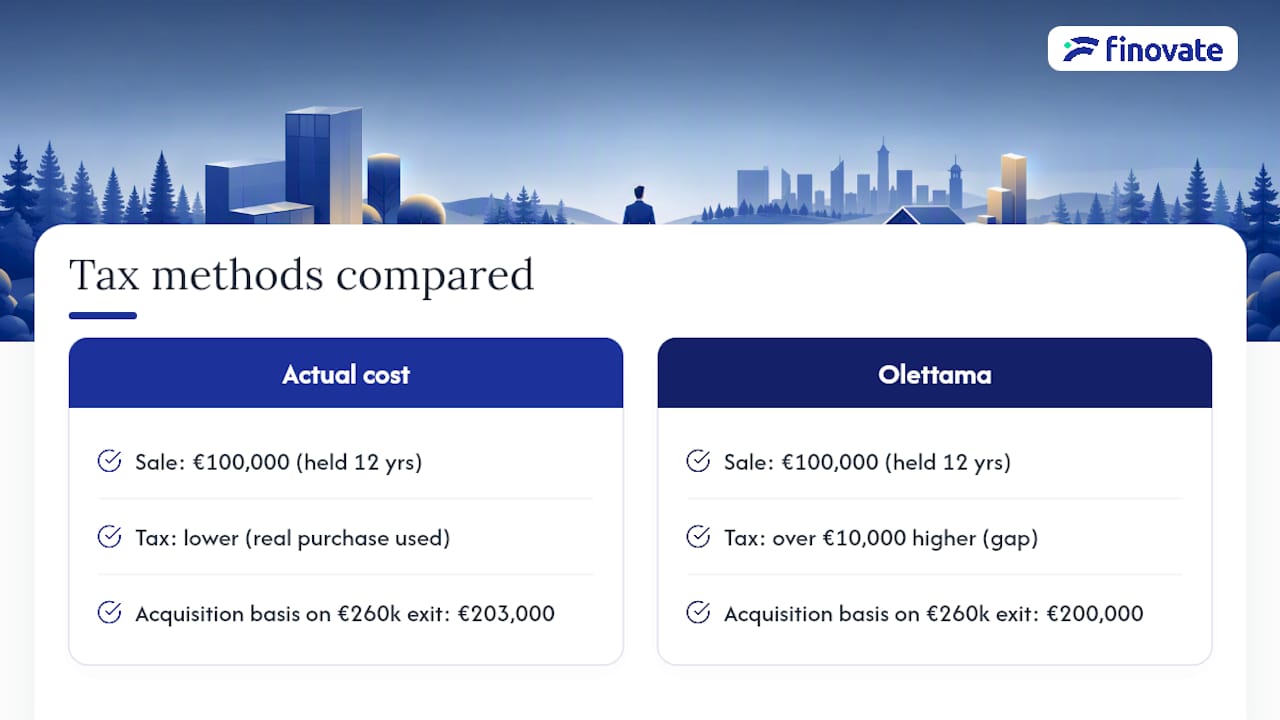
If that buyer later sells the same shares for €260,000, the gain calculation starts from €203,000, not €200,000, trimming the eventual tax on exit.
Pro Tip: Run both the hankintameno-olettama and actual-cost calculations side by side before you file. The 20 minutes it takes can be worth thousands in avoided tax.
Timing, reporting, and the due diligence that prevents late surprises
The tax year for reporting a gain is normally the year the binding sale agreement is signed, not the year payment lands in your account, though earn-outs complicate this. Get the reporting sequence wrong and you risk penalties on top of the tax itself.
- Confirm whether signing date or completion date triggers your reporting obligation, particularly when closing spans a calendar year-end.
- Check for historical unpaid VAT, payroll tax, or corporate tax liabilities that transfer with the company in a share deal.
- Identify any real estate in the deal early, since it changes the varainsiirtovero rate from 1.5% to 3%.
- Review whether prior tax losses in the target company survive the ownership change, since Finnish rules restrict loss carry-forward after major ownership shifts.
Earn-outs need particular care: draft the payment triggers so the tax recognition point lines up with when cash actually arrives, rather than an earlier estimate that leaves you paying tax before you have been paid. Focused tax due diligence catches these mismatches before they become disputes with Verohallinto.
Pro Tip: Bring your accountant in before you sign a letter of intent, not after. Structural decisions made in week one are far cheaper to fix than a tax bill discovered in month six.
A short checklist before you sign anything
- Model both share-sale and asset-sale outcomes side by side, including post-tax proceeds for each.
- Gather and verify original acquisition cost documentation before assuming hankintameno-olettama is your best option.
- Build varainsiirtovero and any VAT exposure into the buyer's cashflow forecast from the outset.
- Draft earn-out clauses with clear, objective triggers, and get specialist input the moment cross-border assets or foreign buyers enter the picture.
Pro Tip: Treat tax planning as part of deal structuring, not paperwork you handle afterwards. The structure you choose in the first meeting often decides the tax outcome months later.
Finovate's perspective: what a proper tax review actually catches
We see the same pattern repeatedly: sellers who calculate hankintameno-olettama without checking their real acquisition cost, and buyers who forget varainsiirtovero until the closing statement lands. Our transaction support covers gain modelling, due diligence on historical liabilities, and filing the resulting returns correctly. Talk to us before you sign, not after.
— Busayo
How Finovate supports you through a company sale
Selling or buying a company in Finland involves more moving parts than most owners expect, and the tax consequences rarely announce themselves until the paperwork is due. Accounting firms handle the accounting side of that process: modelling gain scenarios under both share and asset structures, preparing the financial records a buyer's due diligence will scrutinise, and filing the returns once the deal closes.

If you already run your bookkeeping through a provider, transitioning that into transaction support can be straightforward, as the provider holds your financial history and can locate acquisition cost documentation. For businesses that want ongoing accounting support once the deal is done, our monthly invoicing and accounting service covers the day-to-day work, while larger transactions may need the more hands-on Pro accounting package. Be honest with yourself about scale: a straightforward asset sale between two small businesses rarely needs a specialist M&A tax lawyer, but a cross-border share deal involving multiple jurisdictions usually does, and professional advice should be sought in such cases.
Where to check the official rules yourself
- Osakkeiden myynti — Verohallinto's guidance on share sale taxation and hankintameno-olettama.
- Yritysjärjestelyt ja verotus — detailed rules on business transfers and transfer tax.
- Director's tax liability guidance for background on historical liability exposure during due diligence.
This article is general information, not a substitute for advice from a qualified financial advisor. Consult a qualified financial professional about your own circumstances before acting on anything here.
Sources
- Osakkeiden myynti
- Yritysjärjestelyt ja verotus - liiketoimintasiirto
- Verotus yrityskaupoissa vuonna 2026 - Advance Team Oy