
TL;DR:
- Effective Finnish SME tax planning involves strategically choosing business structures, income methods, and expense management to maximize savings.
- Consistent, year-round monitoring and consulting with tax professionals help optimize dividends, salaries, and allowable deductions while avoiding common mistakes.
Effective company tax planning is the process of organising your business finances and decisions to minimise tax liability while fully complying with Finnish tax regulations. For Finnish SME owners, this means understanding three core tax types: corporate tax at 20% on company profits, progressive income tax on salary, and capital income tax on dividends. The gap between these rates is where real savings live. Strategies like the salary-dividend mix, tax-exempt travel allowances, and holding company structures can each reduce your overall tax burden significantly. This guide walks you through each one in practical terms.
How to plan company taxes: what you need before you start
Good tax planning begins with accurate, up-to-date financial records. Without them, you cannot identify deductible expenses, time income and costs effectively, or make informed decisions about salary versus dividends. Your starting point is a clean set of accounts, your prior year tax returns, and a working knowledge of Finnish filing deadlines.
The tools and information you need fall into three categories:
- Financial records: Current bookkeeping, profit and loss statements, and prior tax returns. These reveal your taxable income position and show where deductions are available.
- Tax knowledge: Familiarity with Finnish Tax Administration rules, including VAT obligations, prepayment tax schedules, and the rules governing deductible expenses. The Finnish Tax Administration publishes updated guidance annually, and changes in 2026 affect several SME thresholds.
- Professional support: A qualified tax adviser or accountant who specialises in Finnish SME taxation. Regular consultation with tax professionals improves both strategy effectiveness and compliance, particularly as your business grows.
- Bookkeeping software: Tools like Procountor, Netvisor, or Visma Fivaldi integrate with Finnish tax reporting systems and reduce manual errors in VAT and income declarations.
Ongoing financial monitoring is not optional. A quarterly review of your accounts lets you spot problems early, adjust prepayment taxes, and avoid penalties at year end.
Pro Tip: Set a recurring calendar reminder every quarter to review your profit position, prepayment tax level, and any large planned expenses. Adjusting your prepayment tax mid-year is far less painful than a large settlement bill in the spring.

How to optimise income extraction: salary, dividends, and allowances
The most powerful tax planning tool available to Finnish SME owners is the combination of a modest salary with tax-efficient dividends. This is not a loophole. It is a deliberate feature of the Finnish tax system, and using it correctly is one of the best practices for company tax planning.
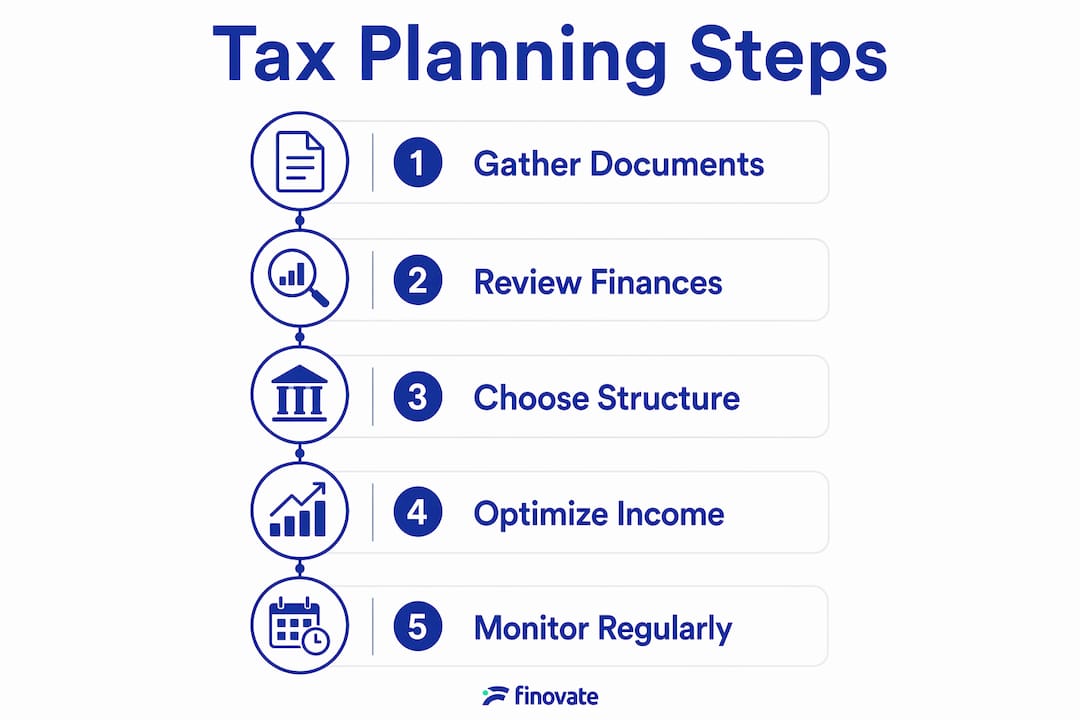
Here is how to approach it step by step:
- Set your salary at a level that covers personal living costs. A lower salary reduces your personal income tax exposure, since Finnish income tax is progressive and rises steeply above moderate earnings.
- Distribute remaining profits as dividends. Dividends from a non-listed company are taxed partly as capital income and partly as earned income, depending on the company's net assets. When structured correctly, combining salary with dividends can reduce your total tax burden to as low as 7 to 8%. That compares very favourably with the top marginal income tax rate, which exceeds 50% in many Finnish municipalities.
- Use tax-exempt travel allowances. Mileage reimbursements and daily allowances paid according to the Finnish Tax Administration's confirmed rates are fully deductible for the company and completely tax-free for you as the recipient. This makes them one of the most efficient income extraction methods available.
- Track dividend limits carefully. The 8% rule on net assets determines how much of your dividend is taxed as capital income rather than earned income. Exceeding this threshold increases your tax rate on the excess amount.
- Avoid common mistakes. Paying yourself a salary that is too low can trigger YEL (entrepreneur's pension insurance) complications. Paying too high a salary eliminates the dividend advantage. The optimal balance depends on your company's net assets and your personal income needs.
Pro Tip: Review your company's net assets at the end of each financial year before deciding on dividend distribution. A small increase in net assets, for example by retaining more profit, can raise the 8% threshold and allow a larger tax-efficient dividend the following year. For a deeper look at capital income tax optimisation, Finovate's blog covers this in detail.
What business structures can enhance your corporate tax planning?
Holding companies are not reserved for large corporations. Small Finnish businesses can access holding structures that allow tax-free dividend flow between entities, asset protection, and tax deferral benefits. Many SME owners overlook this option entirely, which is a missed opportunity.
The table below compares operating directly through a single company versus using a holding structure:
| Feature | Single operating company | Holding company structure |
|---|---|---|
| Dividend taxation between entities | Taxed as income | Tax-free under Finnish participation exemption |
| Asset protection | Assets exposed to operational risk | Assets held separately from trading risk |
| Profit reinvestment | Reinvested at 20% corporate tax rate | Reinvested tax-efficiently via holding entity |
| Exit strategy | Proceeds taxed as capital gain | Holding company can sell shares with tax advantages |
| Complexity | Low | Moderate, requires professional setup |
A holding company works by sitting above your operating company. Profits flow up as tax-free dividends and can be reinvested, held, or distributed in a controlled way. Holding companies effectively protect assets from operational risks and provide a tax-efficient platform for reinvestment and exit planning. If you are considering selling your business in the next five to ten years, a holding structure set up now can make a material difference to your net proceeds.
The right time to consider restructuring is before a major transaction, not during one. Speak to a tax adviser early if your company is growing, accumulating significant assets, or if you are planning to bring in co-owners.
How to manage deductible expenses and timing to reduce taxable profit
Deductible expenses directly reduce your company's taxable profit, which reduces the 20% corporate tax you owe. The key is knowing what qualifies, documenting it correctly, and timing it strategically.
Common deductible expenses for Finnish SMEs include:
- Travel costs: Mileage, public transport, flights, and accommodation for business purposes, all supported by receipts and a travel log.
- Training and professional development: Courses, seminars, and subscriptions directly related to your business activity.
- Marketing and advertising: Website costs, social media advertising, printed materials, and promotional events.
- Equipment and technology: Computers, phones, and software used for business. These may be deducted immediately or depreciated over several years depending on value and use.
- Office costs: Rent, utilities, and a proportion of home office costs if you work from home regularly.
Timely and accurate documentation of these expenses is what separates a successful deduction claim from a rejected one. The Finnish Tax Administration expects clear justification for every business expense.
Timing also matters. Deferring income and accelerating expenses within an accounting period can reduce taxable profit without affecting your operations. For example, if you plan to purchase new equipment in early January, buying it in late December instead brings the deduction into the current tax year. Similarly, invoicing a large client in January rather than December defers that income by one full tax year.
| Timing strategy | Effect on taxable profit | Example |
|---|---|---|
| Accelerate deductible expenses | Reduces current year profit | Purchase equipment in December, not January |
| Defer invoicing where possible | Reduces current year income | Issue invoice in January for December work |
| Use depreciation on assets | Spreads deduction over time | Claim annual depreciation on machinery |
| Prepay deductible costs | Brings forward deduction | Pay annual software licence in December |
How to integrate tax planning into your ongoing financial management
Tax planning is not an end-of-year task. It must be integrated into strategic financial management because every major business decision, from hiring staff to signing a lease, carries a tax implication. The Finnish Tax Administration has reduced proactive guidance in recent years while increasing post-factum tax control. This means the burden of getting it right falls more heavily on you as the business owner.
Effective ongoing tax management involves three habits. First, review your financial position quarterly and adjust your prepayment tax if your income has changed significantly. Second, consult your accountant or tax adviser before making large financial decisions, not after. Third, use income and expense forecasts to anticipate your year-end tax position and act while you still have time to influence it.
Legislation changes regularly. The rules governing YEL income, dividend taxation thresholds, and deductible expense categories are all subject to annual review. A tax adviser who works with Finnish SMEs will flag relevant changes before they affect your filing. For a broader view of tax strategies for Finnish SMEs, Finovate's resources cover the most current approaches.
Pro Tip: Ask your accountant to prepare a tax forecast in October or November each year. This gives you six to eight weeks to take action before your financial year closes, whether that means accelerating a purchase, adjusting your salary, or distributing a dividend.
Key takeaways
Effective company tax planning in Finland requires combining the right business structure, income extraction strategy, and deductible expense management into a continuous, year-round process.
| Point | Details |
|---|---|
| Know your three tax rates | Corporate tax is 20%; salary and dividends are taxed differently, and the gap creates planning opportunities. |
| Optimise salary and dividends | A low salary combined with tax-efficient dividends can reduce your total tax burden to as low as 7 to 8%. |
| Use tax-exempt allowances | Travel and mileage allowances are fully deductible for the company and completely tax-free for you. |
| Consider a holding structure | Holding companies allow tax-free dividend flow between entities and protect assets from operational risk. |
| Plan throughout the year | Quarterly reviews and a November tax forecast give you time to act before your financial year closes. |
Why most Finnish SMEs leave tax savings on the table
Working with small and medium-sized business owners in Finland, I see the same pattern repeatedly. Owners spend considerable energy on their product or service and treat tax as something to deal with in the spring, once the numbers are in. By then, the opportunities have closed.
The salary-dividend mix is the clearest example. Most owners I speak to know it exists, but few have actually calculated their optimal split based on their company's current net assets. They default to a salary that feels reasonable and distribute whatever is left, without checking whether the 8% dividend threshold has been used efficiently. That single calculation, done once a year with proper figures, can save thousands of euros.
Travel allowances are even more overlooked. They are straightforward, fully legal, and require only a proper travel log and adherence to the Finnish Tax Administration's confirmed rates. Yet many entrepreneurs either do not claim them at all or claim them inconsistently, which creates documentation risk.
My honest view is that the complexity of Finnish tax planning is overstated. The rules are specific, but they are not impenetrable. What they require is consistency, good records, and a willingness to plan ahead rather than react. The entrepreneurs who benefit most from the system are not the ones with the most complex structures. They are the ones who apply simple strategies correctly, every year, without exception.
If you are not yet working with a tax adviser who understands Finnish SME taxation specifically, that is the single most valuable step you can take. The cost of good advice is almost always lower than the cost of missed opportunities or a tax authority correction.
— Busayo
How Finovate supports your company tax planning
Finovate works with Finnish SMEs to take the complexity out of tax planning and financial management. Whether you need help with bookkeeping, payroll, VAT filings, or structuring your salary and dividend strategy, we provide practical support grounded in Finnish tax law. Our monthly invoicing service is designed for small business owners who want accurate, compliant financial management without the overhead of a full in-house finance function. We handle the numbers so you can focus on running your business. If you are ready to approach your taxes with a clear plan rather than a year-end scramble, Finovate is here to help. Visit finovate.fi to learn more about our accounting and tax services.
FAQ
What is company tax planning?
Company tax planning is the process of organising your business finances and decisions to legally reduce your tax liability. It includes strategies such as optimising salary and dividends, claiming deductible expenses, and choosing the right business structure.
How much is corporate tax in Finland?
Corporate tax in Finland is a fixed rate of 20% on company profits. Salary and dividends are taxed separately under personal income tax and capital income tax rules.
What is the most tax-efficient way to extract income from a Finnish company?
Combining a modest salary with dividends is the most tax-efficient approach. When structured correctly within the 8% net assets rule, the total tax burden on dividends can be as low as 7 to 8%, compared to progressive income tax rates that can exceed 50%.
Are travel allowances tax-deductible in Finland?
Yes. Travel allowances paid at the Finnish Tax Administration's confirmed rates are fully deductible for the company and completely tax-free for the recipient, making them one of the most efficient benefits available to Finnish entrepreneurs.
When should I consider setting up a holding company?
Consider a holding company if your business is accumulating significant assets, you are planning a future sale, or you want to reinvest profits tax-efficiently. Setting up the structure before a major transaction, rather than during one, produces the best outcome.