

Open your business bank account with three things ready: a government photo ID for every signatory, your formation or registration document, and your tax identification number (an EIN, SSN, or the local equivalent). Almost every application hinges on two rules banks must follow: the Customer Identification Program (CIP) and the Beneficial Ownership Rule, which together dictate what you'll be asked to prove.
- Government-issued photo ID for each signatory
- Business formation or registration paperwork
- Tax identification number (EIN, SSN, or local equivalent)
Pro Tip: *If a business partner can't attend in person, arrange certified or notarised signatures in advance, and bring a recent utility bill showing your registered address. Both are common causes of delay. Finovate regularly helps clients assemble this paperwork correctly the first time.
Key Takeaways
Opening a business bank account successfully depends on preparing verified identity, formation, and tax documents for every qualifying owner before you apply.
| Point | Details |
|---|---|
| Prepare the core three | Government photo ID, formation documents, and a tax ID cover most bank requirements. |
| Know your entity's extras | Partnerships, corporations, and foreign-owned entities each require additional paperwork. |
| Budget time and money | Expect same day to three business days for simple cases, and modest opening deposits from $0 to $100. |
| Avoid the common rejection triggers | Mismatched addresses, absent beneficial owners, and vague industry descriptions cause most delays. |
| Set up bookkeeping immediately | Finovate helps configure bank feeds, invoicing, and tax sub-accounts right after account opening. |
Table of Contents
- Why you need a separate business bank account
- What types of business bank accounts are available?
- What documents do banks require to open an account?
- How do entity-specific requirements differ?
- How do you apply for a business bank account step by step?
- How long does it take and what does it cost?
- What do banks check, and why do applications get rejected?
- Which account features actually save you time?
- Checklist: what to prepare before you apply
- What common problems delay account opening?
- What should you do once the account is open?
- When does it make sense to bring in an accountant?
- How Finovate helps with the whole process
- Where to read more
- Frequently asked questions
- Sources
Why you need a separate business bank account
Mixing personal and business money is the fastest way to undermine the liability protection a limited company is supposed to give you. Courts have pierced the corporate veil when owners treat company funds as their own, which defeats the point of incorporating in the first place. Keeping finances separate also makes bookkeeping and tax reporting dramatically simpler, because every transaction on the statement is genuinely a business one.
There are practical wins too:
- Payroll runs cleanly from a dedicated account rather than a personal one.
- Merchant services and card processing typically require a business account to activate.
- Invoicing and reconciliation take a fraction of the time when personal spending isn't mixed in.
Banks enforce this separation from their side as well. The Beneficial Ownership Rule requires financial institutions to verify who actually owns and controls the business, and CIP obliges them to confirm identity before any account opens. Neither is optional, and both shape almost every document request you'll receive.
What types of business bank accounts are available?
Most banks offer four core account types, and picking the right one from the start saves you switching costs later:
- Business current (checking) account — the day-to-day account for receiving payments and paying suppliers.
- Business savings account — for holding reserves or tax provisions separately from operating cash.
- Merchant services account — links to your current account to process card payments; essential for retail or e-commerce.
- Multi-currency account — holds and settles in several currencies, built for exporters or businesses billing overseas clients.
A sole trader running a local service business usually only needs a current account. A multi-location SME processing card payments needs current plus merchant services. An exporter invoicing in dollars and euros benefits enormously from multi-currency capability, since it avoids repeated conversion fees on every incoming payment.
What documents do banks require to open an account?
Almost every bank in the UK and US asks for the same three categories: proof of identity for signatories, proof the business exists, and a tax identification number. The specifics shift depending on your entity type, but the underlying document checklist rarely changes in substance.
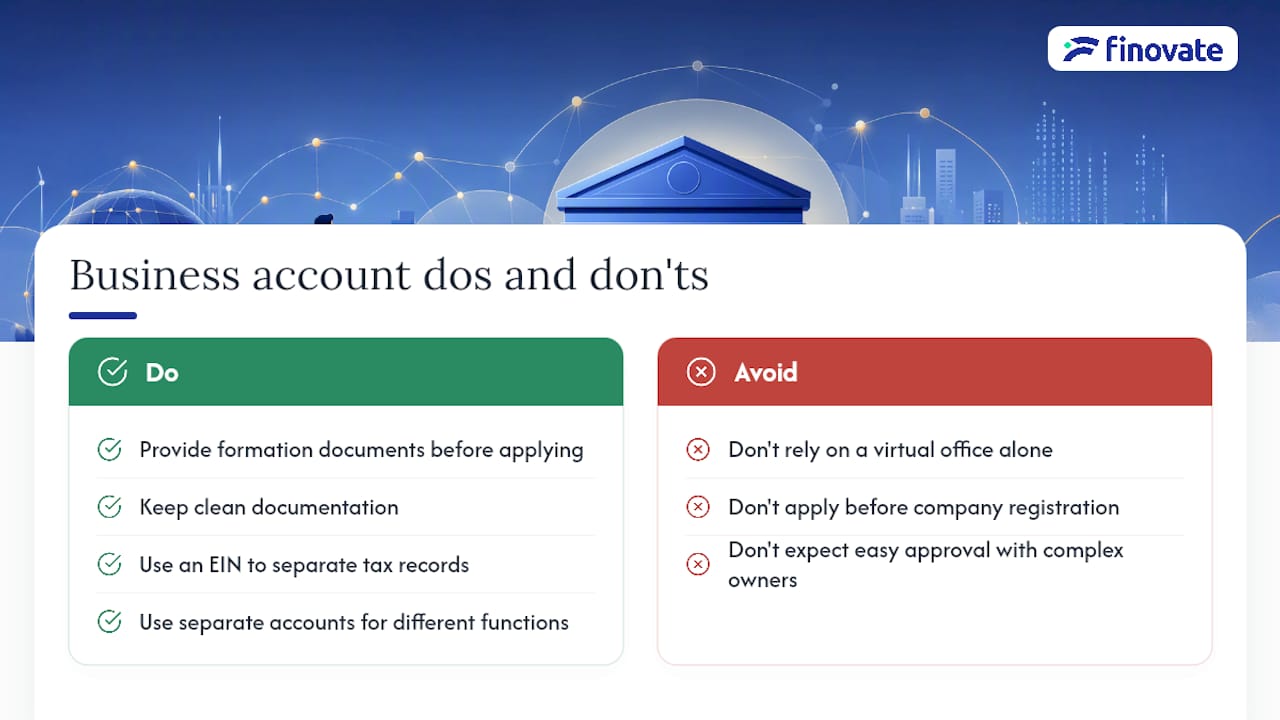
- Government photo ID (passport or driving licence) for every signatory
- Formation or registration documents (articles of incorporation, partnership agreement, or DBA filing)
- Tax ID: EIN, SSN, or the equivalent in your jurisdiction
- Proof of address: a recent utility bill, signed lease, or property deed
Virtual offices and P.O. boxes rarely satisfy the address verification requirement on their own; banks generally want a physical address they can cross-check against a bill or lease. For beneficial owners, CIP requires four specific data points: full legal name, date of birth, residential address, and an identification number, usually an SSN or passport number.
How do entity-specific requirements differ?
Your business structure changes what you're asked to produce, sometimes significantly.
- Sole trader or sole proprietorship: an SSN is often enough, though many owners still apply for an EIN to keep tax filings separate from personal ones.
- Partnerships: you'll need the partnership agreement itself, and banks frequently want every partner present, or notarised authorisation from anyone who can't attend.
- Limited companies and corporations: expect to produce articles of incorporation, company bylaws, a list of current officers, and sometimes a corporate resolution naming who can open and operate the account.
- Foreign-owned or foreign-registered entities: a certificate of authority or foreign registration is usually mandatory, and non-resident owners face extra identity verification.
Missing notarisation is one of the most common reasons multi-owner applications stall.*
How do you apply for a business bank account step by step?
The process is largely the same everywhere: pick the right account, gather your paperwork, choose your channel, and complete verification.
- Choose your bank and account type based on your transaction volume, whether you need merchant services, and any multi-currency needs.
- Gather documents — ID, formation papers, tax ID, and proof of address, per your entity type.
- Complete the application online or in branch, providing business details and expected activity.
- Submit or present identification for every signatory listed on the account.
- Complete beneficial ownership disclosures for anyone owning 25% or more of the business.
- Fund the account to activate it, usually via transfer or an initial deposit.
A sole trader can often finish this in a single sitting online. Multi-owner LLCs and corporations usually take longer, because every officer or member may need to be present or provide notarised authorisation. Some banks still require a branch visit for complex ownership structures, even when the rest of the process is digital.
How long does it take and what does it cost?

A straightforward sole trader application can be approved the same day, or within three business days at most. Multi-owner businesses, foreign-owned entities, or those in higher-risk industries commonly take a week or longer, mainly due to beneficial ownership verification.
Costs vary by provider type:
- Traditional banks often ask for an initial deposit between $25 and $100.
- Online-first providers may open accounts with $0 down but charge monthly fees unless you meet an activity or balance threshold.
- Merchant service fees sit on top of standard account costs and depend on your transaction volume.
Many providers set modest opening deposits precisely to keep the barrier to entry low, while recovering revenue through monthly maintenance fees that are waived once you hit a minimum balance or transaction count.
What do banks check, and why do applications get rejected?
Banks verify four things before approving any account: your identity, your beneficial owners' identities, your business activity, and your address. These checks aren't arbitrary; they stem directly from CIP and anti-money-laundering obligations.
- KYC/AML screening against sanctions and watchlists for every named individual.
- Beneficial ownership verification for anyone holding 25% or more of the company.
- Source of funds review, particularly for larger opening deposits.
- Industry classification checks, often using NAICS or similar codes to flag higher-risk sectors.
Rejections and delays usually trace back to a handful of causes: a registered address that doesn't match your documents, an absent beneficial owner with no notarised authorisation, or a business activity that reads as high-risk without adequate explanation. Being specific and upfront about what your business actually does heads off most of these problems before they start.
Which account features actually save you time?
Prioritise features that cut manual bookkeeping work over ones that just look impressive on a brochure. A bank feed that syncs automatically into your accounting software saves hours every month; a flashy app with no export function doesn't.
Evaluate accounts against this checklist:
- Direct bank feeds into accounting software, avoiding manual CSV imports.
- Multi-user access so your bookkeeper can view transactions without sharing your login.
- Invoicing tools built into the account or easily connected to one.
- Payroll connectivity for automated wage payments and payslip generation.
- Card controls to set spending limits per employee or department.
Bank feeds that connect directly to platforms your accountant already uses cut reconciliation time considerably, since transactions arrive categorised rather than needing manual entry from statements.
Checklist: what to prepare before you apply
- Government photo ID for each signatory
- Formation or registration document
- Tax ID (EIN, SSN, or equivalent)
- Proof of address (utility bill, lease, or deed)
- Beneficial ownership details for all qualifying owners
- Funding method for your opening deposit
Print this list or save it to your phone. Digital uploads are usually accepted for online applications, but branch visits often still require original documents, so check with your chosen bank before you travel.
What common problems delay account opening?
Most delays come down to inconsistency rather than missing paperwork entirely. Being complete, consistent, and transparent about who owns the business and what it does resolves the majority of issues before they escalate.
- Mismatched addresses between your ID, formation documents, and utility bill. Fix: update whichever document is outdated before applying.
- Absent beneficial owners. Fix: arrange notarised identity verification in advance.
- Unsupported virtual addresses. Fix: provide a lease or utility bill for a physical location instead.
- NAICS or industry mismatches. Fix: describe your primary revenue activity precisely, rather than a generic category.
- Poor-quality document scans. Fix: rescan in good light, in colour, with all four corners visible.
What should you do once the account is open?
Configuring the account correctly on day one saves far more time than fixing it three months later. Start by connecting bank synchronisation to your accounting software and mapping transactions to a basic chart of accounts that mirrors your bank feed.
- Assign payment categories so recurring transactions post automatically.
- Set up invoicing and merchant reconciliation so incoming payments match outstanding invoices.
- Create tax-specific sub-accounts for VAT, PAYE, or corporation tax, so liabilities don't get lost in general funds.
- Grant multi-user access to your bookkeeper, rather than sharing your personal login.
Pro Tip: Tag transactions as they arrive rather than batching them monthly. It takes seconds per transaction and saves hours at quarter-end. Direct bank feeds with transaction tagging are the single biggest time-saver Finovate sees clients underuse, particularly in the first few months after opening an account.
When does it make sense to bring in an accountant?
An accountant's role during onboarding is narrower than people expect: reviewing document accuracy, confirming signer authority matches your company's legal structure, and occasionally liaising directly with the bank when ownership questions arise. It's not glamorous work, but it catches errors that cause weeks of delay.
| Situation | Worth hiring an adviser? |
|---|---|
| Single owner, straightforward structure | Usually not necessary |
| Multiple owners or partners | Yes, especially for notarisation logistics |
| Foreign ownership involved | Yes, verification is more complex |
| High-risk NAICS classification | Yes, to pre-empt underwriting questions |
The right accounting support tends to pay for itself the moment it prevents a rejected application or a week-long delay.
How Finovate helps with the whole process
Finovate supports the parts of account opening that entrepreneurs find most tedious: getting the paperwork right and making the account work smoothly with your books from day one.
- Preparing formation and beneficial ownership documents so they're consistent across every form
- Setting up bank synchronisation and chart-of-accounts mapping once your account is live
- Configuring invoicing and merchant reconciliation to match incoming payments automatically
- Connecting payroll so wage payments post correctly against the right sub-accounts
Rather than leaving you to untangle bank feeds and tax sub-accounts on your own, Finovate builds the bookkeeping structure around your new account from the outset, so nothing needs re-doing later. If you're preparing to open an account or have just done so, visit Finovate's accounting services to see how the setup work gets handled for you.
Where to read more
These sources offer official templates, registration guidance, and document examples referenced throughout this guide.
- Novo's document checklist for a full breakdown of standard bank requirements
- Wells Fargo's required documents page for address verification specifics
- Chase's knowledge centre for entity-specific presence requirements
- Old National Bank's guide on timing your account opening
Frequently asked questions
How many business bank accounts can I have? There's no fixed limit. Many businesses hold a current account, a savings account, and a merchant services account simultaneously, each serving a different function.
Is it hard to get approved for a business bank account? Approval is usually straightforward for sole traders with clean documentation. It gets more complex with multiple owners, foreign ownership, or high-risk industry classifications.
Do sole proprietorships need an EIN to open an account? Not always. Many banks accept an SSN for sole proprietors, though using an EIN keeps business and personal tax records cleaner.
What if my business uses a virtual office address? Most banks want a verifiable physical address backed by a utility bill or lease. A virtual office alone often isn't sufficient for verification.
Can I open a business account before registering my company? No. Banks require proof of formation or registration before opening any business account, since that document establishes the business's legal existence.
This article is general information, not a substitute for advice from a qualified financial advisor. Consult a qualified financial professional about your own circumstances before acting on anything here.
Sources
- Business checking account requirements: The complete document checklist | Novo
- What you need to open a business checking or savings account | Wells Fargo
- How to open a business checking account | Chase (knowledge centre)