

Most everyday business costs are deductible from your taxable income, provided they meet HMRC's 'wholly and exclusively' test. That single rule governs almost every claim you will make, whether you are a sole trader filing Self Assessment or a limited company preparing a Corporation Tax return. Before you start, here are the eight categories to work through:
- Office and stationery costs
- Travel and vehicle expenses (excluding ordinary commuting)
- Staff costs, including wages and employer National Insurance contributions
- Premises costs: rent, business rates, and utilities
- Marketing and advertising
- Professional fees and insurance
- Stock and cost of sales
- Capital items (claimed through capital allowances, not as direct revenue expenses)
That last point matters more than most people expect. A laptop or a piece of machinery is not simply an expense you deduct in full the year you buy it. Capital items that create an enduring benefit, typically those expected to last more than two years, go through the capital allowances system. The Annual Investment Allowance can give you 100% first-year relief on qualifying plant and machinery up to the current limit, but you need to classify the item correctly first.
Key takeaways
Claiming the right business expenses requires correct classification, contemporaneous records, and a clear apportionment method applied consistently throughout the tax year.
| Point | Details |
|---|---|
| 'Wholly and exclusively' is the test | Every expense must be incurred purely for business; mixed costs require a documented apportionment. |
| Capital items need separate treatment | Equipment with a useful life over two years goes through capital allowances, not a direct revenue deduction. |
| Simplified expenses suit most sole traders | AMAP rates (55p per mile for the first 10,000 miles) and home working flat rates are simpler and often comparable to actual costs. |
| Keep records for at least five to six years | Self-employed individuals retain records for five years post-deadline; limited companies for six years from the accounting period end. |
| Trading allowance and expenses cannot both apply | Claiming the £1,000 trading income allowance prevents you from also deducting itemised business expenses for the same income. |
Table of Contents
- What does your business expense checklist actually cover?
- How does HMRC decide whether an expense is allowable?
- How do you split costs that are partly personal and partly business?
- Capital allowances, the Annual Investment Allowance, and simplified expenses
- What records do you need to keep, and for how long?
- Where and how do you claim your expenses?
- What mistakes and red flags should you avoid?
- A printable checklist and sample expense entries
- When should you consult an accountant or tax adviser?
- An accountant's perspective on what actually matters
- Ready to get your expenses in order? Finovate can help
- Sources
What does your business expense checklist actually cover?
The categories below form the core of any practical tax deduction checklist for UK small businesses. Work through each one, tick off what applies to your business, and flag anything that looks like a capital purchase for separate treatment.
Office and stationery
- Printer paper, pens, folders, and general stationery
- Postage and courier costs for business correspondence
- Printer ink and toner cartridges
- Small office equipment (staplers, calculators) — likely revenue if under £100 per item
- Computer software subscriptions (monthly SaaS tools) — revenue
- Computers, tablets, or monitors — likely capital; claim via Annual Investment Allowance
Communications and software subscriptions
- Business broadband and telephone line rental
- Mobile phone contract (business proportion only if also used personally)
- Cloud storage, project management tools, and accounting software subscriptions
- Domain registration and website hosting fees
Travel and vehicle costs
According to HMRC's self-employed expenses guidance, travel costs are allowable when the journey is wholly for business, but ordinary commuting between home and a permanent workplace is not deductible.
- Train, bus, and taxi fares for business journeys
- Hotel accommodation and subsistence on overnight business trips
- Business mileage in your own vehicle (at HMRC's Approved Mileage Allowance Payment rates)
- Parking fees and road tolls on business journeys
- Car hire for business trips
- Daily commute to a fixed office: not allowable
Premises costs
- Office or workshop rent
- Business rates
- Water, gas, and electricity for business premises
- Building and contents insurance for business premises
- Cleaning and security costs
- Home office costs (apportioned — see Section 4)
Staff costs
- Gross wages and salaries
- Employer National Insurance contributions
- Employer pension contributions
- Recruitment agency fees
- Subcontractor payments (where the subcontractor is genuinely self-employed)
- Staff training directly related to current duties
- The annual staff party exemption applies up to a certain amount per head; spending beyond that may become a taxable benefit.
Marketing and advertising
- Website design and development costs (recurring maintenance is revenue; initial build may be capital)
- Online advertising spend (Google Ads, social media ads)
- Print advertising, flyers, and brochures
- PR agency fees
- Branded merchandise given to customers (subject to the gifts rules — see Section 8)
Professional fees and insurance
- Accountancy and bookkeeping fees
- Legal fees for business contracts and debt recovery
- Professional indemnity insurance
- Public liability insurance
- Business interruption insurance
- Membership fees for professional bodies directly relevant to your trade
Stock and cost of sales
- Raw materials and components
- Goods purchased for resale
- Packaging materials
- Direct production costs
Repairs and maintenance
- Repairs to business equipment (not improvements — improvements may be capital)
- Routine maintenance of business premises
- Replacement of like-for-like parts
Bank charges and finance costs
- Bank account fees and transaction charges
- Interest on business loans (subject to specific rules for companies)
- Hire purchase interest (the interest element only; the asset itself goes through capital allowances)
Training
- Courses that update or maintain skills you already use in your trade
- Professional development directly linked to your current business activity
- New skills that open an entirely different trade: not allowable
Bad debts
- Specific bad debts written off in the accounting period (traditional accruals basis only; not available under cash basis)
How does HMRC decide whether an expense is allowable?
The legal test is straightforward to state and sometimes difficult to apply: an expense must be incurred 'wholly and exclusively' for the purposes of the trade. HMRC's guidance for the self-employed and the equivalent for companies both use this language, and it has been tested extensively in case law.
Two concrete examples:
A plumber buys a set of specialist pipe-cutting tools used only on client jobs. The cost passes the test: the purpose is entirely business.
The word 'exclusively' is the one that catches people out. If any personal benefit exists and no clear split is possible, the entire expense risks disallowance. The Business Income Manual at BIM37007 makes clear that paying from a business bank account does not, by itself, make a cost allowable. The purpose of the expenditure is what matters.
Revenue versus capital
A revenue expense is one that keeps the business running day to day: rent, wages, consumables, software subscriptions. A capital expense creates an enduring asset or benefit, typically something with a useful life beyond two years. Treating a capital purchase as a revenue expense is one of the most common errors HMRC identifies in enquiries. The company expenses guidance sets out the distinction clearly: revenue expenses reduce profit in the year they arise; capital items are relieved through the capital allowances system over time, or in full via the Annual Investment Allowance where it applies.
When an item sits in a grey area, such as a significant website rebuild or a bespoke piece of software, professional advice is sensible before you file. Getting the classification wrong can result in an incorrect return and potential penalties.
How do you split costs that are partly personal and partly business?
Only the business proportion of a mixed-use cost is allowable. HMRC expects you to hold contemporaneous records that show how you arrived at the split, not a rough estimate made at year-end. The Business Income Manual is explicit: auditors look for clear mathematical apportionment supported by evidence gathered at the time.
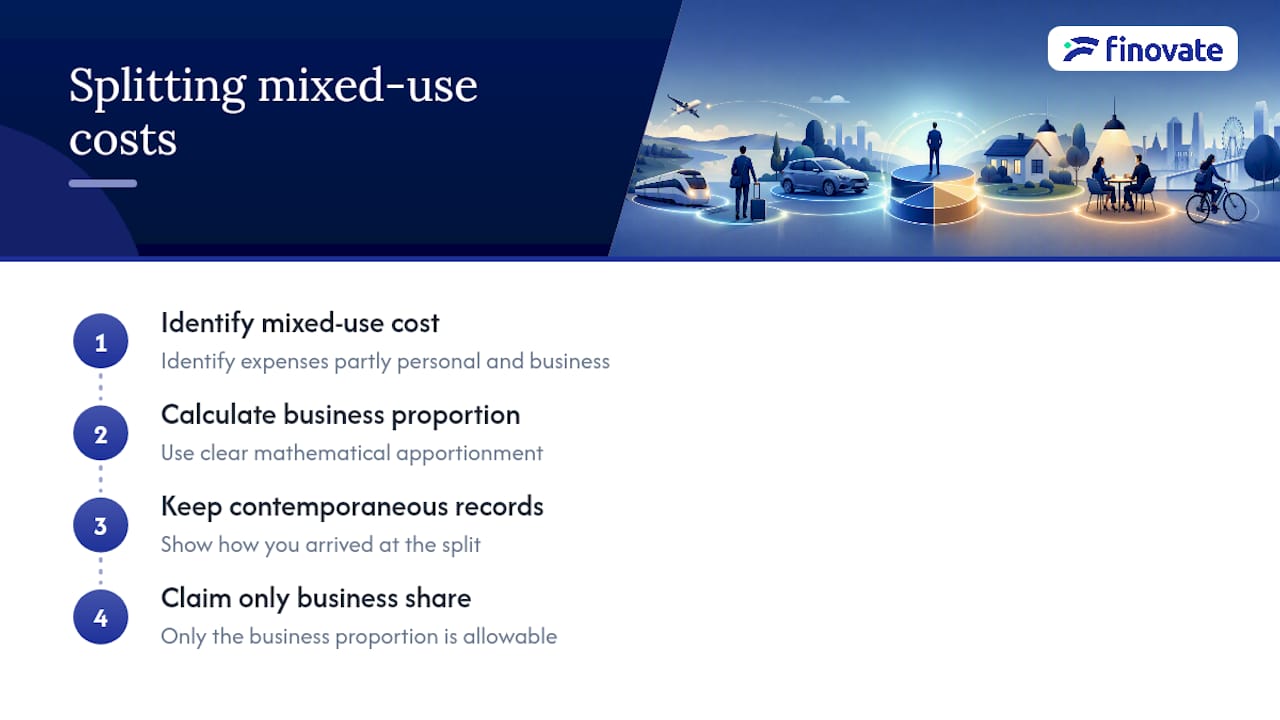
Worked example 1: home office costs
Suppose your home has eight rooms of roughly equal size and you use one room exclusively as an office for 40 hours a week out of a total 168 hours.
- Calculate the room proportion: 1 room ÷ 8 rooms = 12.5%
- Calculate the time proportion: 40 hours ÷ 168 hours = 23.8%
- Combined apportionment: 12.5% × 23.8% ≈ 3%
- Apply that percentage to total household costs (mortgage interest or rent, council tax, utilities, insurance) for the year.
The alternative is HMRC's simplified flat rate for home working, which avoids the calculation entirely. The detailed helpsheet on expenses and allowances sets out the flat rates: £10 per month for 25–50 hours of business use, £18 per month for 51–100 hours, and £26 per month for over 100 hours. For a low-use home office, the flat rate is often simpler and produces a comparable result. For a dedicated room used heavily, actual apportionment usually yields a higher deduction.
Worked example 2: vehicle mileage log
Under the simplified mileage method, you claim at the Approved Mileage Allowance Payment (AMAP) rate: 55p per mile for the first 10,000 business miles in the tax year, and 25p per mile thereafter. If you use actual vehicle costs instead, you apportion total running costs (fuel, insurance, servicing, road tax) by the ratio of business miles to total miles driven. High-mileage drivers often find the actual cost method more favourable; for lower mileage, the AMAP rate is simpler and frequently produces a similar or better result.

Pro Tip: Keep your mileage log in a dedicated app or a shared spreadsheet updated after each journey. A log reconstructed at year-end from memory will not satisfy HMRC if they open an enquiry. Tools such as Prism Wallet can help freelancers and sole traders track mileage and daily costs in real time, reducing the administrative burden significantly.
Capital allowances, the Annual Investment Allowance, and simplified expenses
Use a revenue deduction for costs that recur and keep the business running. Use capital allowances for items that create an enduring benefit, such as plant, machinery, and some fixtures.
The Annual Investment Allowance gives 100% first-year relief on qualifying plant and machinery up to the current limit. That means the full cost of a qualifying item reduces your taxable profit in the year of purchase, rather than being spread over several years through writing-down allowances. Most common business equipment, from CNC machines to office furniture, qualifies. Cars do not qualify for AIA and follow separate rules.
Simplified expenses are available to sole traders and partnerships (not limited companies). They cover three areas:
- Home working (the flat rates described above)
- Business mileage (the AMAP rates)
- Living in your business premises (a flat-rate private use adjustment for bed-and-breakfast owners and similar)
Decision checklist: revenue expense, capital allowances, or simplified expenses?
- Is the item a recurring cost with no lasting asset created? Use a revenue deduction.
- Does the item have a useful life of more than two years and create an enduring benefit? Claim via capital allowances; check whether AIA applies.
- Is the item a vehicle or home office used partly for business? Choose between simplified mileage/flat rate or actual apportionment, and stick with that method for the full tax year.
- Is your business a limited company? Simplified expenses are not available; use actual apportionment for mixed-use costs.
The expenses and allowances helpsheet contains worked examples and tables that show which everyday items are revenue and which need capital allowance treatment, making it a useful reference when you are unsure.
What records do you need to keep, and for how long?
Keep every receipt, invoice, bank statement, and contemporaneous log that supports a claim. For self-employed individuals, HMRC requires records to be retained for at least five years after the 31 January submission deadline for the relevant tax year. For limited companies, the minimum is six years from the end of the accounting period. If HMRC opens an enquiry, they can request records going back further in cases of suspected fraud.
Records to keep by expense type:
- Supplier invoices and receipts: date, supplier name, amount, and description of goods or services
- Mileage logs: date, start and end point, purpose of journey, miles driven (business and private)
- Home office apportionment: a written calculation showing the method used, the household costs included, and the resulting percentage, updated annually
- Payroll records: payslips, RTI submissions, employer NIC calculations, and pension contribution records
- VAT records (if registered): VAT invoices, import VAT certificates, and the VAT account; retain for at least four years, though aligning with the six-year rule is prudent
- Bank and credit card statements: to reconcile every transaction against a receipt or invoice
- Contracts and agreements: for subcontractors, professional services, and leases
Digital record-keeping best practice:
Scan or photograph receipts immediately after a transaction and save them with a consistent file name: YYYY-MM-DD_SupplierName_Amount. Store files in a cloud folder with automatic backup so that a lost phone or crashed hard drive does not destroy your evidence. Accounting software such as Xero, FreeAgent, and QuickBooks all support receipt capture via mobile app, with optical character recognition (OCR) that reads supplier name, date, and amount directly into the transaction record. That removes manual data entry and creates a timestamped audit trail automatically.
For a step-by-step guide to logging and reconciling expenses throughout the year, the business expense tracking tutorial covers the full workflow from capture to year-end reconciliation.
Where and how do you claim your expenses?
Self-employed individuals claim allowable expenses on the Self Assessment return. If your annual turnover is below the threshold for the short form, you report total expenses in a single box on the SA103S. Above that threshold, or if you want to show a detailed breakdown, you use the SA103F, which has separate boxes for each expense category. The SA103F notes give box-by-box guidance and explain the interaction with the £1,000 trading income allowance: if you claim that allowance, you cannot also claim allowable expenses or simplified expenses for the same income. For most small traders with real costs above £1,000, itemised expenses produce a better result.
Limited companies deduct allowable revenue expenses before calculating Corporation Tax on the CT600 return. The company expenses guidance confirms that revenue expenses not specifically disallowed and incurred wholly and exclusively for business reduce the company's taxable profit directly.
The claiming workflow, step by step:
- Record each expense at the point of purchase, with the receipt or invoice attached.
- Reconcile your records against your bank statement at least monthly to catch missing items.
- Allocate each transaction to the correct expense category in your bookkeeping software.
- At year-end, review the expense list for any items that should be reclassified as capital.
- Include the categorised totals in your accounts and transfer them to the correct boxes on your Self Assessment or CT600 return.
Cash basis versus accruals: Under the cash basis (available to most sole traders with turnover below the relevant threshold), you record income when received and expenses when paid. Under traditional accruals accounting, you match income and expenses to the period they relate to, regardless of when cash moves. The SA103S guidance explains the simplified reporting options available to small traders. Limited companies must use accruals.
Software used by UK small businesses: Xero, FreeAgent, and QuickBooks are the most widely used bookkeeping platforms among UK sole traders and small companies. All three connect directly to UK bank feeds, categorise transactions automatically, and produce expense reports that map to Self Assessment and Corporation Tax categories. FreeAgent is particularly popular with freelancers and is offered free to many RBS and NatWest business account holders. Xero and QuickBooks suit businesses with more complex needs, including payroll and multi-currency transactions.
For a broader guide to managing expenses across the financial year, the 2026 expense management guide covers planning, reconciliation, and year-end preparation in detail.
What mistakes and red flags should you avoid?
HMRC's enquiry process focuses on patterns that suggest errors or deliberate misreporting. Knowing what triggers scrutiny helps you avoid it.
Most frequent errors:
- Claiming private costs as business expenses: personal groceries, family holidays, or clothing that is not a uniform or protective gear
- No apportionment on mixed-use items: claiming 100% of a mobile phone bill when the phone is also used personally
- Insufficient receipts: bank statements alone are not enough; HMRC expects the underlying invoice or receipt
- Misclassifying capital items as revenue: expensing a £3,000 piece of equipment in full rather than routing it through capital allowances
- Using the trading allowance incorrectly: claiming the £1,000 trading income allowance and also deducting expenses against the same income, which the SA103F notes explicitly prohibit
Disallowed items and why they fail:
- Client entertainment: HMRC does not allow the cost of entertaining clients or suppliers, even where the meeting has a clear business purpose. Staff entertaining up to £150 per head annually is exempt.
- Fines and penalties: a parking fine or a late-filing penalty is not a business cost; it is a consequence of breaking a rule and is specifically disallowable.
- Ordinary clothing: a suit worn to client meetings is not allowable because it also serves a private purpose. Protective clothing (hard hats, hi-vis jackets) and uniforms with a permanent business logo are allowable.
- Personal travel: the daily commute between home and a fixed place of work is not deductible, regardless of how far you travel.
Audit red flags HMRC looks for:
- Round-number expenses appearing consistently (e.g., exactly £500 every month with no supporting invoices)
- Expenses that are disproportionately high relative to turnover in the same sector
- Absence of mileage logs where vehicle costs are claimed
- Inconsistent treatment of the same type of cost across different years
If you spot any of these in your own records, act before you file. Correct the classification, gather the supporting evidence, and if the issue is material, consider whether an amended return or voluntary disclosure is appropriate. Seeking professional advice at that point is far less costly than waiting for HMRC to raise an enquiry.
A printable checklist and sample expense entries
Copy the table below into a spreadsheet or print it for your next meeting with an accountant. The 'Evidence to keep' column tells you exactly what to attach to each entry in your records.
Six annotated sample ledger entries:
- Hotel stay, client meeting, Birmingham — £148 — 1 night — receipt attached — allocate to: Travel and subsistence — note: business purpose confirmed, no personal element
- Google Ads, March 2026 — £320 — platform invoice attached — allocate to: Marketing and advertising — note: 100% business use
- Mobile phone bill, March 2026 — £45 total — 70% business use — claim £31.50 — allocate to: Communications — note: apportionment based on call log review
- Laptop purchase — £1,200 — purchase invoice attached — allocate to: Capital additions — note: claim via Annual Investment Allowance on Self Assessment/CT600
- Accountancy fee, year-end accounts — £900 — invoice attached — allocate to: Professional fees — note: 100% business use
- Business mileage, March 2026 — 220 miles at 55p — £121 — mileage log attached — allocate to: Vehicle costs — note: simplified mileage method elected for this tax year
Save the table as a CSV and import it directly into Xero, FreeAgent, or QuickBooks using the software's import function. That keeps your records consistent and reduces the risk of transcription errors at year-end.
When should you consult an accountant or tax adviser?
DIY expense management works well for straightforward businesses with clear-cut costs. There are situations, however, where professional input saves more in tax than it costs in fees, and others where getting it wrong carries real financial risk.
Get professional help when:
- You have made large capital purchases and are unsure whether AIA applies or how to pool the asset correctly
- Your business has complex apportionment, such as a vehicle used across multiple trades or a home that is partly let and partly used as an office
- You are VAT-registered and have mixed supplies or partial exemption calculations
- HMRC has opened an enquiry or sent a compliance check letter
- You are switching from sole trader to limited company and need to transfer assets at the right value
- Your turnover has grown significantly and you are unsure whether the cash basis still applies
What to prepare before the meeting:
- Copies of all receipts and invoices for the period in question
- Your mileage log for the tax year
- Bank statements for all business accounts
- A summary of any items you are unsure how to classify
- A list of specific questions, particularly around capital purchases or apportionment disputes
A practical example: a sole trader who purchases a fleet of three vans in a single year needs to confirm that each van qualifies for AIA, that the total claim does not exceed the annual limit, and that private use adjustments are correctly applied. Getting that wrong could mean overclaiming relief and facing a penalty, or underclaiming and paying more tax than necessary. An accountant familiar with HMRC's capital allowances rules will resolve that in a single meeting.
For a broader view of the financial management decisions that affect SME profitability beyond tax, the financial management tips for SMEs guide covers planning and cost control across the year.
An accountant's perspective on what actually matters
Most small business owners I work with are not trying to overclaim. They are trying to avoid missing legitimate deductions they are entitled to, and they are worried about getting it wrong. Both concerns are reasonable, and both are addressed by the same habit: record expenses at the point they happen, not at year-end.
The single most common problem I see is a shoebox of receipts handed over in January with no context. By that point, the business owner cannot remember whether a particular meal was a client meeting or a personal dinner, whether a software subscription was used wholly for the business or shared with a personal project, or whether a piece of equipment was bought to replace something broken or to add a new capability. Those distinctions matter enormously for allowability, and without contemporaneous notes, the safest answer is often to disallow the claim rather than risk an HMRC enquiry.
The 'wholly and exclusively' test, as set out in HMRC's guidance, is not designed to catch honest traders. It is designed to prevent personal costs from reducing business tax. If you keep clear records and apply a reasonable apportionment where costs are genuinely mixed, you will satisfy the test in the vast majority of cases. The businesses that run into trouble are those that claim first and document later, or not at all.
One more point worth making: the trading income allowance of £1,000 sounds attractive, but for most businesses with real costs, itemised expenses produce a significantly better outcome. Run the numbers before you decide, and if you are unsure, the SA103F notes set out the interaction clearly.
Ready to get your expenses in order? Finovate can help
Managing a business expense checklist is straightforward when you have the right support. Finovate provides bookkeeping, tax preparation, and advisory services that take the administrative burden off your hands, so you can focus on running your business.
Whether you need help with your Self Assessment, Corporation Tax return, or ongoing bookkeeping, our team is ready to assist. Our Invoicing Service Pro is particularly suited to small businesses and self-employed individuals who want professional expense handling and invoicing managed on their behalf, at a transparent percentage-based fee. For those who prefer a fixed monthly arrangement, the monthly invoicing service offers a predictable cost with full support included.
Get in touch with Finovate today to discuss your specific situation.
Sources
The following GOV.UK and HMRC pages are the primary references for UK business expense rules. Check them for updates if your business has unusual items or if you are filing for a period after the date of this article.
This article provides general information about UK tax rules and is not a substitute for professional advice. Tax rules change, and your specific circumstances may affect what you can claim. Confirm current rules with HMRC or a qualified tax adviser before filing.