

What is receipt management, and why does it matter?
Receipt management is the systematic process of capturing, organising, and storing proof-of-purchase documents for every business transaction. For UK small businesses, this means maintaining a clear, retrievable record of every expense, from a small parking charge to a large equipment purchase. It is not simply filing paperwork; it is the foundation of accurate bookkeeping, tax compliance, and financial clarity.
A valid UK receipt must include specific information to be accepted by HMRC:
- Date of the transaction
- Supplier name and address
- Description of goods or services purchased
- Amount paid (including VAT where applicable)
- Supplier's VAT registration number, if they are VAT-registered
Without these elements, a receipt may be rejected during an HMRC enquiry, leaving you unable to claim the deduction it represents.
Table of Contents
- How does the receipt management process work?
- Why receipt management matters specifically for UK businesses
- Benefits and challenges of digital receipt management
- Best practices for effective receipt management
- UK legal requirements and compliance tips for 2026
- Why receipt management is important beyond compliance
- Challenges of manual receipt management
- Digital receipt management tools and software options
- How to integrate receipt management with your accounting system
- Finovate can handle your receipt management for you
- Key takeaways
How does the receipt management process work?
The process follows four clear stages, each building on the last to create a complete and compliant financial record.
Capture. Every receipt should be recorded at the point of purchase. Mobile apps with optical character recognition (OCR) technology can photograph and extract data from a paper receipt in seconds, removing the risk of loss or fading.

Categorise. Each receipt is assigned to an expense category: travel, office supplies, professional fees, and so on. Consistent categorisation makes tax reporting straightforward and helps you spot spending patterns across the year.
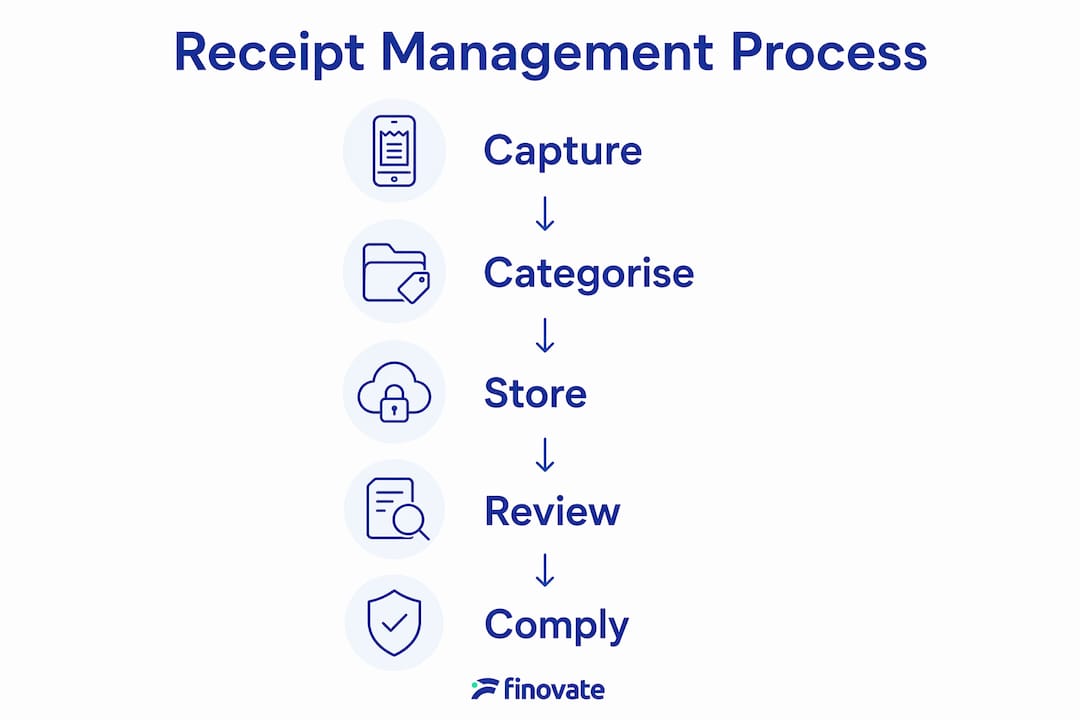
Store. Receipts are saved in a secure, structured digital system. HMRC requires that digital copies be unalterable and legible, so a read-only or audit-trail-enabled format is necessary, not optional.
Retrieve. When you need a receipt for a tax return, expense report, or audit, a well-organised system means you can locate it within moments rather than hours.
A practical weekly workflow looks like this:
- Photograph or scan receipts immediately after each transaction
- Use OCR to extract and verify the data automatically
- Tag each item with the correct category and project code
- Reconcile against your bank feed or credit card statement
- Archive in a compliant, backed-up digital folder
Pro Tip: A consistent weekly review of receipts, rather than a frantic year-end catch-up, takes under 10 minutes once your system is established. The time saved at Self Assessment alone makes the habit worthwhile.
Why receipt management matters specifically for UK businesses
UK businesses operate under a specific set of legal obligations that make disciplined receipt management non-negotiable. Making Tax Digital (MTD) requires businesses above the VAT threshold to keep digital records of income and expenses and submit returns through compatible software. HMRC can request records at any time, and the expectation is that those records are complete, accurate, and immediately accessible.
The consequences of falling short are concrete:
- Penalties of up to £3,000 for inadequate record-keeping, even without deliberate fraud
- Disallowed expense claims, increasing your taxable income and therefore your tax bill
- Extended HMRC enquiries, which consume time and professional fees
- Reputational risk if financial records appear disorganised or incomplete
Good receipt management also maximises your allowable deductions. Every legitimate business expense you can evidence reduces your taxable profit. Lost or incomplete receipts mean lost deductions, and over a full tax year, that adds up to a meaningful sum.
Benefits and challenges of digital receipt management
Digital receipt management offers clear advantages over paper-based methods. Automating data extraction through OCR and syncing with accounting software gives you continuous, real-time visibility of your cash flow, not just a snapshot at year end. Searching for a specific receipt takes seconds rather than minutes of rummaging through folders.
Key benefits include:
- Reduced data entry errors through automated extraction
- Faster reconciliation when receipts sync directly with bank feeds
- Instant retrieval for audits or expense reports
- Reduced physical storage costs and the risk of document loss
- Real-time financial data to support better business decisions
The challenges are real, though. Initial setup requires time and a degree of technical confidence. Staff adoption can be inconsistent, particularly in businesses where employees are accustomed to paper processes. Data privacy is also a genuine concern: receipts often contain sensitive supplier and transaction details, so the storage platform must meet UK GDPR requirements.
A disconnected digital folder, where you save photos but do nothing further, offers limited efficiency gains. True value comes from integration: receipts feeding directly into your accounting system, reconciling automatically, and generating reports without manual intervention. That is the standard worth aiming for.
Worth knowing: Sophisticated software is not a prerequisite for HMRC compliance. Consistency, accuracy, and accessibility matter most. A simple, well-maintained system beats a complex one used poorly.
Best practices for effective receipt management
The businesses that handle receipts well share a few consistent habits. None of them are complicated, but all of them require discipline.
- Capture immediately. Photograph or scan every receipt at the point of purchase. Thermal paper fades within months; a digital copy taken on the day is permanent.
- Reconcile regularly. Match receipts against your bank and credit card statements at least weekly. Discrepancies are far easier to resolve when the transaction is recent.
- Use consistent categories. Agree on a fixed list of expense categories and apply them without exception. Inconsistent tagging makes reporting unreliable and tax preparation slower.
- Store in backed-up, read-only formats. Cloud storage with automatic backup protects against device failure. Read-only or audit-trail formats satisfy HMRC's requirement for unalterable records.
- Separate business and personal spending. A dedicated business bank account and card removes ambiguity and makes reconciliation significantly faster.
For guidance on building a broader recordkeeping workflow, a structured approach from the outset saves considerable time as your business grows.
UK legal requirements and compliance tips for 2026
Understanding what the law actually requires removes a great deal of uncertainty. For UK businesses in 2026, the key rules are as follows.

What a valid receipt must contain. HMRC expects date, supplier name, description of the purchase, amount paid, and the supplier's VAT number where applicable. A bank statement alone is not sufficient evidence of a business expense.
Retention periods. Sole traders must keep records for five years after the Self Assessment filing deadline for the relevant tax year. Limited companies must retain records for six years from the end of the accounting period. Documents relating to assets, such as equipment or property, may need to be kept for longer still.
MTD digital storage requirements. HMRC requires that digital records be stored in unalterable, audit-ready systems. A photo saved to an editable folder on your desktop does not meet this standard. Cloud-based systems with version control or read-only storage do.
Compliance tips to keep in mind:
- Never rely solely on thermal paper receipts; always create a digital copy on the day
- Use software that generates an audit trail, showing when a record was created and whether it has been altered
- Back up your digital records to at least two locations, one of which should be off-site or cloud-based
- Review your retention schedule annually to confirm records are being kept for the correct period
Pro Tip: Thermal receipts from petrol stations, supermarkets, and restaurants can become completely illegible within six months. Photograph them immediately and discard the paper copy only once the digital version is confirmed and backed up.
Why receipt management is important beyond compliance
Compliance is the floor, not the ceiling. The deeper value of a well-run receipt tracking system is the financial intelligence it generates throughout the year. When every expense is captured and categorised in real time, you can see exactly where your money is going, which clients or projects are profitable, and where costs are creeping up before they become a problem.
This matters particularly for small businesses, where cash flow can shift quickly. A business owner who reviews categorised expense data monthly is in a far stronger position to make spending decisions than one who only sees the full picture at year end. Effective bookkeeping automation amplifies this further, turning receipt data into management reports with minimal manual effort.
Receipt management also supports professional credibility. When you work with an accountant or apply for finance, clean, complete records demonstrate that your business is well-run. Lenders and advisers draw conclusions from the quality of your financial documentation, not just the numbers within it.
Challenges of manual receipt management
Manual receipt management creates problems that compound over time. The most common is simple loss: paper receipts are misplaced, left in jacket pockets, or destroyed in a wash. Each lost receipt is a potential deduction you cannot claim and a gap in your records that could attract scrutiny.
Data entry errors are another persistent issue. Manually typing figures from receipts into a spreadsheet introduces transcription mistakes that distort your accounts. Identifying and correcting those errors later is time-consuming and sometimes impossible without the original document.
The so-called 'shoebox' method, where receipts are collected in a box and sorted once a year, is particularly risky. By the time you need to reconcile twelve months of transactions, many receipts will be faded, duplicated, or missing entirely. HMRC expects records to be produced promptly on request; a disorganised shoebox is not a compliant system.
Manual processes also scale poorly. A sole trader managing ten receipts a week can just about cope with a paper system. A growing business with fifty or a hundred weekly transactions cannot, and the point at which the system breaks down is rarely obvious until it already has.
Digital receipt management tools and software options
Several categories of software support digital receipt management for UK small businesses. The right choice depends on your transaction volume, whether you need VAT tracking, and how closely you want receipts to integrate with your accounts.
Mobile capture apps allow you to photograph receipts and extract data automatically using OCR. Many connect directly to cloud accounting platforms, so a receipt photographed at a supplier's premises appears in your accounts within minutes.
Cloud accounting platforms with built-in receipt management, such as Xero, QuickBooks, and FreeAgent, handle capture, categorisation, and reconciliation in a single system. These are well-suited to businesses that want everything in one place and are already using the platform for invoicing and payroll.
Dedicated expense management tools sit alongside your accounting software and handle the receipt and expense workflow specifically, then push approved data through to your accounts. These suit businesses with employees submitting expenses, where an approval workflow adds value.
When evaluating any tool, check that it meets HMRC's MTD requirements: digital storage must be unalterable, legible, and accessible for the full retention period. For businesses seeking broader bookkeeping and compliance support, professional services can complement software by providing oversight and expertise that technology alone cannot replicate.
How to integrate receipt management with your accounting system
Integration is what separates a genuinely efficient system from a digital version of the shoebox. When your receipt management tool connects directly to your accounting platform, data flows automatically: a captured receipt becomes a categorised transaction, which reconciles against your bank feed, which updates your profit and loss report, all without manual re-entry.
The practical steps to achieve this are straightforward:
- Choose a receipt capture tool that offers a direct integration or API connection to your accounting software.
- Map your expense categories in both systems so that categorisation is consistent across platforms.
- Enable bank feed connectivity so that transactions import automatically and can be matched to receipts.
- Set up approval workflows if employees submit expenses, so that receipts are reviewed before they enter the accounts.
- Schedule a monthly reconciliation to confirm that every transaction has a matched receipt and that no duplicates have entered the system.
The GOV.UK record-keeping guidance makes clear that VAT records must be complete and maintained regularly. An integrated system makes this straightforward rather than burdensome. For businesses managing expenses across multiple projects or cost centres, integration also enables project-level reporting, giving you a clear view of profitability at a granular level.
Finovate can handle your receipt management for you
Managing receipts accurately is straightforward in principle but time-consuming in practice, particularly when you are also running a business. Finovate offers a practical alternative: professional bookkeeping and accounting services that take the administrative burden off your hands, so you can focus on the work that generates revenue.
Where software tools require you to set up, maintain, and review your own system, Finovate's team handles the process on your behalf, from categorising expenses to preparing compliant records for HMRC submissions. Our services cover bookkeeping, VAT, payroll, and tax planning, giving small business owners a single point of contact for their financial management needs. We work with sole traders, limited companies, and light entrepreneurs, and we understand the specific obligations that UK and Finnish businesses face under their respective tax regimes.
If you are spending more time on receipts and records than on your actual business, that is a sign the current approach is not working. Visit finovate.fi to find out how we can put a compliant, efficient system in place for you.
Key takeaways
Effective receipt management is the single most reliable way to protect your tax position, satisfy HMRC requirements, and maintain real-time financial clarity throughout the year.
| Point | Details |
|---|---|
| Valid receipt requirements | UK receipts must show date, supplier name, description, amount, and VAT number where applicable. |
| Retention periods | Sole traders keep records for five years after the Self Assessment filing deadline for the relevant tax year; limited companies for six years from the end of the accounting period. |
| MTD compliance | Digital copies must be unalterable and stored in audit-ready systems; editable folders do not qualify. |
| Manual process risks | Poor organisation can result in penalties of up to £3,000 and lost expense deductions. |
| Finovate's role | Finovate provides professional bookkeeping and tax services that manage compliant receipt records on your behalf. |