

Autoetu is taxed as earned income in Finland, whether you receive vapaa autoetu or käyttöetu. Your monthly taxable value equals the perusarvo (a percentage of the car's new-price basis) plus a fixed monthly addition set by Verohallinto. For 2026, zero-emission cars keep a reduction worth up to €170 a month, but employer-paid charging now counts as taxable income too. Run your own numbers through the official autoetulaskuri before you agree to anything.
TL;DR:
- The taxable value of a company car in Finland is based on a percentage of the car’s new price plus a fixed monthly amount, varying by car age and benefit type.
- Fully electric cars benefit from a €170 monthly reduction in 2026, but employer-paid charging now counts as taxable income, adding about €20–30 monthly to the benefit.
- Using a driving diary can lower taxable value significantly if private mileage stays below 18,000 km annually, especially when properly documented.
- Heavy private driving above 18,000 km or over 30,000 km of work trips can increase or decrease the benefit value, respectively, based on thresholds.
- Correct payroll reporting of the autoetu benefit as part of gross salary is crucial to avoid surprises, as it affects tax withholding and net income.
Table of Contents
- What is autoetu verotus: vapaa autoetu vs käyttöetu
- How is the taxable value of a company car calculated?
- Electric vehicle rules and the 2026 charging benefit change
- When can you use kilometre-based calculation instead?
- Key thresholds: 18,000 km, 30,000 km and the accessory limit
- Payroll reporting and what it means for your net income
- Is a company car worth it? A quick decision checklist
- What documentation does an accountant actually need?
- Why the 2026 rules deserve a second look, not just a calculation
- How Finovate supports your autoetu decisions and payroll
- Where to check the official figures yourself
- Sources
What is autoetu verotus: vapaa autoetu vs käyttöetu
Company car taxation in Finland splits into two distinct arrangements, and the difference between them changes what lands on your payslip every month.
Vapaa autoetu means your employer covers everything: fuel, insurance, maintenance, tyres, the lot. You get a car and pay for nothing beyond the taxable benefit itself. Käyttöetu, by contrast, means you pay for your own fuel or charging while your employer covers the fixed costs like depreciation, insurance and servicing. The taxable value is lower under käyttöetu because you're carrying part of the running cost yourself.
This distinction matters for withholding. Your employer adds the benefit's monthly taxable value to your gross salary before calculating tax, so it shows up as a separate line on your payslip rather than as a lump sum at year end.
- Employee with vapaa autoetu: higher taxable value, but zero out-of-pocket running costs.
- Employee with käyttöetu: lower taxable value, but you pay fuel or charging costs directly.
- Entrepreneur (osakeyhtiö): the company buys or leases the car; the same autoetu rules apply to you as an employee of your own company, and the benefit still counts as your personal earned income.
- Travel deductions: if you use the car for commuting, that mileage generally can't also be claimed as a separate travel expense deduction, since the benefit already covers the cost of getting to work.
A sole trader running a toiminimi can't usually claim autoetu in the same way. Instead, vehicle costs are handled through business expense deductions, which is a different calculation entirely.
How is the taxable value of a company car calculated?
The formula behind autoetun verotusarvo looks simple on paper but has several moving parts worth understanding before you sign anything.
Verohallinto calculates the monthly value as perusarvo + fixed monthly addition. The perusarvo is a percentage of the car's uushankintahinta, effectively its "new price" basis, which is not necessarily what you or your employer actually paid. For cars first registered from 2021 onwards, uushankintahinta is based on the manufacturer's recommended retail price at first registration, minus a standard €3,400 adjustment.
The percentage and fixed addition both depend on the car's registration-year band, and vapaa autoetu always carries a higher fixed addition than käyttöetu because it reflects the employer covering fuel or energy costs too.
These 2026 figures come from sector guidance built on Verohallinto's own bands, and the pattern is consistent: newer cars carry a higher percentage but a lower fixed addition, while older cars flip that balance.
- Perusarvo = uushankintahinta × the percentage for your car's band.
- Add the fixed monthly amount for your benefit type.
- Add any accessory value over €1,200 to the price base before calculating perusarvo.
Rather than working through this by hand, Verohallinto's autoetulaskuri takes your benefit type, usage-start year, recommended price and accessories, and returns the exact monthly figure. It doesn't cover every vehicle, though: foreign-benefit cars registered before 2008, heavy goods vehicles and certain light-hybrid models fall outside its scope, so check those exclusions before relying on the output.
Electric vehicle rules and the 2026 charging benefit change
Zero-emission cars still get a genuine tax break in 2026, but one perk that employees enjoyed for years has just disappeared.
Fully electric vehicles continue to receive a €170 monthly reduction to their taxable value, a policy Verohallinto has confirmed will run through 2029. This applies on top of the standard perusarvo and fixed addition calculation, so it meaningfully lowers the monthly figure for a fully electric company car compared with a petrol or diesel equivalent in the same price band.
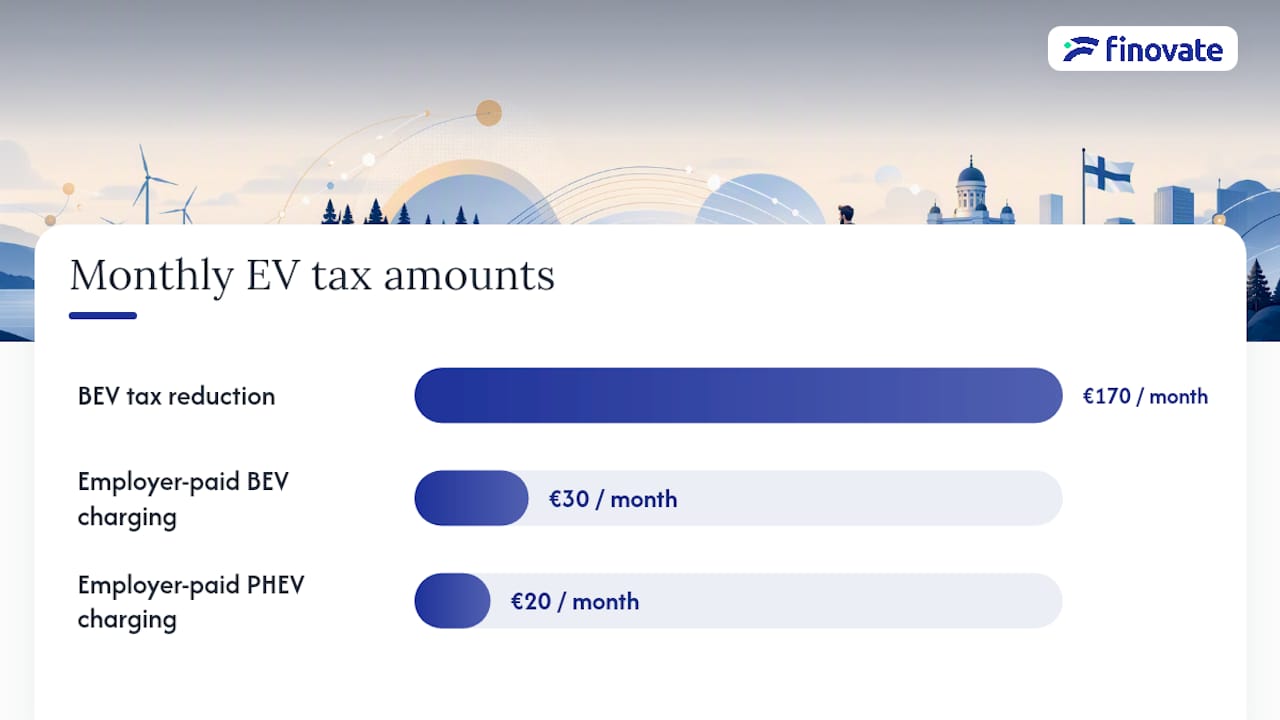
Statistic in focus: from 1 January 2026, employer-paid charging at the workplace or at public points becomes taxable income: €30 a month for a fully electric car and €20 a month for a plug-in hybrid, unless the car is on vapaa autoetu, where charging costs are already folded into the benefit value.
This reverses the temporary exemption that ran from 2021 to 2025, when employer-paid charging was tax-free regardless of where it happened. In practice:
- Employers must add €30 or €20 to the monthly taxable value for käyttöetu cars where they cover charging.
- Payroll systems need updating to reflect this as a separate addition, not folded into the base perusarvo figure.
- Employees who budgeted around free workplace charging will see a small but real increase in their monthly tax.
When can you use kilometre-based calculation instead?
Standard autoetu valuation assumes a certain level of private driving. If your actual private mileage is much lower, kilometre-based calculation (kilometriperusteinen laskenta) can bring your taxable value down considerably.
You can request this method when you keep a reliable ajopäiväkirja, a driving diary that Verohallinto inspects for completeness and consistency rather than accepting informal notes. It works best for people whose job involves substantial business driving but relatively little private use, such as field sales staff or consultants who drive to client sites most days.
To keep a diary that will actually hold up:
- Record the date of every trip, both business and private.
- Note the start and end locations and the purpose of each journey.
- Log the exact kilometres driven for each trip, not an estimate.
- Keep a running total that can be cross-checked against the car's odometer.
If your standard valuation looks too high once the year is over, you can request a correction through OmaVero or by submitting form 50A with your tax return.
Pro Tip: Start your ajopäiväkirja on day one of using the car, not halfway through the year when you realise it might help. Verohallinto wants a complete record, and a partial diary carries far less weight than a full one.
Key thresholds: 18,000 km, 30,000 km and the accessory limit
Three numbers decide whether your standard valuation moves up, down, or stays put, and most drivers never check where they fall against them.
If your private driving exceeds 18,000 km a year, Verohallinto may increase your standard calculated value above the normal perusarvo figure, on the assumption that heavy private use understates the real benefit you're receiving.
- Below 18,000 km private driving: standard valuation usually applies without adjustment.
- Above 18,000 km private driving: value may be increased.
- Above 30,000 km work driving: perusarvo may be reduced by 20%.
- Accessories under €1,200 total: excluded from the uushankintahinta calculation entirely.
- Accessories over €1,200 total: added in full to the price base before the percentage is applied.
Knowing which side of these lines you fall on before the tax year ends gives you time to adjust your ajopäiväkirja habits or flag a correction early, rather than discovering the gap on your tax return.
Payroll reporting and what it means for your net income
Autoetu isn't a footnote on your tax return. It flows through payroll every single month, and understanding that mechanism helps you avoid surprises.
Your employer must add the monthly taxable value to your gross salary before calculating withholding tax, and report it correctly on your payslip and annual income statement. This isn't optional paperwork; it's how Verohallinto tracks fringe benefits as part of earned income throughout the year rather than settling it all at once.
- Employers withhold tax on the benefit value monthly, alongside your regular salary.
- The benefit typically rules out claiming separate travel deductions for the same commuting distance.
- Entrepreneurs running their own limited company face a direct trade-off between the company deducting car costs and the owner-employee paying personal tax on the benefit.
- Your marginal tax rate decides how expensive the benefit really is: someone near a bracket threshold can find that autoetu pushes a meaningful slice of income into a higher rate.
For payroll teams handling multiple employees with company cars, correct monthly reporting matters as much as getting the initial valuation right, and specialist payroll processing support can catch errors before they compound across a tax year.
Is a company car worth it? A quick decision checklist
Before you accept or offer a company car, run through a short checklist rather than relying on gut feeling.
- Estimate your annual private kilometres. Close to 18,000 km makes autoetu more attractive; well below it often doesn't.
- Check your marginal tax rate. A benefit that pushes you into a higher bracket costs more than the headline figure suggests.
- List what your employer actually covers. Fuel, insurance, servicing and tyres all add real value under vapaa autoetu.
- Compare against private ownership costs, including loan interest, insurance and maintenance you'd otherwise pay yourself.
Run your exact figures through the autoetulaskuri rather than relying on estimates like this one.
Pro Tip: Entrepreneurs often forget that autoetu is taxed as personal income even when the car sits on the company balance sheet. The tax hit lands on you, not the business, so weigh it against your own entrepreneurship tax planning rather than the company's books alone.
What documentation does an accountant actually need?
When a client brings us a company car question, the paperwork gap is almost always the same. We need the purchase invoice showing the original recommended price, the exact registration date, any accessory invoices over €1,200, and a genuine ajopäiväkirja if kilometre-based calculation is on the table.
The most common mistake we see is treating commuting as somehow separate from the benefit, when it's already priced into the autoetu value. The second is registering a car late in the year rather than early, missing a chance to lock in a lower age band for longer, since banding runs by calendar year rather than exact registration date. The third is a driving diary with gaps that Verohallinto simply won't accept.
Why the 2026 rules deserve a second look, not just a calculation
The conventional advice on company cars stops at "run it through the calculator," and that's not wrong, but it's incomplete. The autoetulaskuri gives you a number. It doesn't tell you whether that number makes sense against your marginal tax rate, your actual private driving, or what you'd pay to own the same car privately.
What gets underestimated most is the charging benefit change. It looks small, €20 or €30 a month, and on its own it is. But it signals something bigger: Finland's temporary EV incentives are being unwound piece by piece, even as the core €170 reduction survives through 2029. Anyone who negotiated a company car deal assuming free workplace charging needs to revisit that assumption now, not at their next tax return.
My honest view is that most people accept or reject a company car offer based on the headline monthly figure alone, without checking where their private mileage sits against the 18,000 km and 30,000 km thresholds. That single check often changes the entire calculation. Get your ajopäiväkirja habits right from day one, and you keep genuine control over your own tax position rather than defaulting to Verohallinto's standard assumption.
— Busayo
How Finovate supports your autoetu decisions and payroll
Working out whether a company car makes financial sense, and then keeping payroll accurate once you've decided, is exactly where an experienced accountant earns their fee. Finovate calculates autoetu values correctly against the current registration-year bands, manages the monthly withholding on your payroll, and reviews ajopäiväkirja entries if you want to pursue a kilometre-based reassessment through OmaVero or form 50A.

Bring your car's purchase invoice, registration date, any accessory costs over €1,200, and an estimate of your annual private mileage to a first meeting, and we can tell you within that conversation whether your current valuation looks right. If you're a light entrepreneur weighing up vehicle costs against other business expenses, our accounting support for delivery partners covers exactly that ground too. Get in touch through Finovate's accounting and tax services to book a first consultation.
Where to check the official figures yourself
Verohallinto's 2026 decision on in-kind benefits sets the legal bands and fixed additions. Run your own numbers through the autoetulaskuri, and read Veronmaksajat's guide for an independent explanation of how the benefit interacts with your marginal tax rate.
This article is general information, not a substitute for advice from a qualified financial advisor. Consult a qualified financial professional about your own circumstances before acting on anything here.