

TL;DR:
- Tax residence determines which country has the right to tax your worldwide income based on legal criteria such as physical presence and economic ties. Confusion often arises from dual residency and varying rules like the 183-day rule and the substantial presence test, which can lead to double taxation if not properly managed. Proper planning, documentation, and obtaining a certificate of residence are essential to ensure compliance and avoid costly mistakes.
Tax residence is the legal status that determines which country has the right to tax your income, assets, and gains. It is not the same as citizenship, immigration status, or simply where you live. Countries assign tax residence based on specific legal criteria, including physical presence, the location of your permanent home, and your economic ties. Getting this wrong carries real financial consequences. Whether you are an individual relocating abroad or a business owner operating across borders, understanding tax residence rules is the first step to managing your obligations correctly.
What is tax residence and how is it defined?
Tax residence is a statutory determination, not a personal choice. Tax residency is determined by law and facts about your behaviour, housing, and economic connections, not by where you prefer to pay tax. This distinction matters enormously. You can be physically absent from a country for most of the year and still remain its tax resident if you retain significant ties there.

The core concept is straightforward. A country designates you as a tax resident when you meet its legal threshold for connection. Once designated, you typically owe tax on your worldwide income to that country. Non-residents, by contrast, usually owe tax only on income sourced within that country's borders.
Three primary factors drive most tax residency definitions globally: physical presence, the location of your permanent home, and the centre of your vital interests. Vital interests include where your family lives, where your bank accounts are held, and where your professional life is based. Canadian tax residency illustrates this well. Canada weighs residential ties such as a home, a spouse, dependants, personal property, and social and economic connections, not just days spent on Canadian soil.
What are the common tax residence rules used worldwide?
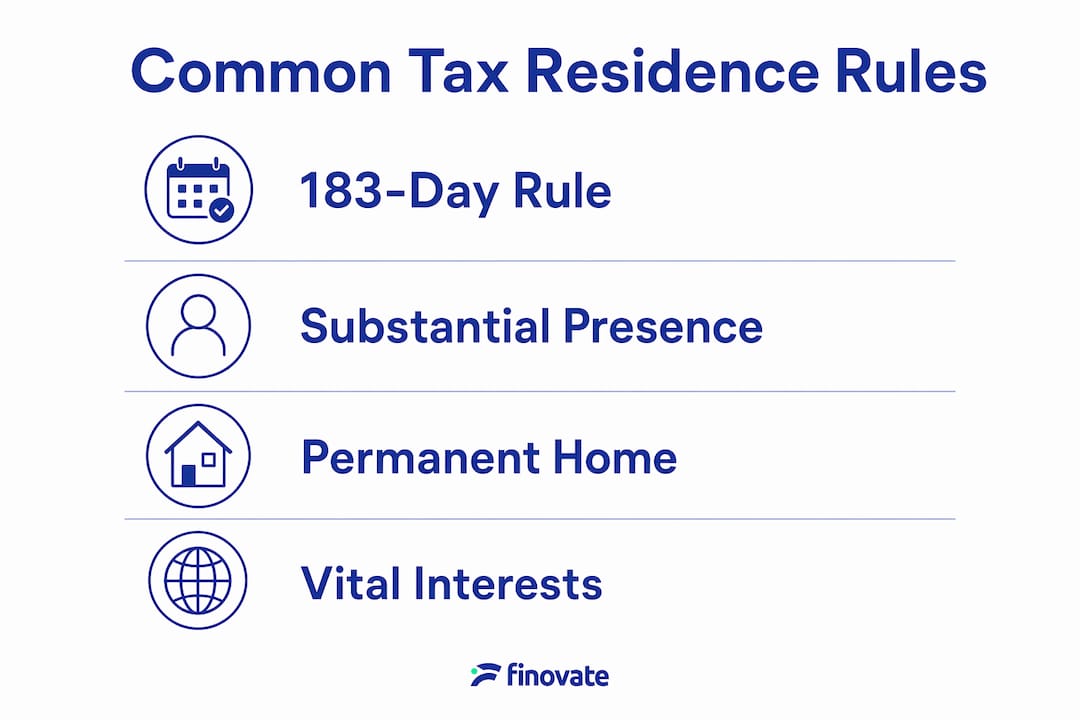
Most countries apply one or more of three standard frameworks to determine residency for tax purposes: a day-count rule, a substantial presence test, or a permanent home and vital interests test.
The 183-day rule
The 183-day rule is the most widely used threshold globally. If you spend 183 days or more in a country during a calendar or fiscal year, most jurisdictions treat you as a tax resident for that year. The UK, Finland, Germany, and many EU nations apply variants of this rule. The count sounds simple, but the definition of a "day present" varies. Some countries count any part of a day; others require an overnight stay.
The US substantial presence test
The United States applies a more complex formula. The substantial presence test counts days across three years using weighted values: all days in the current year, one-third of days in the previous year, and one-sixth of days two years prior. If the total reaches 183 or more, the individual qualifies as a US tax resident. This means you can trigger US tax residency even if you spent fewer than 183 days in the US in the current year alone.
Crucially, not all days count toward the US test. Transit days, days spent due to a medical emergency, and days for certain visa holders are excluded. This nuance catches many people off guard.
Permanent home and vital interests tests
| Country | Primary residence test | Day threshold | Additional criteria |
|---|---|---|---|
| United Kingdom | Statutory Residence Test | 183 days (automatic) | Ties test for fewer days |
| United States | Substantial Presence Test | 183 weighted days | Green card test also applies |
| Canada | Residential ties | No fixed threshold | Home, family, economic ties |
| Finland | Habitual abode | 183 days | Permanent home considered |
| Germany | Habitual abode or home | 183 days | Domicile rules apply |
Pro Tip: Keep a travel diary with dated records of every country you enter and exit. A contemporaneous log is far stronger evidence than reconstructed records if a tax authority ever challenges your residency status.
How is dual residency determined and resolved internationally?
You can be simultaneously tax resident in more than one country. This happens when two countries each apply their own rules and both conclude you meet their residency threshold. The result is dual residency, which without relief means you face tax obligations in both jurisdictions on the same income.
Double taxation treaties resolve this through a structured set of tie-breaker rules. The OECD Model Tax Convention, which underpins most bilateral treaties, applies the following hierarchy:
- Permanent home. The country where you have a permanent home available to you takes priority.
- Centre of vital interests. If you have a permanent home in both countries, the country with which your personal and economic relations are closer takes precedence.
- Habitual abode. If vital interests cannot be determined, the country where you habitually reside applies.
- Nationality. If habitual abode is also equal, nationality is the deciding factor.
- Mutual agreement. If nationality does not resolve the conflict, the two tax authorities negotiate directly.
Tie-breaker rules follow a strict hierarchy and are applied in order. You do not skip to step three because step two feels inconvenient. Knowing this order is essential for tax planning and for resolving disputes with tax authorities.
For businesses, dual residency arises when a company is incorporated in one country but managed and controlled from another. A business is typically tax resident where it is incorporated and where it is centrally managed. When those locations differ, the company may face dual residency, resolved again by treaty tie-breakers based on the place of effective management.
Claiming treaty relief is not automatic. Certificates of tax residence are required to invoke treaty benefits and avoid double taxation. You must apply to your home country's tax authority for this certificate and present it to the other country's authority. For Finnish entrepreneurs navigating cross-border residency, Finovate's guide on tax residency for entrepreneurs covers this process in practical detail.
Pro Tip: Apply for your certificate of tax residence before you need it. Processing times vary by country and can take several weeks. Waiting until a tax deadline creates unnecessary pressure.
What practical issues arise from tax residence status?
Tax residence is determined by law, not by personal preference or administrative convenience. Maintaining ties to a country such as a home, a bank account, or a spouse can keep you tax resident there even if you have physically relocated. This is the most common and costly misunderstanding in cross-border tax situations.
Several practical issues arise regularly:
- Mid-year moves. When you relocate partway through a tax year, both your old and new country may claim residency for overlapping periods. Both countries may claim residency during partial years, and treaty-based relief mechanisms resolve the overlap. You may need to file tax returns in both countries for that year.
- Retaining property abroad. Keeping a home in your previous country of residence is one of the strongest indicators of continued tax residency there. Simply renting it out does not sever the tie in many jurisdictions.
- Assuming non-residency. Many individuals assume that leaving a country ends their tax obligations there. Tax authorities do not share this assumption. You must actively demonstrate that ties have been severed.
- Business owners operating remotely. A director managing a company from a different country can inadvertently shift the company's place of effective management, creating dual residency for the business.
For expats managing these complexities, understanding the distinction between tax resident and non-resident status is a practical starting point before engaging a tax adviser.
How do you determine your tax residence status accurately?
Determining your residency for tax purposes requires a structured review of several factors. The following steps give you a clear starting point.
- Count your days. Record the number of days you were physically present in each country during the tax year. Include arrival and departure days as required by each jurisdiction's rules.
- Assess your permanent home. Identify which country you have a home available to you on a permanent basis. Ownership is not required; a long-term rental qualifies.
- Map your economic ties. List where your bank accounts, investments, employment, and business interests are located. These ties carry significant weight in residency determinations.
- Identify your family location. Where your spouse and dependants live is a primary indicator of your centre of vital interests.
- Gather documentation. Collect utility bills, lease agreements, employment contracts, and bank statements that corroborate your claimed residency. Tax authorities expect contemporaneous evidence.
- Apply for a certificate of residency. If you need to claim treaty relief, contact your country's tax authority to obtain a formal certificate confirming your residency status.
- Consult a tax professional. Complex cases involving multiple countries, mid-year moves, or business interests require professional advice. The cost of advice is almost always less than the cost of misclassification.
Finovate's overview of Finnish tax compliance provides country-specific guidance for individuals and businesses based in Finland.
Pro Tip: If you are unsure whether you have severed residency ties with a previous country, assume you have not. Proactively filing a tax return or seeking a ruling from the tax authority is safer than ignoring the question.
Key takeaways
Tax residence is a legal determination based on physical presence, permanent home, and economic ties. It is not a personal choice, and misclassifying your status carries significant financial risk.
| Point | Details |
|---|---|
| Tax residence is statutory | Your residency status is set by law and facts, not by preference or administrative convenience. |
| The 183-day rule is standard | Most countries use a 183-day threshold, but day-count methods and exceptions vary significantly. |
| Dual residency requires treaty relief | Treaties resolve conflicts through a strict hierarchy: permanent home, vital interests, habitual abode, then nationality. |
| Certificates are not automatic | You must apply for a certificate of tax residence to claim treaty benefits and avoid double taxation. |
| Documentation is decisive | Contemporaneous records of travel, housing, and economic ties are your strongest defence in a residency dispute. |
The part of tax residence nobody warns you about
The most persistent problem I see is not complexity. It is confidence. People relocate, assume their tax obligations have followed them to the new country, and stop there. They do not check whether their old country still considers them a resident. They do not apply for a certificate of residency. They do not file in the jurisdiction they left.
What surprises me most is how often this happens to people who are otherwise meticulous about their finances. Tax residence sits in a gap between immigration law, personal finance, and accounting. Nobody owns the conversation, so it falls through.
The tie-breaker rules in double taxation treaties are genuinely useful once you understand them. But they only help if you know they exist and apply them in the correct order. I have seen cases where someone correctly identified that they had a permanent home in only one country, which should have resolved the conflict at step one, but they never claimed the treaty benefit because they did not know they needed to. The tax authority in the other country was happy to keep collecting.
Early planning and proper documentation change the outcome entirely. If you are moving countries, changing your business structure, or simply spending more time abroad, address your residency status before the tax year ends. Retroactive fixes are possible but expensive. Proactive advice from a qualified tax adviser, combined with the right records, is the most reliable path through this. For Finnish entrepreneurs specifically, Finovate's tax tips for entrepreneurs offer a practical starting point.
— Busayo
How Finovate supports your tax residence questions
Understanding your tax residence status is one thing. Managing the compliance that follows is another.

Finovate provides accounting and tax advisory services for individuals and businesses in Finland, including support for cross-border residency questions, tax planning, and compliance. Whether you are assessing your residency status for the first time, dealing with a mid-year move, or managing obligations across multiple countries, Finovate's team offers clear, practical guidance. Visit Finovate's accounting services to learn how we can help you manage your tax obligations with confidence. For small business owners and light entrepreneurs, our accounting for entrepreneurs service is designed to fit your specific needs.
FAQ
What is the tax residency definition in simple terms?
Tax residency is the legal status that determines which country can tax your worldwide income. It is based on factors such as days spent in a country, your permanent home, and your economic ties, not on citizenship or personal preference.
How does the 183-day rule work?
The 183-day rule means that spending 183 or more days in a country during a tax year typically makes you a tax resident there. Day-count methods and exceptions vary by country, so the exact calculation differs between jurisdictions.
Can you be a tax resident in two countries at once?
Yes. Two countries can each classify you as a tax resident under their own rules. Double taxation treaties resolve this conflict through tie-breaker tests, prioritising permanent home, then centre of vital interests, then habitual abode, and then nationality.
What is a certificate of tax residence and do you need one?
A certificate of tax residence is an official document issued by a tax authority confirming your residency status in that country. You need this certificate to claim relief under a double taxation treaty. Treaty protection is not automatic without it.
How does changing tax residency work when you move abroad?
Changing your tax residency requires you to sever significant ties with your previous country, such as giving up your permanent home there, and establish qualifying ties in the new country. Mid-year relocation can trigger partial-year residency in both countries, requiring treaty-based relief to avoid double taxation on the same income.