

In the UK, the main types of tax filings are: Self Assessment (SA100 plus supplementary pages) for individuals with income outside PAYE; the Corporation Tax return (CT600) for limited companies; the Partnership Tax Return (SA800) for partnerships; VAT returns (typically submitted via the VAT100 process) for VAT-registered businesses; PAYE and Real Time Information (RTI) submissions for employers; and trust and estate returns (SA900) alongside Inheritance Tax forms where relevant. Capital gains disposals and non-resident obligations may require additional reporting. Your first action is straightforward: identify your taxpayer type, then check the relevant HMRC form code and deadline at Gov.
Key authorities to consult:
- HMRC — the primary source for all UK tax filings, form codes, deadlines and penalties
- SA100, CT600 and SA800 — the three core return forms covering most individual, company and partnership obligations
File taxes early to give yourself time to gather supplementary pages and avoid last-minute errors.
Key takeaways
The most important principle across all UK tax filings is this: your taxpayer type and income sources determine your form codes, and your form codes determine your deadlines — get those two things right and the rest follows.
| Point | Details |
|---|---|
| Individuals file SA100 | Attach the correct supplementary pages (SA102–SA110) for every income type; missing a page is treated as an incomplete return. |
| Companies file CT600 | Payment is due nine months and one day after the accounting period end; the return itself is due 12 months after. |
| Partnerships file SA800 | Each partner then reports their share on their own SA100; a late SA800 triggers a £100 penalty per partner. |
| VAT and PAYE have separate deadlines | VAT is due one month and seven days after the period end; PAYE FPS must be submitted on or before each pay date. |
| Finovate supports your filings | Finovate provides accounting, VAT, payroll and Self Assessment support for entrepreneurs and small businesses. |
Table of Contents
- What are the main types of tax filings at a glance?
- Self Assessment (SA100) and its supplementary pages explained
- How partnership returns (SA800) work for partners
- Corporation Tax (CT600): what companies must file and when
- VAT returns: who must register and how to file
- PAYE and RTI: employer reporting obligations
- Trusts, estates and specialist filings: SA900, IHT and capital gains
- How to decide which forms and supplementary pages you need
- Key deadlines and penalties for late filing or payment
- SA103S versus SA103F: how to make the right choice
- Reliefs and exceptions that affect your filing requirements
- Finovate's perspective on navigating UK tax filings
- Finovate: professional support for your tax filing obligations
- Sources
What are the main types of tax filings at a glance?
The table below maps each filing type to the taxpayer it covers, the forms typically required, the key deadlines and the available filing routes.
| Filing type | Who must file | Typical forms / supplementary pages | Key deadlines | How to file |
|---|---|---|---|---|
| Self Assessment | Individuals with self-employment income, rental income, foreign income, capital gains, or income over £85,000 | SA100 + SA102, SA103S/F, SA104S/F, SA105, SA106, SA107, SA108, SA109, SA110 | Paper: 31 October; Online: 31 January (following tax year-end) | HMRC online, commercial software, or paper |
| Corporation Tax | UK limited companies and certain other corporate bodies | CT600 + company accounts and tax computations (iXBRL format) | Payment: usually about nine months after accounting period end; Return filing: 12 months after accounting period end | HMRC online / commercial software |
| Partnership return | Partnerships (nominated partner files on behalf of all partners) | SA800 + partnership statements; partners file individual SA100 returns | Same as Self Assessment (paper 31 October; online 31 January) | HMRC online or paper |
| VAT return | VAT-registered businesses (mandatory above registration threshold; voluntary below) | VAT100 (or online equivalent under Making Tax Digital) | Usually a little over one month after end of VAT period | HMRC online VAT service or MTD-compatible software |
| PAYE / RTI | Employers operating a payroll | Full Payment Submission (FPS); Employer Payment Summary (EPS); P60; P11D | FPS: on or before each pay day; P60: by 31 May; P11D: by 6 July | HMRC-recognised payroll software |
| Trusts and estates | Trustees and personal representatives | SA900; IHT400 or IHT205 (estate returns) | SA900: same Self Assessment dates; IHT: usually within 12 months of death | HMRC online or paper |
Self Assessment (SA100) and its supplementary pages explained
SA100 is the main individual tax return in the UK. HMRC guidance confirms that SA100 covers items including student loan repayments, interest and dividends, pension income, Gift Aid donations and the High Income Child Benefit Charge. You complete the core SA100 form first, then attach whichever supplementary pages match your income sources.
The full list of supplementary pages covers every common income type:
- SA102 — Employment income; complete one page per employment or directorship
- SA103S — Self-employment (short); for simpler sole-trader businesses
- SA103F — Self-employment (full); for more complex accounts, capital allowances or adjustments
- SA104S — Partnership income (short)
- SA104F — Partnership income (full)
- SA105 — UK property income, including furnished lettings
- SA106 — Foreign income and gains
- SA107 — Trust and estate income received by an individual
- SA108 — Capital gains and losses
- SA109 — Residence, remittance basis and domicile
- SA110 — Tax calculation summary (used when HMRC cannot calculate the tax automatically)
Supplementary pages are not optional extras. Failing to include a required page is treated as an incomplete return and can attract penalties even when the tax itself has been paid on time.
SA103S versus SA103F: which self-employment page do you need?
The choice between the short and full self-employment pages depends on the complexity of your business accounts. SA103S suits straightforward sole traders with lower turnover and no complex adjustments. SA103F is required when your accounts include capital allowances, stock adjustments, balance sheet entries or when your turnover exceeds the short-return threshold. HS222 also explains how the choice between cash basis and traditional accounting affects which page applies and how taxable profits are calculated. The SA103F notes set out required business details, how to report income and expenses, and when the full pages are necessary.
Deadlines and filing routes for Self Assessment
The paper deadline is in autumn following the end of the tax year, and the online deadline is in late January. Filing online gives you three extra months and means HMRC calculates your tax automatically in most cases. The tax registration steps guide explains how to set up a Government Gateway account if you have not filed online before.
Pro Tip: Check which supplementary pages you need before you start filling in SA100. Gathering payslips, rental statements, dividend vouchers and Gift Aid records in advance prevents delays and reduces the risk of an incomplete submission.
How partnership returns (SA800) work for partners
A partnership does not pay tax as a single entity. Instead, the partnership files an SA800 to report the partnership's income, and each partner then reports their individual share on their own SA100 return. The SA800 Partnership Tax Return manual sets out the nominated partner's responsibilities, the contents of the pages sent to partnerships and the penalties structure for late filing.
One partner must be nominated to file the SA800 on behalf of the whole partnership. If partners cannot agree on a nominee, HMRC will appoint one. The nominated partner is responsible for completing the return accurately and on time, but the penalty for a late return falls on every partner who was a member during the return period, not just the nominee.
Steps for completing a partnership filing
- The nominated partner completes the SA800, reporting total partnership income, expenses and profit for the accounting period.
- The partnership profit is allocated between partners according to the profit-sharing agreement.
- Each partner receives a partnership statement showing their allocated share of income, losses and tax credits.
- Each partner includes their share on their individual SA100, using SA104S or SA104F as appropriate.
- All partners file their individual returns by the Self Assessment deadline (31 January for online filing).
The SA850 Partnership Tax Return Guide confirms that each partner who was a member during the return period is liable for the standard automatic penalty if the partnership return is late. That penalty is currently £100 per partner, so a three-partner firm filing late faces a minimum £300 immediate charge before any daily penalties accrue.
Short partnership statements suit straightforward income allocations. Full statements are required when the partnership has foreign income, capital gains, or other complex items that need separate disclosure. Providing partner statements promptly after completing the SA800 gives each partner enough time to file their own return without rushing.
Corporation Tax (CT600): what companies must file and when
CT600 is the Corporation Tax return that UK limited companies and certain other corporate bodies must submit to HMRC. It must be filed together with the company's accounts and tax computations. HMRC's CT600 guidance makes clear that a notice to file is a legal obligation — companies must file even if they made a loss or owe no tax. This applies to dormant companies too; receiving a notice and ignoring it is not an option.
The company tax return guide confirms that penalties apply for late filing, separate from any interest on late payment.
Filing versus payment: two different deadlines
Many directors conflate the filing deadline with the payment deadline, and that confusion is costly. Corporation Tax is usually due about nine months after the end of the accounting period. The CT600 return itself must be filed within around 12 months of the accounting period end. A company with a 31 December year-end therefore pays by 1 October the following year but files the return by 31 December of that same year.

Accounts and tax computations submitted with the CT600 must be in iXBRL format for most companies. Preparing iXBRL-tagged accounts takes time, particularly if your accounting software does not produce them automatically.
Pro Tip: Reconcile your Corporation Tax payment date and your return filing date in your calendar as two separate entries. Missing either triggers its own penalty regime, and the two dates are far enough apart that one is easy to overlook.
VAT returns: who must register and how to file
A business must register for VAT when its taxable turnover exceeds the VAT registration threshold in any rolling 12-month period. Voluntary registration is available below that threshold and can be worthwhile when a business incurs significant input VAT on purchases. Once registered, the business submits periodic VAT returns and pays any VAT due to HMRC.
Most VAT-registered businesses file quarterly returns, though monthly and annual accounting schemes are available. The standard VAT return (historically referred to as the VAT100) captures output VAT charged on sales, input VAT reclaimed on purchases and the net amount payable or refundable. Payment and the return are both due a little over one month after the end of the VAT period.
Making Tax Digital and VAT filing routes
Under Making Tax Digital (MTD) for VAT, most VAT-registered businesses must keep digital records and submit returns using MTD-compatible software rather than HMRC's older online portal. Compatible software connects directly to HMRC's systems, reducing manual data entry and the risk of transposition errors. The VAT filing guide for taxi and courier operators illustrates how quarterly VAT record-keeping works in practice for businesses with frequent, small transactions.
Key points for VAT compliance:
- Register within 30 days of the date your taxable turnover first exceeded the threshold
- Keep VAT records for at least six years to support any reclaimed input VAT
- Align your VAT return period with your accounting period where possible to simplify reconciliation
- Check whether the Flat Rate Scheme, Cash Accounting Scheme or Annual Accounting Scheme suits your business before choosing a return frequency
PAYE and RTI: employer reporting obligations
Every employer operating a payroll must register for PAYE with HMRC and report payments to employees in real time. Real Time Information (RTI) means that each time you pay an employee, you submit a Full Payment Submission (FPS) to HMRC on or before the pay date. There is no annual catch-up; the obligation runs with every payroll run.
Setting up and running PAYE as a new employer
- Register as an employer with HMRC to receive a PAYE reference number.
- Set up HMRC-recognised payroll software capable of producing RTI submissions.
- Calculate Income Tax and National Insurance Contributions (NICs) for each employee using the correct tax code.
- Submit the FPS on or before each pay date.
- Submit an Employer Payment Summary (EPS) in any month where you pay no employees or wish to claim statutory payment recoveries.
- Make monthly PAYE payments to HMRC by the 19th of the following month (22nd for electronic payment).
At the end of the tax year, employers must issue a P60 to every employee still on the payroll by late May. Expenses and benefits provided to employees must be reported on a P11D by early July., unless the benefit is covered by a PAYE Settlement Agreement or payrolled through the payroll system.
Pro Tip: Use payroll software that produces P60s automatically from the year-end payroll run. Manual P60 preparation from payroll records is time-consuming and prone to transcription errors, particularly when employees have changed tax codes mid-year.
Trusts, estates and specialist filings: SA900, IHT and capital gains
Trustees and personal representatives have distinct filing obligations that sit alongside, rather than within, the standard Self Assessment process.
SA900 is the tax return for trusts and estates. Trustees complete it annually to report trust income and gains, and the return follows the same Self Assessment deadlines: paper by 31 October, online by 31 January. Beneficiaries receive a statement of their share of trust income, which they then report on their own SA100 using SA107.
Inheritance Tax (IHT) forms are separate from income tax returns entirely. When someone dies, the personal representative must usually submit an IHT account to HMRC. For most estates, IHT400 is the full account form; IHT205 (now replaced by a simplified online process for excepted estates) applied to smaller, simpler estates. IHT is generally due within several months of the end of the month of death, though the return itself may be submitted later.
Capital Gains Tax (CGT) for individuals is reported through Self Assessment using SA108. However, disposals of UK residential property by UK residents must be reported and any CGT paid within a short window of completion using HMRC's online residential property disposal service. Non-UK residents disposing of any UK property face the same 60-day reporting and payment window, regardless of whether they are otherwise within Self Assessment.
Non-residents with UK-sourced income — rental income from UK property, for example — must complete SA109 alongside their SA100 to declare their residence status and, where applicable, claim treaty relief or the remittance basis.
How to decide which forms and supplementary pages you need
Choosing the right combination of forms is a matter of working through your circumstances methodically. The self-employment tax guide for sole traders and the business tax checklist both provide structured starting points.
Work through these steps:
- Step 1 — Identify your taxpayer type. Are you an individual, a partner in a partnership, a company director filing on behalf of a limited company, or a trustee? Each type has a different primary return.
- Step 2 — List every income source. Employment, self-employment, rental property, foreign income, trust income, dividends, interest and capital gains each trigger a different supplementary page.
- Step 3 — Check turnover and complexity thresholds. If your self-employment turnover is below the short-return threshold and your accounts require no complex adjustments, SA103S may suffice. Higher turnover or capital allowances point to SA103F. The Short Tax Return notes set out the circumstances that require a full return, including company directorships, partnership membership and capital disposals.
- Step 4 — Match income types to form codes. Use the list in the Self Assessment section above to confirm which supplementary pages apply.
- Step 5 — Confirm your filing route. Online filing via HMRC or MTD-compatible software is available for most returns. Paper is still permitted for Self Assessment but closes three months earlier.
When deciding between SA103S and SA103F, the key question is whether your accounts contain items that the short page cannot accommodate: capital allowances, stock valuations, balance sheet entries or adjustments to profits. If any of those apply, use SA103F. The Concordecompanysolutions provides a useful supplementary explanation of the Self Assessment process for readers who want a second perspective.
Pro Tip: Download the relevant HMRC helpsheet before you start each supplementary page. Helpsheets explain exactly what evidence to keep and which boxes to complete, and they are updated each tax year to reflect any legislative changes.
Key deadlines and penalties for late filing or payment
Missing a deadline costs money. HMRC applies penalties automatically, and they escalate the longer a return remains outstanding.
Self Assessment deadlines
- 31 October — paper SA100 (and supplementary pages) for the previous tax year
- 31 January — online SA100; also the deadline for paying any tax owed for the previous year and the first payment on account for the current year
- 31 July — second payment on account
An SA100 filed even one day late attracts an immediate £100 penalty. After three months, daily penalties of £10 per day (up to 90 days, so up to £900) begin to accrue. Interest runs on unpaid tax from the due date.
Corporation Tax deadlines
- Nine months and one day after accounting period end — Corporation Tax payment due
- 12 months after accounting period end — CT600 return and accounts filing deadline
Late filing of the CT600 triggers an immediate £100 penalty, rising to £200 after three months. Continued delay attracts percentage-based penalties. Late payment attracts interest from the day after the due date.
VAT and PAYE deadlines
VAT returns and payment are due one month and seven days after the end of each VAT period. PAYE payments are due by the 19th of the following month (22nd for electronic payment). RTI submissions must reach HMRC on or before each pay date; late FPS submissions attract penalty notices.
One frequently overlooked trigger: failing to include a required supplementary page is treated as an incomplete return. HMRC may issue a penalty even when the tax has been paid correctly, because the return itself is considered outstanding. The penalty avoidance guide covers the most common compliance errors and how to address them before they escalate.
SA103S versus SA103F: how to make the right choice
The distinction between the short and full self-employment pages matters more than many sole traders realise. Choosing the wrong version can cause inaccuracies in your return or prompt HMRC to request a corrected submission.
When SA103S (short) is appropriate
SA103S suits sole traders whose self-employment is straightforward:
- Turnover is below the short-return threshold (check the current figure in the Short Tax Return notes for the relevant tax year)
- Accounts are prepared on the cash basis with no complex adjustments
- No capital allowances claims beyond the annual investment allowance on simple assets
- No stock or work-in-progress adjustments
- No losses brought forward from earlier years
When SA103F (full) is required
SA103F is required when any of the following apply:
- Turnover exceeds the short-return threshold
- Accounts are prepared on the traditional (accruals) basis
- Capital allowances are claimed on plant, machinery or vehicles
- The business has a balance sheet with stock, debtors or creditors
- Losses are being carried back or sideways
- The business is a Lloyd's underwriter or has other specialist income
HS222 explains the cash basis versus traditional accounting distinction in detail. One point worth noting: if you claim the trading income allowance (£1,000), you cannot also claim business expenses for the same income. That election affects your taxable profit and may influence which page you complete.
Common errors that force a corrected return include: understating turnover by omitting cash receipts, forgetting to include capital allowances on vehicles, and misclassifying personal expenditure as a business expense. The self-employment tax guide covers these pitfalls in more detail.
Pro Tip: If you are unsure whether your accounts are complex enough to require SA103F, err on the side of the full pages. An unnecessarily detailed return is not penalised; an incomplete short return can be.
Reliefs and exceptions that affect your filing requirements
Certain reliefs and personal circumstances change what you need to include in your return, or whether you need to file at all.
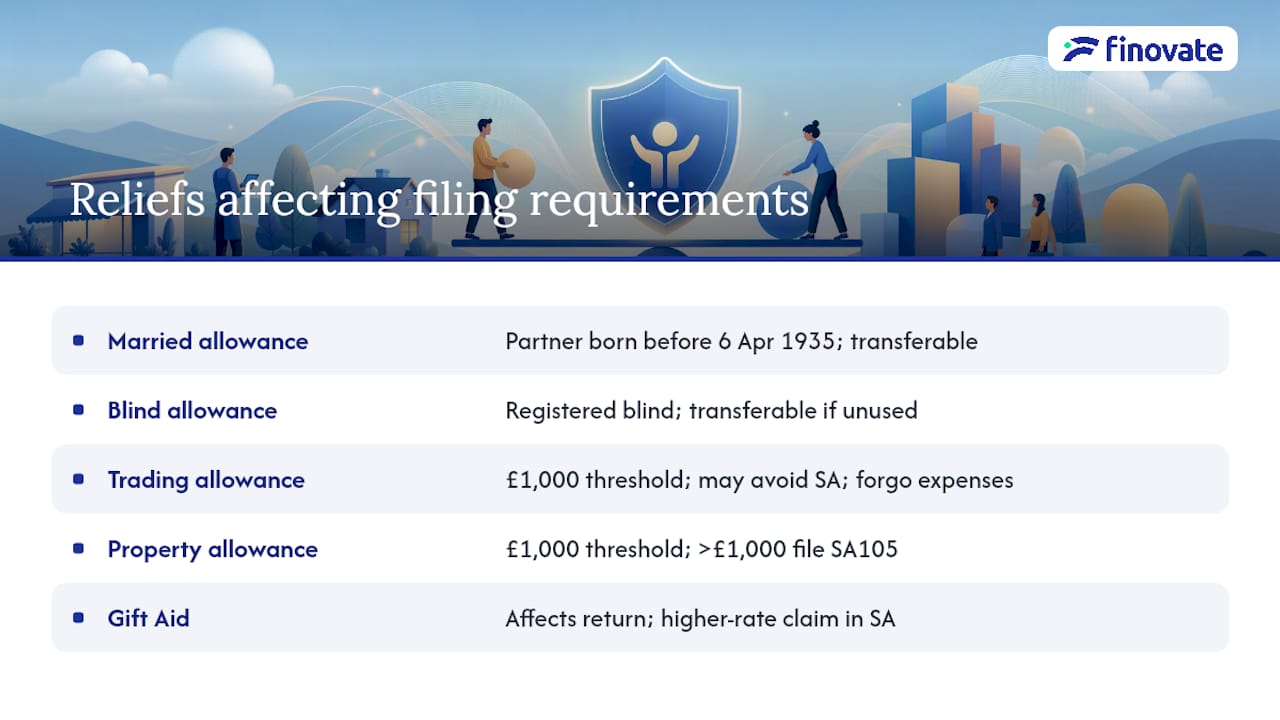
Married Couple's Allowance is available to couples where at least one partner was born before 6 April 1935. It reduces the tax bill rather than reducing taxable income, and it must be claimed through Self Assessment or by contacting HMRC directly. Where one partner has insufficient tax liability to use the full allowance, the unused portion can be transferred to the other partner.
Blind Person's Allowance is an additional personal allowance available to registered blind individuals. It can be transferred to a spouse or civil partner if the blind person cannot use it in full. Claiming it requires notification to HMRC, either through Self Assessment or a separate claim form.
It is claimed through HMRC's online service or through Self Assessment.
Trading income allowance of £1,000 means that individuals with very small amounts of trading or casual income below that threshold may not need to register for Self Assessment at all, provided they have no other reason to file. Claiming it, however, means forgoing any deduction for actual business expenses.
Property income allowance of £1,000 works similarly for rental income. Landlords with gross rental income below £1,000 may not need to report it, but those above the threshold must complete SA105.
Gift Aid does not exempt you from filing, but it does affect your return. Higher-rate and additional-rate taxpayers can claim relief on Gift Aid donations through Self Assessment, and failing to include donations means leaving a legitimate deduction unclaimed.
Finovate's perspective on navigating UK tax filings
Knowing which form to file is only half the challenge. The part that catches most individuals and small-business owners off guard is the interaction between different filing obligations: a sole trader who also rents out a property and employs one part-time member of staff is simultaneously managing Self Assessment (SA100 with SA103S or SA103F and SA105), PAYE and RTI, and possibly VAT. Each of those has its own deadline, its own penalty regime and its own record-keeping requirement.
What we see consistently is that errors cluster around two moments: the point where someone first crosses a threshold (VAT registration, the need to file SA103F instead of SA103S, the first year of employing staff) and the point where a filing obligation changes mid-year (a new rental property, a capital disposal, a change in partnership profit-sharing). Both moments benefit from professional review before the return is submitted, not after HMRC has issued a penalty notice.
We work with entrepreneurs, small businesses and sole traders across a range of filing situations, from straightforward Self Assessment returns to VAT, payroll and annual accounts. If your situation has become more complex than a single form, we are glad to help you map the obligations and meet the deadlines.
Finovate: professional support for your tax filing obligations
Managing multiple types of tax filings simultaneously is where small businesses most often run into difficulty. Sole traders crossing the VAT threshold, new employers setting up RTI, and company directors reconciling CT600 payment and filing dates all face the same pressure: the deadlines do not move, and the penalties for missing them are automatic.
Finovate offers accounting, VAT reporting, payroll management and tax preparation services for entrepreneurs and small businesses. We handle the form codes, the deadlines and the record-keeping requirements so you can focus on running your business. Whether you need support with a first Self Assessment return, ongoing VAT filing under Making Tax Digital, or a full payroll and PAYE setup, we provide a clear service agreement and a named point of contact from the start.
To discuss your filing obligations and how we can help, visit Finovate and get in touch with our team.
Sources
Always verify deadlines and form codes on the official HMRC pages for the current tax year, as thresholds and procedures are updated annually.