

A työsuhde can end lawfully in five ways: resignation by the employee, dismissal by the employer for proper and weighty reasons, summary dismissal for serious breach, natural expiry of a fixed‑term contract, or mutual agreement. Whichever route applies, your first action should be the same: check your contract and collective agreement for the notice period, then confirm what your final pay and työtodistus (employment certificate) should include.
- Check the paperwork first — your employment contract and any collective agreement set the notice period and terms.
- Confirm timing — note the exact date your notice period starts and ends.
- Secure your documents — request your työtodistus and check that your lopputili (final settlement) is correct.
For official guidance, Suomi and Työsuojelu both publish free guidance for employees and employers, and either is worth bookmarking before you act.
Key Takeaways
Correctly ending a työsuhde in Finland depends on identifying the right legal route, respecting notice periods and hearing rights, and paying the final settlement in full and on time.
| Point | Details |
|---|---|
| Identify the correct route | Resignation, dismissal, purkaminen, fixed-term expiry, or mutual agreement each carry different rules and consequences. |
| Respect procedural rights | Employees are entitled to a hearing (kuuleminen) and a representative before dismissal for personal reasons. |
| Get final pay right | Lopputili must include unpaid salary, holiday compensation, overtime, and agreed benefits, paid on time. |
| Know the compensation range | Unlawful dismissal can trigger court-ordered compensation of three to twenty-four months' salary. |
| Get payroll support when needed | Finovate offers payroll processing and final-pay checks to help Finnish employers avoid common termination errors. |
Table of Contents
- What are the lawful ways to end an employment relationship?
- How long is the statutory notice period?
- What must the final pay and employment certificate include?
- What procedural protections apply before dismissal?
- What compensation applies for unlawful dismissal?
- What checklist should employees and employers follow?
- Which final-pay mistakes do employers make most often?
- What rights and duties apply to you during termination?
- What legal grounds justify ending an employment contract?
- How do you dispute a termination you believe was unfair?
- How does termination affect unemployment benefits?
- Do confidentiality and non-compete clauses still apply after you leave?
- What do payroll professionals see going wrong most often?
- Get final pay and payroll compliance right the first time
- Sources
What are the lawful ways to end an employment relationship?
Finnish law recognises several distinct routes, and each carries different obligations. An employee can resign at any time without giving a reason, subject only to the agreed notice period. An employer has far less freedom: a permanent contract can be terminated only for asiallinen ja painava syy, meaning proper and weighty grounds tied to the employee's conduct or to genuine production and economic reasons, according to Suomi.fi.
Summary dismissal (purkaminen) sits at the extreme end. It ends employment immediately, with no notice period, and is reserved for extremely serious breaches such as theft or serious insubordination. Both employer and employee can invoke it if the other side fundamentally breaches their obligations, notes Työsuojelu.
Fixed‑term contracts behave differently again: they typically end automatically when the term or the agreed task is complete, and early termination is only possible if the contract allows it or exceptional circumstances arise, per YTK.
- Mutual agreement (sopimus) lets both sides part ways on negotiated terms, sometimes including an erokorvaus (severance payment).
- Signing a mutual agreement is voluntary. It can affect your eligibility for unemployment benefit, so weigh it carefully before agreeing.
How long is the statutory notice period?
Notice periods come from three sources, in order of priority: your employment contract, any applicable collective agreement, and, failing either, the Employment Contracts Act. Typical statutory lengths run from 14 days for short service up to six months for employees with many years of tenure, though collective agreements frequently set different figures, so check yours before assuming the legal minimum applies.
- Confirm the source of your notice period — contract first, collective agreement second, statute as the fallback.
- Mark the end date — employment ends only once the full notice period has run, not on the day notice is given.
- Watch the 14‑day window for purku disputes — if you believe a summary dismissal was unjustified, act quickly; delay weakens your position.
- Track the työtodistus deadline — you can request a basic certificate at any time, but a request for conduct or skill assessment is limited to five years, and the employer's duty to provide the certificate at all runs for ten years.
If your final pay arrives late, you may be entitled to waiting pay for up to six working days in certain circumstances, an important safeguard confirmed by Työsuojelu.
What must the final pay and employment certificate include?
Your lopputili should be paid on your last working day, or as close to it as payroll practically allows. It must include every unpaid salary component, not just the headline monthly figure.
- Outstanding basic salary up to the termination date.
- Compensation for any unused, accrued annual leave.
- Unpaid overtime or on-call payments already worked.
- Agreed benefits, such as bonuses, commission, or expense reimbursements owed but not yet paid.
You're also entitled to a written työtodistus stating the duration of employment and your main duties. Employers must be able to provide this for up to ten years after employment ends, and if you want an assessment of your conduct or skills included, you need to ask within five years, as set out by Suomi.fi.
Pro Tip: Compare your final payslip line by line against your contract and your last few months of payslips. Holiday pay and overtime are the two items most often miscalculated, so check those figures twice before you sign anything off.
What procedural protections apply before dismissal?
Finnish law gives employees a genuine say before they're dismissed, not just a formal notification after the decision is made. Before dismissing someone for personal reasons, the employer must hear the employee's side of the story, and the employee can bring an assistant or union representative to that discussion, according to Suomi.fi.
- Right to be heard (kuuleminen) before any dismissal decision is finalised.
- Right to bring a representative or assistant to the hearing.
- In most conduct‑related cases, the employer should first issue a warning and a genuine opportunity to correct the behaviour, unless the breach is serious enough to bypass that step.
- Dismissal grounded in discrimination, pregnancy, trade union activity, or similar unlawful reasons is void regardless of any procedural correctness elsewhere.
Employers who skip these steps expose themselves to real legal risk, however solid their underlying business reason might be.
What compensation applies for unlawful dismissal?
Courts commonly award compensation corresponding to multiple months' salary where a dismissal is found unlawful, with the exact amount depending on how long the person was employed, how the dismissal was handled, and the employee's prospects of finding new work, according to Suomi.fi.
- Compensation is usually financial; reinstatement is rare in the private sector and mainly relevant to civil servants.
- Poor documentation of the hearing process tends to push awards towards the higher end of the range.
- Employees can raise concerns first with their trade union, then with Työsuojelu (the Occupational Safety and Health Authority), and ultimately with the district court if no resolution is reached.
Getting early advice, from a union, a lawyer, or an accountant familiar with payroll obligations, often resolves disputes before they reach court.
What checklist should employees and employers follow?
- Employees: verify your notice period against your contract, request your työtodistus in writing, check your lopputili against your payslips, and confirm whether you need to register as a jobseeker with TE-palvelut to protect your unemployment benefit.
- Employers: calculate final pay precisely, including holiday pay and overtime, prepare the työtodistus promptly, and keep a written record of any hearing and the reasons behind the decision.
- Both sides: keep copies of all correspondence, the contract, and any termination letter for at least ten years, matching the employer's documentation obligation.
Pro Tip: Set a calendar reminder for the exact date the notice period ends, not the date notice was given. Missing this distinction is one of the most common reasons final pay gets calculated incorrectly.
Which final-pay mistakes do employers make most often?
Payroll errors at termination are common and usually predictable. The most frequent culprits are missed or under-calculated holiday pay, overtime hours left off the final payslip, and forgotten reimbursements for expenses the employee had already incurred. An external payroll review tends to catch these before they become disputes, a pattern Finovate's payroll guidance highlights repeatedly.
- Recalculate accrued holiday pay against the actual employment period, not a rounded estimate.
- Cross-check overtime records against timesheets rather than relying on memory or verbal agreements.
- Confirm every expense claim and bonus commitment has been settled before issuing the lopputili.
Pro Tip: If your business doesn't run payroll every month, bring in an accountant or payroll partner for terminations specifically. A second set of eyes on a final settlement is far cheaper than a wage dispute later, and Finovate's payroll processing guide sets out the calculation order step by step.
What rights and duties apply to you during termination?
You keep working, and being paid, throughout your notice period unless your employer explicitly releases you from that duty (sometimes called being placed on paid leave during notice). You're entitled to look for new work during this time, and in many cases entitled to reasonable paid time off for job interviews, depending on your contract or collective agreement.

Your duty of loyalty to your employer continues until your last working day. That means you shouldn't compete directly with your employer, disclose confidential business information, or solicit clients on behalf of a new employer while still technically employed. Breaching this during notice can, in serious cases, justify summary dismissal even after notice has already been given.
You also have an obligation to hand back company property, equipment, and access credentials by your last day, and to cooperate with a reasonable handover if your contract or workplace practice requires it. Refusing to do so without good reason can complicate your final settlement, though it doesn't give your employer the right to withhold pay you're legally owed.
If you're dismissed for personal reasons, you have the right to be heard before the decision is finalised, and you can bring a representative to that meeting. If you believe the process was unfair or the grounds unlawful, raising the issue promptly, ideally in writing, protects your position far better than waiting.
What legal grounds justify ending an employment contract?
Employer‑led termination rests on one of two broad grounds under Finnish law: reasons connected to the individual employee, or reasons connected to the employer's production and economic circumstances.
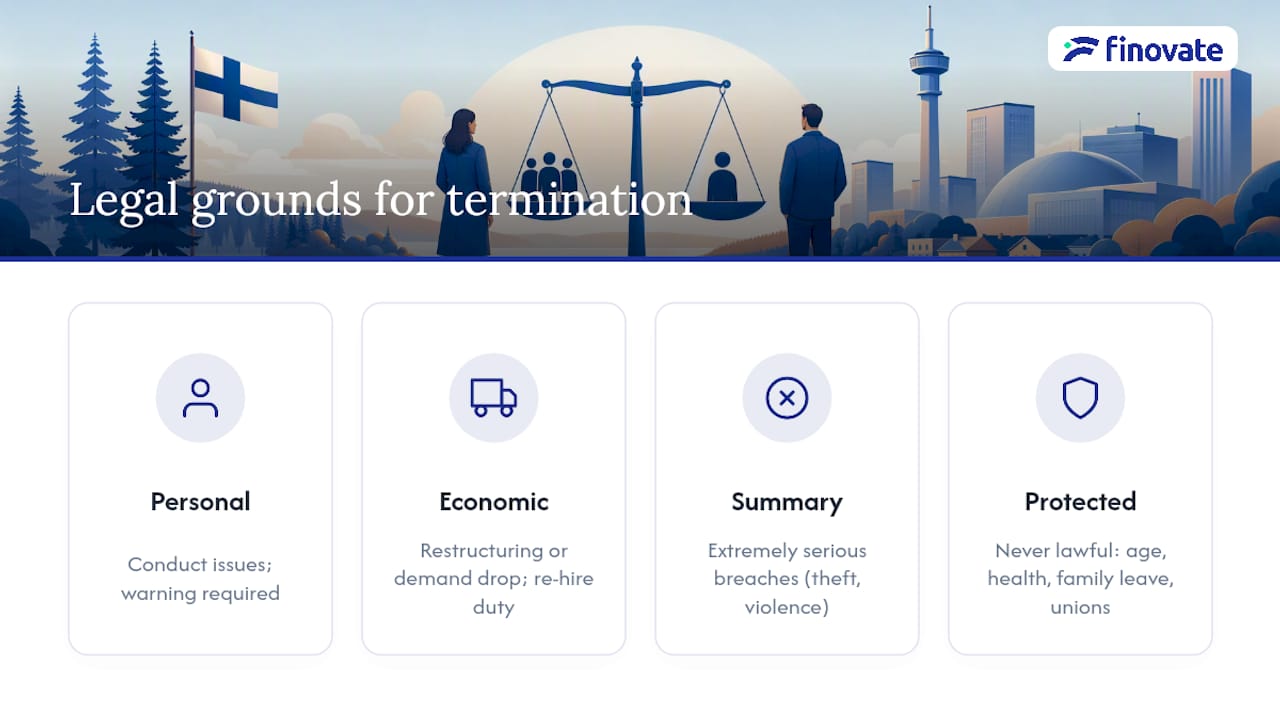
Personal grounds cover conduct issues: repeated unauthorised absence, serious breach of workplace rules, or persistent failure to perform agreed duties despite a warning. The bar is deliberately high. A single minor mistake rarely qualifies as a proper and weighty reason, and employers are expected to have given the employee a genuine chance to correct their behaviour first, except in the most serious cases.
Production and economic grounds apply when the work itself genuinely disappears, through restructuring, a drop in demand, or the closure of a business unit, not merely because the employer wants to replace someone with a cheaper alternative. Employers dismissing on these grounds also carry a re-employment obligation in many cases, meaning they must offer the same or a similar role back to the dismissed employee if it becomes available again within a set period.
Summary dismissal requires an entirely different threshold: an extremely serious breach that makes continuing the employment relationship even for the length of a notice period unreasonable. Theft, violence at work, or serious insubordination typically meet this bar; a single argument or an isolated lapse in performance usually does not.
Grounds that relate to age, health, family leave, trade union membership, or other protected characteristics are never lawful, regardless of how the decision is framed, and dismissals built on these grounds can be challenged directly.
How do you dispute a termination you believe was unfair?
If you think your dismissal was procedurally flawed or substantively unjustified, start by raising the issue in writing with your employer, setting out clearly why you believe the grounds or process were inadequate. Many disputes resolve at this stage once an employer realises its documentation is weak.
If that doesn't resolve things, your trade union, if you belong to one, can raise the matter formally with your employer and advise on next steps, including whether to pursue a claim. Työsuojelu, the Occupational Safety and Health Authority, offers free guidance and can investigate certain procedural failures, though it doesn't itself award compensation for wrongful dismissal.
For compensation claims, the matter ultimately goes to the district court (käräjäoikeus) if no settlement is reached. Courts weigh the strength of the employer's stated grounds, whether the hearing process was properly followed, and the employee's length of service and prospects of finding comparable work, when deciding an award within that three to twenty‑four month range discussed earlier.
Time limits matter here. Claims relating to summary dismissal need to be raised quickly, and general limitation periods for employment claims in Finland typically run for two years from when the claim arose, though the exact period depends on the type of claim, so getting advice early rather than waiting is always the safer course. A guide to procedural fairness in workplace investigations offers useful background on how documentation gaps tend to surface once a dispute reaches this stage.
How does termination affect unemployment benefits?
Losing your job doesn't automatically mean losing income support, but how your employment ended matters a great deal to your eligibility. If you're dismissed for production or economic reasons, or your fixed‑term contract simply expires, you're generally treated the same as any other jobseeker and can register with TE-palvelut (employment services) to claim unemployment benefit through your unemployment fund or Kela.
Resigning voluntarily, however, typically triggers a waiting period before benefits start, because the system is designed to support people who lose work involuntarily rather than those who choose to leave. The same caution applies to mutual termination agreements: because you've agreed to end the relationship rather than being dismissed, signing one can be treated similarly to a voluntary resignation for benefit purposes, which is exactly why it's worth thinking twice before signing, even when an employer frames it as the easier option.
Severance pay (erokorvaus) received as part of a mutual agreement can also affect the timing of your benefit entitlement, since it's often treated as income that pushes back the date your unemployment benefit period begins.
Registering with TE-palvelut promptly, ideally on your first day without work, protects your position regardless of how your employment ended. Delaying registration is one of the most common reasons people lose benefit days they were otherwise entitled to claim.
Do confidentiality and non-compete clauses still apply after you leave?
Confidentiality obligations almost always survive termination, whether or not your contract says so explicitly. Trade secrets, client information, and internal business knowledge you learned during employment remain protected, and misusing them after you leave can expose you to a legal claim from your former employer regardless of how your employment ended.
Non‑compete clauses are a different matter, and considerably more restrictive under Finnish law. A non‑compete clause is only enforceable if it was validly agreed in the contract and there's a genuine, specific business reason for it, not simply a general desire to limit competition. Since changes to Finnish law, employers must generally pay compensation for the restricted period if they want to enforce a non‑compete beyond a short window, which has made employers considerably more selective about using them.
If your contract includes a non‑compete or confidentiality clause, read it again at termination, not just when you signed it. Circumstances change, and a clause that seemed reasonable at the start of employment may be unenforceable or may entitle you to compensation you weren't aware of. Raising a question about scope or compensation with your former employer, or with a legal adviser, before you accept a new role is far cheaper than discovering a breach claim after the fact.
What do payroll professionals see going wrong most often?
The termination process itself rarely causes disputes. What causes them is sloppy documentation: no written record of the hearing, no clear paper trail on holiday pay calculations, no evidence the employee was given a genuine chance to respond. Get the paperwork right at every stage and most disputes never happen in the first place.
— Busayo
Get final pay and payroll compliance right the first time
Termination payroll is unforgiving. Miss a day of accrued holiday, misjudge an overtime calculation, or forget a reimbursement, and you're looking at a correction, an awkward conversation, or worse, a dispute that lands in front of Työsuojelu. Finovate handles payroll processing, final-pay calculations, and työtodistus support for Finnish employers who would rather have someone double-check the numbers than find out later they got it wrong.
If you run payroll occasionally, in-house, a termination is exactly the moment to get a second opinion. Finovate's payroll and accounting services cover everything from routine monthly processing to one-off final-settlement checks, and the firm also supports light entrepreneurs and delivery partners who need invoicing and payroll handled correctly from the outset. Get in touch with Finovate for a final-pay review before your next lopputili goes out.
Sources
This article is general information, not a substitute for advice from a qualified lawyer. Consult a qualified legal professional about your own circumstances before acting on anything here.