

Yes, you can continue your toiminimi's business as a newly formed osakeyhtiö in Finland. You cannot "convert" the sole trader registration itself; instead, you found a new limited company and transfer the business into it. Whether that transfer costs you anything in tax depends entirely on meeting the continuity conditions in Section 24 of the Income Tax Act (TVL 24) — assets and liabilities move at the same book values, the business stays the same, and ownership stays substantially unchanged.
- Register a new oy and file separate notifications for the company and for the toiminimi's termination
- Document asset and liability values before you file anything
- Submit PRH and YTJ notifications together to reduce delay and naming conflicts
Pro Tip: Meeting the continuity test isn't automatic. If ownership shifts even slightly during the changeover, Verohallinto can treat the transfer as a taxable disposal rather than a neutral restructuring.
TL;DR:
- Transferring a sole trader business into a limited company in Finland requires founding a new oy and separately terminating the toiminimi, not simple conversion.
- Continuity conditions must be fully met, including unchanged ownership, asset book values, and business structure, to avoid triggering tax liability.
- Meeting the TVL 24 continuity test is critical, as ownership shifts or asset value mismatches can cause the transfer to be taxable.
- Processing both the PRH and YTJ notifications simultaneously shortens the registration period and reduces administrative issues.
- Proper documentation of asset valuations, final accounts, and ownership structure is essential before filing to ensure compliance and maintain tax neutrality.
Table of Contents
- When does it make sense to change a toiminimi into an osakeyhtiö?
- How does TVL 24 keep the transfer tax-neutral?
- What are the official steps to register and file the change?
- What does it cost and how long does it take?
- How does bookkeeping and tax reporting change afterwards?
- What the official guidance gets right, and where it leaves you exposed
- Key Takeaways
- Sources
When does it make sense to change a toiminimi into an osakeyhtiö?
There's no single trigger, but a handful of signals show up again and again among entrepreneurs who make the switch.
- Profits exceed personal need. Once a toiminimi consistently earns more than the owner draws for living costs, the oy's flat corporate tax rate on retained earnings often beats paying it all as personal income.
- Transaction sizes and liability grow. A toiminimi carries unlimited personal liability. As contract values rise, so does the exposure sitting on your own assets.
- You want to bring in partners or staff. Share ownership structures make it far easier to split equity, issue options, or bring in a co-founder than a sole trader arrangement ever can.
- Clients and suppliers expect an oy. Some procurement processes, larger B2B clients, and public sector tenders simply favour or require limited company status.
- Your personal tax situation is already stretched. If other income pushes you into higher marginal rates, shifting business profits into a company structure opens up more predictable tax planning.
Pro Tip: Run the numbers before you file anything. If your annual profit barely covers your own salary, incorporation adds administrative cost without a tax benefit.
How does TVL 24 keep the transfer tax-neutral?
The continuity principle under TVL 24 is the single most important rule in this whole process. Verohallinto allows a business-form change without immediate tax consequences only when three conditions hold together: the business itself continues unchanged, assets and liabilities transfer at their existing book values, and ownership stays substantially the same.
Confirmed tax losses can typically carry over to the new oy, which matters if the toiminimi has run at a loss in recent years. What breaks continuity is usually one of two things: an ownership change that looks like a disposal, or assets that don't move over at matching values, which Verohallinto can reclassify as an apportti (a taxable capital contribution) rather than a neutral transfer.
Tax advisers describe continuity as the deciding factor in every one of these conversions. Change the ownership mix, even modestly, and what should be a tax-neutral restructuring risks becoming a taxable event.
There's also a hard administrative consequence regardless of tax treatment: the change always creates a tax-year break. The sole trader's accounting period ends on the date the new oy is registered in the trade register, and the oy then starts its own separate tax reporting period. Get your final toiminimi accounts and valuations documented before that registration date, not after.
What are the official steps to register and file the change?
PRH is explicit on this point: a sole trader's business cannot legally continue as the same entity. You register a brand new osakeyhtiö and separately close the toiminimi, and PRH recommends requesting simultaneous processing of both notifications to avoid gaps or naming conflicts.
- Decide whether you're founding a new oy (the common route, and the one TVL 24 typically applies to) or transferring into an existing company.
- Prepare the founding documents for the new oy: articles of association, share allocation, and opening balance sheet.
- Submit the trade register notification for the new oy and the termination notification for the toiminimi at the same time.
- File through YTJ, which routes a single submission to both Verohallinto and the trade register, though changes only take effect once the authorities have processed them.
- Confirm your new Y-tunnus and, where relevant, file a Y6 form for further changes to the company's details.
A few technical points catch people out. Company names must carry the "oy" or "osakeyhtiö" suffix, and if you want the new company to keep your existing trade name, you generally need to change or close the toiminimi's name notification separately, otherwise the old registration can block the new one. You'll also need asset lists, an opening balance sheet, copies of key contracts, and proof of ownership ready before you file.
What does it cost and how long does it take?
Budget for two layers of cost: the official filing fees and professional advisory time.
- PRH lists a fee for certain change notifications tied to this process, though your total filing cost depends on exactly which notifications you submit.
- Accountant or legal fees for preparing valuations, opening balances, and the filings themselves vary by firm and complexity, so ask for a fixed quote upfront rather than an hourly estimate.
- Processing times at PRH and YTJ vary by workload, and because the tax-year break happens on the registration date, timing your filing around your accounting calendar avoids an awkward reporting gap.
Requesting simultaneous handling of both notifications, as PRH itself advises, is the most reliable way to shorten the practical waiting period.
How does bookkeeping and tax reporting change afterwards?
The switch reshapes your accounting obligations from the registration date forward, not retroactively.
- Close out the toiminimi's books with a final set of accounts and a final personal tax return covering the period up to registration.
- Start separate bookkeeping and tax reporting for the oy from day one, including corporate income tax filings distinct from your personal return.
- Check your VAT registration: in most cases it carries over without a break, but confirm the registration details match the new Y-tunnus.
- Set up payroll if you'll now draw a salary rather than owner drawings, since an oy owner working in the business is typically an employee for payroll and pension purposes, and profit can be split between salary and dividends.
- Record the opening balances precisely, matching the book values used in the toiminimi's final accounts to preserve the continuity conditions.
Choosing the right accounting method at this stage avoids rework later, particularly around how opening balances are structured.
A short checklist before you file
- Compile full asset and liability lists with agreed valuations that match what will appear in the oy's opening balance sheet.
- Check nobody's ownership share is changing in a way that could break the continuity conditions, and lock in the intended shareholding.
- Decide the company name, confirm share allocation, book time with an accountant, and prepare to submit the PRH and YTJ notifications together.
Pro Tip: Sort your asset valuations and contract assignability questions with an accountant at least a few weeks before filing. Trying to fix a documentation gap after the oy is already registered is far harder than getting it right first.
Why get an accountant involved in the conversion
A qualified accountant earns their fee here by handling the parts most likely to go wrong: valuing assets consistently, preparing the final toiminimi accounts, filing PRH and YTJ notifications correctly, and documenting that every TVL 24 condition is genuinely met.
- Confirms whether your specific transfer qualifies for tax neutrality before you file, not after
- Prepares the opening balance sheet so it matches the closing toiminimi accounts
- Handles the PRH/YTJ paperwork and timing so both notifications process together
Finovate's guidance for Finnish entrepreneurs covers many of the documentation questions that come up during exactly this kind of change.
What the official guidance gets right, and where it leaves you exposed
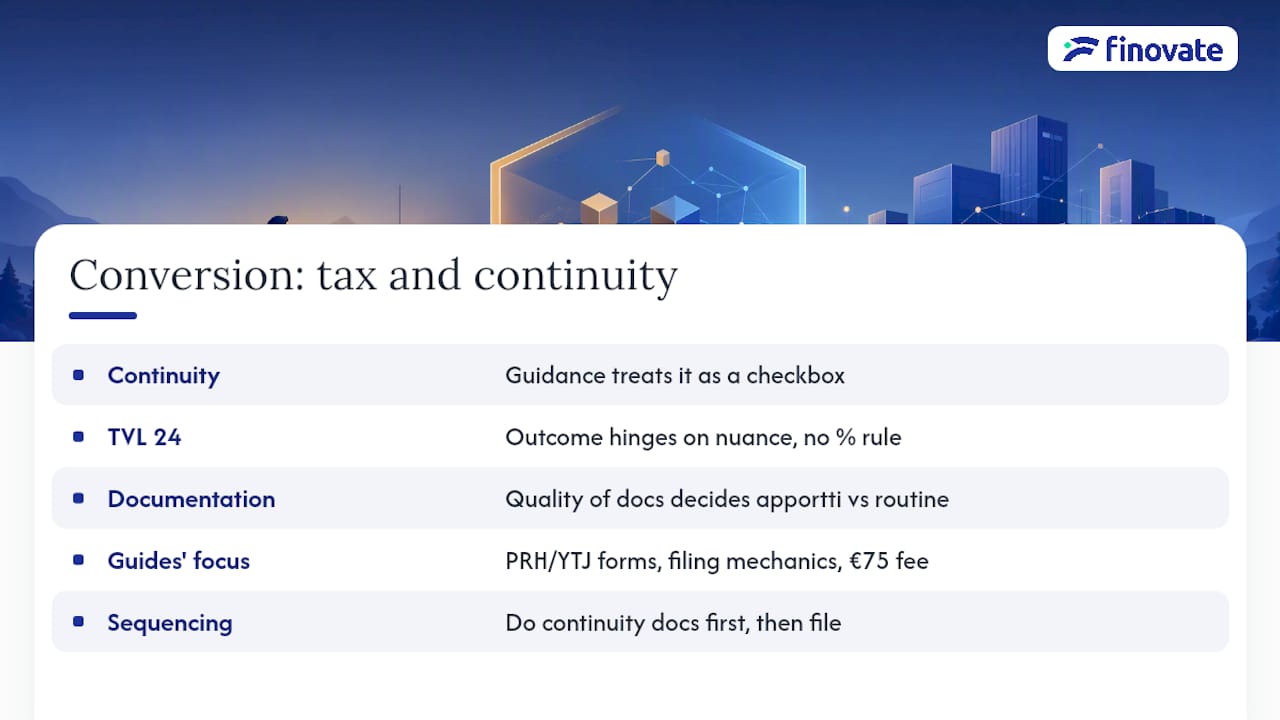
The PRH and Verohallinto guidance is thorough on process, but it treats continuity as a checkbox rather than a judgement call. In practice, the TVL 24 test hinges on nuance: how much ownership can shift before Verohallinto calls it a disposal isn't spelled out with a clean percentage, and the difference between a routine asset transfer and an apportti often turns on documentation quality rather than intent.

Most guides fixate on the filing mechanics, PRH forms, YTJ notifications, the 75 € fee, and skip past the part that actually determines your tax bill: whether your valuations and ownership structure will survive scrutiny. That's backwards. Get the continuity documentation right first, then treat the PRH/YTJ filing as the easy part.
My honest read is that the entrepreneurs who handle this well aren't the ones who file fastest. They're the ones who sat down with an accountant before drafting the opening balance sheet, not after. If you take one thing from this guide, let it be that sequencing.
— Busayo
How Finovate supports your conversion from toiminimi to oy
Finovate handles the parts of this process where mistakes are expensive: valuing assets correctly, preparing your final toiminimi accounts, and filing PRH and YTJ notifications so your TVL 24 conditions are properly documented rather than assumed. For entrepreneurs still weighing the timing, Finovate offers a starting consultation to review whether your business is ready for the switch.

If you're not ready to incorporate yet but want your invoicing handled properly in the meantime, accounting support for light entrepreneurs is a lower-commitment option worth considering first. Once you've decided to proceed, book a call with Finovate to get your asset valuations and filing timeline mapped out before you submit anything to PRH or YTJ.
Key Takeaways
Converting a toiminimi into an osakeyhtiö stays tax-neutral only when the business, its asset values, and its ownership structure all carry over unchanged under TVL 24.
| Point | Details |
|---|---|
| Continuity is the deciding factor | Ownership changes or mismatched asset values can turn a neutral transfer into a taxable event. |
| The toiminimi can't be moved, only replaced | You register a new oy and separately close the toiminimi, filing both with PRH and YTJ. |
| Expect a tax-year break | The sole trader's tax year ends at oy registration; the new company starts its own reporting period immediately. |
| File simultaneously to save time | Requesting joint PRH and YTJ processing reduces delays and naming conflicts. |
| Get documentation right before filing | Finovate helps entrepreneurs prepare valuations, final accounts, and PRH/YTJ filings that hold up under Verohallinto's continuity test. |