

The right mix depends on three things: your company's net assets, how much cash you need each month, and how salary affects your YEL pension and social security cover. The sections below walk through the numbers and give you a checklist to run before your next payout.
TL;DR:
- Dividends are more tax-efficient only when the company's nettovarallisuus is strong, profits are distributable, and the annual payout stays within the 8% allowance and €150,000 cap.
- Salary is preferable for owners needing steady income, wanting to reflect their true earnings for pension purposes, or when the company's net assets are too low to support dividends.
- Combining salary up to personal living costs with dividends up to the allowance usually results in higher net income than taking only a salary.
- Proper documentation and regular scenario reviews are crucial to optimize payouts and avoid issues with balance sheet changes or missed compliance steps.
- Engaging an accountant for tailored scenario analysis and accurate payroll setup ensures compliance and maximizes tax advantages.
Table of Contents
- When salary is usually the better choice for Finnish owners
- When dividends (osinko) are usually more tax‑efficient
- A practical rule‑of‑thumb and stepwise approach to combine salary and dividends
- Key Finnish numbers and quick reference
- How to run a quick calculation checklist before you pay yourself
- When an accountant genuinely earns their fee
- How Finovate can help with your salary and dividend planning
- Sources
When salary is usually the better choice for Finnish owners
Salary works differently from dividends at a structural level. It's a deductible expense for the company, which lowers its taxable profit, while dividends come out of profit that's already been taxed. For the owner, salary counts as ansiotulo, earned income taxed progressively, whereas dividends split between capital and earned income under different rules entirely.
Several practical situations tilt the decision towards salary rather than dividends:
- Your company is young and hasn't built up nettovarallisuus (net assets), so the 8% dividend allowance is small or nonexistent.
- You need steady monthly income rather than an occasional lump sum, since dividends require a formal distribution decision each time.
- You want your YEL pension basis to reflect your real earnings, because salary (and your YEL income level) directly shapes your future pension and your entitlement to parental and sickness benefits.
- Your business needs to reinvest most of its profit, leaving little to distribute anyway.
Here's a simple illustration. Say your Oy earns €50,000 in profit before owner withdrawals. Take nothing as salary, and the full €50,000 stays exposed to corporate tax before any dividend can be paid, leaving you with no earned‑income base for YEL contributions or pension accrual that year.
When dividends (osinko) are usually more tax‑efficient
Dividend taxation from an unlisted Oy (listaamaton osakeyhtiö) splits into two categories, and the split depends on your company's nettovarallisuus, the mathematical value of the shares. Up to 8% of that value can be paid out each year as pääomatulo‑osinko: of that portion, 25% is taxed as capital income and 75% is tax‑free, provided the total stays under the €150,000 annual pääomatulo threshold.
That structure makes dividends attractive specifically when nettovarallisuus is healthy and profits are genuinely distributable. A few conditions need to hold:
- The company must have retained, distributable profit on its balance sheet. Dividends can't legally exceed that figure.
- A yhtiökokous (shareholders' meeting) must formally approve the distribution and record it in minutes.
- Paying a dividend doesn't reduce the company's taxable profit, so it should never be treated as a substitute for legitimate business deductions.
Picture €1,000 of company profit. Taken as salary, it's fully deductible for the company but taxed at your personal marginal rate, which for many owner‑managers sits somewhere between 30% and 45% once municipal tax and pension contributions are counted.
A practical rule‑of‑thumb and stepwise approach to combine salary and dividends
Rather than picking one or the other, most efficient structures blend both, following a rough order of priority:
- Use deductible reimbursements first. Kilometre allowances and per‑diems for genuine business travel are tax‑free to you and deductible for the company, so claim these before touching salary or dividends.
- Set a base salary that covers your living costs. A guideline figure often cited is a modest salary sufficient to cover living costs, though your own number depends on personal expenses and how much you value building YEL pension entitlement.
- Add dividends up to the 8% pääomatulo‑osinko limit, assuming distributable profit and nettovarallisuus support it.
- Consider top‑ups or pension contributions once salary and the 8% dividend allowance are exhausted, rather than jumping straight to higher‑taxed ansiotulo‑osinko.
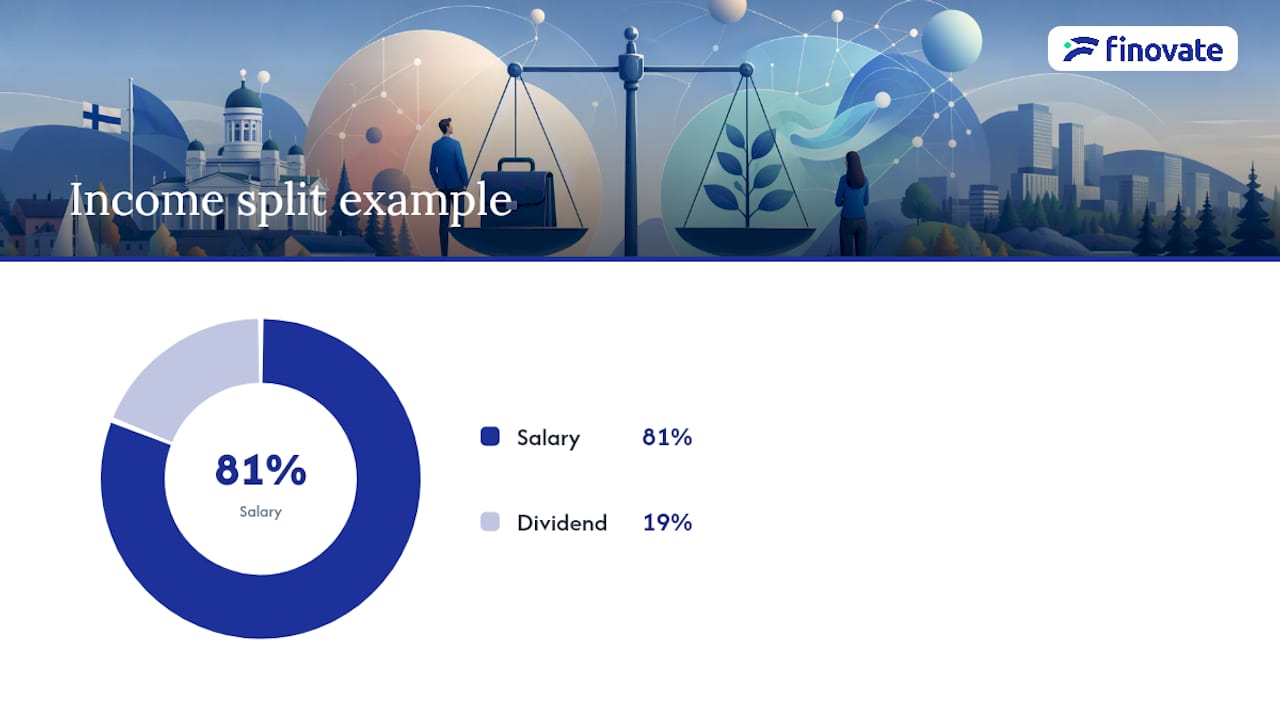
A worked example helps. Suppose your nettovarallisuus supports €8,000 of pääomatulo‑osinko this year, and your living costs run to roughly €35,000. Take €35,000 as salary (covering YEL and living needs) and €8,000 as dividend within the allowance. Your combined net income lands higher than taking the full €43,000 as salary alone, because a chunk of it was taxed far more lightly through the dividend route.
Pro Tip: If you don't need the cash immediately, ask your accountant about employer pension contributions on top of statutory YEL. They're deductible for the company and don't count as taxable benefit to you until drawn, which can beat both salary and dividend for money you can afford to leave untouched for years.
Key Finnish numbers and quick reference
A few figures anchor almost every salary versus dividend calculation.
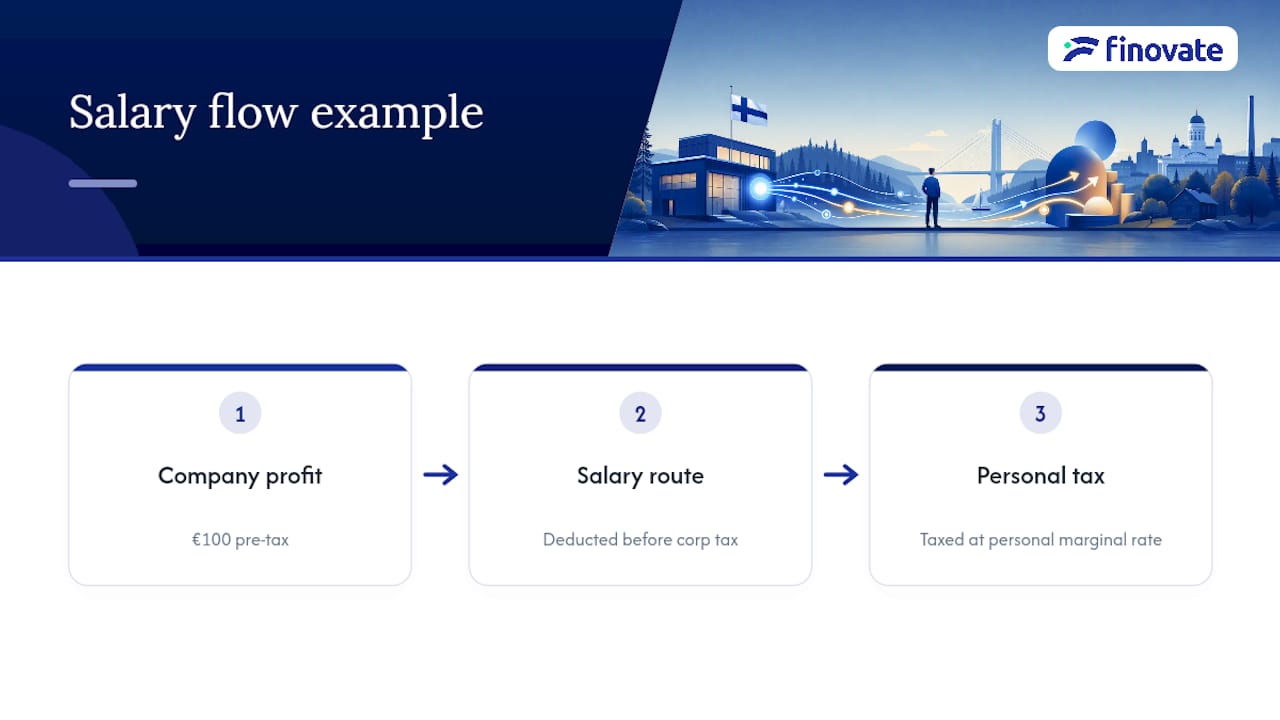
Here's how €100 of pre‑tax company profit flows through each route. As salary, it's deducted before corporate tax, then taxed at your personal marginal rate on the full amount. Rules shift periodically, so always check current figures directly with Verohallinto before finalising a payout.
How to run a quick calculation checklist before you pay yourself
Before setting a payout for the year, gather these inputs: your company's nettovarallisuus, distributable profit on the balance sheet, your other personal income, your monthly cash needs, and your YEL income base.
Then work through it in order:
- Confirm distributable profit exists and matches available cash, not just paper profit.
- Calculate 8% of nettovarallisuus to find your pääomatulo‑osinko ceiling.
- Check that ceiling against the €150,000 pääomatulo cap across all your income.
- Estimate your marginal personal tax rate on additional salary.
- Model both routes, salary only, dividend only, and a blend, side by side.
- Confirm the split still supports adequate YEL pension accrual.
- Document the decision properly if dividends are involved, with signed minutes.
- Re‑run the check mid‑year if profit forecasts or personal income change materially.
When an accountant genuinely earns their fee
We see the same pattern repeatedly: owners who calculate salary and dividends purely on last year's numbers, then get caught out when nettovarallisuus shifts or SVOP funds and shareholder loans complicate the balance sheet. Those balance‑sheet details change the optimal split materially, which is exactly when it's worth calling in help. A good adviser delivers scenario comparisons, drafts the dividend decision minutes, and sets up payroll correctly from month one. The most common mistake we catch isn't a bad calculation. It's skipping proper documentation for a dividend that was entirely legitimate on paper.
— Busayo
How Finovate can help with your salary and dividend planning
Accounting and payroll professionals can handle tax planning, bookkeeping, dividend documentation, and one‑off scenario calculations tailored to a company's actual nettovarallisuus and cash position, not a generic rule of thumb.
A typical engagement with an accounting service starts with a review of your current balance sheet and income needs, moves into side‑by‑side salary and dividend scenarios using our Finnish AI Content Generator, and finishes with proper implementation: payroll set up correctly, dividend minutes drafted, and filings handled on schedule. If you invoice as a light entrepreneur rather than through your own Oy, our light entrepreneur accounting service covers the bookkeeping side of that separately. For a full picture of your options, get in touch through Finovate's accounting and tax services and we'll build the calculation around your actual figures rather than an assumption.
Sources
- Palkkaa vai osinko — Tampereen kauppakamarilehti
- Tulos
- Palkkaa vai osinkoa: miten yrittäjä voi nostaa rahaa — yrityksen‑perustaminen.net
- Osakeyhtiön yritysomistajan verosuunnittelusta — Theseus thesis
This article is general information, not a substitute for advice from a qualified financial advisor. Consult a qualified financial professional about your own circumstances before acting on anything here.