

TL;DR:
- In Finland, a business tax ID primarily refers to the Y-tunnus, a unique identifier issued to registered businesses for taxation, invoicing, and contracts. The VAT number, derived from the Y-tunnus, is used for EU cross-border transactions and VAT compliance, requiring correct formatting. Proper and consistent use of these identifiers from the start prevents compliance errors, delays, and administrative headaches for entrepreneurs.
If you are starting or running a business in Finland, understanding what is a business tax id is not optional. It is a legal requirement that affects how you invoice clients, pay taxes, open bank accounts, and sign contracts. The challenge is that "business tax ID" is not a globally standardised term. In Finland, the concept maps to two specific identifiers: the Y-tunnus (business identity code) and the VAT number. Knowing the difference between them, and when to use each one, will save you time, prevent compliance errors, and help you operate with confidence from day one.
Table of Contents
- Key takeaways
- What is a business tax ID in Finland?
- Your VAT number and how it relates to Y-tunnus
- Finnish business IDs vs international equivalents
- How to get a business tax ID in Finland
- Common pitfalls when using Finnish business IDs
- My perspective: why clarity on Y-tunnus matters more than you think
- How Finovate helps you manage your business tax IDs
- FAQ
Key takeaways
| Point | Details |
|---|---|
| Y-tunnus is your core ID | Every Finnish business receives a Y-tunnus, the foundational identifier used across taxation, banking, and contracts. |
| VAT number is derived from Y-tunnus | Your VAT number is formed by adding "FI" before your Y-tunnus digits, without the hyphen. |
| EIN and TIN are US equivalents | American tax IDs serve similar functions but operate under a different system; knowing the distinction prevents confusion in international dealings. |
| VAT registration has a threshold | VAT registration becomes mandatory when your revenue exceeds a set threshold or when you trade within the EU. |
| Consistent use prevents errors | Using the correct identifier in every invoice, contract, and banking form keeps your records clean and avoids costly verification delays. |
What is a business tax ID in Finland?
The term "business tax ID" does not refer to a single universal document. In Finland, it specifically refers to the Y-tunnus, also known as the business identity code. Every Finnish business receives a Y-tunnus, a unique identifier issued by the Finnish authorities that is used across invoicing, taxation, and contracts. Think of it as the official name tag for your business entity in every formal context.
The format is straightforward: seven digits followed by a check digit, separated by a hyphen, for example 1234567-8. This code does not identify you as a person. It identifies your business as a legal entity, whether you are a sole trader, a limited company, or a general partnership.
The Y-tunnus serves several practical functions:
- It appears on every invoice you issue to clients
- Banks require it to open a business account
- Tax authorities use it to link your filings to your business
- Contracts and procurement agreements reference it for verification
- It is used in the Finnish trade register and company databases
One detail that surprises many new entrepreneurs is that you can obtain a Y-tunnus even without registering in the trade register. A sole trader operating at a small scale may only need a tax registration, not a full trade register entry. The Y-tunnus is issued either way.
Pro Tip: Store your Y-tunnus somewhere accessible, such as in your invoicing software settings, so it appears automatically on every document you produce. Manually adding it each time increases the risk of errors.
The importance of business tax ID registration cannot be overstated. Without it, you cannot legally conduct business in Finland in any structured way.

Your VAT number and how it relates to Y-tunnus
Once your revenue grows or you begin trading across EU borders, a second identifier comes into play: the VAT number, known in Finnish as the ALV-numero. This is not a completely separate number issued from scratch. The VAT number is derived from your Y-tunnus by adding the prefix "FI" and removing the hyphen. So if your Y-tunnus is 1234567-8, your VAT number becomes FI12345678.
This distinction matters practically in the following situations:
- Domestic invoicing: Your Y-tunnus is sufficient for invoices to Finnish clients
- EU cross-border invoicing: You must include your VAT number when invoicing VAT-registered businesses in other EU member states
- Reverse charge transactions: Your VAT number is required so the recipient can process the VAT correctly in their own country
- VIES database verification: EU businesses can look up your VAT number to confirm your registration status before making payment
Correct VAT number formatting is non-negotiable. A common mistake is leaving out the "FI" prefix or including the hyphen from the Y-tunnus. Either error can trigger additional verification steps or cause the invoice to be treated incorrectly for VAT purposes.
Your bookkeeping and invoicing software should store both the Y-tunnus and the VAT number as separate fields. They serve different compliance functions, and conflating them in your records creates problems during audits and EU VAT reporting. For guidance on how these identifiers fit into your broader tax obligations, the tax preparation guide for Finnish SMEs from Finovate is a useful reference.
Pro Tip: Before sending your first cross-border invoice, verify that your invoicing template uses your VAT number in the correct format. Ask your counterpart which identifier they need before assuming.
Finnish business IDs vs international equivalents
If you have worked with international clients or researched tax IDs globally, you will have come across terms like EIN and TIN. These are American identifiers, and understanding how they compare to Finnish ones removes a great deal of confusion.
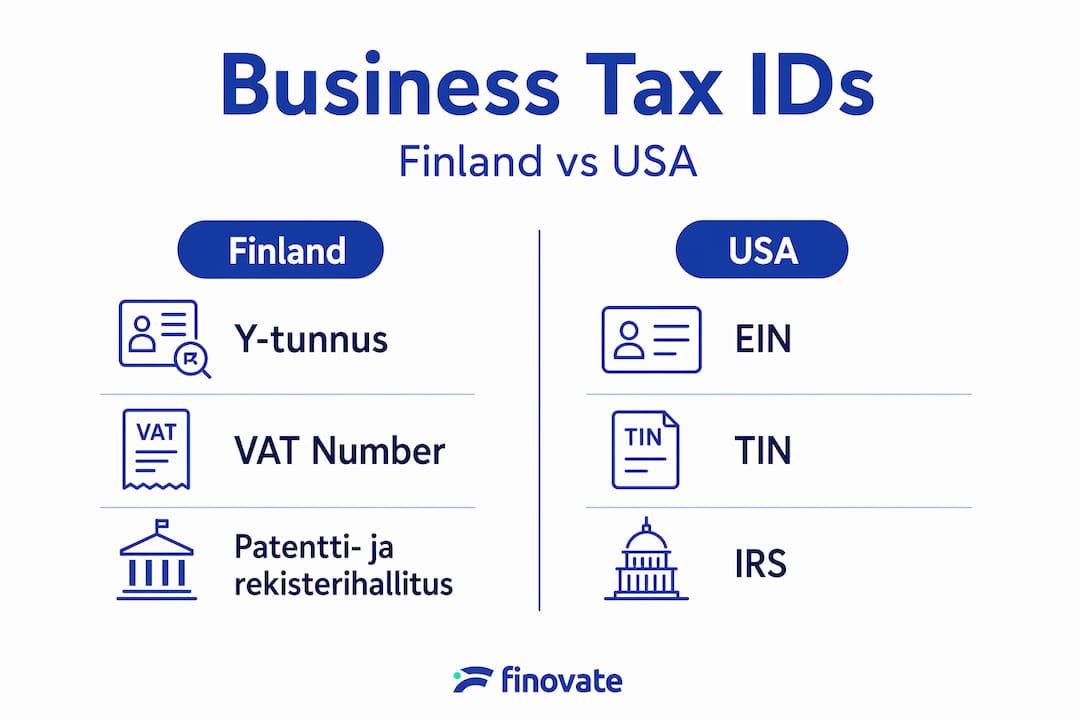
The Employer Identification Number (EIN) is issued by the US Internal Revenue Service (IRS) to identify businesses for federal tax purposes. It is free to obtain online and serves a similar function to the Y-tunnus in that it identifies the business entity rather than an individual.
The Taxpayer Identification Number (TIN) is a broader umbrella term used by the IRS. The EIN is one type of TIN. Other types include the Social Security Number (SSN) for individuals, the Individual Taxpayer Identification Number (ITIN) for non-citizens, and others. This is why international tax ID terminology varies so widely and can confuse Finnish entrepreneurs dealing with US clients or partners.
The table below clarifies how each identifier compares:
| Identifier | Issuing authority | Format | Primary usage context |
|---|---|---|---|
| Y-tunnus | Finnish Patent and Registration Office / Tax Administration | 7 digits + check digit (e.g., 1234567-8) | All Finnish business transactions, taxation, contracts |
| VAT number | Finnish Tax Administration (Verohallinto) | FI + 8 digits (e.g., FI12345678) | EU cross-border invoicing, VAT reporting |
| EIN | US Internal Revenue Service | 9 digits (XX-XXXXXXX) | US federal business tax filings |
| TIN | US Internal Revenue Service | Varies by type | Broad US tax identification for individuals and entities |
The practical takeaway here is straightforward. When a foreign client asks for your "tax ID," do not assume they mean the same thing you use domestically. Confirm which identifier they require before submitting anything. In most cases, a Finnish business working with an EU partner will provide the VAT number. A US partner may ask for something analogous to an EIN, in which case your Y-tunnus is the closest equivalent.
For a broader look at entrepreneurship tax in Finland and how it relates to international operations, Finovate has put together a practical resource worth reviewing.
How to get a business tax ID in Finland
The business tax ID application process in Finland is more accessible than most entrepreneurs expect. Here is how it works step by step:
- Decide on your business structure. Whether you are registering as a sole trader (toiminimi), a limited company (Oy), or another form, the structure determines which registrations are required.
- Access the OmaVero portal or YTJ. The Business Information System (YTJ) is operated jointly by the Finnish Tax Administration and the Finnish Patent and Registration Office. You can apply for a Y-tunnus and register for taxes in one place.
- Choose your registrations. At minimum, you will register for prepayment tax (ennakkoperintärekisteri). If you expect revenue above the VAT threshold or you are trading with EU businesses, also register for VAT at the same time.
- Submit your application. For sole traders not requiring trade register entry, this can be done entirely through the Verohallinto OmaVero online service. For limited companies, trade register entry is mandatory and involves a registration fee.
- Receive your Y-tunnus. Once processed, your Y-tunnus is issued and your business becomes officially registered in the relevant Finnish systems.
- Obtain your VAT number. VAT registration is mandatory when revenue exceeds the threshold or for intra-EU trade. Upon successful VAT registration, your VAT number is issued automatically based on your Y-tunnus.
The timeline for a sole trader tax-only registration is typically a few business days. Trade register entries for limited companies take longer, particularly if documentation is incomplete.
Pro Tip: Register for VAT from the outset if you plan to work with VAT-registered businesses, even if your turnover is below the threshold. This allows you to reclaim input VAT on your purchases, which can represent a meaningful saving in the early months of trading.
For a full walkthrough of the legal and administrative steps involved, the Finovate guide on starting a business in Finland covers the process in detail.
Common pitfalls when using Finnish business IDs
Having a Y-tunnus and VAT number is one thing. Using them correctly, every time, is another. Here are the most common errors Finnish entrepreneurs make, and how to avoid them.
- Wrong identifier on invoices: Using the Y-tunnus where the VAT number is required, or vice versa, causes validation failures and delays payment from EU clients.
- Hyphen errors in VAT number: The Y-tunnus contains a hyphen (e.g., 1234567-8), but the VAT number does not (FI12345678). Including or omitting characters incorrectly creates compliance problems in automated invoice processing.
- Outdated information in software: If your business details change, such as a new trading address or bank account, and your accounting software is not updated, mismatched records can flag issues during tax audits.
- Not verifying the counterpart's VAT ID: Before processing a reverse charge transaction, you are expected to verify your client's VAT number through the EU's VIES system. Skipping this step creates VAT liability risk.
- Using personal identification instead of business ID: Sole traders sometimes submit their personal Finnish identity code (henkilötunnus) instead of the Y-tunnus. These are entirely different identifiers and should never be confused.
Consistent use of Y-tunnus across all your business systems is what keeps payments, tax filings, and banking records aligned. The moment identifiers start diverging across documents, you create unnecessary work for yourself and your accountant.
Pro Tip: Run a quarterly check on your invoicing templates, accounting records, and bank mandate forms to confirm all identifiers are consistent and current.
My perspective: why clarity on Y-tunnus matters more than you think
I have worked with dozens of Finnish entrepreneurs who came to us after making avoidable errors with their business identifiers. The most common issue I see is not ignorance. It is assumption. People assume that because they have a Y-tunnus, they are covered for everything. They are not.
In my experience, the Y-tunnus and VAT number confusion causes more administrative headaches than almost any other compliance topic for small businesses. An invoice sent with the wrong identifier, or no identifier at all, can delay payment by weeks. In the early stages of a business, that kind of cash flow disruption is significant.
What I have learned is that the entrepreneurs who get this right from the start treat these identifiers the same way they treat their bank account number. They verify the format, update it in every system, and never guess. The ones who run into trouble treat it as an afterthought.
If you are unsure whether your current setup is correct, working with an experienced tax adviser is genuinely worth the cost. Not because it is complicated, but because one correction made early prevents ten corrections made under pressure later.
— Busayo
How Finovate helps you manage your business tax IDs
Keeping your Y-tunnus and VAT number in order is not difficult once the right systems are in place. At Finovate, we work with Finnish entrepreneurs and small business owners to make sure the details are handled correctly from registration through to ongoing compliance.
Our monthly invoicing service is built for entrepreneurs who want their billing handled accurately and on time, with both the Y-tunnus and VAT number applied correctly on every invoice. For those needing a lighter option, our light invoicing plan offers the same accuracy at a lower cost for smaller volumes. We also provide full bookkeeping, VAT filing, and expert accounting services for businesses at every stage. If you want confidence that your identifiers are being used correctly across all financial documents, we are here to support you.
FAQ
What is a Y-tunnus and why do I need one?
The Y-tunnus is the Finnish business identity code, a unique identifier issued to every registered business. You need it to invoice clients, register for taxes, open a business bank account, and sign contracts.
What is the difference between Y-tunnus and VAT number?
The Y-tunnus identifies your business entity across all Finnish systems. The VAT number is derived from it by adding the "FI" prefix and removing the hyphen, and it is specifically used for VAT-related invoicing and EU cross-border transactions.
Do I need a business tax ID as a sole trader in Finland?
Yes. Even sole traders operating at a small scale require a Y-tunnus. You can obtain one through the Verohallinto OmaVero service without registering in the trade register.
How does the Finnish business tax ID compare to an EIN?
The Y-tunnus and the US Employer Identification Number (EIN) serve similar purposes: both identify a business entity for tax and administrative purposes. However, they operate within entirely different legal systems and are not interchangeable in cross-border dealings.
When is VAT registration mandatory in Finland?
VAT registration becomes mandatory when your annual revenue exceeds the Finnish threshold or when you carry out intra-EU trade. Upon registration, your VAT number is issued automatically based on your Y-tunnus.