

From 2026, most employer bicycle benefits are taxable income; only agreements committed before 24 April 2025 can remain partly tax-exempt, up to €1,200 a year. For everyone else, the benefit's full value counts as taxable pay, which means payroll must calculate a monthly figure, withhold tax on it, and report it correctly to the Tulorekisteri from day one.
TL;DR:
- Employees with agreements signed and bicycles ordered before April 24, 2025, can retain a tax-exempt benefit of up to €1,200 annually for up to five years or until the contract ends.
- From 2026, any new bicycle benefit agreement or order becomes fully taxable, requiring payroll to calculate and report the benefit as income from day one.
- Correct valuation depends on whether the bicycle is employer-owned or leased, with monthly taxable values based on capital cost, lease payments, or fair market value, supported by detailed documentation.
- Contract amendments, provider switches, or upgrades after April 2025 cancel grandfathering, making the full benefit taxable unless proof of original commitment date is kept.
- Accurate payroll reporting requires specific codes, proper withholding, and careful record-keeping to avoid corrections and ensure compliance with Finnish tax regulations.
Table of Contents
- Työsuhdepyörä verotus: what changed for 2026 and who is affected
- How to value the bike benefit: employer-owned bikes and leasing
- Transitional rules and payroll pitfalls to avoid
- Reporting to Tulorekisteri: codes, withholding and contributions
- Worked examples: what the numbers look like in practice
- Employer checklist: what HR and payroll must do now
- Finovate's practitioner view on getting this right
- How Finovate supports employers through the transition
- Sources
- FAQ
Työsuhdepyörä verotus: what changed for 2026 and who is affected
The rule change removes the blanket tax exemption that made employer bicycle schemes so popular over the past few years. Any bicycle benefit agreed, ordered, or committed to from 24 April 2025 onwards is now fully taxable, with no annual allowance to soften it. That single date is the dividing line the whole system now runs on.
Two conditions decide whether an employee keeps the older, more generous treatment:
- The agreement between employer and employee (or the leasing order) must have been signed before a critical cutoff date in April 2025 as specified by legislation.
- The bike itself, or the leasing contract covering it, must have been ordered before that cutoff date for legacy tax treatment to apply.
Where both conditions hold, the legacy tax‑exempt threshold of €1,200 per year can still apply, but only for the length of the original contract or a maximum of five years, whichever ends first. Switching leasing providers, renewing early, or moving employer voids that legacy status immediately, requiring careful payroll tracking.
How to value the bike benefit: employer-owned bikes and leasing
Payroll needs a monthly figure, not a rough estimate, and the calculation differs slightly depending on who owns the bicycle.
- Employer-owned bikes. The monthly taxable value equals one-twelfth of the annual capital cost (the purchase price portion plus any interest charged) plus a share of annual maintenance, repair, and running costs.
- Leased bikes. The monthly lease instalment typically forms the base value, with maintenance and insurance added where the employer covers them separately.
- Fair market value override. Verohallinto permits using a lower fair market value instead of the standard reference figures when the specific terms of the deal justify it, for example a heavily discounted or second-hand bike.
Pro Tip: Keep the invoice, the leasing schedule, and any discount correspondence on file. If Verohallinto ever queries a lower valuation, that paperwork is what proves the figure was fair rather than favourable.
VAT changes on bicycle sales and servicing also feed into the capital cost, so payroll and finance should confirm which ALV rate applied when the purchase or lease was invoiced, since that affects the base figure used for the monthly allocation.
Transitional rules and payroll pitfalls to avoid
Grandfathering sounds simple until an ordinary administrative change quietly cancels it. Practitioners consistently warn that even minor contract amendments count as a new agreement, stripping away the legacy exemption without anyone intending it.
Watch for these common triggers:
- Switching the leasing company mid-contract, even for an identical bike model.
- An employee changing employer while the bicycle contract is still running.
- Re-signing or "refreshing" a contract to extend its term or update terms.
- Upgrading the bike model, which most providers treat as a fresh order.
Pro Tip: Store the original order confirmation and signed agreement date for every employee on a legacy scheme. If Tulorekisteri or Verohallinto questions the exemption later, the order date is the only evidence that actually settles it.
Payroll teams most often go wrong by applying the €1,200 exemption blanket-wide instead of checking each individual's commitment date. A scheme launched in 2024 can have some employees grandfathered and others not, depending on exactly when each person signed.
Reporting to Tulorekisteri: codes, withholding and contributions
Finland's income register uses two specific codes for this benefit, and getting them right avoids most correction headaches later.
- Income type 363 covers the tax-free portion (verovapaa osa) for qualifying legacy agreements, reported up to the €1,200 annual cap.
- Income type 364 covers the taxable portion (veronalainen palkaksi katsottu osuus), which applies to the full value for anyone without grandfathered status.
Reporting happens monthly, either as a separate benefit line or combined within the regular payroll run, depending on the payroll system's configuration.
Two structural choices affect the numbers:
- Salary sacrifice. When the employee's gross cash salary is reduced to fund the benefit, social security bases and withholding must be calculated on the combined figure, meaning reduced cash salary plus the taxable benefit value, not the reduced salary alone.
- Benefit on top. Where the bicycle is added without touching cash salary, the taxable value simply adds to gross pay for withholding and employer contribution purposes.
If an employee's entitlement changes mid-year, whether they lose legacy status or the benefit ends early, correct the affected months in the Tulorekisteri rather than adjusting the current period only, since backdated corrections keep the annual totals accurate for both employee and employer records.
Worked examples: what the numbers look like in practice
Legacy agreement (ordered March 2025). Annual capital cost and maintenance total €1,000, comfortably under the €1,200 cap. Payroll reports the full amount monthly under income type 363, with no tax withheld and no impact on net pay.
New agreement from January 2026. A leased bike costs €1,500 a year in instalments plus €150 in annual maintenance, giving a monthly taxable value of roughly €137.50. That entire amount goes to income type 364, tax is withheld on it as ordinary salary, and employer contributions apply in full.
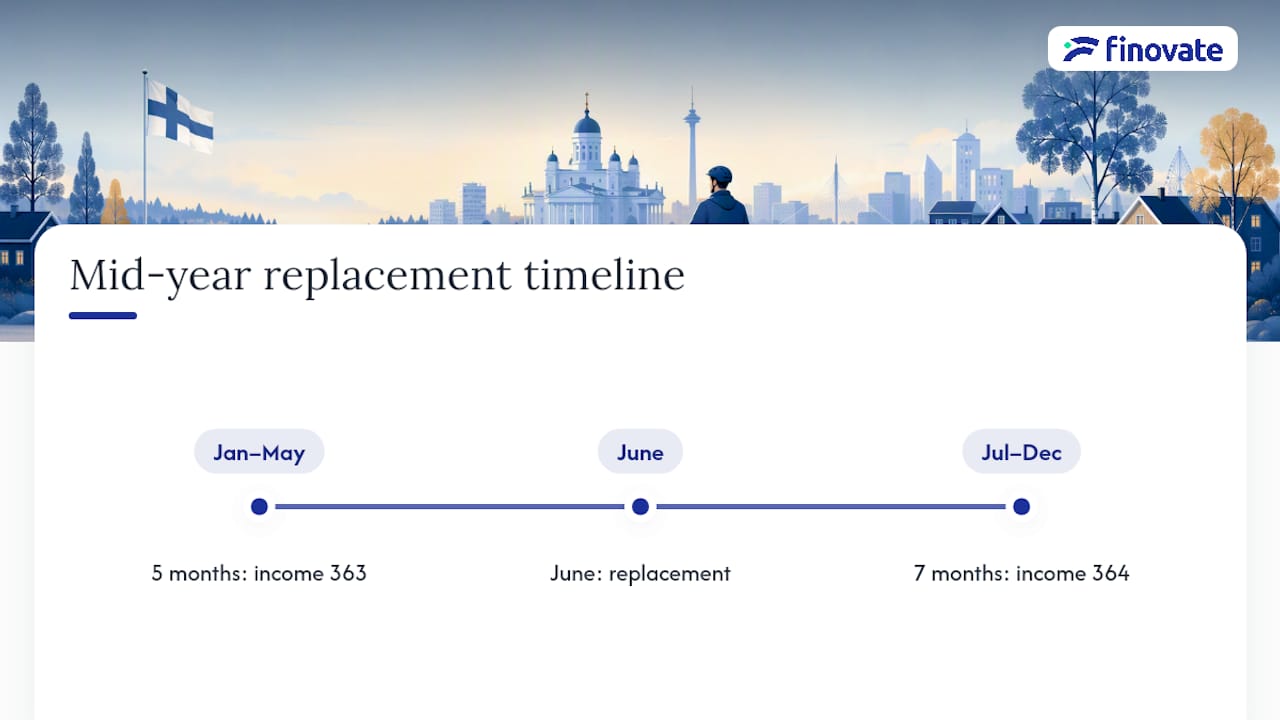
Mid-year replacement. An employee's legacy bike is replaced with a new leasing contract in June. From that point, the new contract's commitment date governs treatment, so the first five months stay under 363 while the remaining seven fall under 364, split proportionally rather than applied to the full year.
Consistently, the combined tax-free cap sits at €3,400 when a bicycle benefit runs alongside a työsuhdematkalippu, so payroll must track both together rather than checking each exemption in isolation.
Employer checklist: what HR and payroll must do now
Run through this before the next payroll cycle closes:
- Confirm the commitment and order date for every employee with a bicycle benefit, and flag each as legacy or post-commitment.
- Decide whether each scheme runs as salary sacrifice or benefit on top, then configure payroll rules accordingly.
- Set up Tulorekisteri templates for income types 363 and 364, and test them against a sample payroll run before going live.
- Archive supplier contracts, order confirmations, and any amendment paperwork for every current agreement.
Pro Tip: Run one full test payroll cycle with both income codes active before the real submission deadline. Catching a misclassified employee in a test run costs nothing; catching it after a live Tulorekisteri submission means a correction filing.
Finovate's practitioner view on getting this right
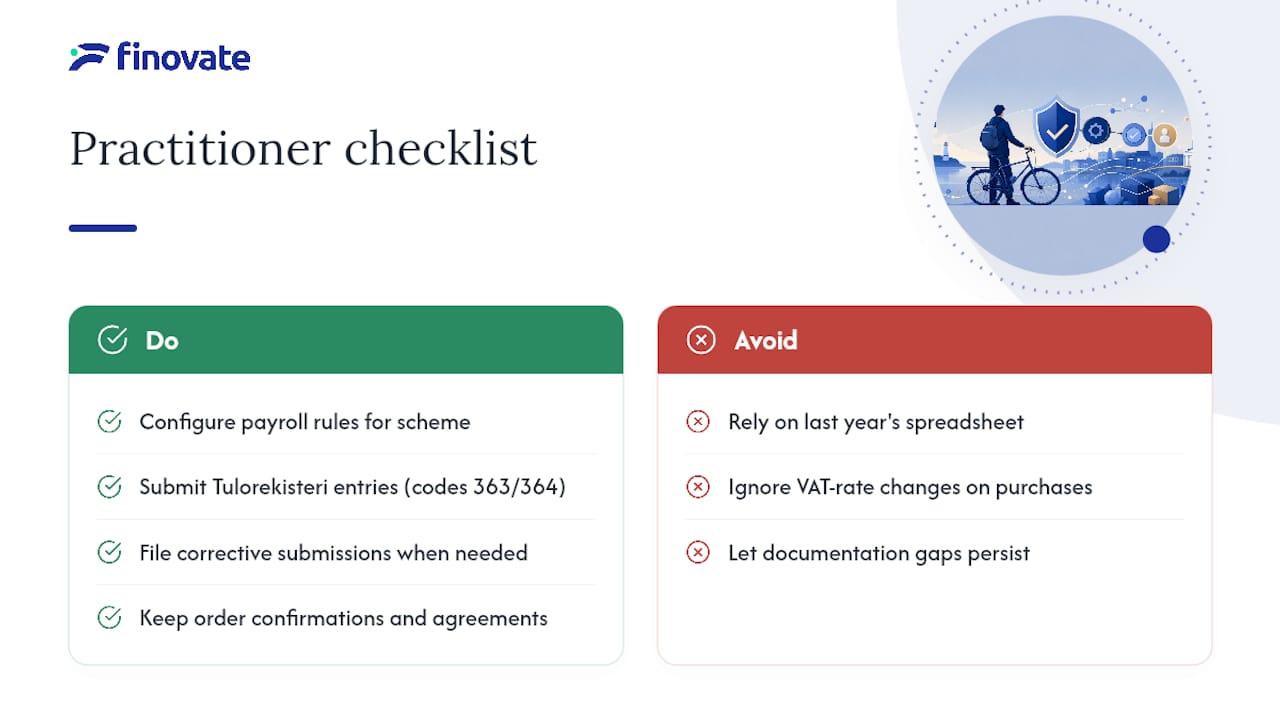
We see the same pattern across clients rolling out or maintaining bicycle benefit schemes: the tax rule itself is straightforward, but the record-keeping behind it rarely is. Fleet-wide rollouts, mid-year provider switches, and VAT-rate changes on the underlying purchase all create the kind of edge cases that a spreadsheet built for last year's simpler exemption cannot handle cleanly.
An accountant earns their fee fastest in exactly these situations: reclassifying a batch of employees after a provider switch, correcting several months of Tulorekisteri entries after a documentation gap comes to light, or setting up payroll rules for a company-wide scheme launch. What we provide in practice is payroll configuration, accurate Tulorekisteri submissions under codes 363 and 364, and corrective filings when an earlier report needs adjusting. Keep every order confirmation and signed agreement; it is the only evidence that settles a legacy status dispute.
— Busayo
How Finovate supports employers through the transition
Finovate is the practical alternative to handling this in-house with a spreadsheet and a hopeful guess at the right Tulorekisteri code. We configure payroll systems to split bicycle benefits correctly between income types 363 and 364, handle the monthly reporting itself, and step in with corrective filings if an earlier submission needs fixing.

For employers running fleet-wide schemes or juggling a mix of legacy and new agreements, that means one team tracking commitment dates, valuation methods, and withholding calculations, rather than HR, payroll, and finance each guessing independently. Our payroll management service covers this end to end, and our guide on managing payroll in Finland walks through the wider reporting obligations that sit alongside bicycle benefits. If your business also relies on light entrepreneurs or delivery partners, our accounting service for light entrepreneurs extends the same reporting discipline to that side of the business. Request a quote to receive detailed information about what your current setup needs before your next payroll run.
Sources
For updates directly from the source, check Verohallinto's guidance on fringe benefits, the Tulorekisteri's bicycle benefit page, and Veronmaksajat's 2026 explainer. Industry commentary from Fleet Innovation also tracks how employers are adapting their schemes, and payroll teams comparing valuation approaches across benefit types may find this freelance invoicing perspective on fair market value a useful outside reference.
This article is general information, not a substitute for advice from a qualified financial advisor. Consult a qualified financial professional about your own circumstances before acting on anything here.
FAQ
Is the bicycle benefit tax-free in 2026?
No, not for most employees. Only agreements committed and ordered before 24 April 2025 can keep the tax-free treatment, up to €1,200 a year; everything committed from that date onward is fully taxable.
Is the bicycle benefit's tax advantage disappearing?
It is disappearing for new agreements but not for existing ones. Legacy agreements ordered before 24 April 2025 keep their exemption for the remainder of the contract term or up to five years, whichever comes first.
What happens to an existing employer bicycle scheme?
If the agreement and order both predate 24 April 2025, the scheme continues under the old rules until the contract ends or five years pass. Any renewal, provider switch, or new contract after that date makes the benefit fully taxable from the start.
Is a work bicycle benefit still worth taking?
It depends on the employee's tax bracket and whether the employer covers maintenance costs. Even as a taxable benefit reported under income type 364, many employees still find it cheaper than buying and maintaining a bicycle privately, though the net saving is smaller than under the old exemption.