

Most refund delays and penalty notices trace back to five things: clerical slips, missing income, the wrong filing status, basic maths errors, and filing before your official documents arrive. Fix these and you eliminate the majority of problems taxpayers run into.
Run through this before you submit anything:
- Wrong SSN, TIN or name — check every ID number against the official card or certificate, not memory.
- Missing income — side gigs, freelance work, investment income and foreign earnings all get matched against employer and institution filings.
- Wrong filing status — confirm the correct status for your situation; it affects your entire calculation.
- Maths errors — let software or e‑filing do the arithmetic rather than a calculator and a hunch.
- Filing before final statements arrive — pay stubs are not year‑end documents.
- Wrong bank details — one digit out on a routing or account number can bounce your refund into a paper cheque.
- Unsigned return — an unsigned paper return is treated as not filed at all.
- Claiming credits you don't qualify for — check eligibility rules before you claim, not after a notice arrives.
Found an error after submitting? Wait until the original return is accepted, and if you're due a refund, wait until it lands before you file an amendment.
Key Takeaways
Most tax filing errors come from rushing: filing before final documents arrive, skipping a personal‑details check, or estimating income instead of confirming it.
| Point | Details |
|---|---|
| Wait for year‑end statements | Filing from pay stubs instead of final W‑2s or 1099s is a leading cause of amended returns. |
| Verify identity and bank details | Check SSNs, names and account numbers against official documents before submitting. |
| Amend only after acceptance | Wait for your original return to be accepted, and for any refund to arrive, before filing corrections. |
| Keep organised records | Retain income statements, receipts and bank records for as long as the tax authority can review that year. |
| Get professional review when it's complex | Finovate reviews returns, reconciles year‑end figures, and handles tax authority correspondence for entrepreneurs and small businesses. |
Table of Contents
- Why avoiding these tax filing mistakes matters
- The full list of common tax filing errors and how to prevent them
- What should you check before you submit your return?
- How do you correct a mistake after you've already filed?
- What triggers a tax return review or audit?
- Recordkeeping: what to keep and for how long
- When should you bring in a tax professional?
- How Finovate helps you avoid these mistakes entirely
- Frequently asked questions
- Sources
Why avoiding these tax filing mistakes matters
The consequences aren't abstract. A mismatched Social Security number or a misspelled name is one of the most common causes of refund delays, simply because the tax authority's system can't match your return to your record. Underreported income triggers something similar but sharper: an automated notice asking you to explain the gap between what you declared and what your employer or bank reported on your behalf.
Wrong bank details cause a different kind of delay. Instead of a same‑cycle deposit, your refund gets reissued as a paper cheque, which can add weeks to the timeline. Late or amended filings, meanwhile, cost you twice: once in the original processing time, and again while the correction works its way through the queue.
None of this is inevitable. Most of it comes down to patience and a five‑minute check before you hit submit.
Pro Tip: Waiting a few extra days for your final year‑end statements almost always costs less time than filing early and correcting it later. Tax professionals consistently see the short wait pay off against the hassle of an amendment.
The full list of common tax filing errors and how to prevent them
This is the checklist we'd hand a client if they asked us to review their return line by line. Work through it in order, and you'll catch the errors that cause most of the headaches.
1. Misspelled names or wrong ID numbers. A name that doesn't match your official identification document, or a transposed digit in your Social Security number or tax identification number, stops automated processing dead. Prevention: compare every ID field against your official card or certificate before submission, not from memory. Example: a single swapped digit in an SSN is enough to bounce an otherwise correct return.
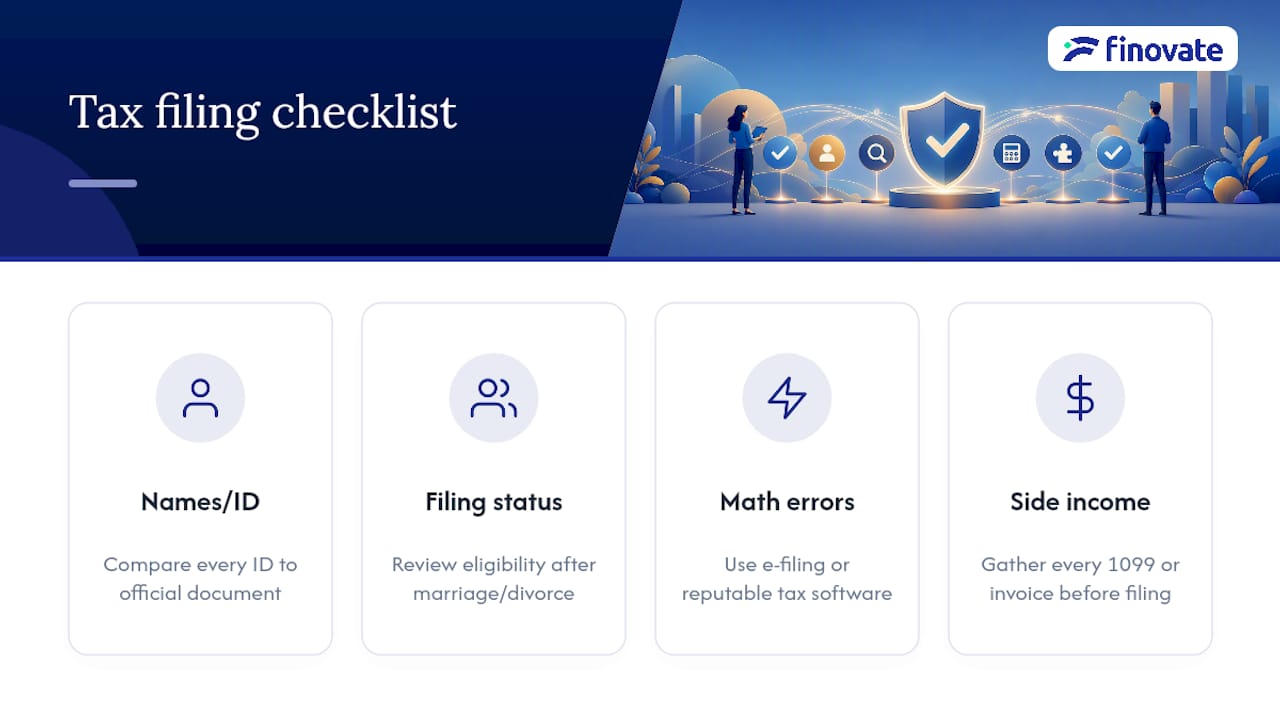
2. Incorrect filing status. Choosing the wrong status changes your entire tax calculation, including the deductions and credits available to you. Prevention: review the eligibility criteria for each status rather than assuming last year's status still applies, especially after a marriage, divorce, or change in dependants.
3. Simple maths errors. Manual arithmetic on complex returns is where small slips creep in, particularly when totalling multiple income sources or deductions. Prevention: use e‑filing or reputable tax software rather than a calculator. Electronic filing and software catch these errors automatically far more reliably than a manual review.
4. Missing income from side gigs or freelance work. Any income you earn outside your main job still counts, and tax authorities receive information returns from clients and platforms that they match against your declaration. Prevention: gather every 1099‑equivalent or invoice record before you begin, not after you've already estimated a figure.
5. Missing investment or foreign income. Dividends, interest, and income earned abroad are just as visible to tax authorities as wages. Prevention: cross‑check every statement from banks, brokers and foreign employers against what you report, since tax authorities typically match declared income against employer and institution filings.
6. Claiming credits or deductions you're not eligible for. Overclaiming, even by accident, invites correspondence and potential repayment with interest. Prevention: check the current eligibility rules each year rather than assuming a credit you claimed previously still applies. Rules change annually, and last year's allowance is not a guarantee.
7. Missing genuinely eligible deductions. The opposite problem is just as costly: overlooking legitimate business expenses or reliefs because the paperwork wasn't organised. Our business expense checklist is a useful reference if you're unsure what qualifies.
8. Wrong bank routing or account numbers. A single incorrect digit can misdirect your refund entirely, forcing a slower paper cheque instead of a direct deposit. Prevention: copy the numbers directly from a bank statement or banking app rather than typing from memory.
9. Unsigned returns. A paper return without a signature is treated as though it was never filed. Prevention: if you're filing jointly, both signatures are required; if you're filing electronically, confirm the identity verification step actually completed.
10. Filing too early, before year‑end forms arrive. This is one of the most avoidable and most repeated mistakes. Pay stubs are not final documents, and filing from an estimate rather than an official year‑end statement routinely produces discrepancies once the real figures are matched. Our piece on why filing early carries risk covers this in more depth.
11. Multi‑state or multi‑jurisdiction filing errors. Moving, working remotely across borders, or earning income in more than one region creates filing obligations that are easy to miss. Prevention: confirm whether you owe a return in more than one place before you file, rather than discovering it later.
12. Not keeping receipts or supporting paperwork. Claiming a deduction without retaining the evidence behind it is a gamble that only pays off if you're never asked to prove it. Prevention: scan and store every receipt tied to a claim the moment you make it, not at filing time.
13. Using pay stubs instead of year‑end statements. Worth repeating on its own, because it's genuinely one of the most frequent causes of an amended return: your pay stub estimate and your final W‑2 or equivalent rarely match exactly, and the mismatch is a common trigger for correction.
If your income situation includes freelance or gig work specifically, our guide on income reporting for entrepreneurs walks through exactly what counts and how to declare it correctly.
What should you check before you submit your return?
Run through this the night before you file, not the morning of.
- Every W‑2, 1099 or equivalent year‑end statement is in hand, not just estimated from pay stubs.
- Name, date of birth, and SSN or TIN match your official documents exactly.
- Bank routing and account numbers are copied from a statement, not typed from memory.
- Filing status reflects your current circumstances, not last year's.
- Dependant information is complete and matches their own official records.
- The return is signed, or electronic identity verification is confirmed complete.
- All attachments and supporting schedules are included, not just the main form.
Keep a copy of the completed return and every supporting document together in one place, ideally a dedicated folder for that tax year, so you can find it quickly if a query comes in later.
Pro Tip: If a form is late or you're expecting an amended statement from an employer or broker, wait for it. Filing on time with incomplete information almost always costs more time overall than filing a few days later with everything correct.
How do you correct a mistake after you've already filed?
The one rule that matters most: don't rush to amend. Wait until your original return has been accepted, and if you're due a refund, it's usually worth waiting until that refund arrives before submitting a correction.
Once you're ready, the process runs in a fairly consistent order:
- Confirm the actual error. Re‑read the notice or re‑check your figures against the source document before assuming what went wrong.
- Gather the supporting paperwork. This might be a corrected year‑end statement, a missing 1099, or proof of a deduction you initially left off.
- Use the correct amendment channel. Most tax authorities have a specific amendment process rather than a full resubmission, so use the right form or online service.
- Submit and keep proof. Save a confirmation or receipt of submission; you may need it if there's a delay in processing.
- Expect a longer timeline than your original filing. Amendments generally take longer to process than a first‑time return, so build that into your expectations.
If the error touches payroll withholding, affects a filing in more than one jurisdiction, or involves income you underreported rather than simply mistyped, that's the point to bring in a tax professional rather than handling it alone.
Pro Tip: An accountant can often spot whether an issue needs a full amendment or a simpler correspondence response, which saves you from over‑correcting and creating a second error.
What triggers a tax return review or audit?
Most reviews are automated matching exercises, not the intensive audits people imagine. A few patterns consistently draw attention:
- Large, unexplained deductions relative to your income level, especially without supporting receipts.
- Income that doesn't match information returns, such as a 1099 or employer filing that doesn't line up with what you declared.
- Disallowed credits claimed anyway, often because eligibility rules changed and weren't rechecked.
- Business losses that look personal, particularly recurring losses on a side business with limited commercial activity.
- Omitted crypto or foreign income, which is increasingly visible to tax authorities through information‑sharing agreements.
Most of these result in a straightforward notice asking for clarification or documentation, not a full investigation. Good recordkeeping and conservative, well‑supported claims are still the best defence, because they let you answer a query in minutes rather than scrambling to reconstruct evidence months later.
Recordkeeping: what to keep and for how long
Keep income statements, receipts for every claimed deduction, bank statements showing relevant transactions, and proof of any tax payments made. For a small business, that extends to invoices, expense records and payroll documentation. As a general rule, retain your return and its supporting documents for at least as long as the tax authority is permitted to review or query that year, and longer if you have carryforward losses or credits that depend on earlier figures.
A simple system beats a sophisticated one you don't maintain:
- Scan paper receipts as soon as you receive them, rather than storing a shoebox of paper.
- Use consistent file names, such as the year and document type, so you can find anything in seconds.
- Store everything in one secure cloud folder rather than splitting it across devices.
- Tag or subfolder by tax year so historic records don't get mixed with the current one.
If you substantially underreported income in a previous year, or you're carrying forward losses or reliefs, keep those records longer than the standard period, since they may still be relevant to a future assessment.
When should you bring in a tax professional?
Some situations genuinely need a second pair of eyes. If you have multiple 1099s, rental income, cryptocurrency transactions, or a life change like marriage, a new business, or relocation, professional input tends to pay for itself in avoided errors alone. The same applies if you're facing a large or unexpected refund discrepancy, or you simply don't feel confident navigating an amendment process on your own.
A good accountant will review your return for anything missed, prepare and file any necessary amendments, handle correspondence with the tax authority on your behalf, and advise on how to keep better records going forward. Our step‑by‑step guide for entrepreneurs covers what that process looks like in practice.
If you do hire someone, bring last year's return, your final year‑end statements, receipts for any claims, and recent bank statements. That's usually enough for a first meaningful review.
Real mistakes we see and how clients avoid them
The errors we see most often aren't complicated: a transposed digit in a bank account number, a return filed the week pay stubs arrived rather than waiting for the year‑end statement, a side‑gig payment that got left off because it felt too small to matter. One taxi entrepreneur client filed early two years running, based on estimated fares, and both times needed an amendment once the final statements came through. The fix wasn't complicated. Once they started waiting an extra week for official documents, the amendments stopped, and their year‑end accounting became noticeably quicker to complete.

That's really the pattern across almost every case: patience with paperwork and a five‑minute verification pass beat rushing every time.
How Finovate helps you avoid these mistakes entirely
Finovate reviews your return before it's submitted, not after a notice arrives, which is the single biggest difference between our process and filing solo through generic software.

When you work with us, three things happen that meaningfully reduce your filing risk: we cross‑check every document against your final year‑end statements rather than early estimates, we reconcile personal and banking details against your official records before submission, and if a query ever does come in, we correspond directly with the tax authority on your behalf rather than leaving you to interpret the notice yourself. For small businesses, that same review extends to payroll, invoicing and bookkeeping, so the numbers feeding into your return are already correct long before filing season starts.
A first meeting is simple: bring your previous return, your most recent year‑end statements, and any receipts or bank records tied to deductions you plan to claim. From there, we can tell you quickly whether your paperwork is ready to file or whether it's worth waiting a few more days for an outstanding document. Our accounting services page outlines the full range of tax, bookkeeping and payroll support available, or you can reach us directly through Finovate to book a pre‑filing review before your deadline arrives.
Frequently asked questions
What is the most common tax filing mistake to avoid? Filing before your official year‑end statements arrive is one of the most frequent and most avoidable mistakes, since estimated figures from pay stubs rarely match final documents exactly.
How do I avoid tax mistakes if I have side income? Keep a running record of every payment throughout the year and reconcile it against any 1099 or invoice records before filing, since tax authorities match declared income to information returns submitted by clients and platforms.
What happens if I already filed and then found an error? Wait until your original return is accepted, and if you're due a refund, wait until it arrives, then follow the correct amendment process rather than resubmitting immediately.
Do tax software programs actually reduce filing errors? Yes. Reputable software and e‑filing catch basic maths errors and missing attachments far more reliably than manual paper returns.
How long should I keep tax paperwork? Keep income statements, receipts, and bank records for at least as long as the tax authority can review or query that year, longer if you have carryforward losses or reliefs.
When is it worth hiring a professional instead of filing myself? If you have multiple income sources, rental or investment income, a major life change, or you're uncertain about an amendment, professional review typically saves more time than it costs.
This article is general information, not a substitute for advice from a qualified financial advisor. Consult a qualified financial professional about your own circumstances before acting on anything here.
Sources
For official guidance on deadlines, penalties and processing times, Vero's guidance on late filing penalties and its FAQ on return processing times are worth bookmarking. For broader pre‑filing protocols, Ready Accounting's tax season preparation guide is a useful practical reference. These are starting points. For anything beyond a straightforward return, speak to a qualified tax professional about your specific situation.
- Vero: Tax return — late filing penalty and punitive tax increase