
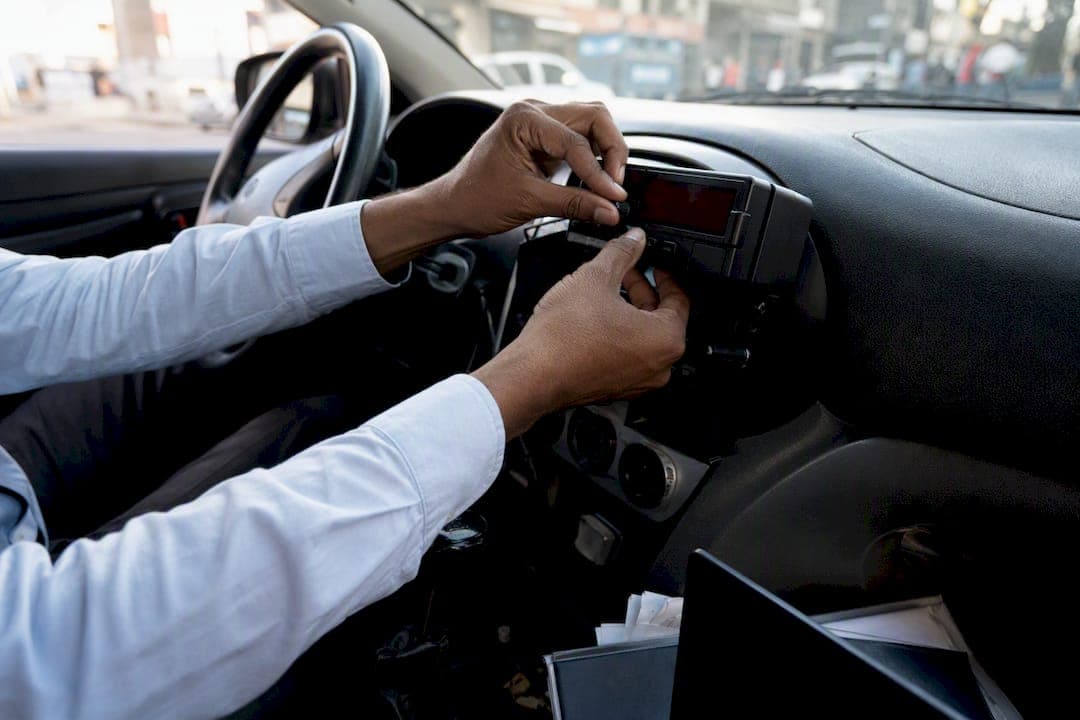
Three obligations sit above everything else in taksiyrittäjän kirjanpito: registering correctly with YTJ and Verohallinto, issuing a receipt for every paid ride, and keeping an ajopäiväkirja (or an equivalent taksamittari report) that stands up to scrutiny. Get these three right, and most other bookkeeping tasks fall into place. Get them wrong, and you risk penalty interest, rejected deductions, or a drawn-out tax audit.
We recommend one course of action above all others: hand your bookkeeping to an accountant who already understands passenger transport, rather than learning the rules from scratch while you drive fourteen-hour shifts.
What to do this week:
- Register your business through YTJ and select the correct Verohallinto registers (VAT, prepayment, employer where relevant).
- Issue a receipt to every passenger and keep a running ajopäiväkirja or taksamittari report.
- Record vehicle purchase costs correctly, including autovero, and apply proper depreciation.
- Consider outsourcing to a taxi-specialist accountant such as Finovate so deductions and VAT filings are handled correctly from day one.
Pro Tip: Photograph or scan every receipt the same day you receive it. Waiting until month-end is how fuel and maintenance deductions quietly disappear.
Key Takeaways
Correct taksiyrittäjän kirjanpito rests on three pillars: proper registration, disciplined daily record-keeping, and accurate vehicle accounting under Kirjanpitolautakunta rules.
| Point | Details |
|---|---|
| Register before your first fare | Complete YTJ registration and select the correct Verohallinto registers, including VAT and prepayment. |
| Ajopäiväkirja or taksamittari report | Keep one continuously; a compliant taksamittari report can legally replace the manual log. |
| Capitalise autovero correctly | Add autovero to the vehicle's acquisition cost and depreciate it, per Kirjanpitolautakunta guidance. |
| Reconcile weekly, not monthly | Match booking-platform settlements and taksamittari data to your bank statement every week to catch gaps early. |
| Consider specialist support | Finovate offers taxi-focused bookkeeping, VAT filing, and year-end accounts built around platform reconciliation. |
Table of Contents
- How to register your taxi business and meet your first obligations
- What records should a taxi driver keep every day?
- When do you need to register for VAT, and what can you deduct?
- How should you account for autovero and vehicle depreciation?
- What's the right bookkeeping rhythm for a taxi business?
- How do you choose an accountant who understands taxi operations?
- How Finovate handles taxi bookkeeping in practice
- Why specialist bookkeeping changes the outcome
- Get your taxi bookkeeping handled properly from day one
- Where to check the rules yourself
- Frequently asked questions
- Sources
How to register your taxi business and meet your first obligations
Before you accept your first fare, three registrations need sorting. Miss one, and your bookkeeping starts on the wrong foot.
- Register via YTJ. The Yritys- ja yhteisötietojärjestelmä gives you a business ID and routes your application to Verohallinto simultaneously.
- Choose the right Verohallinto registers. Most taxi entrepreneurs need the VAT register and the prepayment register; add the employer register the moment you hire staff.
- Meet Traficom's operator requirements. Traficom sets out what's needed to become a licensed taxi operator, and the vehicle details you register there feed directly into your bookkeeping records, since your taximeter and vehicle identification link every trip back to your accounts.
- Start issuing receipts immediately. Verohallinto requires a receipt for every paid ride, and that receipt is your primary sales record from day one.
Skipping any of these steps doesn't just create legal exposure. It leaves gaps in your bookkeeping that are far harder to fill retroactively than to record properly the first time.
What records should a taxi driver keep every day?
Finnish law requires taxi entrepreneurs to keep an ajopäiväkirja, but there's a practical shortcut: Verohallinto confirms that a taksamittari report can substitute for the mileage log, provided the meter records everything the log legally requires. If your meter already captures this, you don't need to duplicate the work by hand.
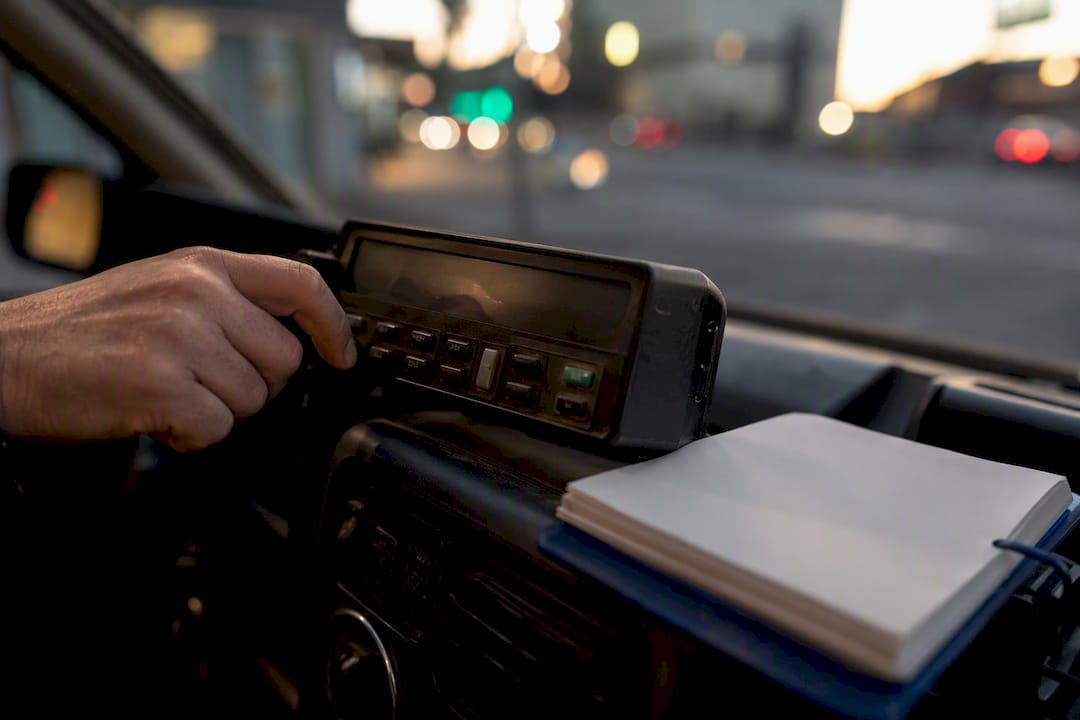
Cash takings need their own discipline. Run a kassakirja (cash book) daily, and reconcile it weekly against your bank deposits. Do the same for card payments and booking-platform tilitykset (settlements) — Uber, Yandex Go, and similar platforms often pay out on a delay, so the settlement date rarely matches the ride date, which trips up entrepreneurs who reconcile by eye instead of by report.
Your daily routine should include following advice from Financial Records for Freelancers: What to Keep and Why:
- Logging odometer readings at the start and end of each shift.
- Photographing or scanning every fuel, repair, and toll receipt before it fades or goes missing.
- Recording cash takings in a kassakirja and matching card settlements to bank deposits weekly.
- Filing taksamittari reports alongside your ajopäiväkirja, even where the meter is doing the legal heavy lifting.
Pro Tip: Set a fixed 20-minute slot each Sunday evening to reconcile the week's takings. Entrepreneurs who batch this weekly rarely lose receipts; those who leave it for month-end usually do.
When do you need to register for VAT, and what can you deduct?
Passenger transport services are VAT-liable in Finland once your turnover exceeds the level Verohallinto sets for small businesses, and taxi income counts as taxable business income that must appear on your elinkeinotoiminnan veroilmoitus (business tax return) regardless of your VAT status. Every paid ride needs a receipt, and that receipt trail is what Verohallinto expects to see behind your reported turnover.
When you prepare your business tax return, the income side is usually straightforward: it's the fare income shown across your taksamittari reports and platform settlements. The deduction side is where entrepreneurs leave money on the table. Common deductible categories include:
- Fuel costs, provided receipts are kept and match logged mileage.
- Vehicle repairs and servicing.
- Booking-platform commissions, which appear as a deduction from gross settlement figures.
- Insurance premiums tied to the vehicle's commercial use.
- Taxi-specific equipment such as the taximeter itself.
Every one of these needs documentary evidence. A bank statement showing a fuel-station payment isn't enough on its own; you need the itemised receipt too. Finovate's guide to business deductions walks through how to build that evidence trail so nothing gets disallowed at audit.
How should you account for autovero and vehicle depreciation?
Vehicle accounting is where taxi bookkeeping diverges most sharply from a typical small business, and it's the area entrepreneurs get wrong most often. Kirjanpitolautakunta guidance is explicit: autovero (car tax) is added to the vehicle's acquisition cost rather than expensed immediately, then depreciated over the vehicle's useful life.
Autovero isn't a one-off cost to write off in the year you buy the car. It becomes part of the asset's value on your balance sheet, and it depreciates alongside the vehicle itself, shaping taxable profit for several years rather than one.
A related Kirjanpitolautakunta ruling on double-entry bookkeeping for taxi operators clarifies when a taxi business needs full double-entry bookkeeping and when the financial year (tilikausi) can be extended. This matters more than it sounds: get the accounting method wrong at set-up, and correcting it later means restating prior years.
Practically, this means:
- Repairs that maintain the vehicle get expensed immediately.
- Improvements that extend its useful life get capitalised alongside the purchase cost.
- Leased vehicles follow different entries again, since lease payments are typically expensed rather than capitalised.
What's the right bookkeeping rhythm for a taxi business?
Compliance breaks down when bookkeeping becomes a monthly scramble instead of a daily habit. The routine that works for most taxi entrepreneurs follows three cycles:
- Daily: Log start and end mileage, capture every receipt, and record cash and card takings as they happen.
- Weekly: Reconcile taksamittari and booking-platform reports against your bank statement, catching discrepancies while they're still easy to trace.
- Monthly: Run a simple profit check and prepare VAT figures ahead of your filing deadline.
Cloud accounting tools and receipt-capture apps make this considerably faster than paper records, largely because your accountant can work directly from the same source data you're entering, rather than waiting for a shoebox of receipts at year-end. Finland's statutory retention period for accounting records is six years from the end of the financial year, so whichever system you choose, it needs to hold data reliably for that long.
Pro Tip: Manual spreadsheets work for the first year or two, but once you're juggling multiple booking platforms, automated reconciliation stops being a convenience and starts being the difference between catching a missing payout and missing it entirely.
How do you choose an accountant who understands taxi operations?
Not every accountant understands taksamittari reconciliation or how booking-platform commissions should be treated for VAT. Before signing with anyone, ask:
- How often will you report, and in what format?
- Which accounting software do you use, and does it integrate with booking-platform exports?
- How do you reconcile platform payouts against taksamittari data?
- Is pricing fixed for ongoing bookkeeping, or does it vary month to month?
Watch for these warning signs:
- No references from other transport-sector clients.
- Vague or hesitant answers about VAT treatment for passenger transport.
- No clear process for reconciling taksamittari reports against payouts.
An accountant without transport-sector experience will treat your booking-platform settlements as generic income, missing the commission deductions and reconciliation nuances that are specific to taxi work.
How Finovate handles taxi bookkeeping in practice
Finovate builds its taxi-focused service around the exact friction points above: bookkeeping, VAT returns, payroll, and year-end accounts, all handled by accountants who already know how passenger transport works.
- Booking-platform settlement reports are ingested and matched against taksamittari data before anything hits the bank reconciliation.
- Vehicle purchases are recorded following Kirjanpitolautakunta's autovero guidance from the outset, not corrected retroactively.
- Year-end accounts are prepared with the specific deductions taxi operators are entitled to already mapped out.
Reconciliation errors between platform payouts and meter reports are one of the most common reasons taxi entrepreneurs under-report income without realising it. Matching the two data sources properly, every month, closes that gap.
Why specialist bookkeeping changes the outcome
Most bookkeeping mistakes in this sector aren't caused by carelessness. They happen because generalist accountants, or entrepreneurs doing it themselves, don't know that autovero gets capitalised, or that a taksamittari report can legally replace a manual ajopäiväkirja. Specialist knowledge here isn't a nice extra; it's what separates a clean tax return from a costly correction.
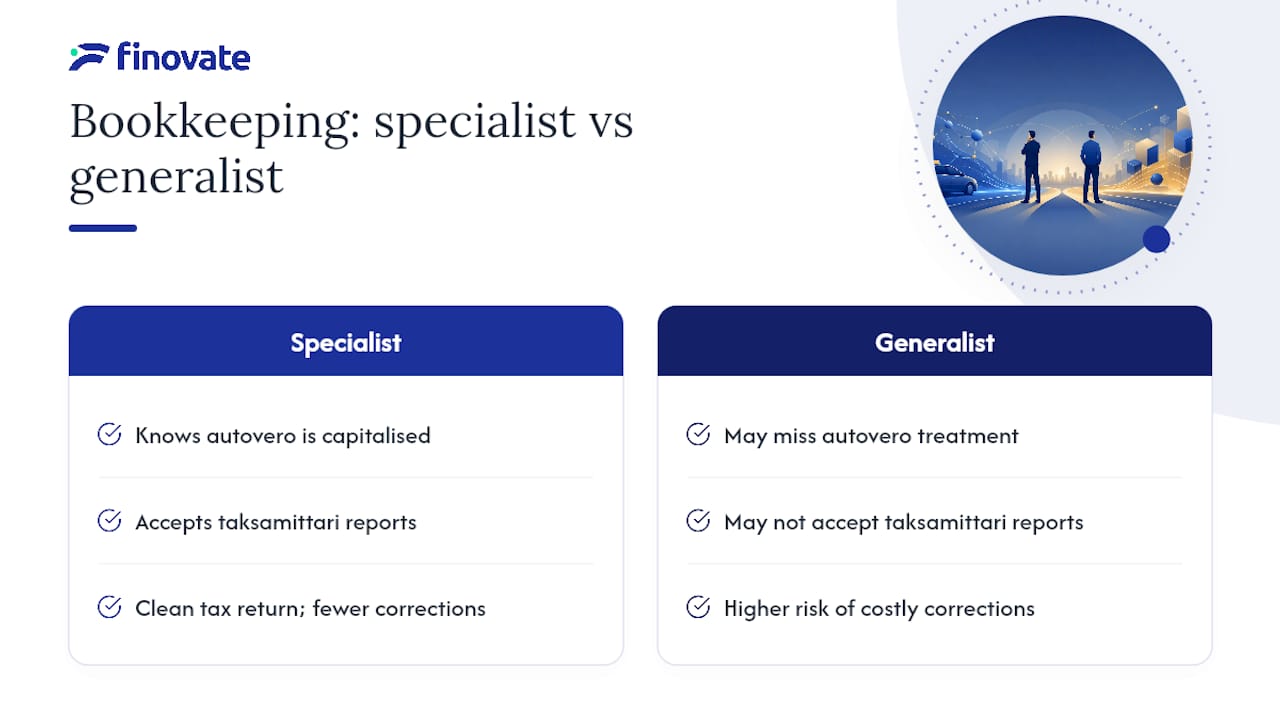
If you take one thing from this article, digitalise your receipt capture this week, and book an initial compliance check with an accountant who already knows the taxi sector before your next VAT deadline.
Get your taxi bookkeeping handled properly from day one
Finovate is built around exactly the workflow described above: booking-platform payouts matched against taksamittari reports, autovero capitalised correctly from the first entry, and VAT returns prepared by accountants who've done this for other taxi operators before you.

Our taxi-focused packages cover monthly bookkeeping, VAT reporting, payroll where you employ drivers, and year-end accounts, all priced as a fixed monthly service rather than a variable hourly bill. That means no surprise invoices when your booking-platform reconciliation takes longer than expected. If you're currently piecing together spreadsheets between shifts, an initial compliance check is the fastest way to see exactly where your current setup is exposed. Visit Finovate's accounting services to see the full taxi entrepreneur package, or explore the light entrepreneur invoicing option if you're operating without full company registration. Book your initial review before your next VAT filing date.
Where to check the rules yourself
The rules covered above come from official Finnish sources, and it's worth bookmarking them directly:
- Verohallinto's taxi entrepreneur guidance covers receipts, VAT registration, and tax return requirements in full.
- Kirjanpitolautakunta's autovero statement and its ruling on double-entry bookkeeping set the technical accounting treatment.
- Traficom's operator guidance explains licensing and vehicle registration requirements.
Frequently asked questions
Does a taksamittari report replace the need for an ajopäiväkirja? Yes, provided the meter captures all the data an ajopäiväkirja legally requires. Verohallinto confirms this substitution is acceptable, though you should still verify your specific meter model meets the requirement.
Do I need to register for VAT immediately as a new taxi entrepreneur? It depends on your expected turnover. Passenger transport is VAT-liable once you cross Verohallinto's threshold for small business exemption, so check your projected annual turnover before deciding whether to register from your first invoice.
Can I deduct booking-platform commissions from my taxable income? Yes. Commissions charged by booking platforms are a deductible business cost, but you need the settlement statements showing gross fares and commission deductions separately, not just the net payout figure in your bank account.
How long do I need to keep taxi bookkeeping records? Finnish law requires accounting records to be retained for six years from the end of the relevant financial year, whether stored digitally or on paper.
Is autovero fully deductible in the year I buy the vehicle? No. Per Kirjanpitolautakunta guidance, autovero is added to the vehicle's acquisition cost and depreciated over its useful life, not expensed as a lump sum.
This article is general information, not a substitute for advice from a qualified financial advisor. Consult a qualified financial professional about your own circumstances before acting on anything here.
Sources
- Vero
- Autoveron kirjaamisesta taksiyrittäjän kirjanpitoon - Kirjanpitolautakunta
- Taksiautoilijan kahdenkertainen kirjanpito, tilikauden pidennys - Kirjanpitolautakunta
- Traficom — Haluan taksiliikenneyrittäjäksi