

A Finnish employer should budget roughly 19–21% on top of every gross salary in 2026 to cover statutory side costs. The largest single item is the employer's TyEL pension contribution at 17.10%, followed by the employer sickness insurance charge at 1.91%. The exact figure moves up or down depending on your industry's accident risk and whether you count as a small or large employer for unemployment insurance purposes. We walk through both scenarios below with worked examples.
TL;DR:
- Most Finnish employers should allocate about 19 to 21 percent of gross salary for statutory employer side costs in 2026, depending on sector risk and company size.
- The average employer TyEL pension contribution is 17.10%, with sickness insurance at 1.91%, and unemployment rates varying from 0.31% to 1.23% based on employer size.
- Accident insurance and group life insurance are variable costs set by insurers, often around 0.5% and 0.06%, respectively, depending on industry risk.
- Calculating total employer cost involves using a multiplier of 1.20 to 1.25 on gross salary, plus specific sector risk adjustments; re-calculate annually with confirmed rates.
- YEL insurance applies only to self-employed entrepreneurs' own pension contributions and does not affect employee wages or benefits.
Table of Contents
- What are the 2026 statutory employer side cost rates?
- What does each side cost actually pay for?
- How do you calculate total employer cost from a gross salary?
- Does YEL work the same way as employee side costs?
- What compliance steps do employers need to follow?
- Finovate's viewpoint on payroll side costs
- Let Finovate handle the calculations for you
- Where to verify these figures yourself
- Sources
- FAQ
What are the 2026 statutory employer side cost rates?
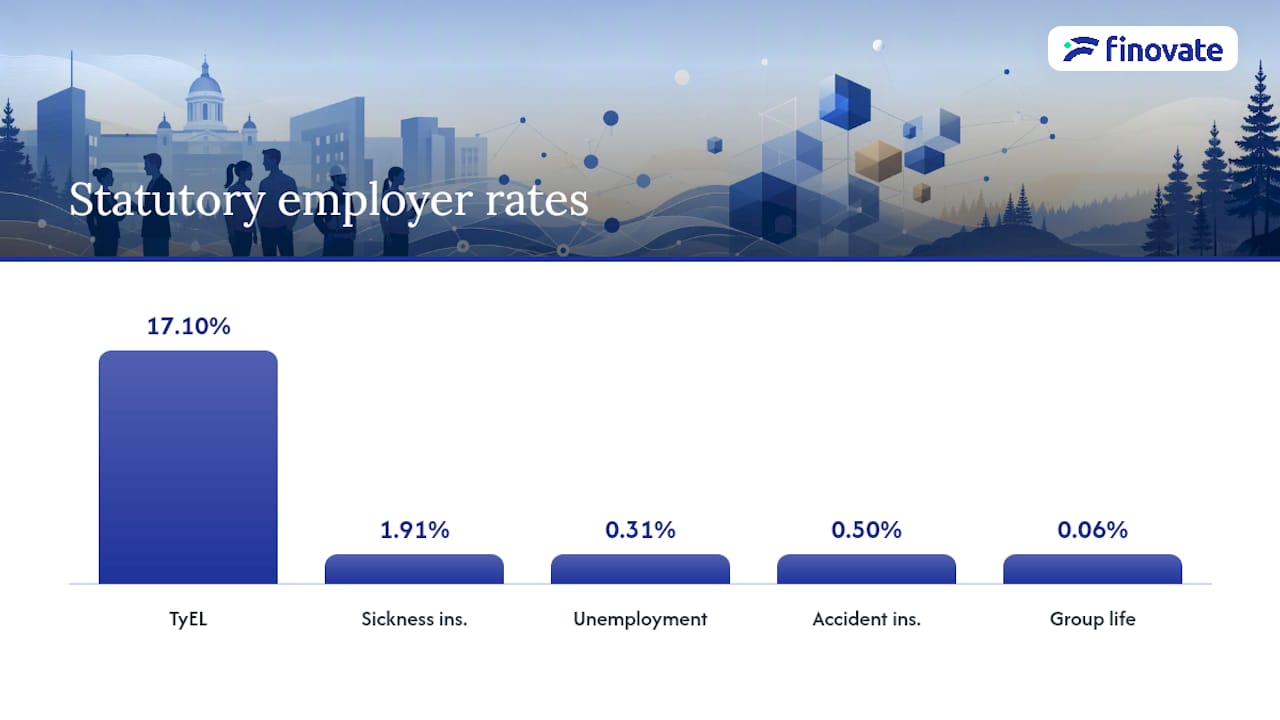
Before you can plan a payroll budget, you need the actual percentages. Here are the headline 2026 employer contributions, drawn from Verohallinto and Eläketurvakeskus (ETK):
| Contribution | Employer rate 2026 | Employee rate 2026 | Notes |
|---|---|---|---|
| TyEL pension insurance | 17.10% (average) | 7.30% | Employer share varies slightly by company size and history |
| Sairausvakuutus (sickness insurance) | 1.91% | Withheld separately via tax card | Employer-only cost; up from 1.87% in 2025 |
| Työttömyysvakuutus (unemployment insurance) | 0.31% (small employer) / 1.23% (large employer) | Deducted from wages | Threshold determines which rate applies |
| Työtapaturmavakuutus (accident insurance) | around 0.5% for low-risk sectors | None | Set by your insurer based on industry risk class |
| Ryhmähenkivakuutus (group life insurance) | 0.06% | None | Bundled with accident insurance by most insurers |
TyEL, sairausvakuutus, and the employer's unemployment insurance share sit entirely on the employer's side of the ledger. Työtapaturmavakuutus and ryhmähenkivakuutus are employer-only costs too, so none of these five items reduce the employee's net pay.
What does each side cost actually pay for?
Each contribution funds a distinct part of the Finnish social security system, and each has its own quirks worth knowing before you run payroll.
- TyEL funds statutory earnings-related pensions. From 2026, the age-based higher employee contribution band has been removed, simplifying the employee side to a flat 7.30%. On the employer side, larger and longer-established companies may see their rate adjusted through a hoitokustannus (administration cost component) and can qualify for an asiakashyvitys (client rebate) that lowers the effective rate below the 17.10% average.
- Sairausvakuutus funds sickness allowances and part of health insurance. The employer rate rose to 1.91% in 2026, a modest increase from 1.87% the year before. A "minipidätys" nuance applies to certain low-earning or part-time cases, so payroll software should be checked rather than assumed.
- Työttömyysvakuutus kicks in once your payroll crosses the threshold that separates small and large employers, with the large-employer rate more than triple the small-employer one.
- Työtapaturmavakuutus and ryhmähenkivakuutus are the two most variable items on this list. Your insurer sets the accident insurance rate based on your industry's risk class, so a construction firm and a software company doing identical payroll will land in very different places.
How do you calculate total employer cost from a gross salary?
The quickest way to estimate your true payroll cost is to apply a kerroin, a multiplier that bundles the statutory percentages into one number. Most Finnish employers use a kerroin somewhere in the 1.20 to 1.25 range, though this excludes holiday pay accrual, performance bonuses, and taxable fringe benefits, which need separate budgeting.
- Take the gross monthly salary. Say it's €3,000.
- Apply the core statutory rates: 17.10% TyEL + 1.91% sairausvakuutus + 0.31% unemployment (small employer) + 0.5% accident insurance (low risk) + 0.06% group life ≈ 19.88%.
- Add that to the gross figure: €3,000 × 0.1988 = €596.40 in side costs, bringing total employer cost to roughly €3,596.
- Repeat for a higher-risk case. A €4,500 gross salary in a sector with a 2% accident insurance rate pushes the combined rate to around 21.4%, adding roughly €963 and bringing total cost to about €5,463.
That single variable can shift your annual payroll budget by thousands of euros once you scale beyond a handful of staff.
Pro Tip: Never rely on last year's kerroin. Insurer risk classes, TyEL averages, and unemployment insurance thresholds all get revised annually, so re-run your calculation each January using that year's confirmed rates, or check a current payroll calculator before locking in a budget.
Does YEL work the same way as employee side costs?
No, and this trips up a surprising number of new entrepreneurs. YEL (Yrittäjän eläkevakuutus) is the self-employed person's own pension insurance, calculated on your confirmed entrepreneurial earnings rather than on wages paid to staff.
- YEL is mandatory for eligible entrepreneurs, but it is not a payroll side cost in the way TyEL is for an employee.
- If you employ staff alongside running your own business, the standard sivukulut table above still applies to their wages. YEL only covers your own pension contribution.
- Sairausvakuutus, työttömyysvakuutus, and accident insurance largely do not apply to your own earnings the way they apply to an employee's salary.
If you're unsure how YEL fits your situation, Finovate's guide on why YEL insurance matters for self-employed Finns walks through the practical obligations in more detail.
What compliance steps do employers need to follow?
Calculating the right percentages is only half the job. Outsourcing payroll to an accounting firm does not transfer legal responsibility, you remain accountable for correct reporting and timely payment even when someone else runs the numbers.
- Report every payment to Tulorekisteri (the Incomes Register) within the required window, every single pay run.
- Confirm your TyEL classification is current, especially if your headcount or contract type has changed during the year.
- Verify your accident insurance risk class with your insurer rather than assuming last year's class still applies.
- Use confirmed 2026 rates when running payroll, not carried-over figures from 2025.
Pro Tip: Late Tulorekisteri submissions and misclassified tapaturma risk are the two most common triggers for employer penalties Finovate sees. Both are avoidable with a simple annual review before your first January payroll run. For the full reporting timeline, see the Tulorekisteri 45-day reporting checklist.
Finovate's viewpoint on payroll side costs
Employers who get sivukulut wrong tend to make the same three mistakes: the wrong tapaturma risk class, forgetting to accrue holiday pay on top of statutory percentages, and misreporting to Tulorekisteri. None of these are complicated once flagged, but all three compound quietly if left unchecked. We recommend reviewing your rates and insurer classifications every year, not just when something goes wrong.
— Busayo
Let Finovate handle the calculations for you
Running these percentages correctly every month, across every employee, is where payroll goes wrong for busy owners. Payroll and invoicing services can keep your TyEL classification, sickness insurance rate, and accident insurance class current, so your monthly cost is right the first time rather than corrected after a Tulorekisteri deadline has passed.

Onboarding is straightforward: we review your current employer classification, confirm which unemployment insurance threshold applies to your headcount, and set up ongoing payroll processing against the confirmed 2026 rates. If you're a light entrepreneur juggling invoicing alongside payroll questions, our monthly invoicing service bundles both, and our Pro invoicing plan suits SMEs with more complex payroll needs. Get in touch to have your 2026 employer cost checked against the current statutory rates before your next pay run through professional accounting services.
Where to verify these figures yourself
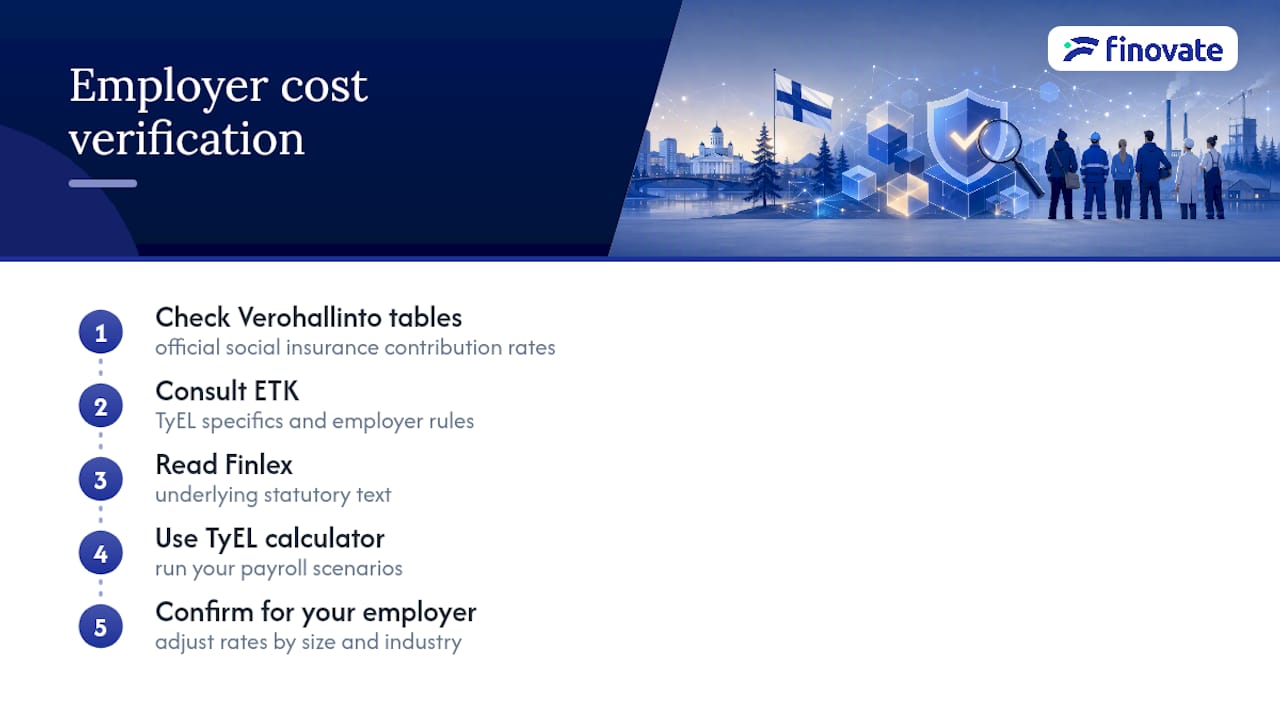
For the official numbers behind every calculation in this guide, check Verohallinto's social insurance contribution tables for current rates, ETK for TyEL specifics, Finlex for the underlying statutory text, and a TyEL calculator to run your own payroll numbers. Always confirm rates against your specific employer size and industry before finalising a budget.
FAQ
What percentage should I budget for palkan sivukulut in 2026?
Most Finnish employers should budget roughly one-fifth on top of gross salary, though sector accident insurance risk can push this higher.
What is the employer's TyEL rate for 2026?
The average employer TyEL share is 17.10% in 2026, while the employee pays a flat 7.30%.
How much is the employer sickness insurance contribution in 2026?
The employer sairausvakuutus rate is 1.91% of gross pay in 2026, up slightly from 1.87% in 2025.
Is YEL the same as employee payroll side costs?
No, YEL is the entrepreneur's own pension insurance calculated on personal earnings, not a side cost applied to employee wages.
Who counts as a large employer for unemployment insurance purposes?
Verohallinto sets the threshold separating small and large employers, with large employers paying 1.23% against 0.31% for small employers in 2026.