

A Finnish osakeyhtiö pays a flat corporate tax on its taxable profit, and the company is taxed entirely separately from its owners. Beyond that flat rate, you're immediately dealing with three obligations: paying ennakkovero through the year, filing the 6B tax return, and withholding tax correctly on any salary you pay yourself. Get those three right and most of the compliance risk disappears.
TL;DR:
- Finnish limited companies are taxed independently at a flat corporate rate of 20%, separate from owners’ personal tax obligations on salaries or dividends.
- Accurate management of advance tax estimates and timely updates in OmaVero prevent costly underpayment interest and surprise final tax bills.
- Disclosures for capital gains and dividends must be carefully documented, especially when claiming tax exemptions based on ownership and holding period conditions.
- Paying salaries reduces taxable profit but exposes owners to earned-income taxes, while dividends can be lightly taxed under the 8% "huojennettu osinko" rule if thresholds are met.
- No local municipal or trade taxes apply to corporate profits in Finland, but property taxes and cross-border tax treaties can influence overall tax planning.
Table of Contents
- What is osakeyhtiön verotus and when does it apply?
- What counts as taxable income, and what can you deduct?
- How does advance tax work, and how do you manage it in OmaVero?
- Filing the 6B tax return: what to include and when
- Salary or dividends: how owners actually get paid
- The mistakes that cost Finnish owners the most
- Practical tax‑planning tips from Finovate
- Your next steps and quick checklist
- Do local or trade taxes apply to a Finnish osakeyhtiö?
- Author perspective: what actually matters in practice
- How Finovate can help — services for osakeyhtiö owners
- Sources
What is osakeyhtiön verotus and when does it apply?
Corporate tax, or yhteisövero, is charged at a flat rate on your company's verotettava tulo, the taxable profit left after deducting business expenses from revenue. This isn't the same figure as your accounting profit. Depreciation schedules, certain provisions, and non-deductible items mean the number on your tax return often differs from the bottom line in your annual accounts.
Finnish limited companies are independent taxpayers, separate entirely from the people who own them. That single fact underpins everything else in this guide: the company settles its own corporate tax bill regardless of what shareholders later do with the profit, and shareholders face their own, separate tax treatment when they draw salary or dividends.
Your tilikausi, or financial period, drives the timing. Most Finnish companies run a calendar-year tilikausi, but plenty don't, and your tax year follows whichever twelve months (or occasionally more or less) your accounts cover. That period determines when your return is due, when advance tax instalments fall, and when the tax authority finalises your assessment. Get the tilikausi dates wrong in your own planning and every downstream deadline shifts with it.
What counts as taxable income, and what can you deduct?
Verotettava tulo starts from your accounting result and gets adjusted for tax purposes. Ordinary running costs reduce it directly: wages and social costs, rent, stock purchases, marketing, professional fees, and depreciation on equipment and premises calculated according to tax rules rather than your own accounting policy.
Capital gains and dividends the company itself receives get special treatment. Dividends received from another Finnish limited company are often tax-exempt under participation exemption rules, depending on the shareholding relationship, while gains on shares can be exempt too if strict conditions on holding period and ownership share are met. These exemptions are genuinely valuable but easy to misapply, so don't assume a gain or dividend is automatically tax-free without checking the specific conditions.
Losses from previous years can typically be carried forward and set against future profits, which matters a great deal for younger companies that post a deficit in year one or two. The 6B filing instructions require you to disclose these carried-forward losses clearly, along with any items where your accounting treatment and tax treatment diverge. Miss that disclosure and the loss relief can be disputed later.
How does advance tax work, and how do you manage it in OmaVero?
Your first ennakkovero estimate is usually set by Verohallinto based on your previous year's result, or on your own estimate if you're a new company with no filing history. It's paid in instalments through the financial year rather than as one lump sum at the end.
The problem is that first estimate is often inaccurate within months. If your company grows faster, or slower, than the tax authority assumed, you need to update the figure yourself in OmaVero rather than wait for a correction to arrive. You can add lisäennakko at any point during the year, and the Lisäennakkolaskuri tool calculates the extra amount and any interest due, so there's no guesswork involved.
A short practical checklist keeps this under control:
- Log into OmaVero and check your current ennakkovero estimate against your actual year-to-date profit at least once mid-year.
- Update the estimate the moment you see a material shift in revenue or costs, up or down.
- Use lisäennakko rather than waiting, since paying late through this route usually costs less in interest than an underpaid balance settled after year end.
Pro Tip: Treat your OmaVero estimate as a living number, not a one-off form you file and forget. A ten-minute review each quarter is far cheaper than a surprise jäännösvero bill in the fourth month after your financial year closes.
Filing the 6B tax return: what to include and when
Form 6B is your company's annual tax return, filed through OmaVero, and it separates accounting figures from tax figures in distinct columns. Where the two diverge, you need to explain why, and certain items, capital gains, dividends received, and specific disclosures, require supporting attachments such as forms 71A, 71B, or 73.

Deadlines follow your tilikausi rather than the calendar. As a general rule, Verohallinto works to a ten-month finalisation window from the end of your financial period, so a company closing its books on 31 December typically sees its assessment finalised around the following October. Once assessed, advance payments made during the year are reconciled against the final bill: overpay through ennakkovero and you get a refund; underpay and jäännösvero falls due with interest.
Salary or dividends: how owners actually get paid
Paying yourself salary reduces the company's taxable profit directly, since wages are a deductible cost, but the salary itself is taxed in your hands as earned income under normal payroll withholding. The company also carries employer obligations: pension contributions, health insurance costs, and correct reporting through payroll.
Dividends work differently. A portion of dividends from an unlisted company, up to 8% of the mathematical value of your shares, qualifies as huojennettu osinko, taxed more lightly as capital income rather than earned income, with a share of that amount often exempt depending on the total sums involved.
A simplified comparison shows why the choice matters:
- Salary route: company deducts the wage, reducing its 20% tax bill, but you pay progressive earned-income tax and payroll contributions on the full amount.
- Dividend route: company pays 20% on profit first, then you're taxed again on the distribution, though the 8% rule softens that second layer up to the threshold.
Most owner-managers use a blend of both, weighted differently depending on the size of the company's net assets and personal income already earned elsewhere that year. A tax planning guide built around your specific numbers beats a generic rule of thumb every time.
The mistakes that cost Finnish owners the most
Shareholder loans catch out more owner-managed companies than almost anything else. If you borrow from your own company and haven't repaid it by the company's financial statement date, Verohallinto treats the outstanding balance as your taxable income, on top of whatever else you've drawn that year.
Under-estimating ennakkovero is the second big trap: it leaves you facing jäännösvero with interest once the final assessment lands, often months after you've already spent the cash. Regular OmaVero updates are the fix.
Fringe benefits, company cars, phones, meal benefits, need reporting at current official values each year. Using last year's figures is a common, avoidable error.
Practical tax‑planning tips from Finovate
Managing osakeyhtiön verotus well comes down to rhythm, not heroics. A simple annual cycle works for most small companies:
- Reconcile bookkeeping monthly rather than in a year-end scramble, so your verotettava tulo estimate stays current.
- Review payroll withholding and any dividend plans at the mid-year point, alongside your OmaVero ennakkovero figure.
- Prepare 6B documentation as the tilikausi closes, gathering attachments for any capital gains or dividend disclosures early.
An accountant typically handles the technical layer underneath this: updating OmaVero estimates, drafting the 6B return with correct attachments, and modelling salary versus dividend outcomes before you commit to either.
Pro Tip: Book your dividend decision conversation before your financial year ends, not after. Once the books close, your options for that year are largely fixed.
Accounting firms work with Finnish entrepreneurs on exactly this cycle, from bookkeeping through to tax-efficient withdrawal planning.
Your next steps and quick checklist
Three checks now will save you a difficult conversation later:
- Pull up your last verotuspäätös and confirm the final tax matched what you expected.
- Log into OmaVero and check whether your current ennakkovero estimate still reflects this year's actual trading.
- Verify payroll withholding rates are current if you've adjusted your own salary recently.
For your next 6B filing, gather your accounts, depreciation schedules, and any dividend or capital gains documentation early. If any of this feels unclear, book a short advisory call and bring your latest accounts and OmaVero screen.
Do local or trade taxes apply to a Finnish osakeyhtiö?
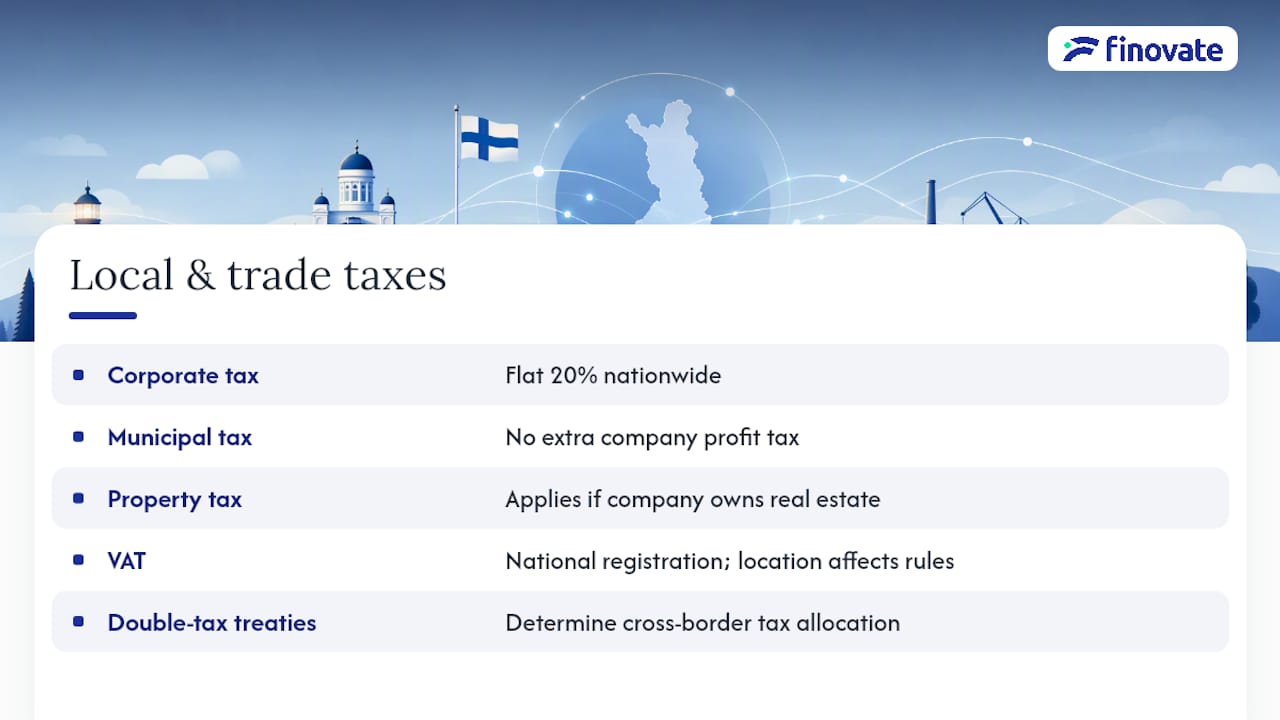
Finland doesn't operate a separate municipal or trade tax on limited companies the way some other countries do. Historically, Finnish corporate tax revenue was split between the state, municipalities, and parishes through a shared allocation formula, but that system applies to how the state distributes the 20% yhteisövero it collects, not to any extra levy your company pays on top.
In practice, this means your osakeyhtiö faces one corporate income tax rate, 20%, regardless of which municipality it's registered in or where it trades within Finland. There's no equivalent of a local business rate or municipal trading tax layered onto company profits, which simplifies planning considerably compared with jurisdictions where local surcharges vary by city or region.
Where local taxes do bite is elsewhere in your operations, not on profit itself. Property tax (kiinteistövero) applies if your company owns real estate, calculated on the property's taxable value and set annually by the municipality where it's located, with rates varying between municipalities. VAT registration and reporting also happen at the national level but interact with your business location for certain sector-specific rules.
Cross-border owners should note that double taxation agreements matter more than any domestic local tax question. If your company has foreign shareholders, or trades across borders, Finland's network of tax treaties generally determines which country taxes what, preventing the same profit being taxed twice. That's a separate, often more consequential, question than domestic municipal allocation, and one worth raising directly with your accountant if any part of your ownership or trading sits outside Finland.
Author perspective: what actually matters in practice
The technical mechanics of osakeyhtiön verotus are well documented. What gets underweighted is the trade-off between growing the company's balance sheet and taking money out personally. Leaving profit inside the company at 20% is often the more tax-efficient move short-term, but it only pays off if that capital gets reinvested with purpose rather than sitting idle.
The single habit I'd push hardest on isn't a tax trick at all: update your OmaVero estimate every quarter, not once a year. Cash-flow shocks from jäännösvero rarely come from bad luck. They come from an estimate nobody revisited.
— Busayo
How Finovate can help — services for osakeyhtiö owners
If reading through ennakkovero rules, 6B columns, and dividend thresholds has confirmed what you suspected, that this takes real attention every month, that's exactly the gap some accounting firms aim to close. Rather than treating your tax return as an annual scramble, these firms may handle ongoing bookkeeping, payroll, and OmaVero updates that keep your estimates accurate all year, so the final assessment holds no surprises.
A first engagement typically starts with a review of your current accounts and tax position, followed by a plan covering bookkeeping cadence, payroll setup, and how you'll split salary against dividends for the year ahead. Whether you're running an established osakeyhtiö or operating as a smaller delivery-partner entrepreneur, Finovate's accounting packages are built around exactly this kind of ongoing support. Visit Finovate to see current services and get a quote for your company's specific situation.
Sources
For forms and calculators: corporate tax guidance, 6B instructions, Lisäennakkolaskuri, and Suomi.
This article is general information, not a substitute for advice from a qualified financial advisor. Consult a qualified financial professional about your own circumstances before acting on anything here.
- Vero