

TL;DR:
- Light entrepreneur invoicing allows self-employed individuals to bill clients through a service company without a personal business ID. It simplifies administration but does not exempt them from statutory obligations like YEL insurance once earnings exceed EUR 9,423.09 in 2026.
Light entrepreneur invoicing is defined as a method where self-employed individuals bill clients through an invoicing service company, without holding a personal business ID. The invoicing service handles administrative tasks such as sending invoices, collecting payments, and remitting wages to you. This arrangement suits freelancers, part-time workers, and anyone testing a business idea without committing to full company registration. What is light entrepreneur invoicing in practice? It is a legal, structured entry point into self-employment that still carries statutory obligations, including mandatory YEL pension insurance once your earnings cross the 2026 threshold of EUR 9,423.09.
How does light entrepreneur invoicing work in Finland?
Light entrepreneurship involves invoicing through a service company without owning a business ID. You agree a fee with your client, the invoicing service issues the invoice on your behalf, collects payment, deducts its service fee and statutory withholdings, then pays you a net wage. The process removes most of the administrative burden that comes with running a registered company.

The invoicing service acts as your employer of record for tax purposes. It handles income tax withholding, reports earnings to the Finnish Tax Administration, and manages payroll notifications. Your income appears as wages on your tax return rather than trade income, which simplifies your personal tax filing considerably.
Service fees vary but are often in the range of 2–4% of each invoice. That percentage covers the administrative work the service performs on your behalf. For a freelancer invoicing EUR 2,000 per month, a 3% fee amounts to EUR 60, which is typically far less than the cost of maintaining a registered company with a separate accountant.
VAT registration is a separate consideration. If your trade income exceeds EUR 20,000 in a calendar year, you must register for VAT. Registration is completed through MyTax, the Finnish Tax Administration's online service. Many invoicing services will flag this threshold and guide you through the process.
Key features of the light entrepreneur billing process:
- The invoicing service sends the invoice and collects payment from your client.
- You receive a net wage after tax withholding and the service fee.
- You do not need a business ID, a separate bank account, or accounting software.
- VAT registration becomes mandatory above EUR 20,000 in annual trade income.
- You remain personally responsible for statutory insurance obligations.
Pro Tip: Keep a simple spreadsheet tracking each invoice date, amount, and client. Even though the invoicing service handles the paperwork, your own records help you monitor your annual income against the VAT and YEL thresholds before they become urgent.
What are the statutory obligations for light entrepreneurs?
Using an invoicing service does not exempt you from Finnish statutory requirements. Many light entrepreneurs mistakenly believe that outsourcing invoicing transfers their legal responsibilities to the service provider. It does not. You remain personally liable for securing the correct insurance coverage.
The most significant obligation is YEL insurance, the Self-Employed Person's Pension Insurance. YEL is the statutory pension scheme for self-employed people in Finland, administered by pension insurance companies such as Varma. It covers not only your future pension but also your eligibility for sickness allowance, parental allowance, and certain unemployment benefits.
The 2026 YEL threshold is EUR 9,423.09 in annual work input value. If your earnings from self-employment reach or exceed this figure, taking out YEL insurance is not optional. It is a legal requirement, and failing to do so puts your pension accrual and social security benefits at risk.
The YEL income base is calculated on your gross salary from work. Costs invoiced to customers or tax-free cost reimbursements do not count towards this figure. Only the portion representing your actual work input is included. This distinction matters when you are estimating whether you have crossed the threshold.
The consequences of skipping YEL insurance are concrete:
- No pension accrual. Uninsured years do not count towards your Finnish pension entitlement.
- No sickness allowance. Kela calculates sickness benefits based on your YEL income. Without valid insurance, you receive no income replacement during illness.
- No parental allowance. YEL income determines the level of maternity, paternity, and parental allowances.
- Reduced unemployment protection. Eligibility for entrepreneur unemployment benefits depends on valid YEL insurance.
- Retroactive liability. The pension insurance company can require you to pay back premiums for uninsured periods, often with interest.
YEL insurance affects pension accrual and eligibility for sickness and parental allowances simultaneously. That breadth of impact makes it the single most consequential compliance issue for light entrepreneurs. Finovate recommends reviewing your YEL status at the start of each year and whenever your income changes significantly. You can read more about why YEL insurance matters for self-employed people in Finland.
What is the difference between light entrepreneurship with and without a business ID?
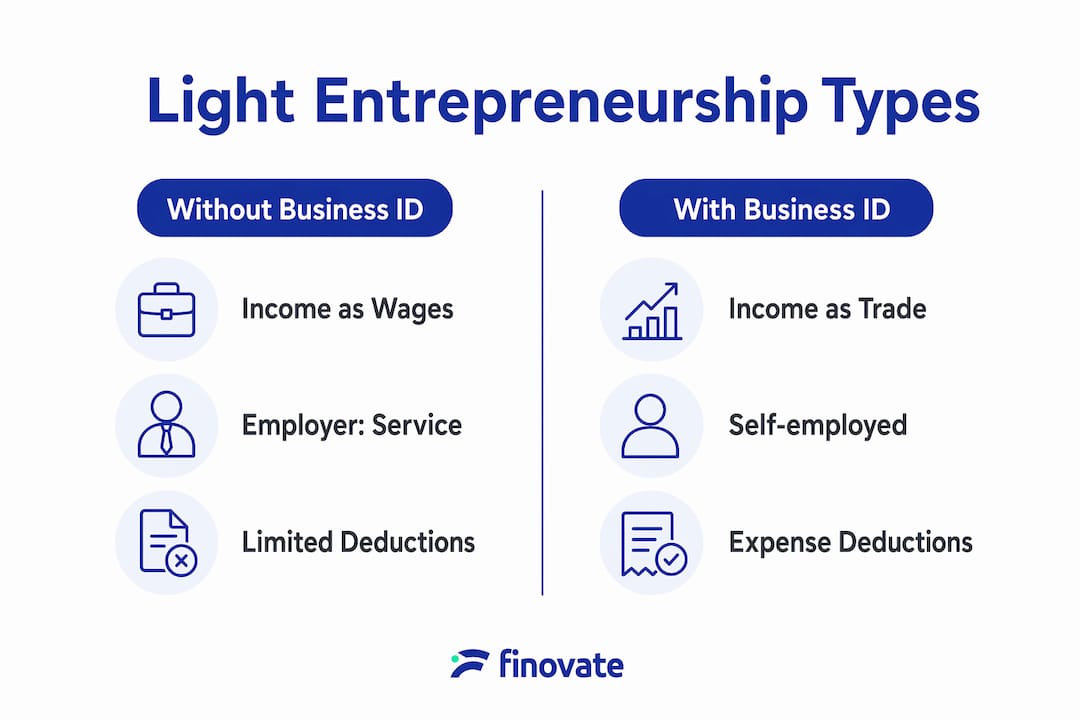
The term "light entrepreneur" covers two distinct groups, and the difference has real financial consequences. This terminological ambiguity affects how tax deductions and YEL insurance are calculated, so understanding which category applies to you is not a minor detail.
Without a business ID
The classic light entrepreneur has no business ID. The invoicing service acts as the employer, and your income is treated as wages. You cannot claim business expenses as tax deductions in the same way a registered entrepreneur can. Your YEL income is based on the gross wage paid by the invoicing service.
With a business ID
Some entrepreneurs hold a business ID but still use invoicing services to handle billing. Tax and insurance implications differ significantly in this case. Your income is classified as trade income rather than wages, which opens up tax deduction opportunities for business expenses such as equipment, travel, and professional development. YEL insurance is calculated on your confirmed trade income rather than your gross wage.
The table below summarises the key differences:
| Feature | Without a business ID | With a business ID |
|---|---|---|
| Income classification | Wages | Trade income |
| Tax deductions for expenses | Limited | Available |
| YEL income base | Gross wage from invoicing service | Confirmed trade income |
| VAT registration | Required above EUR 20,000 | Required above EUR 20,000 |
| Administrative complexity | Low | Moderate |
The without-ID route suits those testing the waters or earning modest supplementary income. The with-ID route suits those earning consistently and wanting to deduct legitimate business costs. Neither route removes the YEL obligation once earnings pass the threshold.
Pro Tip: If you are regularly invoicing above EUR 15,000 per year, ask an accountant to model the tax difference between the two structures. The saving from business expense deductions often outweighs the added administrative cost of holding a business ID.
How can freelancers manage invoicing and finances effectively?
Good financial habits make light entrepreneurship far less stressful. The administrative simplicity of using an invoicing service is an advantage, but it can create a false sense of security if you stop paying attention to your numbers.
Practical steps for managing your finances as a light entrepreneur:
- Track every invoice. Record the date, client name, amount, and payment status. This takes minutes per invoice and prevents surprises at year end.
- Monitor your annual income against thresholds. Watch the EUR 9,423.09 YEL threshold and the EUR 20,000 VAT threshold. Both have legal consequences if you cross them without acting.
- Register for VAT promptly. Once you approach EUR 20,000 in trade income, begin the MyTax registration process. Late registration can result in penalties from the Finnish Tax Administration.
- Review your YEL income annually. Your declared YEL income should reflect your actual work input. Underreporting reduces your future benefits; overreporting increases your premiums unnecessarily.
- Assess your invoicing service fee. Fees of 2–4% are standard, but some services offer lower rates at higher volumes. Finovate's invoicing service at 2% is designed for light entrepreneurs who invoice regularly and want to reduce costs.
Light entrepreneurship is often an experimental phase, ideal for testing ideas or earning part-time income. As your business volume grows, formal registration becomes more financially advantageous because of the tax deduction opportunities it unlocks. The point at which this transition makes sense varies by individual, but consistent annual earnings above EUR 20,000–30,000 are a common signal to review your structure.
Pro Tip: Consult an accountant before you reach the VAT threshold, not after. Planning ahead means you can price your services correctly from the start, including VAT where required, rather than absorbing the cost retrospectively.
For a broader view of how digital tools are changing small business billing, the 2026 SME invoicing guide from Hayat offers useful context on where invoicing technology is heading.
Key takeaways
Light entrepreneur invoicing is a legally structured method that simplifies billing for self-employed individuals in Finland, but it does not remove statutory obligations such as YEL insurance once earnings exceed EUR 9,423.09.
| Point | Details |
|---|---|
| Definition of light invoicing | Billing clients via an invoicing service company without holding a personal business ID. |
| YEL insurance obligation | Mandatory once annual work input value reaches EUR 9,423.09 in 2026; affects pension and benefits. |
| VAT registration threshold | Required when trade income exceeds EUR 20,000 per calendar year; register via MyTax. |
| Business ID distinction | Holding a business ID changes income classification and opens tax deduction opportunities. |
| Transition signal | Consistent earnings above EUR 20,000–30,000 per year often make formal registration more advantageous. |
Why clarity on YEL insurance changes everything
Working with light entrepreneurs over the years, the single most common and costly mistake I see is treating the invoicing service as a full compliance solution. Freelancers assume that because the service handles tax withholding and payroll notifications, everything is covered. YEL insurance is not covered. It is entirely your responsibility, and the gap between assumption and reality can cost years of pension accrual.
The second thing I have observed is that light entrepreneurship works brilliantly as a starting point, but it has a ceiling. The simplicity that makes it attractive at EUR 10,000 per year becomes a financial disadvantage at EUR 25,000 per year, because you cannot deduct the business expenses that a registered entrepreneur can. The structure that felt liberating starts to cost you money.
My recommendation for anyone new to this model is straightforward. Get your YEL insurance in place as soon as your earnings approach the threshold. Review your structure annually with an accountant. And treat the invoicing service fee as a cost of doing business, not as a reason to avoid professional advice. The fee saves you administrative time; professional advice saves you money. You can explore the pros and cons for light entrepreneurs in more detail to make an informed decision about your structure.
— Busayo
Finovate's invoicing services for light entrepreneurs in Finland
Finovate offers invoicing services built specifically for light entrepreneurs who want reliable billing support without unnecessary complexity.

Whether you invoice occasionally or run a steady flow of client work, Finovate has a plan to match. The monthly invoicing service suits light entrepreneurs who prefer a fixed monthly cost and predictable billing support. For those invoicing regularly at higher volumes, the Light@ 3% plan offers a straightforward percentage-based fee with full administrative handling. Both plans include compliance support, so you are never left guessing about your VAT or YEL obligations. Contact Finovate to find the right plan for your situation and get your invoicing working properly from day one.
FAQ
What is light entrepreneur invoicing?
Light entrepreneur invoicing is a billing method where self-employed individuals use an invoicing service company to send invoices and collect payments on their behalf, without needing a personal business ID.
Is YEL insurance mandatory for light entrepreneurs in Finland?
Yes. YEL insurance is mandatory if your annual work input value reaches EUR 9,423.09 in 2026. The invoicing service does not arrange this for you; you must take it out independently.
When does a light entrepreneur need to register for VAT?
VAT registration is required when your trade income exceeds EUR 20,000 in a calendar year. You register through MyTax, the Finnish Tax Administration's online portal.
Can I claim business expense deductions as a light entrepreneur without a business ID?
No. Without a business ID, your income is classified as wages, which limits your ability to deduct business expenses. Registering a business ID changes your income classification to trade income and opens up deduction opportunities.
When should I consider moving from light entrepreneurship to formal business registration?
As business volume grows, formal registration becomes more advantageous due to tax deduction opportunities. Consistent annual earnings above EUR 20,000–30,000 are a common point at which the financial case for registration strengthens.