

UK employers manage several distinct categories of employee payment: bank transfers (BACS, Faster Payments, CHAPS), cash and cheques, pay cards, non-cash benefits and share awards, statutory pay types, tips and tronc arrangements, and tax-advantaged share schemes. For routine salary payments, bank transfer via BACS or Faster Payments is the correct default, as Gov for paying employees and remitting PAYE.
Three compliance flags demand immediate attention. First, any non-cash award that qualifies as a "readily convertible asset" must be processed through PAYE exactly like cash earnings. Second, if an employer retains control over how tips are distributed, Class 1 National Insurance Contributions apply to those payments. Third, HMRC judges whether a payment is "on time" by the date cleared funds reach its account, not the date you initiate the transfer.
This article covers each of the following payment categories in detail:
- Bank transfer methods (BACS, Faster Payments, CHAPS)
- Cash, cheques and pay cards
- Statutory pay types (SSP, SMP, SAP, ShPP, Parental Bereavement Pay, Neonatal Care Pay)
- Non-cash pay, benefits and share schemes (SIP, SAYE, CSOP, EMI)
- Tips, gratuities and tronc arrangements
- Payment timing and HMRC deadlines
- Legal and contractual requirements
- RTI recording and payroll software guidance
- Common HMRC compliance pitfalls
Key takeaways
UK employers must manage multiple employee payment types correctly, each with distinct PAYE, NIC and RTI obligations that HMRC will scrutinise during a compliance review.
| Point | Details |
|---|---|
| Default to electronic bank transfers | BACS and Faster Payments are the approved default; document the method in every employment contract. |
| Readily convertible assets are taxable earnings | Non-cash awards that can be converted to cash must be processed through PAYE like salary. |
| Tronc separation protects NIC exemption | An independent troncmaster with no employer control over distribution is required for Class 1 NIC exemption. |
| BACS clearing takes three working days | Submit BACS payments at least four working days before the deadline; HMRC judges on-time by cleared funds, not initiation. |
| RTI accuracy is non-negotiable | Each payment type has a specific FPS field; mislabelling statutory pay or omitting share awards creates reconciliation problems. |
Always verify current statutory rates, reclaim thresholds and scheme limits on GOV.UK and retain payroll records for a minimum of three years, or six years as best practice.
Table of Contents
- How each employee payment type is delivered in practice
- Statutory pay types you must record correctly
- Non-cash pay, benefits and share schemes: tax and payroll treatment
- Tips, gratuities and troncs: when you are liable for PAYE and NICs
- When is a payment treated as 'paid' for PAYE?
- Legal and contractual rules on how you pay employees
- How to record each payment type in payroll software and file RTI correctly
- Common HMRC pitfalls and how to avoid them
- A practical checklist for payroll teams setting up or reviewing payment types
- What payroll teams should prioritise first
- Sources
How each employee payment type is delivered in practice
Understanding how money physically moves from employer to employee matters for both operational efficiency and PAYE compliance. Each method carries different timing, administrative burden and risk.

BACS direct credit
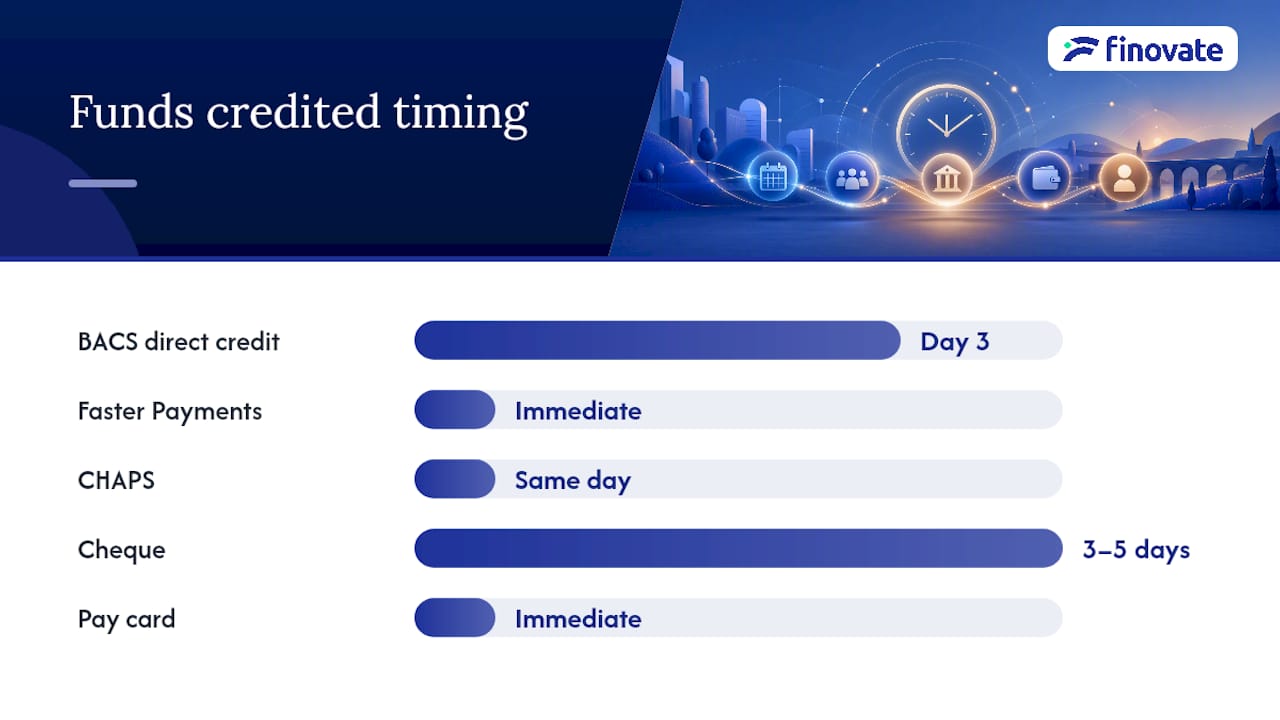
BACS is the standard method for monthly salary runs in the UK. Payments are submitted in bulk to the BACS processing service, which runs a three-day cycle: day one is submission, day two is processing, and day three is when funds credit to the employee's account. For PAYE purposes, the payment date is the date the employee's account is credited, not the submission date. HMRC's approved electronic payment methods include BACS direct credit as a preferred channel for both employee pay and PAYE remittances.
Faster Payments
Faster Payments settles in seconds, around the clock, making it the right choice for ad hoc or emergency payments. There is no clearing delay, so the payment date and the credit date are the same. This simplifies PAYE timing considerably for one-off payments such as a bonus paid outside the normal pay run.
CHAPS
CHAPS is a same-day, high-value settlement service. It is typically reserved for payments requiring urgent processing where the employer cannot wait for BACS clearing. CHAPS carries a per-transaction fee, so it is rarely cost-effective for routine payroll.
Cheques
Cheques are treated as paid on the date the employee receives them, but the PAYE liability crystallises on the earlier of the date the cheque is handed over or the date it clears. Practically, cheques create reconciliation complexity and are increasingly rare in payroll. GOV.UK guidance on paying employees cash in hand notes specific record-keeping obligations that apply to non-electronic payments.
Cash
Cash payments are legally permitted but carry the highest administrative burden. Every cash payment must be documented with a signed receipt, and PAYE and NICs must still be deducted before payment. HMRC scrutinises cash payrolls closely during enquiries.
Pay cards
Pay cards (prepaid debit cards loaded by the employer) are a legitimate option for employees without bank accounts. They are treated as cash equivalents for PAYE purposes, with the payment date being the date funds are loaded to the card.
Pro Tip: Schedule your BACS submission at least four working days before the employee pay date to allow for the three-day clearing cycle and a buffer for any banking system delays by using specialised payroll services to manage timing and compliance effectively. This also gives you time to correct errors before funds leave your account.
| Delivery method | Funds credited | PAYE payment date | Admin complexity | Best use-case |
|---|---|---|---|---|
| BACS direct credit | Day 3 after submission | Date credited to employee | Low (bulk submission) | Monthly salary runs |
| Faster Payments | Immediate | Date of transfer | Low | Ad hoc or emergency pay |
| CHAPS | Same day | Date of transfer | Low (per-transaction fee) | Large or urgent one-off payments |
| Cheque | 3–5 working days to clear | Date received or cleared (earlier) | High | Rare; legacy arrangements |
| Cash | Immediate | Date of payment | Very high | Small allowances; no-bank-account cases |
| Pay card | Immediate on load | Date loaded | Medium | Employees without bank accounts |
Statutory pay types you must record correctly
Statutory pay sits alongside contractual pay in every payroll run, and the recording obligations are distinct. Missing or mislabelling statutory payments in RTI submissions is one of the more common reasons HMRC opens a compliance check.
The main statutory pay types are:
- Statutory Sick Pay (SSP): Payable from the fourth qualifying day of sickness. Employers pay SSP directly; there is no longer a general reclaim mechanism for most employers, though small employers affected by COVID-19 reclaim rules should check current GOV.UK guidance for any residual provisions.
- Statutory Maternity Pay (SMP): Paid for up to 39 weeks. Employers can reclaim 92% of SMP paid (or 103% if they qualify as a small employer under the Small Employers' Relief threshold).
- Statutory Adoption Pay (SAP): Same rate and reclaim structure as SMP; applies when an employee adopts a child.
- Statutory Shared Parental Pay (ShPP): Allows eligible parents to share up to 37 weeks of pay between them; reclaim rules mirror SMP.
- Statutory Parental Bereavement Pay (SPBP): Two weeks' pay for employees who lose a child under 18 or suffer a stillbirth after 24 weeks of pregnancy. Reclaim rules apply.
- Neonatal Care Pay (NCP): Introduced from April 2025, this provides up to 12 weeks of statutory pay for parents of babies admitted to neonatal care. Employers should verify current rates and reclaim eligibility on GOV.UK.
For RTI purposes, each statutory pay type has a dedicated field in the Full Payment Submission (FPS). You must record the statutory pay amount separately from contractual pay, show the correct pay type code, and include the start and end dates of the statutory period. Payslips must itemise statutory pay so employees can see what they have received and why.
Reclaims are processed through your payroll software by reducing the PAYE/NIC remittance to HMRC by the recoverable amount. Keep the underlying evidence (fit notes, MATB1 certificates, adoption matching certificates) for at least three years, as HMRC can request these during a compliance review.
Non-cash pay, benefits and share schemes: tax and payroll treatment
Non-cash pay is where payroll teams most frequently encounter unexpected PAYE liabilities. The critical concept is the "readily convertible asset."
A readily convertible asset is any non-cash item that can be converted into cash without significant effort, such as listed shares, certain commodities, or crypto assets traded on an established exchange. HMRC's Employment Income Manual at EIM11875 confirms that such assets are treated as earnings and must be processed through PAYE. The employer must calculate the market value at the date of award, deduct Income Tax and NICs via payroll, and report the amount on the FPS.
Tax-advantaged share schemes
GOV.UK's guidance on employment-related securities sets out four approved tax-advantaged schemes:
- Share Incentive Plan (SIP): Employees can receive free, matching or partnership shares. Income Tax and NICs are deferred or avoided if shares are held for the required period.
- Save As You Earn (SAYE): Employees save monthly and use the proceeds to buy shares at a discounted option price. No Income Tax or NICs on the option gain at exercise.
- Company Share Option Plan (CSOP): Discretionary options up to £60,000 in value (at grant). No Income Tax or NICs on exercise if conditions are met.
- Enterprise Management Incentives (EMI): For qualifying smaller companies; options up to £250,000 per employee. Significant Income Tax and CGT advantages if conditions are satisfied.
Non-advantaged awards, by contrast, trigger PAYE and NICs on the value of the shares at the date of award or exercise, whichever is the taxable event. The employer must report these through the FPS and also file an annual Employment-Related Securities return by 6 July following the tax year end.
HMRC's position on asset enhancement: Under section 697 ITEPA 2003, if an employer enhances the value of an asset already owned by an employee — for example, by paying a premium into an employee's life assurance policy — that enhancement can create an immediate PAYE liability. EIM11860 sets out when such enhancements are taxable and lists the narrow exceptions that apply to approved schemes.
GOV.UK's non-cash pay guidance explains the valuation methodology and the point at which PAYE must be applied for non-cash awards. For share awards specifically, the HS305 helpsheet explains how employer reporting feeds into employees' Self Assessment returns.
Tips, gratuities and troncs: when you are liable for PAYE and NICs
Tips are one of the most misunderstood areas of payroll compliance. The key question is always: who controls the distribution?
A tronc is a separate, organised arrangement for distributing tips and service charges to employees. When an independent troncmaster controls distribution entirely, HMRC's tronc guidance confirms that Class 1 NICs are not due on those payments. PAYE, however, still applies. The troncmaster must register a separate PAYE scheme with HMRC and file FPS returns for tronc payments independently of the main employer payroll.
If the employer controls how tips are allocated, Class 1 NICs apply in full, and the employer cannot claim the NIC exemption regardless of how the arrangement is labelled.
Setting up a compliant tronc
- Appoint an independent troncmaster who is not a director or senior manager with authority over pay decisions.
- Register a separate PAYE scheme for the tronc with HMRC.
- Document the tronc rules in writing, including how points or shares are calculated.
- Ensure 100% of pooled tips flow through the tronc with no employer retention.
- File FPS returns for tronc payments on or before each payment date.
- Retain distribution records for at least three years.
Common errors that destroy NIC exemption:
- The employer decides which employees receive tips or in what proportion.
- Tips are held in the employer's bank account before transfer to the tronc.
- The troncmaster is a manager who also makes pay decisions.
- Records of individual distributions are incomplete or missing.
The Employment (Allocation of Tips) Act 2023 introduced a legal requirement for employers to pass all tips to workers in full and to maintain a written tips policy. Employers must also keep records of tip allocations for three years and provide workers with access to those records on request.
When is a payment treated as 'paid' for PAYE?
This is where many payroll teams make costly scheduling errors. HMRC's internal guidance at DMBM520935 is unambiguous: a payment is "on time" only when cleared funds reach HMRC's account, not when you initiate the transfer.
Pro Tip: For BACS payments to HMRC, submit no later than three working days before the payment deadline. For Faster Payments or CHAPS, same-day submission is sufficient, but confirm your bank's cut-off times.
A typical BACS pay run follows this sequence:
- Day 1 (submission day): Payroll software generates the BACS file and submits it to the BACS processing service.
- Day 2 (processing day): BACS validates and processes the file. No funds have moved yet.
- Day 3 (credit day): Funds are credited to employees' accounts. This is the legal payment date for PAYE purposes.
- RTI deadline: The FPS must be submitted on or before the payment date (day 3), not the submission date.
For Faster Payments and CHAPS, steps 1 and 3 are the same day, which simplifies RTI timing. For cheques, the payment date is the earlier of the date the cheque is handed to the employee or the date it clears, creating ambiguity that electronic methods avoid entirely.
Large employers operating under the Electronic Data Processing (EDP) arrangement have different agreed submission schedules with HMRC, but the cleared-funds rule still applies to the final remittance.
Legal and contractual rules on how you pay employees
The legal framework governing payment methods is straightforward but frequently overlooked when employers want to change how they pay staff.
The Wages Act 1986 (now consolidated into Part II of the Employment Rights Act 1996) established that employees have the right to receive an itemised pay statement and that deductions from wages require either statutory authority or prior written consent. Changing the method of payment, for example moving from cheque to BACS, requires a contractual variation if the original contract specifies the payment method.
When you need to change a payment method, the process should follow these steps:
- Review the existing contract of employment to identify whether the payment method is specified.
- Consult with the affected employee and explain the proposed change.
- Obtain written consent before implementing the change.
- Issue a written variation to the contract or an updated written statement of particulars.
- Update payroll records and software to reflect the new method.
Red flags that can lead to wrongful deduction claims:
- Switching from cash to bank transfer without written consent where cash is specified in the contract.
- Deducting amounts from wages to recover overpayments without a prior written agreement permitting this.
- Paying by pay card where the employee has not agreed and incurs fees to access their own wages.
For employers distinguishing between employees and contractors, the self-employment tax guide for UK sole traders provides useful context on where PAYE obligations begin and end.
How to record each payment type in payroll software and file RTI correctly
Accurate RTI filing depends on tagging each payment correctly in your payroll software before the FPS is generated. Errors at this stage create reconciliation problems that can take months to resolve with HMRC.
Key RTI line items and codes to use:
- Regular salary or wages: Pay type "salary" or "wages"; taxable pay field populated; tax code and NIC category applied.
- Statutory pay (SSP, SMP, SAP, ShPP, SPBP, NCP): Separate statutory pay fields in the FPS; amount, start date and end date required for each type.
- Tronc payments: Filed under the separate tronc PAYE scheme; not included in the main employer FPS.
- Share awards (non-advantaged): Taxable value included in the "pay after statutory deductions" field; Employment-Related Securities annual return filed separately by 6 July.
- Non-cash benefits processed through payroll: Included as a "payrolled benefit" if the employer has registered to payroll benefits; otherwise reported on P11D.
- Expenses: Reimbursed business expenses that qualify as exempt under a PAYE Settlement Agreement or dispensation are excluded from the FPS; taxable expenses are included.
Record retention requirements under HMRC rules are a minimum of three years from the end of the tax year to which they relate, though best practice for payroll records is six years to align with the standard limitation period for contract claims. Organising your financial data with a consistent folder structure — one folder per tax year, sub-folders for FPS submissions, P60s, statutory pay evidence and share award documentation — makes HMRC enquiry responses significantly faster.
Before finalising an RTI submission, run through this QA checklist:
- Confirm the payment date on the FPS matches the date funds will credit to employees' accounts.
- Verify that statutory pay amounts match the underlying evidence documents.
- Check that any non-cash benefits being payrolled have been valued at market value.
- Confirm tronc payments are excluded from the main FPS.
- Reconcile total FPS taxable pay to the payroll journal before submission.
Common HMRC pitfalls and how to avoid them
Most HMRC compliance issues in payroll arise from a small number of recurring errors. Knowing them in advance is far less costly than discovering them during an enquiry.
The most common pitfalls are:
- Employer control over tips: Retaining any influence over tip distribution removes the NIC exemption. Even informal guidance to the troncmaster about allocation can be enough for HMRC to treat the employer as controlling the arrangement.
- Misclassifying readily convertible assets: Awarding listed shares, crypto assets or other liquid non-cash items without operating PAYE is one of the most frequent errors HMRC identifies in Employment-Related Securities reviews.
- Late crediting to HMRC: Initiating a BACS payment on the deadline day rather than allowing for the three-day clearing cycle results in a late payment, triggering interest and potentially a surcharge.
- Failing to file the Employment-Related Securities annual return: This return is due by 6 July each year. Missing it attracts automatic penalties.
- Undocumented cash payments: Cash payrolls without signed receipts and contemporaneous records are treated by HMRC as evidence of potential underpayment.
If you identify a past error, voluntary disclosure is always preferable to waiting for HMRC to raise an enquiry. Use HMRC's online disclosure service or contact the employer helpline to correct FPS submissions and arrange payment of any underpaid tax and NICs. Penalties for prompted disclosures are substantially lower than for unprompted ones discovered during an enquiry.
Internal controls that reduce risk include monthly reconciliations of the payroll journal to the PAYE remittance, a documented approval process for any non-standard payments, and a written policy covering tips, share awards and non-cash benefits. For broader tax penalty avoidance guidance, reviewing your internal controls against HMRC's published compliance framework is a practical starting point.
A practical checklist for payroll teams setting up or reviewing payment types
Use this checklist when establishing a new payroll or conducting a periodic review of existing payment arrangements.
- Register PAYE with HMRC before making any payments to employees; register a separate PAYE scheme for any tronc arrangement.
- Choose and document the default payment method (BACS or Faster Payments for most employers) and record it in employment contracts.
- Confirm written particulars include the payment method, frequency and any variation procedure.
- Schedule payment runs with BACS clearing times in mind; build in a four-working-day lead time before the employee pay date.
- Set up tronc correctly if tips are received: appoint an independent troncmaster, register the tronc PAYE scheme, and document the distribution rules.
- Document share awards at the date of grant and award; record the market value, the scheme type (advantaged or non-advantaged) and the PAYE treatment applied.
- Tag statutory pay correctly in your payroll software and retain supporting evidence for each type.
- File the Employment-Related Securities annual return by 6 July each year if any share awards have been made.
- Reconcile the payroll journal to the PAYE remittance each month before submission.
- Review payment methods annually to confirm employee consent is current and contracts reflect actual practice.
Audit evidence to retain for HMRC enquiries:
- Signed contracts and written variations confirming payment method consent
- BACS submission confirmations and bank statements showing credit dates
- Statutory pay evidence (fit notes, MATB1 certificates, adoption documents)
- Tronc distribution records and troncmaster appointment documentation
- Share award agreements and valuation evidence
- FPS submission confirmations from HMRC
Quick red flags to act on immediately:
- Employees paid by a method not specified or consented to in their contract
- Non-cash awards made without a PAYE calculation or FPS entry
- Tronc distributions where the employer decided the allocation
- BACS submissions initiated on the PAYE deadline day with no clearing buffer
What payroll teams should prioritise first
The single most important operational decision is to make bank transfer the default payment method and document every exception. Everything else in payroll compliance becomes more manageable once the payment infrastructure is settled and the records are clean.
From a practical standpoint, three priorities stand out. First, get the timing right: a BACS submission that arrives one day late at HMRC is a late payment, regardless of intent, and the interest clock starts immediately. Second, treat any non-cash award as taxable until you have confirmed in writing that it qualifies for an approved scheme exemption. The cost of a retrospective PAYE liability on misclassified share awards is almost always higher than the cost of taking advice before the award is made. Third, separate employer and tronc payrolls completely. The NIC saving from a valid tronc arrangement is real and worth protecting, but it disappears the moment an employer exercises any control over distribution.
Payroll teams should also involve HR and legal colleagues whenever a payment method change requires a contractual variation. A unilateral change, even one that seems administratively straightforward, can generate an unlawful deduction claim that far outweighs the operational benefit of the change.
Sources
The following GOV.UK pages and HMRC manuals are the primary references for the topics covered in this article.
- Gov
This article is general information, not a substitute for advice from a qualified financial advisor. Consult a qualified financial professional about your own circumstances before acting on anything here.