

TL;DR:
- Finovate offers fixed-price outsourced accounting services for UK SMEs, including bookkeeping, payroll, VAT, and tax returns. Proper onboarding and verification of HMRC authorization, qualifications, and data security are essential for reliable compliance and operational efficiency. Monitoring key performance indicators ensures the ongoing success of outsourcing engagement.
For UK SMEs that need reliable bookkeeping, payroll, VAT filing, and tax returns, Finovate is the recommended outsourced accounting partner. The next step is straightforward: request a fixed-price quote, confirm HMRC agent status, agree your service scope, and begin a structured onboarding period.
TL;DR: Outsourced SME accounting packages typically run on fixed monthly retainers, with payroll and advisory add-ons priced separately. Onboarding takes a few months. Before signing, verify HMRC agent authorisation, professional qualifications (ICAEW, ACCA, or ICAS), and GDPR-compliant data handling.
Immediate next steps:
- Request a written, fixed-price quote covering all core services
- Ask for the provider's HMRC agent number and proof of professional membership
- Agree scope, service-level agreement (SLA), and reporting cadence in writing
- Schedule your onboarding call and prepare bank statements, prior-year accounts, and payroll records
Table of Contents
- Which UK businesses benefit most from outsourced accounting?
- What services does an outsourced SME accounting package include?
- What UK compliance obligations must your provider handle?
- How do you evaluate and choose an outsourced accounting provider?
- What does outsourced accounting typically cost for a UK SME?
- What happens during the first 30–90 days of onboarding?
- How do you measure whether outsourcing is actually working?
- Why Finovate is the right choice for UK SMEs
- Key takeaways
- What the best providers get right — and what most miss
- Get started with Finovate today
- Useful sources and further reading
Which UK businesses benefit most from outsourced accounting?
Outsourced accounting delivers the clearest value to businesses where the owner's time is better spent on operations than on compliance. That covers a wide range of profiles.
You will benefit most if your business falls into one of these categories:
- Turnover between £50,000 and £10 million, where VAT registration, PAYE, and corporation tax all apply simultaneously
- Payroll complexity: multiple employees, variable hours, or benefits-in-kind that require accurate RTI submissions to HMRC
- Cross-border activity: international teams or suppliers requiring multi-currency bookkeeping and foreign employer obligations
- Rapid growth: a business scaling faster than its internal finance capability can keep pace with
- No dedicated finance hire: founders managing accounts themselves alongside every other responsibility
A sole trader with minimal transactions and no employees may manage adequately with basic software. Once payroll, VAT, and corporation tax converge, the compliance burden shifts the calculation firmly toward outsourcing. Firms with international staff should specifically seek a UK-registered provider with multilingual capability. Accounting firms serving international clients commonly offer services in English and additional languages, which matters when your team spans borders.
Pro Tip: Busayo recommends that any business approaching the £90,000 VAT registration threshold treat that moment as the trigger to outsource. The MTD for VAT obligations that follow require digital record-keeping and compatible software from day one — getting that right from the start avoids costly corrections later.

What services does an outsourced SME accounting package include?
The term "outsourced accounting" covers a specific bundle of services. Understanding what is typically included helps you evaluate any provider against a consistent checklist.
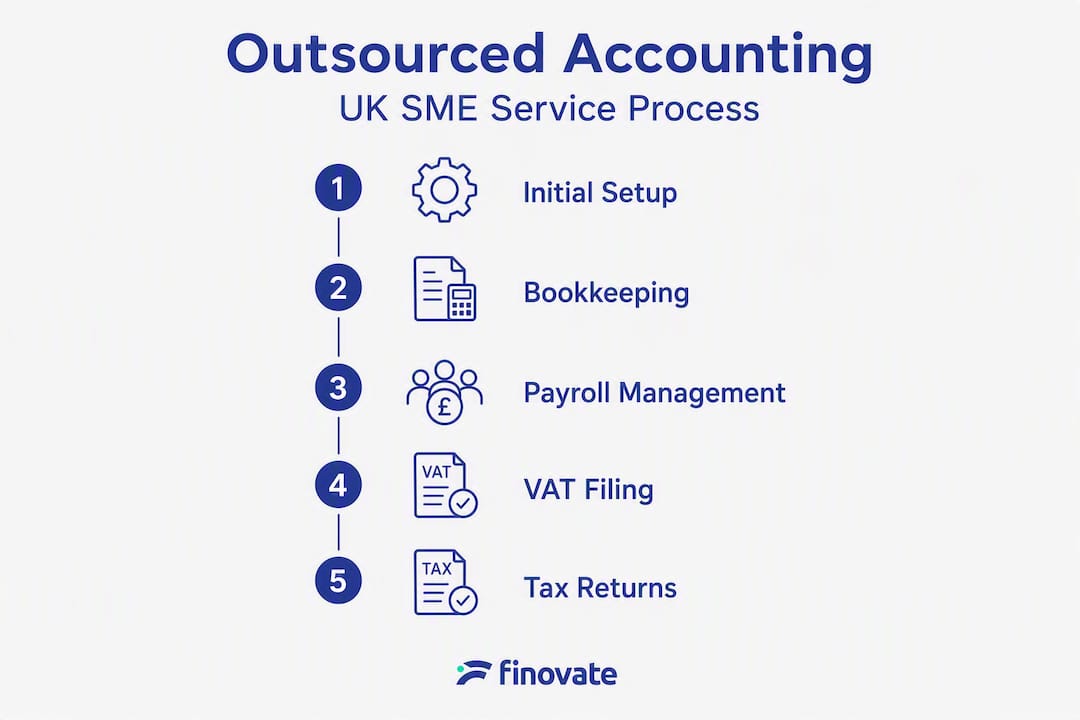
Core services in a standard SME package:
- Bookkeeping: recording all income and expenditure, bank reconciliations, and maintaining accurate ledgers
- Payroll and PAYE/RTI: processing employee pay, calculating deductions, and submitting Real Time Information reports to HMRC each pay period
- VAT and MTD for VAT: preparing and submitting VAT returns through HMRC-compatible software under Making Tax Digital rules
- Corporation tax returns: preparing and filing CT600 returns with HMRC, including tax computations
- Annual accounts: preparing statutory accounts for Companies House and HMRC
- Invoicing and collections: raising sales invoices, chasing debtors, and maintaining accounts receivable records
- Management accounts: monthly or quarterly profit-and-loss and balance sheet reporting for internal decision-making
Outsourcing financial management is an established practice for businesses that want professional financial administration without the overhead of an in-house team. Beyond the core bundle, providers often offer cashflow forecasting, multi-currency bookkeeping, HR and payroll benefits administration, and integration with payment platforms and e-commerce systems. These add-ons are worth discussing at the quote stage, as bundling them early is usually cheaper than adding them later. For a detailed look at what accounting services for Finnish small businesses typically include, Finovate's service guide covers the full scope.
What UK compliance obligations must your provider handle?
Your outsourced accountant is not just a bookkeeper. They are responsible for keeping your business on the right side of HMRC and Companies House. The obligations below are non-negotiable, and you should confirm competence in each before signing.
| Obligation | Deadline / Cadence | Governing Body |
|---|---|---|
| PAYE/RTI submissions | Each pay period | HMRC |
| VAT returns (standard) | Quarterly | HMRC |
| Corporation tax return (CT600) | 12 months after year-end | HMRC |
| Annual accounts | — | Companies House |
| Confirmation statement | Annually | Companies House |
| MTD for VAT digital records | Ongoing | HMRC |
Late filing carries real penalties. HMRC charges a £100 fixed penalty for a late corporation tax return, with additional tax-geared penalties for returns more than 12 months overdue. VAT surcharges apply on a sliding scale for repeated late submissions. Confirm that your provider will manage deadline tracking and submit on your behalf using their HMRC agent authorisation.
Evidence to request from any provider:
- HMRC agent authorisation number (verifiable directly with HMRC)
- Proof of Companies House filing experience
- GDPR-compliant data processing agreement
- Evidence of professional body membership (ICAEW, ACCA, or ICAS)
Authorised accounting firms meet higher, verified standards than unregistered bookkeepers. Verifying membership before signing is a minimum due-diligence step, not an optional extra.
How do you evaluate and choose an outsourced accounting provider?
The decision comes down to five criteria, in this order: HMRC agent status, professional qualifications, pricing transparency, software compatibility, and sector experience.
Step-by-step evaluation process:
- Confirm HMRC agent status — ask for the agent reference number and verify it. Without this, the provider cannot correspond with HMRC on your behalf.
- Check professional qualifications — ICAEW, ACCA, and ICAS members are bound by professional conduct rules and carry indemnity insurance.
- Request a written, itemised quote — fixed monthly fees with named deliverables, not open-ended hourly rates.
- Assess software compatibility — confirm the provider uses HMRC-recognised MTD-compatible software and can integrate with your existing systems.
- Ask about sector experience — a provider familiar with your industry will handle sector-specific VAT rules and payroll structures more accurately.
- Evaluate language support — if your team includes non-English speakers, multilingual capability reduces errors in payroll and HR documentation.
Questions to ask in vendor conversations:
- What is your HMRC agent number, and can I verify it?
- Which professional body are you a member of?
- How do you handle a missed filing deadline?
- Who is my named contact, and what is their response-time SLA?
- What happens to my data if I cancel?
Red flags to watch for:
- Vague or hourly-only pricing with no fixed scope
- No HMRC agent authorisation
- Reluctance to provide references or case studies
- No written data-security or GDPR policy
What to negotiate in the contract: SLA turnaround times for each deliverable, data ownership clauses confirming your records remain yours, cancellation terms with at least 30 days' notice, and exit assistance covering bookkeeping handover to a new provider.
What does outsourced accounting typically cost for a UK SME?
Fixed monthly retainers are the most common pricing model, and the most predictable for SME budgets. Fixed monthly pricing with explicit per-payroll or per-employee add-ons is the simplest structure for planning purposes. Open-ended hourly arrangements create uncertainty that compounds over time.
Primary price drivers include transaction volume, number of payroll employees, frequency of management reporting, multi-currency requirements, and the number of software integrations needed. A business with 10 employees, quarterly VAT, and monthly management accounts will pay more than a sole trader with annual accounts only.
One-off fees apply for backlog clean-up, historical data migration, and initial software configuration. These are legitimate costs, but ask for them to be quoted separately so they do not obscure the ongoing monthly rate.
Pro Tip: Bundle your core services into a 12-month agreement. Providers typically offer better rates for committed annual contracts, and you avoid the administrative cost of renegotiating scope every quarter. Automating document flows (bank feeds, receipt capture) also reduces the provider's processing time, which often translates directly into a lower monthly fee.
What happens during the first 30–90 days of onboarding?
A well-run onboarding delivers your first management accounts within 30–60 days and eliminates backlog within 90. A practical onboarding sequence follows four clear stages.
Onboarding timeline:
- Pre-start (Week 1): Sign engagement letter, share access credentials, provide bank statements, prior-year accounts, payroll records, and HMRC login details.
- Data ingest (Weeks 1–2): Provider imports historical data, identifies backlog, and configures accounting software.
- Payroll set-up (Weeks 2–4): Payroll structure confirmed, test run completed, RTI registration verified with HMRC.
- First reporting (Month 1–2): First management accounts and bank reconciliations delivered; VAT return prepared if due.
- Stabilisation (Month 2–3): Reporting cadence established, SLA reviewed, any outstanding filings cleared.
Documents to prepare before onboarding begins:
- Last 12 months of bank statements
- Prior-year statutory accounts and tax returns
- HMRC online services credentials (Government Gateway login)
- Current payroll records and employee details
- Outstanding invoices (sales and purchase ledger)
Banks may also request KYC documentation when a new provider is added as an authorised signatory, so prepare company registration documents and director identification in advance.
How do you measure whether outsourcing is actually working?
The clearest indicator is simple: every statutory filing lands on time, with no penalties. Beyond that, four KPIs give you a reliable picture of operational health.
KPIs to track:
- On-time filing rate: 100% target for all HMRC and Companies House submissions
- Bookkeeping backlog: zero outstanding transactions older than 30 days by month three
- Payroll accuracy rate: zero RTI corrections required after initial submission
- Management accounts delivery: received within 15 working days of month-end
Build these into your contract as SLA commitments, not informal expectations. A monthly review call with your named contact, a quarterly VAT reconciliation sign-off, and an annual performance review are the minimum cadence for a healthy provider relationship. If management accounts are consistently late or payroll errors recur, those are grounds to invoke the SLA and, if unresolved, to trigger the exit clause.
Why Finovate is the right choice for UK SMEs
Finovate delivers full outsourced bookkeeping, payroll, VAT filing, and tax returns for entrepreneurs and small to medium businesses. The service covers every obligation in the compliance table above, with named deliverables and fixed pricing agreed before work begins.
What Finovate provides:
- Bookkeeping, bank reconciliation, and ledger maintenance
- Payroll processing, PAYE/RTI submissions, and employer registration support
- VAT preparation and MTD-compliant filing
- Corporation tax returns and annual accounts
- Business advisory, cashflow forecasting, and financial projections
- Light entrepreneur invoicing service
- HR management and technology integration
Trust signals to verify when you contact us:
- Professional qualifications and body membership
- HMRC agent authorisation number
- GDPR-compliant data processing agreement
- Multilingual support for international teams
- Client references and case studies available on request
Key takeaways
Choosing the right outsourced accounting provider means verifying HMRC agent status, professional qualifications, and fixed pricing before anything else.
| Point | Details |
|---|---|
| Verify HMRC agent status first | Ask for the agent reference number and confirm it directly with HMRC before signing. |
| Require fixed-fee pricing | Insist on itemised monthly fees with named deliverables; avoid open-ended hourly arrangements. |
| Onboarding takes a few months | Expect first management accounts within 30–60 days and full stabilisation by month three. |
| Track four core KPIs | Monitor on-time filing rate, backlog age, payroll accuracy, and management accounts delivery. |
| Start with Finovate | Finovate offers fixed-fee outsourced accounting, payroll, VAT, and tax returns for UK SMEs. |
What the best providers get right — and what most miss
The conventional advice on choosing an outsourced accountant focuses almost entirely on qualifications and price. Both matter, but they are not where most engagements go wrong.
The real failure point is data quality at handover. Businesses arrive at a new provider with months of unreconciled transactions, missing receipts, and payroll records in spreadsheets that no one has touched since the previous accountant left. A provider that does not triage this in week one will spend months catching up, and your first management accounts will be late, incomplete, or both.
Payroll is the other area where inexperience shows quickly. RTI submissions must be accurate and on time every pay period. A single correction filing triggers HMRC scrutiny, and repeated errors can result in penalties that dwarf the cost of getting it right from the start. Ask specifically how the provider handles a payroll error discovered after submission.
The third blind spot is bank reconciliation speed. Slow reconciliations mean your management accounts are always based on stale data, which makes cashflow decisions unreliable. A provider that reconciles weekly rather than monthly gives you a materially better picture of where the business stands.
Pro Tip: Before your first onboarding call, export and organise your bank statements, outstanding invoices, and payroll records into clearly labelled folders. Providers who receive clean, organised data complete onboarding faster and charge less for backlog clean-up.
Get started with Finovate today
Finovate offers a fixed-price outsourced accounting service for UK SMEs that covers bookkeeping, payroll, VAT filing, corporation tax, and business advisory under one agreement. The onboarding process runs 30–90 days, beginning with an initial review and a written quote before any work starts.
To begin, you will need to prepare the following:
- Last 12 months of bank statements
- Prior-year accounts and tax returns
- HMRC Government Gateway credentials
- Current payroll records and employee details
Visit Finovate's accounting and tax services to request your introductory quote and schedule your onboarding call. If you are a light entrepreneur or delivery partner, the light entrepreneur accounting package offers a straightforward off-the-shelf option.
Useful sources and further reading
- HMRC: PAYE and RTI obligations — the primary reference for employer registration, RTI submissions, and PAYE deadlines
- Companies House: filing requirements — annual accounts, confirmation statements, and late-filing penalties
- HMRC: Making Tax Digital for VAT — MTD-compatible software requirements and digital record-keeping rules
- Finovate: accounting and tax services — fixed-fee outsourced accounting, payroll, VAT, and advisory for UK SMEs
- Finovate: SME accounting procedures guide — practical procedures and statutory reporting timelines
- Finovate: payroll services for SMEs — payroll set-up examples and pricing models