

If your deductible input VAT exceeds output VAT for a period, you are entitled to an alv palautus, and Verohallinto pays it automatically once your tax return has been processed, provided the refund amount meets the minimum payout threshold, currently set by Verohallinto. Your first move is simple: check your VAT return status in OmaVero, confirm your bank details are current, and if you paid VAT elsewhere in the EU, start gathering invoices before the September deadline.
TL;DR:
- Ensuring your bank details are current and accurately registered in OmaVero before filing can prevent delays in receiving VAT refunds.
- Properly documenting all invoices and reconciling your ledger before submitting claims minimizes the risk of automatic holds and rejection delays.
- Filing EU VAT refund claims on time and attaching all necessary supporting documents according to specific country rules is critical to avoiding refusals.
- Addressing prior outstanding VAT returns and unpaid taxes beforehand ensures your refund process is not automatically frozen or offset.
- Engaging professional accountants to prepare and review VAT returns and refunds can significantly speed up payouts and reduce common errors.
Table of Contents
- When are you eligible for an alv palautus?
- How does Verohallinto process and pay domestic refunds?
- How do you claim VAT refunds from purchases in other EU countries?
- Why are refunds delayed or refused, and how do you prevent it?
- What to prepare before filing a domestic or EU refund claim
- How professional accounting reduces hold-ups and speeds refunds
- What happens if your VAT refund claim is denied?
- Editorial take: what the rules actually reward
- How Finovate helps you get alv refunds paid faster
- Sources
When are you eligible for an alv palautus?
A refund arises whenever the VAT you have paid on business purchases is higher than the VAT you have collected from sales for the same reporting period. Accountants call this negative VAT, and it happens most often to businesses with heavy upfront costs: a newly renovated shop, a courier fleet buying vehicles, or a seasonal firm stocking up before its busiest months.
Eligibility extends beyond this basic case, though. Several other situations trigger a refund:
-
Corrected returns: if you amend a previous VAT filing and it turns out you overpaid, Verohallinto processes the difference as a refund.
-
Unused prepayments: money paid in advance against an estimated liability that turns out lower than expected is returned once reconciled.
-
Foreign business refunds (ulkomaalaispalautus): businesses established outside Finland can reclaim Finnish VAT under separate rules, with their own minimum thresholds and documentation.
-
EU cross-border claims: Finnish businesses that pay VAT in another EU country reclaim it through a dedicated procedure, covered in detail below.
Each of these follows slightly different timing and paperwork, but they share one trait: nothing moves until your underlying VAT return or claim is accurate and complete.
How does Verohallinto process and pay domestic refunds?
Once your VAT return is submitted, Verohallinto processes it and, if it shows negative VAT, releases the refund automatically. Money typically lands in your account roughly a week after processing finishes, not a week after you filed. That distinction catches out a lot of first-time filers who assume filing day and payment day are the same thing.
The process runs in a fairly fixed order:
- You submit your VAT return through OmaVero for the relevant period.
- Verohallinto checks the return against your filing history and payment status.
- If everything reconciles and the refund exceeds €10, payment is triggered to the bank account registered in OmaVero.
- If you owe unpaid taxes elsewhere on your account, the refund is offset against that debt before anything reaches your bank.
Verohallinto only pays out to one active account at a time, and it must be entered correctly in OmaVero before you file. If you switch banks, update the details immediately rather than waiting for a refund to bounce.
Pro Tip: Check your registered bank account in OmaVero the same day you submit a VAT return showing a refund, not after. A mismatched account is one of the easiest, and most avoidable, causes of a delayed payout.
How do you claim VAT refunds from purchases in other EU countries?
If you paid VAT on business expenses in another EU country, such as fuel, hotel stays, or conference fees, you claim it back through OmaVero rather than the foreign tax authority directly. Finland acts as the intermediary: you file with Verohallinto, and it forwards your application electronically to the relevant Member State under the EU's harmonised refund procedure.
The process follows these steps:
- Log into OmaVero and select the EU refund application for the country where you paid VAT.
- Enter your purchases by category and attach supporting invoices where required.
- Submit before 30 September of the year following the year when the VAT was incurred. Missing this deadline may result in the claim being denied.
- Verohallinto forwards the application to the refunding country, which then assesses and pays it directly.
The deadline for claims filed by Finnish businesses is firm, and minimum thresholds apply if you claim for less than a full calendar year rather than the whole year at once.
Documentation rules vary sharply by country, which is where many claims stumble:
- Some Member States demand original invoices or certified scans, others accept simple copies.
- Low-value invoices are sometimes exempt from attachment requirements entirely.
- Fuel and accommodation costs often carry different attachment thresholds than general business expenses.
If the refunding country pays late, interest may become payable under the EU procedure, though this rarely offsets the frustration of a delayed claim.
Why are refunds delayed or refused, and how do you prevent it?
Most delays trace back to something entirely within your control. A refund gets held automatically if you have an outstanding VAT return from an earlier period, even one unrelated to the current claim, or if Verohallinto detects a mismatch between your reported figures and previous filings.
The most common triggers are:
- A missing or late VAT return from a prior period, which freezes processing until it is filed.
- Unpaid taxes on the same tax account, against which the refund is automatically offset.
- Documentation for EU claims that doesn't match the refunding country's specific attachment rules.
- Bank account details in OmaVero that are outdated or incorrectly entered.
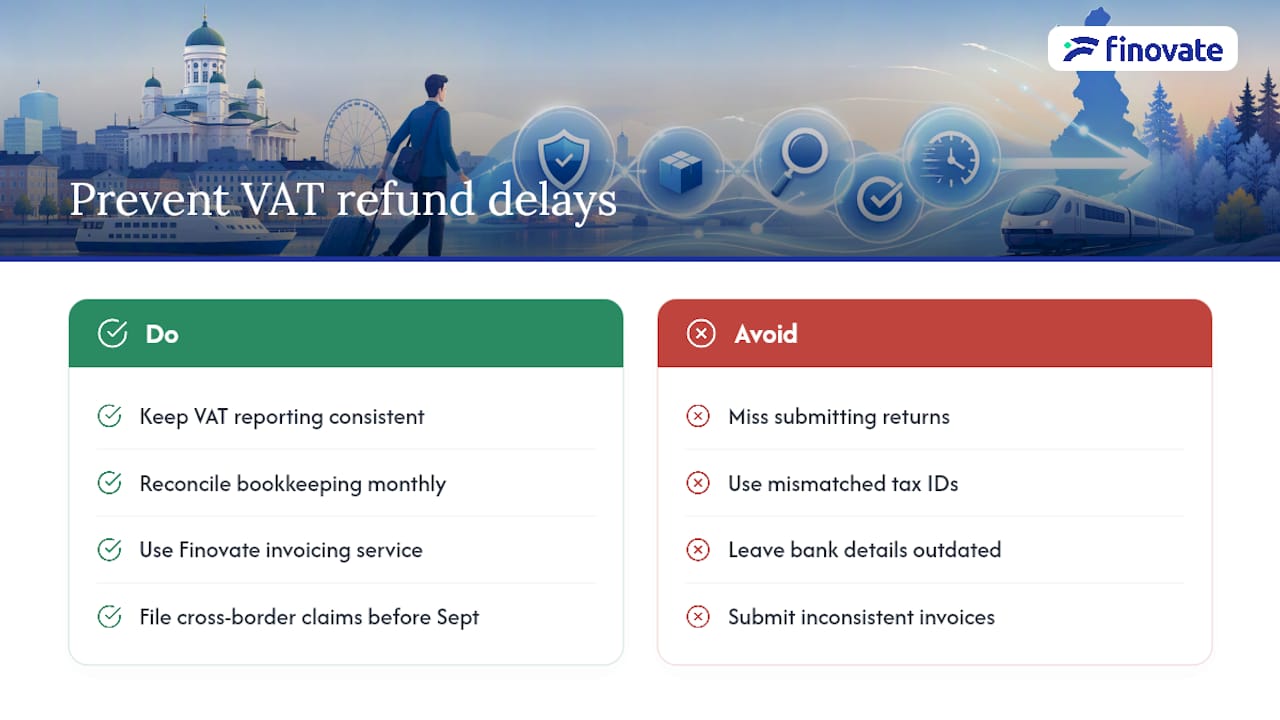
Cleaning up bookkeeping before you file cuts these risks substantially. Reconciling your ledger against submitted returns, correcting and resubmitting anything inconsistent, and keeping a single active refund account in OmaVero removes the three most frequent causes of a held payout.
Pro Tip: Before submitting any refund claim, run a quick internal check: are all previous VAT returns filed, does your VAT ID match across every invoice, and is your OmaVero bank account current? Clearing these four points first avoids the bulk of hold-ups.
What to prepare before filing a domestic or EU refund claim
A little preparation before you file saves weeks of back-and-forth later. Work through this checklist:
- Gather invoices by refund period, with totals summarised separately for each month or quarter you're claiming.
- Check invoice fields: supplier VAT number, date, net amount, and VAT rate should all be legible and consistent.
- Classify EU costs using standard categories such as fuel, accommodation, transport, and event costs, since these codes determine how the refunding country processes your claim.
- Confirm your bank account is correctly registered and active in OmaVero.
- Arrange agent authorisation in advance if someone else, such as an accountant, will file on your behalf.
- Verify the claim meets minimum thresholds before submitting, since sub-threshold periods are often rejected outright rather than partially paid.
Non-EU established businesses claiming Finnish VAT face additional rules, including a separate application form and stricter refund period requirements, so check those in advance if that applies to you.
How professional accounting reduces hold-ups and speeds refunds
Most refund delays we see stem from bookkeeping gaps, not genuine tax disputes: a missed prior return, an unreconciled ledger, or an invoice field that doesn't match across systems, as explained in the tax compliance for employers in Portugal: a practical guide. Tightening these basics before filing removes the majority of automatic holds.
For EU claims specifically, appointing an authorised agent makes sense once you're filing in more than one or two countries a year, since attachment rules differ enough that manual tracking becomes error-prone. Our guides on Finnish VAT reporting and SME bookkeeping compliance cover the groundwork in more depth.
What happens if your VAT refund claim is denied?
A denial is not the end of the road, but it does require prompt action. Verohallinto will state the reason for refusal, and in most cases it comes down to one of a handful of issues: insufficient documentation, a mismatch between claimed amounts and reported returns, or a claim that fell below the minimum threshold for the period covered.
Your first step is to review the decision letter carefully. It will specify which parts of the claim were rejected and why, and correcting straightforward errors, a missing invoice, an incorrect VAT ID, a misclassified cost code, often resolves the issue faster than a formal appeal.
If you believe the decision is genuinely wrong, you can request a reassessment or file an appeal with the tax authority within the timeframe stated in the decision. For domestic VAT matters, this typically means submitting a written objection through OmaVero with supporting evidence. For EU cross-border claims, the appeal process runs through the refunding Member State's own tax authority rather than Verohallinto, since Finland's role in that process is limited to forwarding your original application.
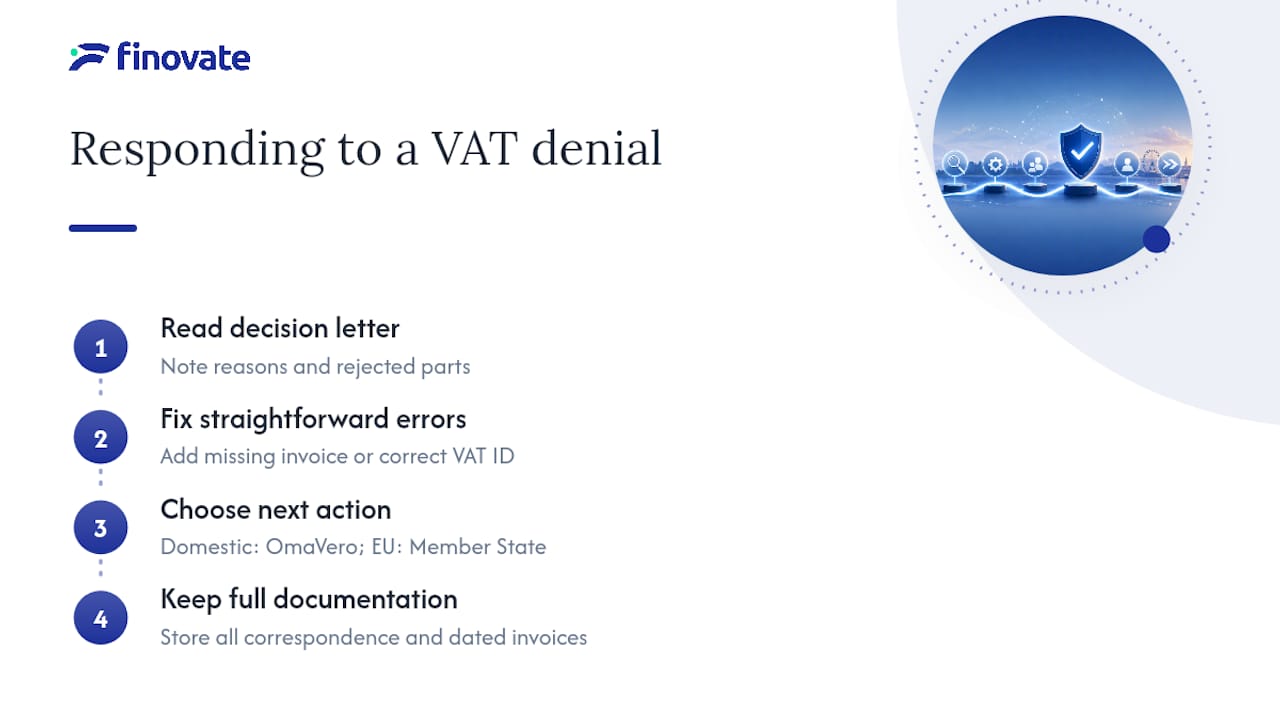
Keep every piece of correspondence and invoice tied to the claim in one place from the outset. If a dispute drags on, having a complete, dated paper trail is what actually resolves it, not persistence alone. Businesses that treat documentation as an afterthought tend to find appeals take considerably longer, simply because they're reconstructing evidence after the fact rather than presenting it upfront.
Editorial take: what the rules actually reward
The conventional advice on alv palautus focuses almost entirely on deadlines, and deadlines matter, but they're not where most businesses lose money. The bigger cost sits in the gap between when a refund could arrive and when it actually does, and that gap is almost always self-inflicted: an unfiled prior return, a bank account nobody updated, an EU invoice missing the one attachment a specific country demands.
What gets underrated is how much a refund functions as working capital, not a bonus. A courier business waiting six extra weeks on a refund because of a mismatched VAT ID is effectively financing Verohallinto's caution with its own cash flow. That's avoidable, and it's avoidable through unglamorous means: reconciled books, consistent filings, one correct bank account.
If you take one thing from this, prioritise the boring groundwork over the clever workaround. There is no shortcut that beats simply having your VAT returns, invoices, and bank details correct before you file.
— Busayo
How Finovate helps you get alv refunds paid faster
Professional accounting firms handle the groundwork that determines whether your refund clears in days or gets stuck for weeks: accurate VAT filing, reconciled bookkeeping, and claim preparation for both domestic and EU refunds.

Clients who keep their VAT reporting and ledgers consistent tend to see fewer automatic holds and faster payouts, because the four most common triggers, missing returns, mismatched IDs, outdated bank details, and invoice inconsistencies, are caught before filing rather than after. If you run a light entrepreneur business or handle EU purchases regularly, our invoicing service keeps your records refund-ready month to month, and our team can assemble and file cross-border claims before the September deadline.
Visit Finovate to book a consultation and get your next VAT refund moving without the usual delays.
This article is general information, not a substitute for advice from a qualified financial advisor. Consult a qualified financial professional about your own circumstances before acting on anything here.