

Kela's sickness allowance takes over once that waiting period, the omavastuuaika has passed, and Kela may reimburse the employer if it has continued paying salary. Many collective agreements extend this obligation further, so check the applicable TES before finalising any calculation.
TL;DR:
- Employers must accurately record the employee's sick start and end dates on the day of absence to avoid costly reclaims later on.
- Calculation of sick-pay varies significantly based on whether the employee is paid monthly, hourly, or by commission, requiring specific methods to avoid errors.
- The nine-day waiting period called omavastuuaika affects employer reimbursement, meaning the employer covers days before Kela's allowance begins, which starts on day ten.
- Proper documentation, including absence notes, medical certificates, and calculation worksheets, is essential to prevent errors and facilitate audits.
- Using a structured workflow or payroll provider reduces mistakes, especially for complex pay types, and saves employers money by minimizing disputes and reconciliation efforts.
Table of Contents
- Sairauspoissaolot palkanlaskenta: what to do the moment an employee reports sick
- How do you calculate sick-leave pay for different pay types?
- How does Kela's omavastuuaika affect employer reimbursement?
- What records and controls prevent sick-pay errors?
- How does a payroll provider handle sick-leave pay end to end?
- What actually saves employers money on sick pay
- Get a payroll health check from Finovate
- Where to check the rules yourself
- Sources
Sairauspoissaolot palkanlaskenta: what to do the moment an employee reports sick
Getting the first 48 hours right matters more than most payroll teams realise. A missed note on the start date, or an assumption about which TES applies, can cascade into a reclaim months later. Here's the order that keeps you covered.
- Record the absence the same day, noting the expected start date and, once known, the return date.
- Confirm how long the employee has been employed and which collective agreement or contract terms apply.
- Decide how you'll fund the statutory period, and whether you'll seek reimbursement from Kela once the waiting period ends.
- Check what evidence your workplace requires, since short absences often need only a self-certification while longer ones require a doctor's note.
- Flag the dates you'll need for the Kela palkkailmoitus and your own bookkeeping entries.
A few things worth double-checking early:
- Does the Employment Contracts Act's qualifying period apply, or does the sectoral TES set different terms?
- Has this employee had a paid sickness period for the same illness within the last 30 days? That can shorten your statutory obligation to the first sick day only.
- Is the absence likely to run long enough that Kela reimbursement becomes worth pursuing?
How do you calculate sick-leave pay for different pay types?
The calculation method depends entirely on how the employee is normally paid. Get the base figure wrong and every downstream Kela report inherits the error.
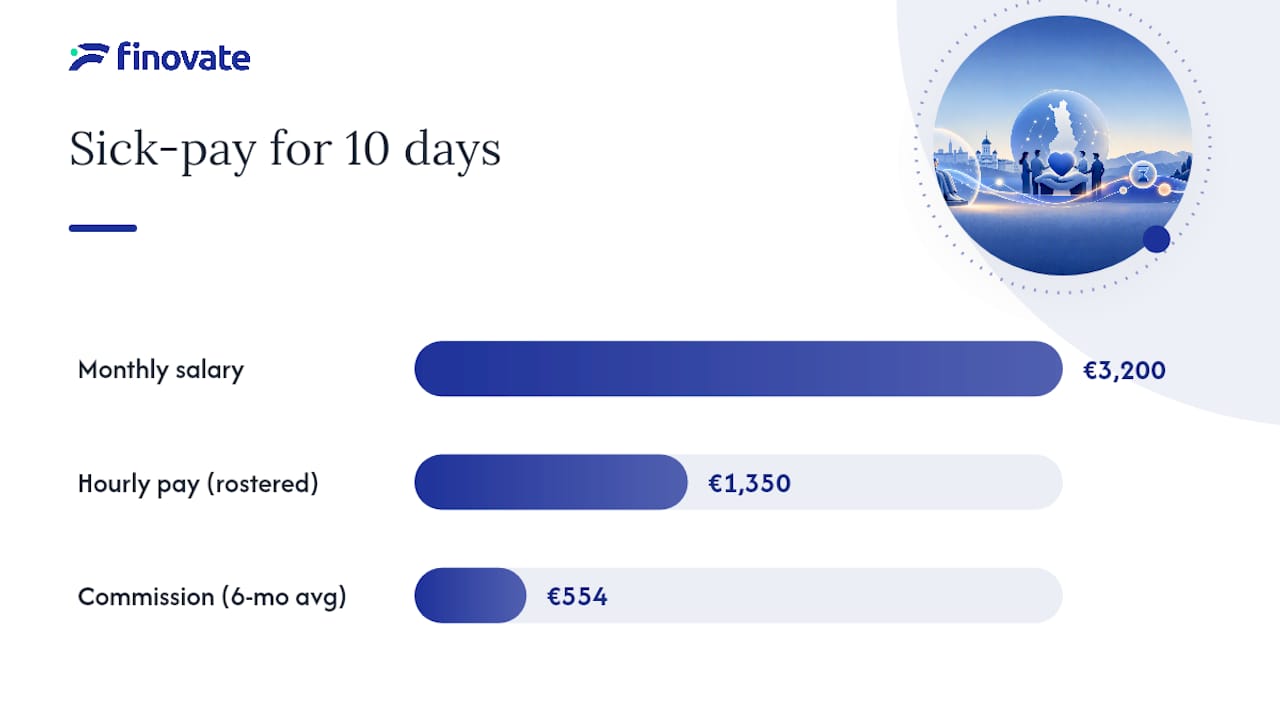
Monthly salary is the simplest case. If the employee earns a fixed monthly salary, you generally continue paying that salary unchanged for the qualifying days, prorating only if the absence spans a partial month against actual working days. Say an employee earns €3,200 a month with 21 working days that month. If sickness covers the day of illness plus the following nine working days (all within that month), the employer typically pays the full €3,200 as normal, since the statutory sick-pay period simply substitutes for worked days within the existing salary.
Hourly pay requires you to reconstruct what the employee would have earned had they worked. Take the hourly rate and multiply it by the scheduled hours for each qualifying day. An employee on €18 per hour scheduled for 7.5-hour shifts earns €135 for each of the ten qualifying days, assuming those shifts were confirmed on the roster before the absence began.
Commission and provision-based pay is where most payroll errors creep in. Rather than paying zero commission during the absence, calculate a representative daily average from a look-back period, commonly six to twelve months. If an employee earned €7,200 in commission over the previous six months (roughly 130 working days), that's a day average of €55.38. Multiply by the ten qualifying days to get roughly €553.80 in commission-based sick pay, added to any base salary component.
- Choose one look-back period and apply it consistently across the workforce.
- Recalculate averages only when the underlying commission structure changes materially.
- Never let salary and commission averaging overlap into double payment for the same days.
Watch for overlapping payments too. If an employee moves from statutory sick pay into a TES-extended period, or from employer-paid days into Kela-reimbursed days, make sure your payroll software isn't running both calculations simultaneously against the same date range.
Pro Tip: Write down which look-back period you used for commission averaging and why, directly in the employee's payroll file. If Kela or an auditor later queries the figure, that one sentence saves you a full recalculation.
How does Kela's omavastuuaika affect employer reimbursement?
The omavastuuaika is the waiting period before Kela's sickness allowance kicks in, and it runs for the day the employee fell ill plus the following nine working days. That window lines up almost exactly with the statutory employer-pay period, which is deliberate. The employer covers the gap, then Kela's allowance becomes payable from day ten onwards, either to the employer (if it has continued paying salary) or directly to the employee.
To claim reimbursement, you submit a palkkailmoitus to Kela detailing the exact pay the employee received during the sickness period. This needs to be accurate down to the day, particularly for part-time or hourly staff whose pay varies week to week.
- Submit the palkkailmoitus promptly once the qualifying period and any employer-extended period are known.
- Include exact daily pay figures, not monthly averages, for anyone paid hourly or on variable hours.
- Keep a copy of every submission, since changes to reported pay require a fresh notification and can alter Kela's reimbursement decision.
- Expect processing time. Don't hold back the employee's statutory pay while waiting on Kela's decision.
The most common timing pitfall is treating Kela's decision as a prerequisite for paying the employee. It isn't. Your obligation under the Employment Contracts Act exists independently of when, or whether, Kela reimburses you.
What records and controls prevent sick-pay errors?
Payroll audits tend to focus on sick pay because it's where documentation gaps show up fastest. Keep these on file for every case:
- The original absence notification, with dates and who reported it.
- Any medical certificate or self-certification the workplace policy required.
- The calculation worksheet showing base pay, commission average, and look-back period used.
- Copies of Kela correspondence, including the palkkailmoitus and any reimbursement decision.
The three errors that recur most often are delaying employer payment while waiting for Kela's decision, using the wrong commission look-back period, and miscounting qualifying days across public holidays. That last one catches out even experienced payroll staff, since public holidays don't always count as working days for the purposes of the nine-day window, and the rule can shift depending on the applicable TES.
Standard templates, a second reviewer on every sick-pay calculation, and a versioned record of which assumptions were used all reduce the risk of a reclaim. Finovate's own payroll documentation standards set out a template structure that works well for Finnish SMEs handling this in-house.
Pro Tip: Store the calculation worksheet and the Kela palkkailmoitus in the same file, dated the same day. Separating them across systems is the single biggest cause of mismatched figures during an audit.
How does a payroll provider handle sick-leave pay end to end?
A structured workflow removes most of the guesswork from sick-leave payroll. Here's how it typically runs when handled by a specialist provider rather than pieced together manually:
- Capture the absence notification and confirm employment length and applicable TES.
- Run an eligibility check against the Employment Contracts Act minimum and any sector-specific extension.
- Calculate pay using the correct method for that employee's pay type, whether monthly, hourly, or commission-based.
- Submit the palkkailmoitus to Kela with day-accurate figures.
- Post the entries to bookkeeping with the calculation worksheet attached.
System controls matter as much as the steps themselves:
- Automated day-averaging for commission-based staff, removing manual recalculation.
- Standardised palkkailmoitus templates that match Kela's expected format.
- Retained evidence for every case, timestamped and versioned.
Escalate to HR or legal review when short-term absences repeat frequently for the same employee, or when medical evidence is disputed. Those cases sit outside routine payroll processing and need judgement calls that a template can't make for you. For general setup guidance, Finovate's payroll management guide for Finland covers the wider process this slots into.
What actually saves employers money on sick pay
Most sick-pay disputes come from timing, not law. Employers who wait for Kela's decision before paying staff misunderstand the sequence entirely, and it's the single costliest mistake I see repeated across payroll setups of every size.
The three real savings from getting this right are fewer reclaims from miscalculated commission averages, better cashflow because reimbursement timing stops surprising the finance team, and considerably less HR time spent untangling disputed calculations months after the fact. None of that requires new software or a bigger team. It requires a consistent method, applied the same way every time, and checked against the correct TES rather than a generic assumption.
If you haven't reviewed your sick-pay process in the last year, a short payroll health check will usually surface the gap before Kela does.
— Busayo
Get a payroll health check from Finovate
Finovate reviews sick-leave payroll for a fixed scope, not an open-ended engagement, which means you know upfront what the check covers and what it costs. We audit your current calculation templates, confirm they match the correct TES for each employee group, and check your palkkailmoitus submissions against Kela's requirements before an auditor ever asks.

Onboarding with Finovate typically starts with a document audit covering your last twelve months of sick-pay entries, followed by automated reporting templates that cut manual recalculation for commission-based staff. For employers who've been patching this together in spreadsheets, that alone tends to remove the biggest source of reclaims. Outsourced payroll support, of the kind offered by providers like TrueMeasure Accounting, shows the same pattern: fewer manual steps means fewer errors reaching Kela.
If your sick-pay process hasn't been reviewed recently, request a payroll health check through Finovate's services page and get a clear view of where your current setup stands.
Where to check the rules yourself
- Kela's employer pages on sickness allowance cover the omavastuuaika and reimbursement process in full.
- Kela's palkkailmoitus guidance explains exactly what payroll data to submit.
- YTK Työelämäpalvelut's guide to sairausajan palkka sets out the Employment Contracts Act minimums.
- PAM's sickness pay guidance is a useful starting point for checking sector-specific TES terms.
Sources
- Työnantajat — sairauspäiväraha | Kela
- Sairausajan palkka — YTK Työelämäpalvelut
- Sairastuminen ja sairausajan palkka — PAM
- Sairausajan palkka — MMA