

Luontoisedut, fringe benefits such as company cars, staff housing, or subsidised meals, are normally taxable earned income under Finnish law. Employers must value each benefit using Verohallinto's annual decision or, where no fixed figure exists, the fair market value (käypä arvo). You then report the benefit through the Tulorekisteri and withhold tax on it exactly as you would on cash wages.
TL;DR:
- Using Verohallinto's annual decision figures ensures accurate valuation, but you should verify and update them each year to avoid misreporting.
- Benefits are taxed in the year employees actually enjoy or access them, which can shift taxable income across years if not carefully tracked.
- When specific benefit values are not listed in the official decision, applying käypä arvo based on invoices or market prices is necessary to determine taxable value.
- Proper classification with the correct tulolaji codes and accurate reporting of gross values and employee reimbursements prevent costly corrections during audits.
- Small timing mistakes, like using last year's benefit figures or missing benefit start dates, are common and easily avoided with short, regular payroll reviews.
Table of Contents
- Luontoisedut verotus: the legal basis and core definitions
- Verohallinto's annual decision and fixed tax values
- When can you use käypä arvo instead of the official figure?
- Tulorekisteri reporting, tulolaji codes and withholding
- Worked examples: calculating common benefit values
- Timing rules and recordkeeping employers must not skip
- Lawful ways to reduce the tax impact of benefits
- A practical payroll checklist for getting luontoisedut right
- What payroll teams get wrong most often
- How Finovate handles luontoisedut for Finnish employers
- Sources
- FAQ
Luontoisedut verotus: the legal basis and core definitions
Fringe benefits are taxed because Finnish tax law treats them as part of pay, not as separate gifts from an employer. Section 64 of the Income Tax Act (TVL 64 §) states that a benefit an employee receives from an employer, in a form other than money, counts as taxable earned income when it has a monetary value. The Withholding Act (EPL 13 §) then obliges the employer to include that value in the wage base used to calculate withholding. Together, these two provisions are the entire reason payroll teams need to think about luontoisedut verotus at all: the benefit is wages, just paid in a different currency than euros.
A concept that trips up many first-time payroll administrators is the nautintaperiaate, or the principle of enjoyment. It determines which tax year a benefit belongs to, and the rule is simpler than the name suggests: the benefit is taxed in the year the employee actually uses or has access to it, not the year it was agreed, invoiced, or paid for. A company car handed over on December 28 but only insured and drivable from January 3 is taxed from the date it becomes usable, which can shift a benefit across a tax year boundary and catch out anyone doing December payroll on autopilot.
The rules extend beyond ordinary employees. According to Verohallinto's own guidance on luontoisedut verotuksessa, the following groups fall under the same or closely related valuation rules:
- Rank-and-file employees on standard employment contracts.
- Managing directors and board members who receive benefits tied to their role.
- Partners in a partnership (yhtiömiehet) who draw benefits from the firm.
- Company owners who take benefits from their own limited company, provided the benefit is booked and reported as palkkatulo (wage income) rather than left informal.
That last point matters more than it looks. Owner-employees who take a company car or company-paid housing without running it through payroll risk having the Finnish Tax Administration reclassify it as peitelty osinko (disguised dividend), according to guidance published on Edilex. Disguised dividend treatment carries a considerably worse tax outcome than a properly reported luontoisetu, so getting the paperwork right from day one protects the owner as much as it protects the company.
Verohallinto's annual decision and fixed tax values
Verohallinto publishes a fresh luontoisetupäätös (fringe benefit decision) every year, usually in the autumn, setting the standard valuation figures that apply from 1 January the following year. Payroll teams cannot simply carry over last year's numbers. Car benefit values, housing benefit rates per square metre, and meal benefit figures all get revised annually, sometimes by only a few cents, sometimes by amounts that genuinely change take-home pay calculations.
Pro Tip: Bookmark the current year's luontoisetupäätös and check it every January before running your first payroll cycle. Payroll software doesn't always update automatically, and using the previous year's car benefit figure by mistake is a common source of corrections.
The decision sets fixed values for a defined list of common benefits, which removes the guesswork for the categories most employers actually use:
- Autoetu (car benefit): valued by car age, list price, and whether it is a full car benefit or a driver-paid-fuel benefit, split roughly into free-use and employee-paid-running-costs categories.
- Asuntoetu (housing benefit): calculated per square metre, with different rates depending on the municipality and the size of the property.
- Ravintoetu (meal benefit): a fixed euro value per meal, adjusted annually, applicable only on days the employee actually eats a subsidised or provided meal.
- Puhelinetu (phone benefit): a flat monthly value covering an employer-paid mobile subscription used for both work and private calls.
- Polkupyöräetu (bicycle benefit): a fixed annual value applied when an employer provides a bicycle for commuting, capped in most years at a level set out in the decision.
- Työsuhdematkalippu (commuter travel card benefit): valued at the actual cost of the travel card, subject to conditions and an annual tax-exempt ceiling.
For any of these that only apply part of the month, whether the employee starts or leaves mid-cycle, takes unpaid leave, or the benefit itself only runs for part of a period, payroll divides the fixed monthly value by 30.33 to get a daily rate, then multiplies by the number of qualifying days. This 30.33 divisor represents the average number of days per month across a full year, and it is the standard method Verohallinto expects payroll systems to use for prorating, according to Verohallinto's syventävä ohje.
Vehicle categories add another layer. The decision splits cars by first registration year and by fuel type, because a benefit calculated on a five-year-old diesel estate looks very different from one on a new electric company car. Payroll teams handling company fleets need to re-check each vehicle's category every year, not just apply a blanket percentage across the whole fleet.
When can you use käypä arvo instead of the official figure?
Käypä arvo, fair market value, applies whenever Verohallinto's decision does not name the specific benefit or does not cover the exact circumstances of how it was provided. Where the decision is silent, you fall back to what the benefit would genuinely cost on the open market, or what it cost the employer to provide it, whichever gives the more defensible figure.
Typical situations where käypä arvo comes into play include:
- One-off gifts or perks that fall outside the named categories in the annual decision, such as an unusual wellness benefit or a bespoke equipment allowance.
- Benefits provided through a third party rather than directly by the employer, where the invoiced cost is the clearest evidence of value.
- Any benefit whose circumstances genuinely differ from the standard case the decision was written to cover, for instance a car provided only for occasional weekend use rather than full private use.
Acceptable evidence for a käypä arvo calculation includes supplier invoices, the employer's own documented cost of provision, and comparable market pricing for the same good or service. If you want to apply a value lower than what the official decision would otherwise suggest, you need to be able to show, on paper, exactly why the benefit's real value to the employee was lower. Vague justification does not survive a Verohallinto review; an invoice trail does.
Pro Tip: Keep a short written note in your payroll file explaining why a benefit was valued using käypä arvo rather than the standard decision figure. A one-paragraph explanation with the supporting invoice attached takes two minutes to write and can save hours of correspondence during a tax audit.
Tulorekisteri reporting, tulolaji codes and withholding
Every luontoisetu has to be reported to the Tulorekisteri at the time of payment, meaning the same pay run in which the cash wages for that period are declared. The benefit's value gets added to the employee's total wage figure for withholding purposes, and the employer separately declares its own social contributions on that combined amount, according to Tulorekisteri's own guidance on fringe benefits.
Getting the tulolaji (income type) code right matters more than most payroll administrators expect, since the wrong code can misclassify the benefit entirely:
- Car benefit, housing benefit, and meal benefit each carry their own distinct tulolaji code within the Tulorekisteri system.
- Phone, bicycle, and travel card benefits are reported under their respective specific codes rather than a generic "other benefit" catch-all.
- Peritty korvaus, the compensation an employee pays back to the employer for a benefit, is declared as its own separate tulolaji, not netted off against the gross benefit value before reporting.
That last point is worth dwelling on, because it is one of the more common sources of Tulorekisteri correction requests encountered. If an employee pays €150 a month towards a car benefit valued at €500, you report the full €500 gross benefit value and the €150 peritty korvaus separately, letting the system calculate the €350 net taxable effect. You do not simply report €350 as the benefit value. Crucially, the peritty korvaus figure can never exceed the benefit's own verotusarvo (taxation value), a rule confirmed directly in Tulorekisteri's reporting instructions. If an employee's contractual payment happens to exceed the official value, only the amount up to the verotusarvo gets reported as peritty korvaus.
| Reporting element | What it captures | Common mistake to avoid |
|---|---|---|
| Gross benefit value | Full verotusarvo or käypä arvo for the period | Reporting the net figure after employee payment instead of the gross value |
| Peritty korvaus | Amount the employee pays back towards the benefit | Declaring a figure above the benefit's own verotusarvo |
| Tulolaji code | Specific code for car, housing, meal, phone, bike, or travel card benefit | Using a generic benefit code instead of the specific one |
| Withholding base | Cash wage plus net taxable benefit value combined | Withholding tax only on cash wages and forgetting the benefit entirely |
Once the gross value and the peritty korvaus are both correctly declared, ennakonpidätys (withholding tax) is calculated on the combined wage figure exactly as it would be on an all-cash salary. Employer social contributions follow the same combined base. Reconciling this monthly, rather than waiting until year-end, is an effective way to avoid corrections. A Tulorekisteri reporting checklist walks through the filing deadlines in more detail if you want a month-by-month reference.
Worked examples: calculating common benefit values
Numbers make this easier to trust than rules alone, so here is how the calculations actually run for the benefits most Finnish employers deal with.
1. Car benefit (autoetu), full month. Say the current year's decision sets the monthly value for a particular car category at €560 for a full car benefit (employer pays running costs). An employee who has the car for the entire month is taxed on the full €560, added to their cash wage before withholding is calculated. Employers running mixed-use fleets, where several employees share one vehicle, use an ajopäiväkirja (driving logbook) to apportion private-use days between users, since Verohallinto expects a documented basis for splitting the benefit rather than an even guess.
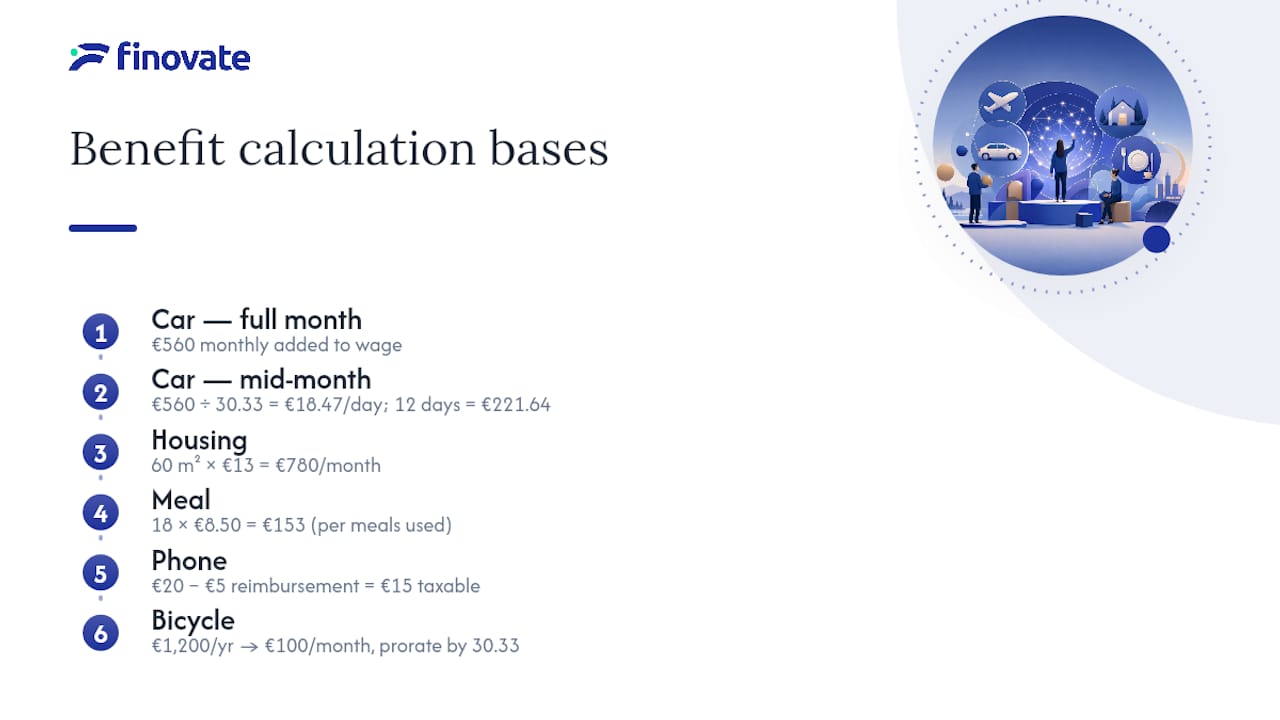
2. Car benefit, mid-month start. The same €560 car is handed to a new employee on the 20th of a 31-day month. Using the 30.33 divisor: €560 ÷ 30.33 = €18.47 per day. With 12 qualifying days remaining in the month, the taxable value is €18.47 × 12 = €221.64, reported for that pay period rather than the full monthly figure.
3. Housing benefit (asuntoetu), full month. A 60m² apartment in a mid-sized municipality with a decision rate of €13 per square metre gives a monthly value of €780. That figure goes straight into the wage base for the month, no proration needed if the tenancy runs the full period.
4. Meal benefit (ravintoetu). If the annual decision sets a fixed value of €8.50 per subsidised meal and an employee receives 18 working meals in a month, the taxable value is 18 × €8.50 = €153. Days without a meal provided simply are not counted, which is why ravintoetu never needs the 30.33 divisor; it is inherently a per-day-used calculation.
5. Phone benefit (puhelinetu), with partial reimbursement. The flat monthly value might sit at €20. If the employee reimburses the employer €5 towards private use, that €5 is reported as peritty korvaus, leaving a net taxable value of €15 flowing into withholding.
6. Bicycle benefit (polkupyöräetu). An employer-provided commuting bicycle valued at €1,200 per year under the decision translates to a monthly figure of €100, prorated with the same 30.33 divisor for any partial month.
Employers with company fleets often use Verohallinto's autoetulaskuri (car benefit calculator), an online tool that applies the current year's figures automatically once you enter the car's registration year, list price, and benefit type. It removes the manual lookup from the decision table, though it does not replace the ajopäiväkirja requirement for shared vehicles. A well-kept driving log, showing dates, purpose, and kilometres, remains the primary evidence Verohallinto asks for when a car benefit split between multiple users gets questioned.
Timing rules and recordkeeping employers must not skip
The nautintaperiaate creates real consequences around year-end payroll. A car benefit that starts on December 30 but is not usable until January 2, because registration or insurance has not gone through, is taxed in January, not December, even though the paperwork might be dated in December. Get this wrong and you either overstate one year's taxable income or understate the other, both of which trigger corrections.
Benefits during lomautus (furlough) or palkaton vapaa (unpaid leave) follow a simple test: if the benefit remains available to the employee, it stays taxable. A company car the employee keeps at home during a furlough period is still taxed for those weeks, because the employee retains the use of it. Ravintoetu behaves differently, since it is only valued for meals actually provided, so an employee on unpaid leave who does not eat at the workplace simply has no meal benefit for those days.
Documentation requirements to keep on file, ideally for at least six years to match general Finnish bookkeeping retention rules:
- The ajopäiväkirja for any shared or partially private car benefit.
- Supplier invoices and cost breakdowns supporting any käypä arvo calculation.
- Usage logs or access records for benefits like housing or equipment that could otherwise be disputed.
- A copy of the specific year's luontoisetupäätös figures used for each calculation, in case a later year's audit needs to trace back which values applied.
Lawful ways to reduce the tax impact of benefits
An employee payment towards a benefit is the most direct lever available: paying part of the value back as peritty korvaus reduces the net taxable amount, reported correctly and capped at the benefit's own verotusarvo as covered above.
Some businesses structure pay using a kokonaispalkka (total salary) agreement, where the employee's gross contractual salary already factors in the value of benefits like a car, and the employer simply deducts the benefit's official value from that agreed total each month rather than adding it on top. This keeps total payroll cost predictable but still requires the same Tulorekisteri reporting steps.
Certain benefits carry conditional exemptions worth knowing:
- Työsuhdematkalippu can be tax-free up to an annual ceiling set in the decision, provided the employer pays it directly to a transport operator rather than reimbursing the employee in cash.
- Polkupyöräetu has historically carried its own annual cap on the tax-exempt portion, above which the excess becomes taxable.
- A genuinely mixed personal-and-work benefit, such as equipment used for both, is taxed only on the private-use proportion if that split can be evidenced, otherwise Verohallinto defaults to treating the full value as taxable.
Pro Tip: Never assume a benefit is exempt just because a colleague's company treats a similar perk as tax-free. Exemption conditions are specific (direct payment to the operator, annual caps, documented usage), and applying an exemption without meeting every condition is one of the fastest ways to trigger a correction on audit.
A common compliance trap is treating an owner-employee's personal use of company assets informally, without running it through payroll at all. That scenario risks peitelty osinko reclassification mentioned earlier, and it costs far more to unwind than it would have cost to report correctly from the start.
A practical payroll checklist for getting luontoisedut right
Running this checklist every pay cycle catches most of the errors that turn into year-end corrections.
- Confirm you are using the current year's luontoisetupäätös figures, not a carried-over value from the previous year.
- Check the exact start and end dates each benefit applied during the pay period, especially for new starters, leavers, and any furlough weeks.
- Gather any employee reimbursement amounts and confirm they do not exceed the benefit's verotusarvo before entering peritty korvaus.
- File the Tulorekisteri entry using the correct benefit-specific tulolaji code, with gross value and peritty korvaus reported separately.
- Reconcile withholding and employer contributions against the combined cash-plus-benefit wage base before closing the pay run.
This is typically handled as part of a standard monthly payroll review: current-year decision values applied automatically, Tulorekisteri filings checked line by line, and a short written note on file for any käypä arvo judgement calls. For owner-managers drawing benefits from their own limited company, that same review flags the palkkatulo-versus-dividend distinction before it becomes a tax office question rather than a payroll one.
What payroll teams get wrong most often
The recurring mistake is not malice, it is timing. Businesses apply last year's car or housing figures out of habit, or they let a furloughed employee's benefit quietly drop off payroll without checking whether it stayed genuinely available. Both errors are avoidable with a five-minute check each January and a habit of documenting judgement calls as they happen, not months later when Verohallinto asks for evidence.
Three things worth doing this week: pull the current luontoisetupäätös and confirm your payroll system is using it, start a simple file for käypä arvo justifications if you have not already, and reconcile last month's Tulorekisteri entries against actual benefit usage dates rather than assuming the automated feed got it right.
— Busayo
How Finovate handles luontoisedut for Finnish employers
Finovate is the practical alternative to piecing together payroll compliance from Verohallinto guidance pages alone. Its payroll service applies the current year's luontoisetupäätös figures directly, files your Tulorekisteri entries with the correct tulolaji codes, and flags käypä arvo judgement calls before they become audit questions rather than after.
For small business owners running everything themselves, that means one less area where a single missed decimal in a car benefit calculation snowballs into a year-end correction. Finovate's monthly payroll management guide explains what a full payroll cycle looks like in practice, and if you own a limited company and take benefits personally, the distinction between salary and dividend treatment covered in Finovate's guide to the 8% rule is worth reading before your next payroll run. Light entrepreneurs and delivery partners handling their own accounting can also see how ongoing bookkeeping support fits their situation through Finovate's fixed-price accounting package for light entrepreneurs.
If you would rather have a payroll specialist check your current luontoisetupäätös application and Tulorekisteri filings before your next pay run, get in touch through Finovate's accounting and payroll services page to arrange a review.
FAQ
How is a luontoisetu taxed in Finland?
A luontoisetu is added to the employee's cash wages at its official or fair market value and taxed as ordinary earned income, with the employer withholding tax on the combined figure under TVL 64 § and EPL 13 §.
What is the verotusarvo of a fringe benefit?
The verotusarvo is the taxation value Verohallinto sets each year in its luontoisetupäätös for standard benefit categories like cars, housing, and meals, and it is the figure payroll must use unless the benefit falls outside those named categories.
What is käypä arvo and when do you use it?
Käypä arvo is the fair market value used when no official verotusarvo exists for a specific benefit, calculated from supplier invoices, actual employer cost, or comparable market pricing.
How should luontoisedut be recorded in payroll?
Each benefit is reported to the Tulorekisteri at payment time under its specific tulolaji code, with the gross benefit value and any peritty korvaus declared separately rather than netted together beforehand.
Can an employee's payment reduce the taxable benefit?
Yes, an employee's peritty korvaus reduces the net taxable value of the benefit, but the reported compensation can never exceed the benefit's own verotusarvo, as confirmed in Tulorekisteri's guidance.